

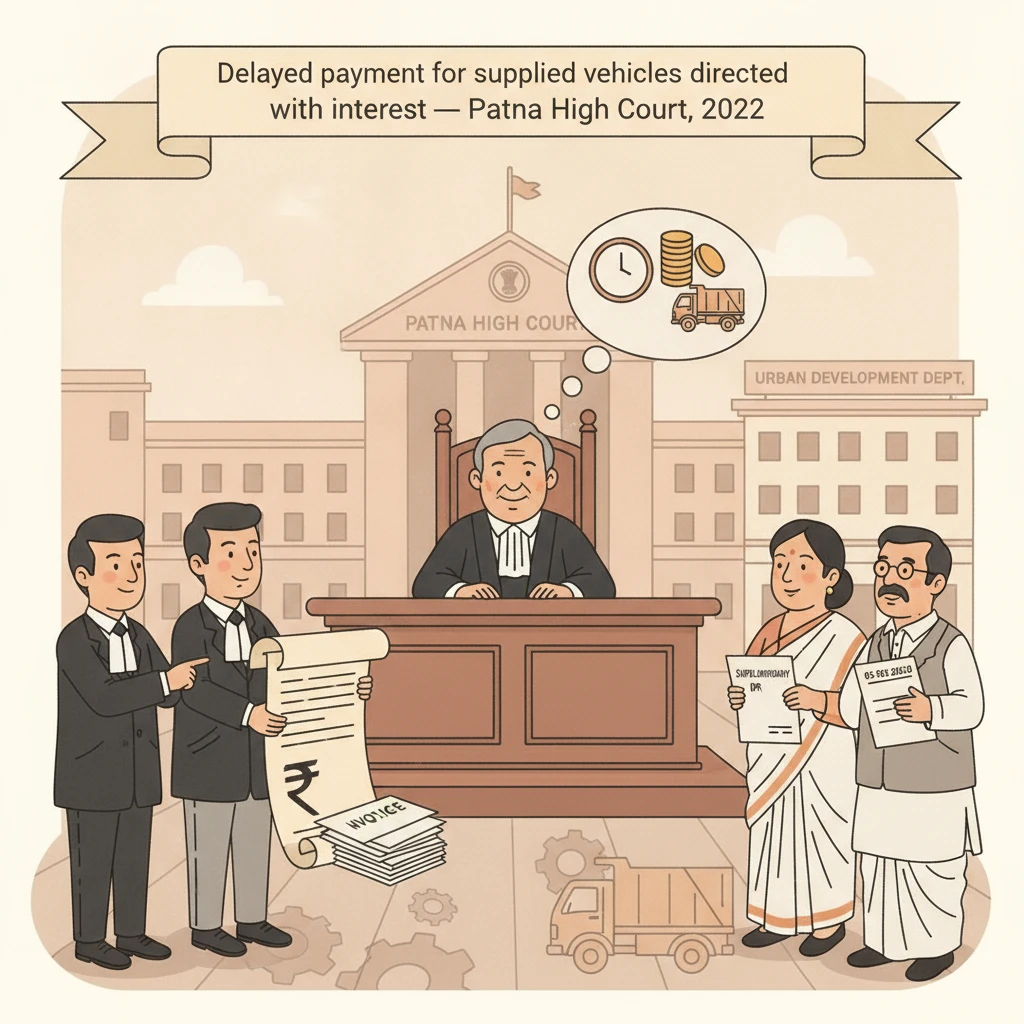
Case Background
The case arose from a government purchase of vehicles for municipal use. Patna Municipal Corporation issued a bid bearing No. GEM/2018/B/117955 dated 12.11.2019. The bid was for supply of 119 units of TATA 3 CuM Tipper on LPK407Ex/27 BS IV vehicles.
The petitioner company participated in this tender process. It emerged as the L1 bidder, meaning it quoted the lowest price among eligible bidders. On this basis, the Corporation placed an order on the company for supply, delivery, testing, training and successful commissioning of the 119 vehicles.
A formal contract was then drawn up between the parties. The agreement was also circulated on the website of respondent no. 2, the Urban Development and Housing Department, Government of Bihar.
As per the Agreement dated 24.01.2019, payment for the vehicles was to be made to the supplier within 15 to 30 days from the final submission of bills. The petitioner supplied the vehicles and submitted bills. However, according to the writ petition, even after a considerable period the Corporation failed to clear the “admitted outstanding amount” of Rs. 12,68,50,516/-.
Due to this long delay, the supplier approached the Patna High Court by filing Civil Writ Jurisdiction Case No. 7509 of 2020, seeking a writ in the nature of mandamus directing the respondents to pay the outstanding dues for the 119 vehicles supplied.
What the Court Examined and Decided
The Division Bench of the Patna High Court, comprising Hon’ble Mr. Justice Rajan Gupta and Hon’ble Mr. Justice Mohit Kumar Shah, heard the matter through video conferencing on 25.03.2022. The core grievance before the Court was straightforward: the petitioner had supplied 119 vehicles under a government contract, but the payment of more than Rs. 12.68 crore, which was admitted as outstanding, had not been made by Patna Municipal Corporation.
The Court first noted the terms of the contract. The Agreement dated 24.01.2019 clearly provided that payment must be made within 15 to 30 days of the final submission of bills. Despite this clause, no payment for the balance amount had been released for a long time. This contractual term highlighted the seriousness of the delay.
The Corporation filed a counter affidavit to explain why the payment had not been made. In paragraphs 9 to 11 of that affidavit, which the Court reproduced in the judgment, the Corporation put forward its stand.
According to the Corporation, the main reason for non-payment was “non-approval of said machine.” It stated that due to non-approval of the machines, payment could not be processed. The Corporation claimed that it had taken appropriate steps to enable proper payment.
The Corporation informed the Court that a supplementary Detailed Project Report (DPR) had been prepared. This supplementary DPR added the machines supplied by the petitioner. The Corporation stated that it had sent this supplementary DPR to the department through Letter No. 4902 dated 05.05.2020.
The Corporation further stated that it was waiting for approval from the Urban Development Department, Government of Bihar, for this supplementary DPR. It assured that once such approval was received, appropriate payment for the machines supplied by the petitioner would be made “immediately.”
The Corporation emphasized that the payment to the petitioner had been “disrupted and delayed due to technical reasons and due to non-approval of the machines supplied.” It vehemently denied any mala fide intention behind the delay.
On the earlier date of hearing, one day before the final order, the Bench had put a clear query to the Corporation. The judges asked within what period the outstanding dues of the petitioner company would be paid. This query signalled that the Court wanted a time-bound commitment rather than a vague assurance.
When the matter was taken up again on 25.03.2022, counsel for the Corporation appeared with specific instructions. He assured the Court that the respondent Corporation would make payment of the admitted outstanding dues within a period of two months from that date.
The petitioner, through its counsel, expressed satisfaction with this assurance. In other words, the supplier accepted the timeline offered by the Corporation, provided that it was backed by a binding order of the Court.
Taking note of this assurance and the petitioner’s readiness to accept it, the Court proceeded to dispose of the writ petition. However, the Bench did not simply record the assurance. It added a clear protective condition to discourage any further delay.
The Court directed that Patna Municipal Corporation shall make payment within a period of two months from 25.03.2022. This turned the assurance into an enforceable direction of the Court.
The judges then addressed the possibility of continued delay. They held that if there was any further delay in making payment beyond this two-month period, the entire amount would carry interest at the rate of 8% per annum.
The interest was to run “from the day the same became due till the actual date of payment.” By fixing this starting point, the Court made it clear that the Corporation would bear the financial burden of having held back an admitted contractual payment for an extended period.
Importantly, the Court also addressed the issue of administrative accountability inside the State and the Corporation. It granted liberty to the State/Corporation to deduct the interest amount from the salary of the officials responsible for the delay in making payments.
This part of the order signalled that officers cannot take shelter behind procedural or technical hurdles when payments for completed public contracts remain due. If they cause avoidable delay, they may have to personally bear the financial consequences.
Finally, with these directions, the Court disposed of the writ petition. There was no detailed discussion on any other relief, as the primary relief sought—payment of the admitted outstanding amount—was effectively addressed through the time-bound direction and the imposition of interest for any further delay.
Why This Judgment Matters
This judgment is significant for contractors, suppliers and service providers dealing with government bodies, especially in Bihar. It shows that the Patna High Court is willing to step in when a government department or municipal body delays payment for supplies whose receipt is not disputed.
The Court did not go into a long legal debate. Instead, it focused on practical justice. The Corporation admitted the outstanding amount, and the Court ensured that a clear outer limit was set for payment. At the same time, the Court imposed an 8% interest rate in case of further delay.
This combination of a time-bound direction and interest works as a pressure mechanism. It nudges authorities to clear dues on time, knowing that any extra delay will cost the public exchequer and can also be recovered from responsible officials.
For government officers, the order is a reminder that unexplained or prolonged delay in paying admitted dues under signed contracts can have personal consequences. The liberty given to the State and the Corporation to deduct the additional financial burden from erring officials’ salaries underlines this point.
For ordinary readers, particularly small contractors or suppliers, the message is that legal remedies like writ petitions are available when government agencies sit on admitted payments without justification. Courts can and do issue directions with interest and accountability riders to ensure fair treatment.
Legal Issues and Answers
-
Issue: Whether Patna Municipal Corporation could indefinitely delay payment of the admitted outstanding amount for 119 supplied vehicles on the ground of non-approval and technical reasons.
Answer: No. The Patna High Court accepted the Corporation’s assurance, directed that payment be made within two months, and ordered that any further delay would attract 8% annual interest from the date the amount became due, with liberty to recover this burden from responsible officials.
Cases Cited by the Court
The judgment does not mention or rely upon any earlier decided case. No prior cases are cited.
Case Details
Case Number: Civil Writ Jurisdiction Case No. 7509 of 2020
Case Title: Tata Motors Limited v. The State of Bihar & Ors.
Citation: 2022(2) PLJR 137
Court: High Court of Judicature at Patna
Coram: Hon’ble Mr. Justice Rajan Gupta and Hon’ble Mr. Justice Mohit Kumar Shah
Date of Judgment: 25-03-2022
Advocates for Petitioner: Mr. Dayanand Singh, Advocate; Ms. Somali Acharya, Advocate
Advocates for Respondents: Mr. Abbas Haider, SC 6; Mr. Yashraj Bardhan, Advocate; Mr. Prasoon Sinha, Advocate
Nature of the Case: Writ petition seeking mandamus for payment of admitted outstanding contractual dues.
Link to the Judgment: Click here to read the full judgment of the Patna High Court
If you found this explanation helpful and wish to stay informed about
how legal developments may affect your rights in Bihar,
you may consider following Samvida Law Associates for more updates.







