

Case Background
The petitioners were former employees of Hindustan Urvarak and Rasayan Limited, a public sector fertilizer company. The company was stated to have been closed, and its employees, including the petitioners, received certain compensation at that time.
After closure, the Government of India issued a circular dated 13.08.2004. By this circular, the Government decided to accommodate ex-employees of the company in some other organisations of the Government of India.
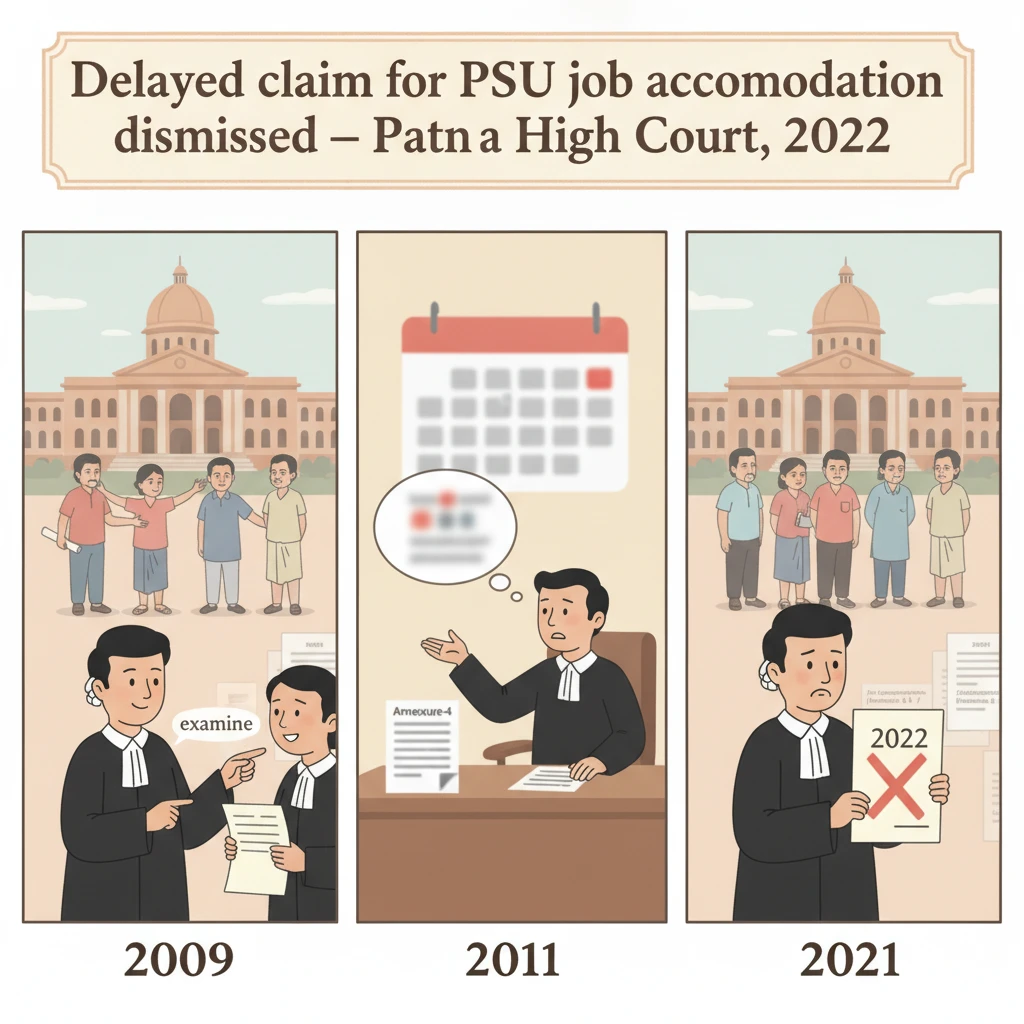
Relying on this circular, the petitioners and others approached the Patna High Court in 2009 by filing CWJC No. 11912 of 2009. That writ petition was decided in their favour only to the limited extent that the authorities were directed to examine the petitioners’ claim.
When the authorities allegedly did not comply, the petitioners filed a contempt petition, M.J.C. No. 1134 of 2011. During the pendency of the contempt case, the respondents passed an order in the year 2011 regarding the petitioners’ claim. That order is referred to in this case as Annexure-4 dated 20.01.2011.
After the 2011 order, the petitioners did not pursue the matter further for several years. They approached the Patna High Court again only in 2021 by filing the present Civil Writ Jurisdiction Case No. 5708 of 2021.
What the Court Examined and Decided
In this writ petition, the petitioners sought a direction to the respondents to appoint or accommodate them in service in any public sector unit of the Government of India. They also asked the Court to consider the fact that Hindustan Fertilizer Company, namely Hindustan Urvarak and Rasayan Ltd., had been revived and to rely on earlier directions issued by the Patna High Court in its order dated 28.07.2010 in CWJC No. 11912 of 2009 read with order dated 12.09.2011 in M.J.C. No. 1134 of 2011.
The essential case of the petitioners was that because the Government had decided in 2004 to accommodate ex-employees of the closed company, and because there were earlier directions of the High Court, they still had an enforceable right to be placed in any suitable post in a central public sector undertaking.
The petitioners’ counsel argued that the cause of action was still alive. They relied on various government correspondences from the year 2018, placed on record as Annexures 6 and 7, to say that the issue of their accommodation continued to be under consideration and therefore they were justified in approaching the Court in 2021.
The Court, presided over by Hon’ble Mr. Justice P. B. Bajanthri, first examined the timeline. The key dates noticed were:
(i) Closure of the company and payment of compensation to employees (prior to the present case).
(ii) Government circular dated 13.08.2004, deciding to accommodate ex-employees in other Government organisations.
(iii) Filing of CWJC No. 11912 of 2009 by the petitioners and others, decided in their favour only for examination of their claim.
(iv) Filing of contempt petition M.J.C. No. 1134 of 2011 for alleged non-compliance.
(v) Passing of an order by the respondents in the year 2011 during the contempt proceedings, specifically on 20.01.2011 (Annexure-4).
(vi) Petitioners remaining inactive after 2011 and filing the present writ petition only in 2021.
The Court described this long inaction as the petitioners having “slept over the matter” from 20.01.2011 till they filed the present case. The Court held that even if there were some correspondence among the respondents in 2018, that by itself could not cure the delay or explain the laches covering the period 2011 to 2021.
The Court also took note of the age of the petitioners. It observed that, except for petitioner no. 2, the other petitioners had already crossed the age of sixty years. This fact was important because they were seeking appointment or accommodation in service; normally, the age of superannuation in government and public sector jobs is around sixty years. Thus, for most petitioners, even if the claim were considered, their age had already become a major practical obstacle.
To support its approach on delay and laches in writ jurisdiction, the Patna High Court relied on decisions of the Hon’ble Supreme Court of India. The Court quoted at length from Jammu and Kashmir v. R.K. Zalpuri, reported in AIR 2016 SC 3006. In that case, the Supreme Court, while dealing with Article 226 of the Constitution, had referred to an earlier decision in City and Industrial Development Corporation v. Dosu Aardeshir Bhiwandiwala and Others.
The extracted passage outlined the factors a High Court must consider when exercising its writ jurisdiction:
(a) Whether adjudication of the writ petition involves complex and disputed questions of fact and whether they can be satisfactorily resolved.
(b) Whether the petition reveals all material facts.
(c) Whether the petitioner has any alternative or effective remedy.
(d) Whether the person invoking jurisdiction is guilty of unexplained delay and laches.
(e) Whether the petition is ex facie barred by limitation laws.
(f) Whether granting relief would be against public policy or barred by any valid law, along with other factors.
The Patna High Court emphasised clause (d) relating to unexplained delay and laches. By quoting this Supreme Court guidance, the Court underlined that it is duty-bound to examine delay while exercising writ jurisdiction, and if delay is significant and unexplained, the Court may refuse to entertain the petition, even if some merit might otherwise exist.
Further, the Court relied on the Supreme Court’s judgment in State of Rajasthan v. Surji Devi, reported in (2022) 1 SCC 17. The relevant paragraphs (6 to 9) were quoted. In that case, the husband of the respondent employee had been removed from service in 1996. He appealed, but died in 2009. The widow filed a writ petition in 2012, about 15 years after the termination and about 13 years after the date when he would have reached superannuation. The Supreme Court held that the High Court should not have entertained the writ petition after such a long delay and that, once the Court concludes that the petition is barred by delay and laches, it should not delve into merits.
Applying these principles, the Patna High Court reasoned that the petitioners’ long inaction of about ten years after the 2011 order, combined with their age, particularly the fact that most had crossed sixty years, made it inappropriate to grant any relief. The Court stated that the petition was liable to be dismissed on the ground of delay and laches alone.
The Court did not find it necessary to go into the merits of the petitioners’ claim for appointment or the effect of the earlier orders in CWJC No. 11912 of 2009 and M.J.C. No. 1134 of 2011. It focused solely on the question of whether such a belated claim could be entertained.
In conclusion, the Court held that, in the light of the facts and circumstances, the writ petition stood dismissed on the ground of delay and laches. No costs were awarded.
Why This Judgment Matters
This judgment sends a clear message to former employees of closed public sector undertakings and other claimants: if they wish to challenge government action or seek benefits through the High Court, they must act within a reasonable time.
For ex-employees seeking accommodation in other public sector units, the decision highlights that keeping silent for years after an adverse order can close the doors of the Court, even when they believe that government correspondence continues. The Court will look at when the cause of action first arose and whether the petitioner stayed inactive.
The judgment also shows that age and the nature of relief claimed matter. When the relief is appointment or accommodation in service, a petitioner who has already crossed the usual retirement age is unlikely to get such relief. The Patna High Court directly noted that all petitioners except one were already above sixty years.
For ordinary readers, especially workers affected by closure of factories or public sector units, this case underlines the importance of promptly following up legal remedies and not assuming that earlier directions will automatically result in a job or placement after many years.
Legal Issues and Answers
-
Issue: Whether ex-employees of a closed public sector fertilizer company could, in 2021, compel appointment or accommodation in a public sector unit on the basis of a 2004 government circular and earlier High Court directions, despite an order passed in 2011 and long inaction thereafter.
Answer: No. The Patna High Court held that the petition was barred by delay and laches because the petitioners had “slept over the matter” from 2011 to 2021, and most had already crossed sixty years of age. -
Issue: Whether later government correspondence in 2018 could revive or keep alive the petitioners’ cause of action despite the long gap since the 2011 order.
Answer: No. The Court held that even assuming such correspondence existed, it could not cure or explain the prolonged delay between 2011 and 2021.
Cases Cited by the Court
- Jammu and Kashmir v. R.K. Zalpuri, AIR 2016 SC 3006 (relied on for principles governing exercise of writ jurisdiction under Article 226, including consideration of delay and laches).
- City and Industrial Development Corporation v. Dosu Aardeshir Bhiwandiwala and Others (quoted within R.K. Zalpuri for factors to be considered in writ jurisdiction).
- State of Rajasthan v. Surji Devi, (2022) 1 SCC 17 (relied on to emphasise that writ petitions filed after long delay and laches should not be entertained and that, once barred by delay, merits need not be examined).
Case Details
Case Number: Civil Writ Jurisdiction Case No. 5708 of 2021
Case Title: Shyam Nandan Roy & Ors. v. Union of India & Ors.
Citation: 2022(2) PLJR 77
Coram: Hon’ble Mr. Justice P. B. Bajanthri
Advocates:
For the Petitioners: Mr. P.N. Shahi, Senior Advocate; Mr. Gajendra Kumar Singh, Advocate
For the Respondents: Dr. Krishna Nandan Singh, ASG; Mr. Manoj Kumar Singh, CGC; Mr. Bishwajeet Kumar, Advocate
Nature of the Case: Writ petition under Article 226 of the Constitution seeking direction for appointment/accommodation in a public sector unit after closure of Hindustan Urvarak and Rasayan Limited.
Link to the Judgment: Patna High Court Judgment
If you found this explanation helpful and wish to stay informed about how legal developments may affect your rights in Bihar, you may consider following Samvida Law Associates for more updates.







