

Case Background
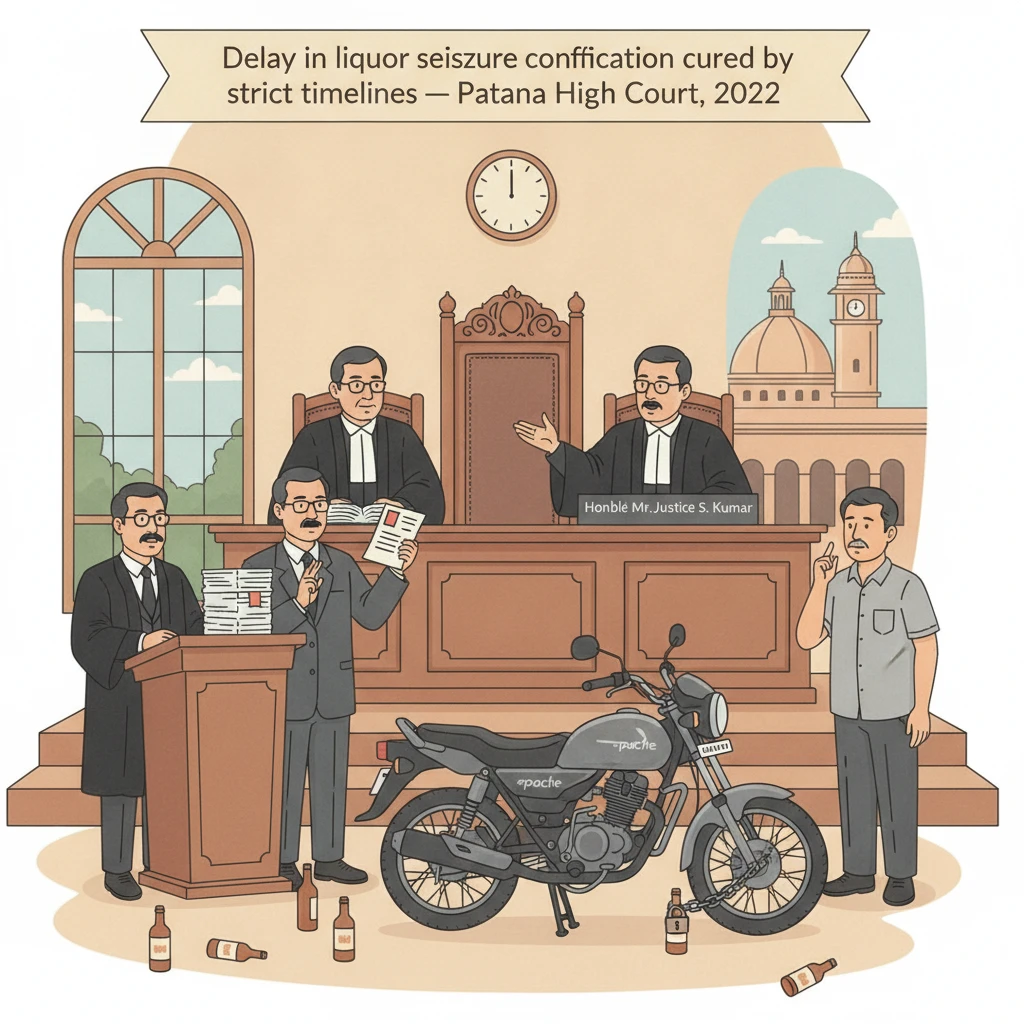
The petitioner is the registered owner of an Apache motorcycle bearing registration number BR30V 2027, with specific chassis and engine numbers. This motorcycle was seized in connection with Nanpur Police Station Case No. 496/2020 dated 14.12.2020 in the district of Sitamarhi, Bihar.
After the seizure, the motorcycle remained in the custody of the authorities. The petitioner moved the Patna High Court under its civil writ jurisdiction seeking release of the vehicle. The reliefs prayed were for release of the motorcycle, for a direction to hand over its possession to him, and for any other appropriate relief.
When the matter came up before the Division Bench (Hon’ble the Chief Justice and Hon’ble Mr. Justice S. Kumar) on 03.03.2022, learned counsel for the petitioner requested that the writ petition be disposed of in terms of earlier orders already passed by the Patna High Court in similar matters concerning seized vehicles under the Bihar Prohibition and Excise Act, 2016.
Those earlier matters were CWJC No.20598 of 2019 (Md. Shaukat Ali v. State of Bihar), CWJC No.17165 of 2019 (Umesh Sah v. State of Bihar & Ors.), CWJC No.2050 of 2020 (Bunilal Sah @ Munilal Sah v. State of Bihar & Ors.), CWJC No.3245 of 2017 (Manish Kumar Chaudhary v. State of Bihar & Ors.), and CWJC No.6148 of 2020 (Vishal Kumar v. State of Bihar & Anr.).
Learned counsel for the State raised no objection to adopting the same approach in the present case. The Court therefore focused on the larger systemic problem of delayed and sometimes non-existent confiscation proceedings under the Bihar Prohibition and Excise Act, 2016, rather than only the individual grievance of the petitioner.
What the Court Examined and Decided
The Bench began by recalling the scheme of the Bihar Prohibition and Excise Act, 2016 (the Act). Section 13 prohibits manufacture, storage, distribution, transportation, possession, sale, purchase and consumption of any intoxicant or liquor, unless permitted under the Act.
In addition to penal consequences, the Act provides for confiscation of certain “things” used in committing offences. Section 56 lists what can be confiscated: liquor or intoxicants, materials and implements used, receptacles and packages, animals and vehicles used for carrying the liquor, and even premises used for storing or manufacturing liquor. The explanation makes clear that “premises” includes the immovable structure, all moveable items within it and the land.
Under Section 58, the power to order confiscation lies with the District Collector or other authorised officer. Once the seizing officer reports the seizure of property, the Collector is required to initiate and decide confiscation proceedings.
The Court noted that in practice the High Court was being flooded with writ petitions about seized vehicles and properties because authorities were either not starting confiscation proceedings under Section 58, or not concluding them within a reasonable time. In some cases, even after interim release ordered by the High Court, parties did not cooperate before the confiscating authority. In others, confiscation orders were not communicated, depriving parties of their right to appeal under Section 92 and revision under Section 93.
There were also situations where appeals and revisions, once filed, were not being decided within a reasonable time, either due to official inaction or lack of cooperation by private parties. All this led to thousands of pending matters, with vehicles and other properties lying unused and deteriorating, resulting in what the Court described as “national loss”.
To address these recurring problems, earlier Benches of the Patna High Court had already framed detailed directions:
In CWJC No.3245 of 2017 (Manish Kumar Chaudhary), by order dated 18.01.2020, the Court laid down a comprehensive framework. It continued interim release orders till completion of confiscation, appeal and further proceedings, provided the owner cooperated and did not transfer or damage the property. It directed that where confiscation proceedings had not started, the appropriate authority must initiate them within four weeks, and then decide them within two months after observing natural justice.
The Court further directed that if confiscation was ordered, the owner must file appeal under Section 92 within the statutory period, and that appeal had to be decided within two months. Where confiscation had already concluded, owners were allowed to file appeals within four weeks or within statutory limitation, and the authorities were told not to use limitation as a ground to reject such appeals. The Court also authorised the authorities to take back possession and sell the property if the owner did not cooperate or did not file appeal in time.
In CWJC No.20598 of 2019 (Md. Shaukat Ali), order dated 09.01.2020, the Court noticed that vehicles were seized long ago and either no confiscation had begun or it was pending. Without deciding merits, it ordered that if confiscation had not started it must be initiated within 15 days, and if already started it must be concluded within 30 days after the petitioner’s appearance before the Collector. If proceedings could not be completed, the authority could consider interim release of the vehicle on suitable terms. Importantly, the Court held that “reasonable delay” in Section 58 should, in general, not exceed three months for deciding confiscation proceedings.
Those directions were reiterated in CWJC No.17165 of 2019 (Umesh Sah) by order dated 14.01.2020, again emphasising quick initiation and conclusion of confiscation and the three-month outer limit.
However, despite these clear directions, the authorities continued to delay or avoid confiscation action. This led to CWJC No.2050 of 2020 (Bunilal Sah @ Munilal Sah). On 29.01.2020, the same Bench recorded the entire history of earlier orders and observed that the Act had generated huge litigation. It recorded that in the High Court around 400 bail applications were filed daily, many under the Act; more than 1,75,000 challans were filed before Sessions Courts; and over 5,000 writ petitions each year concerned release of seized vehicles or properties.
The Bench noted that for years the High Court had been granting provisional release of vehicles to prevent damage, because the State had no adequate mechanism to protect seized property and was not conducting timely confiscation proceedings. It criticised the inaction of District Magistrates who were not initiating proceedings under Section 58, forcing owners to come to court.
In Bunilal Sah, the Court even considered whether to start contempt proceedings under the Contempt of Courts Act or Article 215 of the Constitution, but chose instead to direct the Chief Secretary of Bihar to file a personal affidavit explaining why the Act was not being implemented effectively, and what mechanism the State would adopt to avoid unnecessary litigation and ensure early completion of confiscation and appellate processes.
Subsequently, in CWJC No.6148 of 2020 (Vishal Kumar) decided on 04.06.2020, the same Bench again stressed that all proceedings — confiscation, appeal, revision — should, as far as possible, be concluded within three months from the date the High Court directs parties to appear before the appropriate authority. It clarified that if the authorities still failed to conclude proceedings within this time, the vehicle or property should be allowed to be released on such conditions as the authority considered fit.
In the present case concerning the Apache motorcycle, learned counsel for the petitioner requested that similar directions be applied. The State did not object. The Court noted that despite its repeated orders in many cases, the general position in a large number of matters under Sections 58, 92 and 93 remained unchanged, with proceedings either not started or not concluded.
Therefore, going beyond the individual dispute, the Bench laid down a clear and strict time schedule applicable across such cases:
First, the Court directed that all proceedings under Section 58 must positively be initiated and concluded within ninety days from the date of appearance of the parties before the authority. Second, any appeal or revision under Sections 92 or 93 must be decided within thirty days from the date of its initiation.
The Court added a strong consequence: if these timelines are not followed, the “things” involved — vehicles, properties and other items liable to confiscation — will be deemed to have been released in terms of the earlier orders referred to in Bunilal Sah @ Munilal Sah. This means that without any further order from the High Court, failure of authorities to act in time would automatically operate as release of the seized property.
Further, where confiscation proceedings had already concluded but parties could not file appeals or revisions within the statutory limitation period, the Court directed that if they initiate such proceedings within thirty days from the present order, the plea of limitation shall not be raised and cases must be decided on merits.
Specifically for this petitioner, the Bench recorded an undertaking that he would appear before the appropriate authority on 29.03.2022 at 10:30 A.M. That authority could be the Collector of Sitamarhi or, depending on delegation of power, another officer functioning as appellate or revisional authority. If the Collector was not dealing with the matter himself, he had to fix a date before the delegated officer within one week and inform all parties.
The Court took note of the Covid-19 pandemic and directed that convenience of parties was of prime importance. Authorities were allowed to hear matters using technology such as video conferencing.
The State’s counsel undertook to communicate this order to all concerned, including the District Magistrate. The Court clarified that no certified copy of the order was required to be placed in proceedings under the Act; the order could be downloaded or verified from the Patna High Court’s official website.
Finally, the Bench expressed hope and expectation that authorities under the Act would act in accordance with law and within the fixed timelines, failing which the vehicles, properties or other “things” liable to confiscation would stand deemed released without any further reference to the Court. Liberty was reserved to the petitioner to pursue any other remedy available in law if necessary. On that basis, the writ petition was disposed of.
Why This Judgment Matters
This judgment is important not only for the petitioner but for thousands of people in Bihar whose vehicles or properties have been seized in liquor-related cases.
Firstly, it fixes strict time limits for the authorities. Confiscation under Section 58 must start and finish within ninety days of the parties’ appearance. Appeals and revisions must be decided within thirty days. This prevents indefinite delay while the vehicle lies unused and deteriorates.
Secondly, it introduces a powerful consequence: if the authorities fail to act within these time frames, the seized vehicle or property is deemed to be released. Owners are not forced to rush again and again to the High Court only to get their vehicle back.
Thirdly, for old cases where confiscation orders were passed long back and owners missed the appeal time because they were not properly informed, the Court has opened a window. If such owners file appeal or revision within thirty days, their cases must be heard on merits without objection on limitation.
Finally, the judgment pushes the administration to use technology and to treat the convenience of citizens seriously, especially in pandemic conditions. It signals that the Patna High Court expects the Bihar Prohibition and Excise Act, 2016, to be implemented in a timely and fair manner, without causing unnecessary hardship to vehicle owners.
Legal Issues and Answers
-
Issue: What directions should be issued regarding release and confiscation of a vehicle seized in a prohibition case when authorities delay or fail to start confiscation proceedings under the Bihar Prohibition and Excise Act, 2016?
Answer: The Court declined to order direct release but applied its earlier framework: confiscation under Section 58 must be initiated and concluded within ninety days of the parties’ appearance, and any appeal or revision under Sections 92 and 93 must be decided within thirty days, failing which the seized vehicle or property will be deemed released. The petitioner was directed to appear before the appropriate authority on a fixed date. -
Issue: How should delays in filing appeal or revision against concluded confiscation orders be treated?
Answer: Where confiscation proceedings already stand concluded and parties could not file appeal or revision within the limitation period, if they initiate such proceedings within thirty days from the judgment, the authorities must not reject them on the ground of limitation and must decide them on merits.
Cases Cited by the Court
- CWJC No.3245 of 2017, Manish Kumar Chaudhary v. The State of Bihar & Ors.
- CWJC No.20598 of 2019, Md. Shaukat Ali v. The State of Bihar & Ors.
- CWJC No.17165 of 2019, Umesh Sah v. The State of Bihar & Ors.
- CWJC No.2050 of 2020, Bunilal Sah @ Munilal Sah v. The State of Bihar & Ors.
- CWJC No.6148 of 2020, Vishal Kumar v. The State of Bihar & Anr.
- Several other writ petitions referenced mainly to illustrate past practice on provisional release and confiscation (Diwakar Kumar Singh; Rajesh Kumar Pandit @ Rajesh Pandit; Amar Kumar; Mahendra Manjhi; Laxman Das @ Lakshman Ravidas; Sanjay Kumar; Bikash Kumar; Anandi Prasad; Suraj Ram; Kalesar Chaudhari; Raushan Kumar @ Raushan Kumar Singh; Asharfi Kumar @ Rakesh Kumar; Avinash Kumar; Roshan Kumar; Shanti Devi; Shobha Devi). The judgment recounts prior directions issued in these matters.
Case Details
Case Number: Civil Writ Jurisdiction Case No.20851 of 2021
Case Title: Vinay Kumar Pathak @ Benay Kumar Pathak v. The State of Bihar & Ors.
Coram: Hon’ble the Chief Justice; Hon’ble Mr. Justice S. Kumar (Oral Judgment by Hon’ble Mr. Justice S. Kumar)
Date of Judgment: 03.03.2022
Citation: 2022(2) PLJR 91
Advocates: Mr. Uday Kumar, Advocate for the petitioner; Mr. Kumar Manish (SC 5) for the respondents/State of Bihar
Nature of the Case: Writ petition under civil writ jurisdiction seeking release of a seized motorcycle and related directions under the Bihar Prohibition and Excise Act, 2016
Key Statutory Provisions Discussed: Section 13, Section 56, Section 58, Section 92 and Section 93 of the Bihar Prohibition and Excise Act, 2016
Link to Full Judgment: Patna High Court Judgment in CWJC No.20851 of 2021
If you found this explanation helpful and wish to stay informed about how legal developments may affect your rights in Bihar, you may consider following Samvida Law Associates for more updates.







