
Case Background
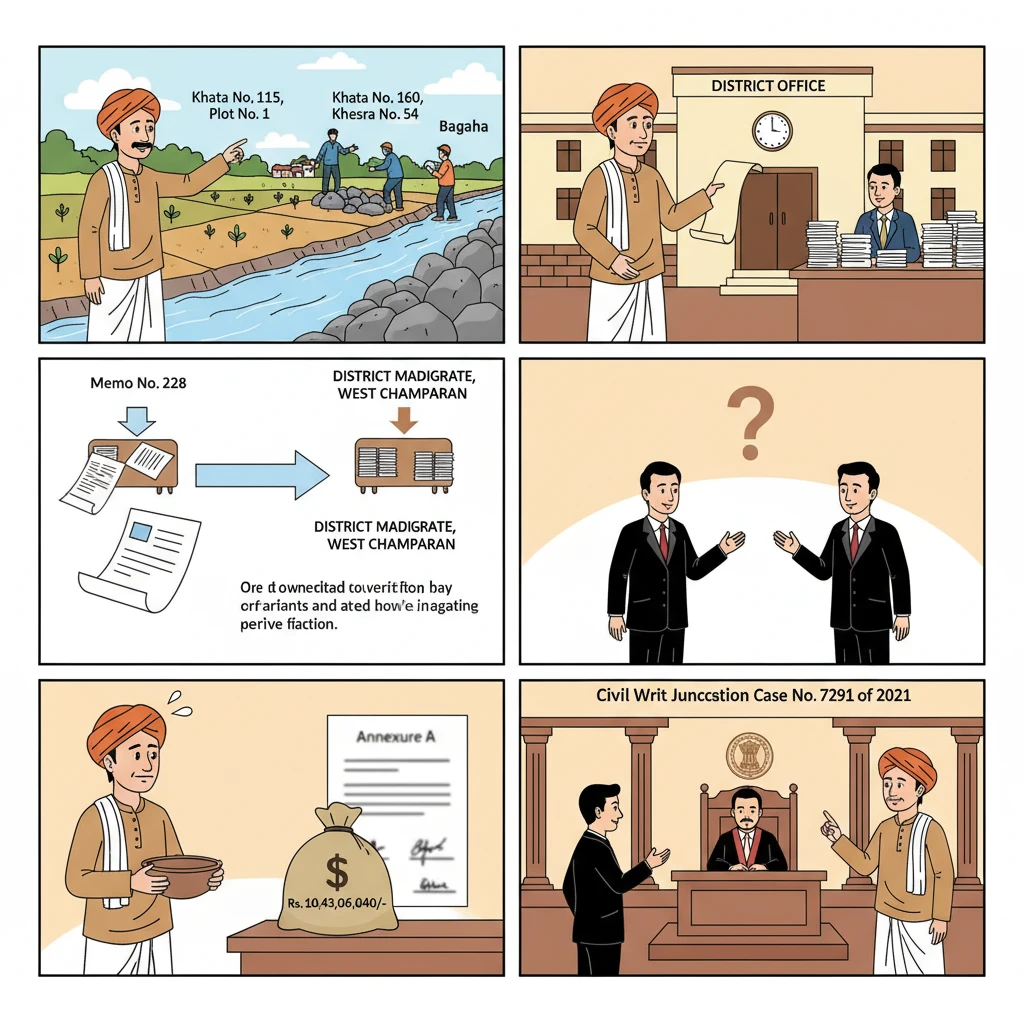
The writ petition was filed under Article 226 of the Constitution of India as Civil Writ Jurisdiction Case No. 7291 of 2021 before the Patna High Court. The petitioner is a raiyat (landholder) from West Champaran district.
He claimed to be the owner of two pieces of land. One parcel is in village Awasani, relating to Khata No. 115, Plot No. 1, Thana No. 141 with an area of 14 decimals. The second parcel is in village Mangalpur, relating to Khata No. 160, Khesra No. 54, Thana No. 142 with an area of 40 decimals.
According to the petitioner, between 2014 and 2018, the State used his land and the land of other raiyats for boulder pitching to control floods and to save Bagaha town. Boulder pitching is a flood control measure where stone pitching is laid to protect embankments or riverbanks.
The petitioner stated that officers told him and other raiyats that their lands would be taken for flood control purposes and that they would get compensation. Trusting these assurances, they allowed boulder pitching work to proceed on their lands.
However, even while the work was going on between 2014 and 2018, the petitioner and others objected about land acquisition and demanded compensation. He kept approaching the authorities and asked not only for compensation for the acquired land but also for all consequential benefits.
The petitioner sent a written representation on 03.01.2018 to the authorities. The Secretary, Water Resources Department, forwarded this representation to the Special Land Acquisition Officer (SLAO), Gandak Project, Muzaffarpur. The SLAO wrote memo no. 228 dated 12.03.2018 to the District Magistrate, West Champaran, asking for a report on the petitioner’s ownership and title so that compensation could be processed.
Despite this, the petitioner alleged that no effective steps were taken and he remained unpaid. He then approached the Patna High Court seeking directions to the State authorities to pay compensation, interest, costs and damages for the land acquired for the boulder pitching work.
What the Court Examined and Decided
Justice Shailendra Singh heard the matter. Mr. Suresh Prasad Sharma appeared for the petitioner, and Mr. Raj Kishore Roy, Government Pleader 18, appeared for the respondents.
The petitioner’s side argued that he was a raiyat of the two specified plots of land in villages Awasani and Mangalpur. His case was that for the flood control work to save Bagaha city from floods, officials persuaded him and other raiyats to let the State use their land. On this assurance, they allowed boulder pitching from 2014 to 2018.
During these years, the petitioner kept objecting and demanded compensation. According to him, officers repeatedly assured him that the compensation process was underway and that payment would be made in due course. Still, nothing concrete happened.
He relied on the representation of 03.01.2018, the forwarding of that representation by the Water Resources Department, and memo no. 228 dated 12.03.2018 from the SLAO to the District Magistrate asking for report on ownership and title. He alleged that even after such official correspondence, no final action was taken in his favour.
The petitioner further claimed that boulder pitching and acquisition had badly affected his livelihood. He said his residential land had been taken, leading to serious housing issues. He also pointed out that an initially formed six-member committee from Bagaha Administration and Flood Control Division described his land as “dhanhar” (paddy growing agricultural land), whereas, according to him, the nature of land was residential. He filed photographs to support his version.
On the other hand, the State–respondents put forward a detailed procedural history. They said the petitioner himself had given written consent for acquisition of his land in Awasani and Mangalpur, and they produced copies of consent letters as Annexure A to their counter affidavit.
The Executive Engineer of the then Champaran Division, Motihari, had paid Rs. 10,43,06,040/- to the Special Land Acquisition Officer, Gandak Project, Muzaffarpur, by letter no. 22 dated 09.06.2016. This amount was for acquisition of 13.17 acres of land in different villages where boulder pitching took place in financial years 2012-13 and 2016-17.
The State explained that the lands were to be acquired under the Bihar Raiyati Land Lease Policy, 2014. Under this policy, the SLAO wrote letter nos. 1518-1522 dated 14.10.2017 to the Collector, West Champaran, asking for a report regarding title and nature of land under acquisition, and even sent reminders. The Collector’s office supplied this report vide letter no. 623 dated 20.10.2018.
However, the State said that thereafter the acquisition proceedings could not be initiated by the SLAO because the Government took a policy decision to dissolve such offices under the Directorate of Land Acquisition and Rehabilitation, Water Resources Department. These offices were dissolved with effect from 01.10.2019.
As a result, the compensation amount was deposited into the Government Treasury and records were sent to the Flood Control Division, Bagaha. The Executive Engineer then requested constitution of a six-member committee through letter no. 111 dated 14.02.2020 to determine the nature of land in light of Revenue Department letter no. 1287 dated 03.10.2017.
The Sub-Divisional Officer, Bagaha, constituted the committee, which conducted a local inspection on 06.03.2020. This committee submitted its inspection report on the same day. It reported that the petitioner’s lands were agricultural in nature. The State filed this report as Annexure C.
Subsequently, the Executive Engineer sought updated Minimum Value Rate (MVR) from the Sub Registrar, Bagaha, through letter no. 468 dated 18.07.2020. The Sub Registrar sent the report on 05.02.2021.
Based on the MVR, the Executive Engineer, Flood Control Division, Bagaha, prepared an estimate of Rs. 29,52,000/- as compensation for land owners of village Awasani and another estimate of Rs. 1,06,69,600/- for land owners of village Mangalpur. The Chief Engineer, Flood Control and Drainage, Water Resources Department, Muzaffarpur, granted technical approval and forwarded it to the Water Resources Department, Patna, by letter no. 1768 dated 08.08.2021 for fund allocation.
Funds were later made available to the Executive Engineer through departmental letters nos. 92 and 93 dated 07.02.2022. The State stated that necessary steps were being taken for payment of compensation to the petitioner and other landowners of Awasani and Mangalpur.
The State further pointed out that, in compliance with directions of the Court during the writ proceedings, a fresh committee was constituted under the chairmanship of the Superintending Engineer, Flood Control Division, Muzaffarpur, along with other officers, as mentioned in paragraph 4 of the counter affidavit of the District Magistrate, West Champaran (respondent no. 8).
This committee was directed to carry out spot inspection in presence of affected persons, including the petitioner. Letters were sent to the petitioner and other beneficiaries informing them of the committee’s formation and the date and time of inspection. The petitioner acknowledged receipt of the letter, writing “received on dated 30.03.2024” (Annexure R/3).
The inspection took place on 06.04.2024 in presence of the petitioner and other landowners. Videography and photography were done. The committee prepared a report (Annexure R/6), signed by all members, which was approved by the Collector, West Champaran, Bettiah, on 13.04.2024.
According to this spot inspection report, the nature of the petitioner’s land in Mauza Awasani was found to be agricultural. Similarly, his land in Mauza Mangalpur was also held to be agricultural. The committee recorded that 40 decimals of land in Mauza Mangalpur was recorded in the Khatiyan as “Dhanhar Quila-1” (paddy field), and 14 decimals in Mauza Awasani was recorded as “Kharaul”, both agricultural categories.
After hearing both sides and examining the pleadings, the Court noted some key admitted facts. First, the petitioner’s land had in fact been acquired for boulder pitching, and the work had been done after he gave consent through written letters. Second, despite this, he had not received any compensation till date.
The Court observed that the State had described various procedural steps: constitution of committees, inspection reports, seeking MVR, preparation of estimates, technical approvals and fund sanctions. However, these steps had resulted in an “unreasonable inordinate delay” in actually deciding and granting compensation to the petitioner.
On the dispute about the nature of the land, the Court recorded that a six-member committee had inspected the site under directions of the Court itself and had delivered report Annexure R/6, besides an earlier committee report. The District Magistrate’s counter affidavit dated 26.04.2024 described the procedure followed by this new committee. After considering all this, the Court found “no reason to disbelieve” the committee’s conclusion that the petitioner’s two plots were agricultural.
The Court noted that the State had not claimed that it had already tendered compensation and that the petitioner refused to receive it. Therefore, the procedural steps and internal delays could not be treated as sufficient justification for withholding compensation for so long after acquisition and use of the land.
In this background, the Court issued clear directions. It directed the State–respondents to decide the compensation payable for the petitioner’s lands within two months from the date of the order and to pay the same to him and all others entitled, as per law.
The Court further ordered that the petitioner and other entitled persons must be paid interest on the compensation as per prevailing law for the period from the date of acquisition till the date of the Court’s order.
Importantly, the Court imposed a strong deterrent for future delay. It held that if the State–respondents failed to pay compensation within the fixed period of two months, the petitioner and other beneficiaries would be entitled to interest at double the rate on the compensation amount till the actual date of payment. This additional burden would be recoverable from the erring officers by the concerned department.
Finally, the Court clarified that once the award is prepared, the petitioner and other beneficiaries would retain their legal right to challenge that award in accordance with law. Thus, the present decision focused on ensuring timely determination and payment of compensation and interest, leaving open any future challenge on quantum or legality of the award.
Why This Judgment Matters
This Patna High Court judgment is important for landholders whose lands are taken for public projects like flood control works. The Court recognised that the State had physically used the land for boulder pitching years ago but had not paid compensation.
The decision makes it clear that long administrative procedures, office closures, or internal approvals cannot be excuses for not paying landowners. Once the State takes land and uses it for a public purpose, it must act promptly to fix and pay compensation.
By directing payment within two months and granting interest from the date of acquisition, the Court protected the financial rights of the petitioner and similarly placed raiyats. The warning of double-rate interest recoverable from responsible officers sends a strong message that such delay will not be tolerated.
The judgment also shows how disputes about whether land is agricultural or residential can affect compensation, and how site inspection committees and revenue records are used to decide the nature of land.
Legal Issues and Answers
- Issue: Whether the State could justify long delay in paying compensation for land already acquired and used for boulder pitching under a flood control project.
Answer: No. The Court held the delay to be unreasonable and directed the State to decide and pay compensation within two months with interest from the date of acquisition, and imposed double-rate interest for any further delay. - Issue: How should the nature of the petitioner’s land (agricultural or residential) be determined for compensation purposes.
Answer: The Court relied on the spot inspection report of the six-member committee constituted under its directions and accepted its conclusion that both parcels of the petitioner’s land are agricultural in nature.
Cases Cited by the Court
- No earlier judicial precedents or other cases are cited or relied upon in the text of this judgment.
Case Details
Case Number: Civil Writ Jurisdiction Case No. 7291 of 2021
Case Title: Ghanshyam Singh @ Ghanshyam Prasad Singh v. The State of Bihar & Ors.
Coram: Hon’ble Mr. Justice Shailendra Singh
Citation: 2026 (1) PLJR 267
Advocates:
- For the petitioner: Mr. Suresh Prasad Sharma, Advocate
- For the respondents: Mr. Raj Kishore Roy, Government Pleader 18 (GP-18)
Nature of the case: Writ petition under Article 226 of the Constitution of India seeking directions for payment of compensation and related benefits for land acquired for boulder pitching (flood control work).
Link to judgment: View full judgment on Patna High Court website
If you found this explanation helpful and wish to stay informed about
how legal developments may affect your rights in Bihar,
you may consider following Samvida Law Associates for more updates.







