

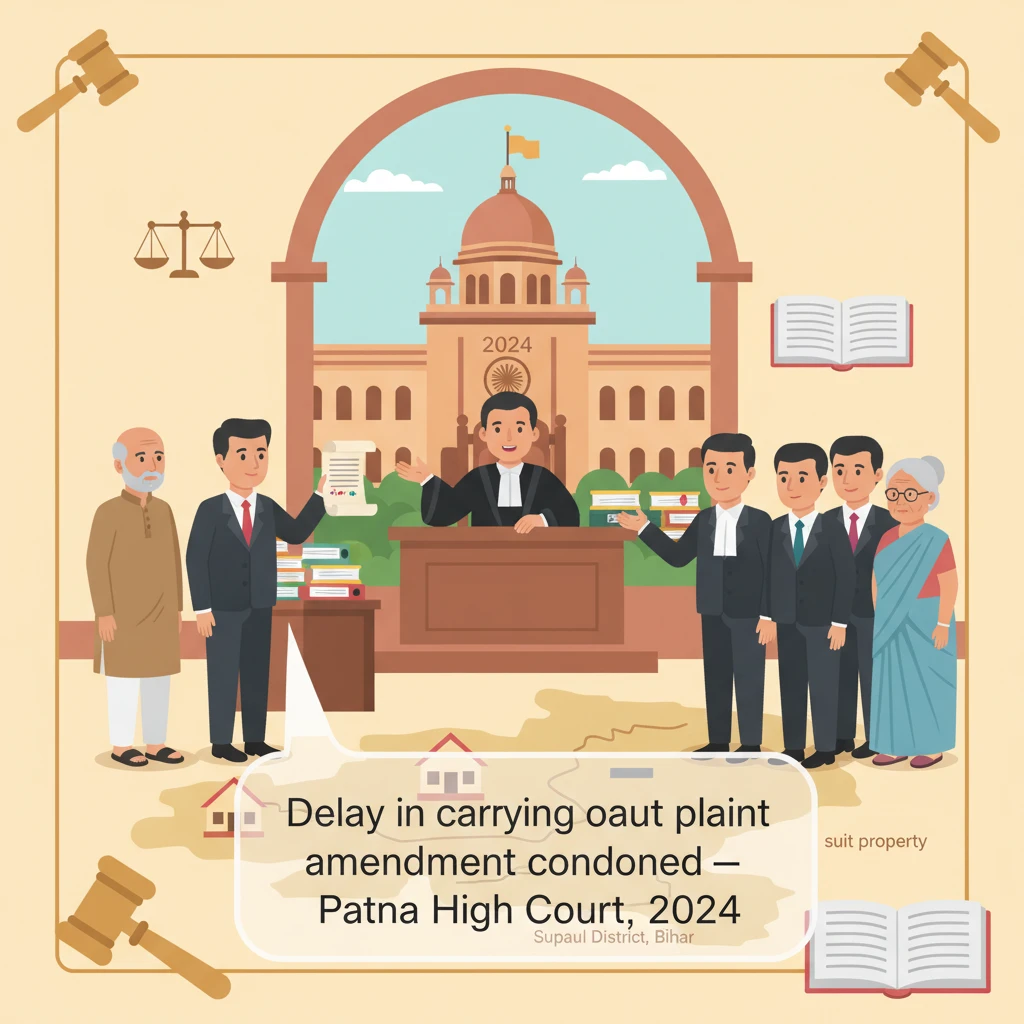
Case Background
The dispute arises from Title Suit No. 29 of 2009 pending before the Court of Sub Judge-IV, Supaul. The plaintiff in that suit is the petitioner before the Patna High Court. The respondents are the substituted heirs and other parties arrayed as defendants in the title suit.
On 30.09.2014, the plaintiff filed a petition under Order VI Rule 17 of the Code of Civil Procedure, 1908 seeking amendment of the plaint. The amendment was sought due to a subsequent event which, according to the plaintiff, affected the reliefs in the suit.
On 17.09.2015, the trial court allowed the amendment petition. However, the plaintiff did not actually carry out the amendment in the plaint as directed. No changes were incorporated in the pleadings within the time provided by law or by the court.
To cure this, on 24.02.2016 the plaintiff moved another petition under Order VI Rule 18 of the Code asking for extension of time to carry out the amendment that had already been allowed on 17.09.2015. On 26.04.2016, the trial court allowed this petition, granting more time on payment of cost of Rs. 100.
Even after getting this extension, the plaintiff again failed to bring the approved changes into the plaint. As a result, on 30.01.2017 the plaintiff filed yet another petition, this time under Sections 148 and 151 of the Code, requesting the trial court to again permit him to carry out the earlier allowed amendment.
On 19.07.2017, the Sub Judge-IV, Supaul rejected this second extension petition. The court found no justification to grant further time and effectively closed the door on carrying out the amendment.
Aggrieved by this order, the plaintiff invoked the supervisory jurisdiction of the Patna High Court under Article 227 of the Constitution of India by filing Civil Miscellaneous Jurisdiction No. 1634 of 2017. The challenge before the High Court was limited to the order dated 19.07.2017 rejecting the petition dated 30.01.2017 under Sections 148 and 151 of the Code.
What the Court Examined and Decided
The matter came up before Hon’ble Mr. Justice Arun Kumar Jha of the Patna High Court. The Court heard the learned counsel for the petitioner as well as the learned counsel representing respondent nos. 1 to 12.
The petitioner’s counsel narrated the sequence of events. He pointed out that the amendment to the plaint had already been allowed by the trial court on 17.09.2015 under Order VI Rule 17 of the Code. According to him, there was no dispute now about whether the amendment itself was permissible; the only issue was whether the plaintiff could be allowed more time to physically carry out the amendment in the plaint.
He explained that due to unavoidable circumstances, the plaintiff had not been able to comply with the court’s order. The petitioner was described as a poor person who had to go outside the State to earn his livelihood. Because of this compulsion, he could not attend to the formal act of incorporating the amendment in the plaint in time, even after the initial extension granted on 26.04.2016.
The petitioner’s counsel stressed that the amendment sought to bring on record a subsequent event relating to dispossession from the property in dispute. If this event was not included in the plaint, the petitioner would not be able to claim the relief of recovery of possession in the same suit. He argued that this would cause serious prejudice to the plaintiff and might bar him from seeking an important relief connected to his alleged dispossession.
On the other side, the counsel for respondent nos. 1 to 12 strongly opposed giving any further indulgence. They argued that the plaintiff had shown persistent negligence in complying with the court’s directions. Despite the order dated 17.09.2015 allowing amendment and the subsequent extension dated 26.04.2016 under Order VI Rule 18 with a nominal cost of Rs. 100, the plaintiff still did not act.
The respondents’ counsel submitted that no satisfactory explanation had been given for this continued failure. In their view, mere statements about poverty or having to work outside the State could not justify such prolonged inaction. They also pointed out that the title suit itself had been pending since the year 2009 and that the plaintiff’s negligent approach was contributing to unnecessary delay in disposal of the case.
After hearing both sides, the Patna High Court examined the legal framework. The Court noted that Order VI Rule 18 of the Code provides that, if no time is specifically prescribed in the order, any amendment should be carried out within fourteen days from the date of the order. In this case, even though the plaintiff had been given an opportunity under Order VI Rule 18 on 26.04.2016, he failed to take benefit of it.
The Court clearly observed that the petitioner was “completely at fault” in not carrying out the amendment in terms of the order dated 17.09.2015. The factual record showed that the plaintiff had first moved under Order VI Rule 18 and then under Sections 148 and 151 of the Code. The second petition had been rejected by the trial court, leading to the present Article 227 petition.
However, the High Court did not stop at merely blaming the petitioner. It also considered the broader purpose of procedural law. The Court emphasised that the effort of any court should be to determine the real controversy between the parties. Procedural rules are meant to assist this process, not to obstruct justice.
The Court added an important qualification: this liberal approach should be adopted when no vested rights have accrued in favour of the opposite side because of the delay. In such a situation, the trial court should normally allow a petition seeking time to carry out an already permitted amendment, rather than shutting out a party on technical grounds.
Applying these principles, the Patna High Court concluded that the trial court ought to have taken a more balanced view. While the plaintiff’s conduct was blameworthy, denying him the chance to bring on record the subsequent event of dispossession could prevent adjudication of the real dispute. In a suit pending since 2009, it would be more appropriate to permit the amendment and then proceed to decide the matter on merits.
Therefore, “without further going into the factual aspects of the case”, the High Court exercised its supervisory jurisdiction. It set aside the impugned order dated 19.07.2017 passed by the Sub Judge-IV, Supaul in Title Suit No. 29 of 2009.
The Court allowed the petition dated 30.01.2017 filed under Sections 148 and 151 of the Code. But this relief was not unconditional. To balance the equities and take care of the delay caused to the defendants, the Court imposed a substantial cost.
The High Court directed that the allowance of the petition would be subject to payment of Rs. 10,000 as cost to the contesting respondents. This amount is to be paid on the first date before the trial court after receipt or production of a copy of the High Court’s order. Only upon such payment can the plaintiff carry out the amendment already permitted on 17.09.2015.
With these directions, the Civil Miscellaneous petition under Article 227 was allowed. The title suit will continue before the Sub Judge-IV, Supaul, with the amended plaint once the ordered cost is paid and the amendment is carried out.
Why This Judgment Matters
This judgment is important for civil litigants, especially in property and title disputes where situations change after a suit is filed. It shows that even if a party carelessly misses deadlines to amend pleadings, the Patna High Court may still step in to prevent technical rules from defeating substantial justice.
The Court made it clear that the main aim is to decide the real controversy between the parties. When no vested right has arisen in favour of the other side due to the delay, courts should be slow to shut out amendments that relate to important subsequent events such as dispossession.
At the same time, the judgment sends a caution to plaintiffs and their lawyers. The High Court described the petitioner as completely at fault and imposed a much higher cost of Rs. 10,000 compared to the earlier Rs. 100 ordered by the trial court. This signals that negligence will not go unnoticed, even if the court ultimately leans in favour of deciding disputes on merits.
For ordinary people involved in long-pending civil suits, this case shows that higher courts can correct overly strict procedural orders of trial courts, but relief may come with financial consequences and stern observations. It stresses the need to act promptly after an amendment is allowed and to keep track of court deadlines.
Legal Issues and Answers
- Issue: Can the trial court refuse further time to carry out an already allowed amendment to the plaint when the plaintiff has repeatedly defaulted?
Answer: The Patna High Court held that, although the plaintiff was at fault, the trial court should normally allow such a petition if no vested right has accrued to the other side and if refusal would obstruct determination of the real controversy. The High Court, therefore, set aside the refusal order and allowed the petition subject to payment of cost. - Issue: How should courts balance procedural delays against the need to decide the real dispute between the parties?
Answer: The Court reiterated that procedural law must not hamper the course of justice. When the amendment concerns a subsequent event and is necessary for full adjudication, courts should adopt a liberal approach, compensating the other side by costs rather than dismissing the request outright.
Cases Cited by the Court
- No earlier judgments are cited or relied upon in the text of this decision.
Case Details
Case Number: Civil Miscellaneous Jurisdiction No. 1634 of 2017; arising out of Title Suit No. 29 of 2009 (Sub Judge-IV, Supaul)
Case Title: Daya Nand Singh v. Suresh Singh & Ors.
Coram: Hon’ble Mr. Justice Arun Kumar Jha
Citation: 2024 (4) PLJR 333
Advocates: Mr. Shashi Nath Jha, Advocate for the petitioner; Mr. Sudish Kumar, Advocate for the respondents; Mr. Saket Tiwary, Advocate for the respondents
Nature of the Case: Petition under Article 227 of the Constitution of India challenging an interlocutory order in a title suit refusing extension of time to carry out an allowed amendment of the plaint.
Date of High Court Judgment: 17.09.2024
Link to Full Judgment: Patna High Court Judgment in C.Misc. No. 1634 of 2017
If you found this explanation helpful and wish to stay informed about
how legal developments may affect your rights in Bihar,
you may consider following Samvida Law Associates for more updates.







