
Case Background
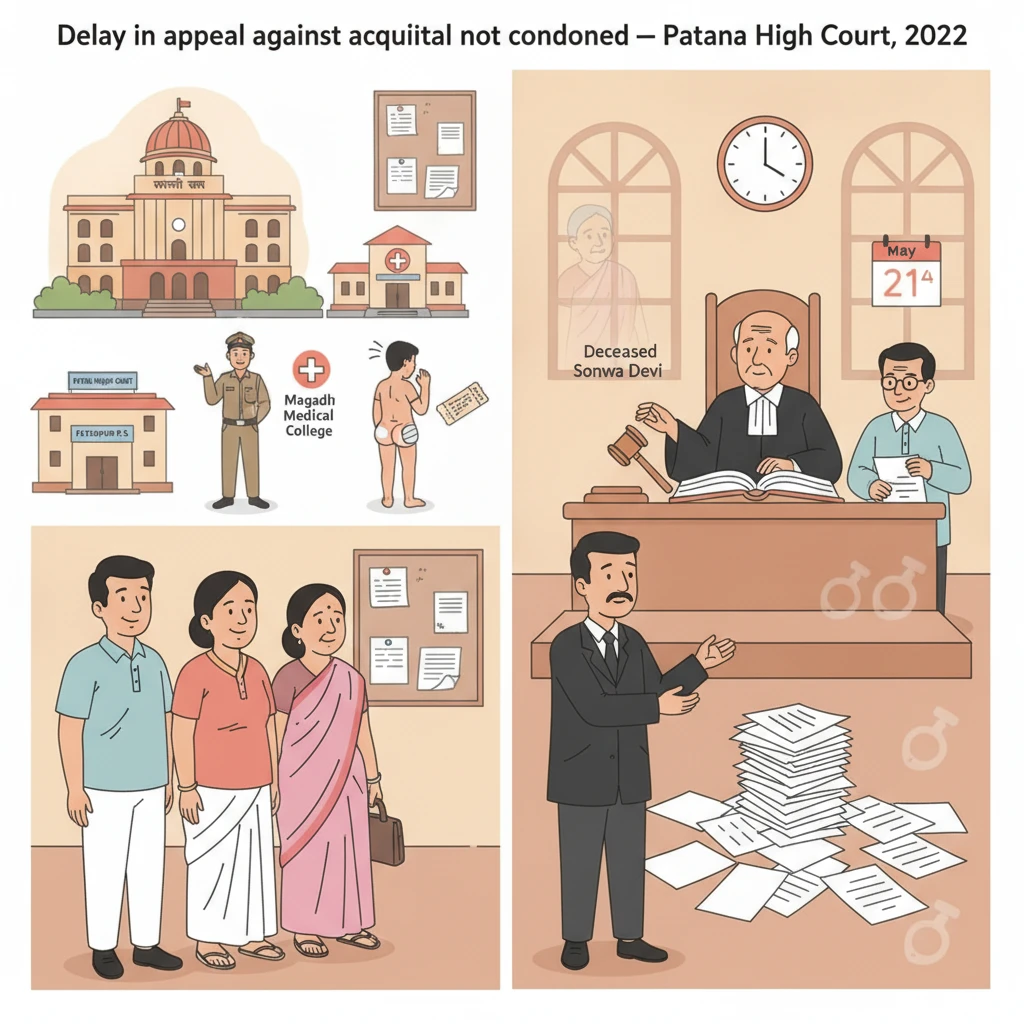
The case started with an FIR registered as Fatehpur P.S. Case No. 75 of 2005 in district Gaya. The informant, a railway khalasi posted at Gajhandi, alleged that he was shot and injured by his co-villagers over a dispute relating to his service benefits.
According to the FIR, on 09.05.2005 at about 8 p.m., the informant came out of his house after hearing a commotion. He saw two neighbours quarrelling and tried to pacify them. At that stage, the accused persons allegedly began abusing him. When he tried to return home, one of the accused, on the exhortation of a co-accused, allegedly fired at him with a pistol. The bullet is said to have hit his right buttock, causing him to fall unconscious.
The informant’s wife and daughter carried him inside the house. As there was no male member present, he remained at home in injured condition during the night. Next morning, his wife called their relatives, who took him first to Magadh Medical College, Gaya, and later to the clinic of a private doctor. He claimed that he regained consciousness there on 12.05.2005.
He further alleged that after he was appointed in the Railways in place of his deceased father, the accused persons started demanding 50% of his salary, and when he refused, they committed the offence. On this basis, the FIR was registered under Section 307 read with Section 34 of the Indian Penal Code and Section 27 of the Arms Act.
Police investigated the case and submitted a charge sheet before the jurisdictional Magistrate on 31.07.2007. The Magistrate took cognizance on the police report under Section 173(2) of the Code of Criminal Procedure and, after supplying necessary documents under Section 207 CrPC, committed the case to the Court of Sessions on 27.02.2008.
The Sessions Judge transferred the case to the court of the Adhoc Additional District and Sessions Judge-2nd, Gaya. On 19.08.2008, that court framed charges against the accused persons for offences under Sections 307/34 IPC and Section 27 of the Arms Act.
During the trial, one of the accused, Sonwa Devi, died on 24.08.2011. Consequently, the trial against her was dropped on 21.05.2014. The remaining three accused continued to face trial.
However, despite repeated adjournments over several years, the prosecution failed to produce any witness, including the informant. The trial court issued summons, then bailable warrants, and finally non-bailable warrants to secure the presence of prosecution witnesses, even routing non-bailable warrants through the Superintendent of Police, Gaya. Dasti summons were also handed to the Additional Public Prosecutor, along with repeated reminders to produce witnesses.
In total, after charges were framed on 19.08.2008, the case was adjourned on not less than 50 occasions for prosecution evidence. All efforts of the trial court between 19.08.2008 and 11.04.2014 to bring witnesses failed. As a last indulgence, the case was posted to 20.05.2014. When no witness appeared even then, the trial court closed the prosecution evidence on 21.05.2014.
Since there was no evidence to support the charges, the trial court, exercising powers under Section 232 CrPC, acquitted the accused persons by judgment dated 23.05.2014 in Sessions Trial No. 142 of 2009/176 of 2008 (SJ).
More than seven years later, the informant filed a criminal appeal under the proviso to Section 372 CrPC before the Patna High Court along with an interlocutory application under Section 5 of the Limitation Act seeking condonation of delay of 7 years, 4 months and 19 days in filing the appeal.
What the Court Examined and Decided
A Division Bench of the Patna High Court, comprising Hon’ble Mr. Justice Ashwani Kumar Singh and Hon’ble Mr. Justice Rajeev Ranjan Prasad, heard the interlocutory application for condonation of delay in Criminal Appeal (DB) No. 702 of 2021.
The informant–appellant explained the delay in several steps. He claimed that he was never informed about the progress of the trial and was not aware that the case had ended in acquittal. According to him, he first learnt about the acquittal on 20.12.2019, when a puja was organised at the house of the accused persons. He and his family members were invited. When he asked why the puja was being held, he was told that the criminal case he had lodged had resulted in acquittal.
After this, he said he went to a lawyer in Gaya, who confirmed that the trial had concluded in acquittal on 23.05.2014. On the informant’s request, the lawyer applied for a certified copy of the judgment on 02.01.2020, which was supplied on 12.03.2020. The lawyer then advised him to challenge the acquittal before the High Court.
The appellant further submitted that soon after he obtained the copy, the Covid-19 pandemic broke out and the Government of India declared a nationwide lockdown in March 2020. Because of restrictions on movement, he said, he could not file the appeal during that period.
Subsequently, on 27.09.2021, he approached another lawyer at Patna, paid legal fees and expenses, and the present criminal appeal was finally filed on 15.11.2021. On this basis, counsel for the appellant argued that from the “date of knowledge” on 12.03.2020, the effective delay in filing the appeal was only 1 year, 3 months and 26 days.
The appellant maintained that the delay was neither wilful nor deliberate, but was caused by the circumstances narrated. He also asserted that he had strong grounds on merits and was ready to adduce evidence if given an opportunity.
The State, represented by the Additional Public Prosecutor, opposed the application. The State pointed out that the appellant was a close agnate of the accused persons and a co-villager. The fact that the appellant and his family members attended a puja in the house of the accused reflected the closeness of their relationship.
Looking at the trial court record, the State submitted that after framing of charges, the case was repeatedly adjourned for prosecution evidence, but no witness, including the informant, ever appeared over almost six years. The trial court undertook all possible measures—summons, bailable warrants, non-bailable warrants routed through the Superintendent of Police, and dasti summons to the Additional Public Prosecutor—yet the witnesses did not turn up. In such compelling circumstances, the trial court closed the prosecution and acquitted the accused under Section 232 CrPC.
The State argued that the appellant had not provided any convincing or plausible explanation for the long delay of more than seven years and four months in filing the appeal, particularly when the record showed consistent inaction and indifference from the prosecution side during the earlier trial.
After hearing both sides and examining the record, the Patna High Court considered whether the appellant had shown “sufficient cause” under Section 5 of the Limitation Act for the huge delay.
The Bench noted first that the appellant was a co-villager and agnate of the accused respondents. Given this close relationship and proximity, it was difficult to accept that he and his family were completely unaware of the ongoing trial proceedings. The Court specifically referred to the fact that the appellant and his family went to attend a puja organised in the house of the accused persons, which indicated close social ties.
Secondly, the Court observed that the trial court had given more than ample opportunity to the prosecution to produce its witnesses. Charges were framed on 19.08.2008 and the prosecution case was closed only on 21.05.2014—a long span of nearly six years. During this period, the case was adjourned more than 50 times only for prosecution evidence, and all possible legal coercive measures were taken to secure the attendance of witnesses.
Despite this, no witness appeared. The Court recorded that all efforts of the trial court failed due to the indifferent attitude of the prosecution and its witnesses. In other words, the informant who had launched the case showed complete complacency for years.
The Bench emphasised that an informant cannot file an FIR, then abandon the matter, and later seek to revive the case after such a long lapse of time. The appellant had allowed more than sixteen years to pass from the date of FIR and more than seven years from the date of judgment of acquittal before approaching the High Court.
The Court then highlighted the constitutional principle of right to speedy trial. It held that speedy trial is an inalienable right under Article 21 of the Constitution of India and is recognised as a basic human right. The administration of criminal justice is not only about conviction of the guilty and acquittal of the innocent; it also requires fair and speedy trial. Justice is not done if an accused is kept under the shadow of a criminal case indefinitely.
The Bench observed that in this case, the accused persons had attended the court proceedings continuously for nine years. One accused died during the pendency of the trial in 2011. The remaining three accused continued to appear regularly from the date of FIR till the date of acquittal. During all these years, the prosecution remained inactive. At such a belated stage, the informant could not legitimately claim that he was unaware of the trial progress and ask for reopening of the trial.
Considering all these circumstances, the Court concluded that the appellant had failed to show sufficient cause for the extraordinary delay in filing the appeal. There was no valid reason to disturb the finality of the acquittal after the accused had already gone through a prolonged trial.
Accordingly, the interlocutory application for condonation of delay was dismissed. As a natural consequence, the criminal appeal against the acquittal was also dismissed, since without condoning the delay, the appeal itself was not maintainable.
Why This Judgment Matters
This judgment is important for informants and victims in criminal cases, especially in Bihar, who may think they can revive old cases at any time. The Patna High Court made it clear that if an informant stays inactive for years and does not help the prosecution by appearing as a witness, it becomes very difficult to later challenge an acquittal.
The decision underlines that courts look closely at the conduct of the prosecution and the informant. If they remain indifferent for a long period, they cannot expect sympathy at the stage of appeal. The Court also stressed that accused persons have a right to speedy trial, and they cannot be harassed indefinitely by late appeals.
For ordinary people, this judgment sends a message: if you lodge a criminal case, you must follow it up, attend court when called, and act within time if you want to challenge an order. Delay without strong and genuine reasons will not be accepted.
Legal Issues and Answers
Issue: Whether the Patna High Court should condone a delay of 7 years, 4 months and 19 days in filing a victim’s appeal against an order of acquittal under the proviso to Section 372 CrPC.
Answer: No. The Court held that the appellant failed to show sufficient cause for such an extraordinary delay, especially when he and the prosecution had remained indifferent during the trial, and the accused had already undergone a long trial.
Issue: Whether the plea of late “knowledge” of the acquittal and the intervening Covid-19 pandemic could justify the delay.
Answer: No. Given the close relationship and co-village status of the parties, and the long history of adjournments and efforts to secure witnesses, the Court did not accept that the appellant was unaware of the proceedings. The overall conduct showed complacency, not a genuine obstacle.
Issue: How does the right to speedy trial under Article 21 affect delayed attempts to reopen concluded criminal cases?
Answer: The Court reaffirmed that speedy trial is part of Article 21 and a basic human right. It held that accused persons cannot be kept under prolonged harassment by reviving cases after many years, particularly when they have regularly attended court and the prosecution has failed to act.
Cases Cited by the Court
- The judgment discusses the right to speedy trial under Article 21 of the Constitution of India in general terms but does not cite any specific earlier case by name.
Case Details
Case Number: Criminal Appeal (DB) No. 702 of 2021; arising out of Fatehpur P.S. Case No. 75 of 2005, District Gaya; Sessions Trial No. 142 of 2009/176 of 2008 (SJ).
Case Title: Lildhari Yadav v. The State of Bihar & Ors.
Citation: 2022 (2) PLJR 361
Coram: Hon’ble Mr. Justice Ashwani Kumar Singh; Hon’ble Mr. Justice Rajeev Ranjan Prasad.
Advocates: Mr. Durgesh Nandan, Advocate for the appellant; Mr. Dilip Kumar Sinha, Additional Public Prosecutor for the State.
Nature of the Case: Criminal appeal (victim’s appeal under the proviso to Section 372 CrPC) challenging judgment of acquittal; interlocutory application under Section 5 of the Limitation Act for condonation of delay.
Date of High Court Judgment: 19.04.2022.
Impugned Trial Court Judgment: Judgment of acquittal dated 23.05.2014 passed by the Adhoc Additional District and Sessions Judge-2nd, Gaya.
Link to Judgment: https://patnahighcourt.gov.in/viewjudgment/NSM3MDIjMjAyMSMxI04=-6K7FCGWrgzQ=
If you found this explanation helpful and wish to stay informed about
how legal developments may affect your rights in Bihar,
you may consider following Samvida Law Associates for more updates.







