
Case Background
The petitioner worked in Lalit Narayan Mithila University, Darbhanga. According to him, he was first engaged on daily wages on 01.01.1992.
He was retrenched from this daily wage work by memo no. 4879/4961 dated 27.04.1994. Later, he was again engaged to work in the university through memo no. 10028/145 dated 24.09.1994. In this memo, his name was shown at serial no. 64 on the post of Assistant.
After this, the Registrar of the university issued a public advertisement inviting applications for several posts, including Assistant, Routine Clerk, Store Keeper and Laboratory In-charge. The petitioner applied for the post of Assistant. He received an interview letter bearing no. 9443 dated 19.07.1997.
Following the interview, a panel of selected candidates was prepared. In this panel, the petitioner was described as working against the post of Assistant.
On 06.06.2004, by memo no. 890-1189/04, the university regularised the petitioner’s service on the post of Routine Clerk. Later, by another notification dated 26.12.2009, memo no. 18868-19154/09, the university shifted back the petitioner’s date of regularisation to 01.01.1992, still on the post of Routine Clerk.
The petitioner claimed that he repeatedly approached the Registrar and the Vice-Chancellor through representations. He sought correction of the post in the notifications from Routine Clerk to Assistant. However, according to him, no action was taken.
The petitioner finally filed the present writ petition in 2022. By that time, he had already served for many years and ultimately retired from university service on 28.02.2023.
What the Court Examined and Decided
The writ petition was heard by Hon’ble Mr. Justice Anil Kumar Sinha of the Patna High Court in Civil Writ Jurisdiction Case No. 2999 of 2022. The judgment was delivered on 01.04.2026.
The petitioner’s main prayer was for modification of the university notifications dated 06.06.2004 and 26.12.2009. He wanted the Court to direct Lalit Narayan Mithila University to:
- treat him as regularised on the post of Assistant, not Routine Clerk, and
- give him the pay scale of Assistant with effect from 01.01.1992.
Through his counsel, the petitioner argued that he had always functioned in connection with the post of Assistant. He emphasised that:
- his re-engagement memo dated 24.09.1994 showed him at serial no. 64 on the post of Assistant,
- he had applied specifically for the post of Assistant pursuant to the advertisement,
- he received an interview call letter for the post of Assistant, and
- the panel prepared after the interview mentioned him as working against the post of Assistant.
Despite this, his services were regularised in 2004 as Routine Clerk and, in 2009, the date of regularisation was back-dated to 01.01.1992 but still as Routine Clerk. According to him, this was a mistake by the university. He claimed that this error deprived him of proper status and chances of promotion.
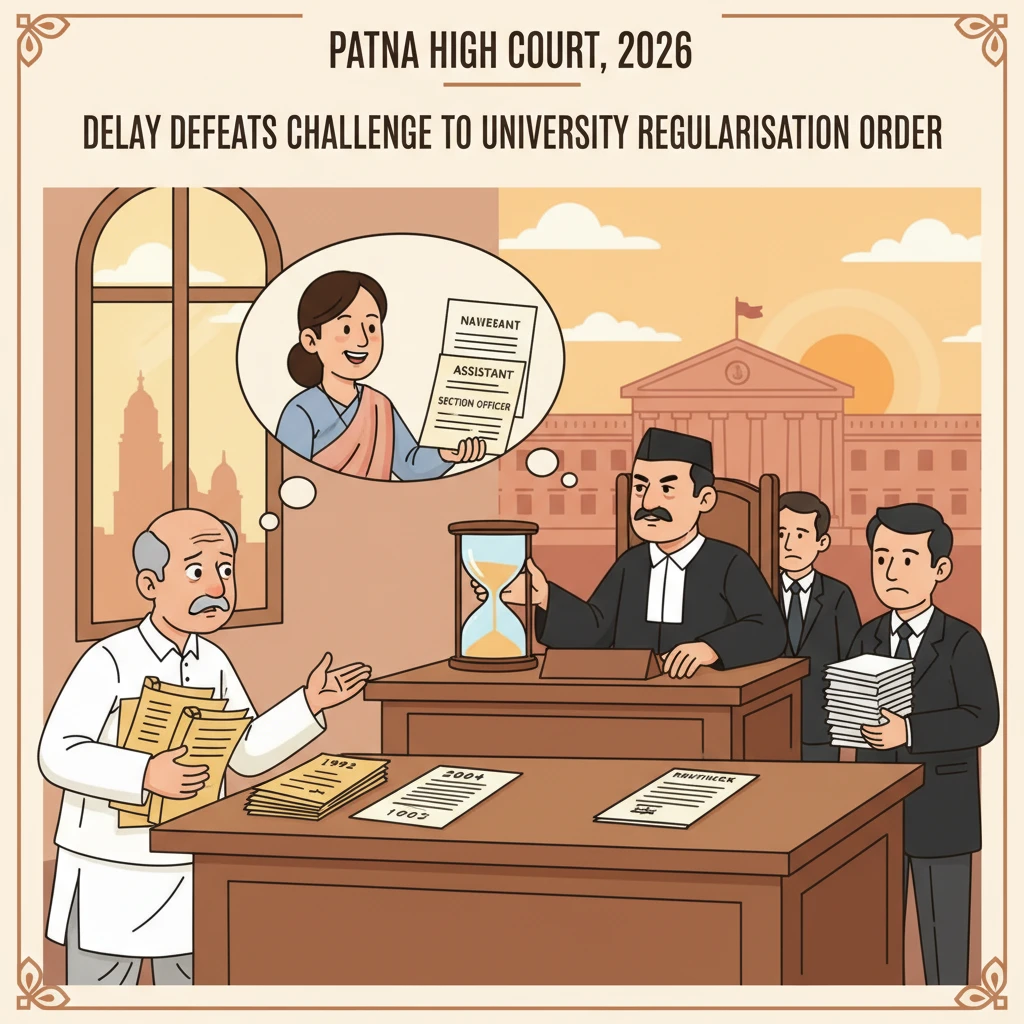
To show alleged discrimination, the petitioner cited the case of one Naveena Kumari. He contended that:
- she was initially regularised as Typist,
- the university later changed her cadre to Assistant, and
- by notification dated 24.07.2024, she was further promoted to the post of Section Officer by order of the Vice-Chancellor.
By contrast, he argued, he had retired on 28.02.2023 without receiving any promotion, whereas other Routine Clerks had been absorbed as Assistants and then promoted to Section Officer. He said he had kept filing representations seeking modification of his regularisation order but received no relief.
On the other hand, the respondents, including the State and the university, opposed the writ petition.
For the respondents it was submitted that the notifications clearly showed the petitioner was regularised against a vacant post of Routine Clerk. This position was finalised in 2004 and further confirmed in 2009. They argued that such an order could not be modified after almost two decades.
Regarding Naveena Kumari, the university’s stand was that she had been absorbed as Typist and later promoted to Assistant strictly according to the reservation roster, as she belonged to the Scheduled Caste category. The benefit was given only after proper verification. She had not been formally promoted to Section Officer; instead, she was merely given charge of the higher post on the basis of a State Government direction in the notification dated 24.07.2024.
They further pointed out that:
- the petitioner retired on 28.02.2023, and
- the temporary promotion process in which others were considered took place in 2024, and all promotions were on a temporary basis.
After hearing both sides and examining the materials on record, the Court focused its attention on the delay with which the petitioner approached the High Court.
The Court explained the doctrine of “delay and laches” in detail. It noted that “laches” is derived from French and means “remissness and slackness”. Referring to the Supreme Court judgment in Union of India and Others v. N. Murugesan and Others, (2022) 2 SCC 25, the Court quoted the principle that laches involves:
- unreasonable delay or negligence in pursuing a claim for equitable relief, which causes prejudice to the other side, and
- neglect to do what the law requires while asserting a right, which can stop a party from obtaining relief.
The Court highlighted the two essential factors mentioned by the Supreme Court in that case:
- the length of the delay, and
- the nature of the acts done during the interval, including any change in position and acquiescence by the claimant.
The High Court reproduced the Supreme Court’s reasoning that a court of equity should not grant remedy to a person whose own long inaction and conduct indicate that he has waived his right, especially where the other side has acted on the basis of the existing position.
The Court then referred to another Supreme Court judgment, Chairman, State Bank of India and Another v. M.J. James, (2022) 2 SCC 301. In that decision, the Supreme Court clarified that “reasonable time” cannot be fixed by a rigid formula; it depends on the facts of each case. A right that is not exercised for a long time becomes, in effect, non-existent. The doctrines of delay, laches and acquiescence are used to non-suit litigants who move the court after unreasonable delay without acceptable explanation.
The Patna High Court also cited Surjeet Singh Sahni v. State of U.P. and Others, (2022) 15 SCC 536, where the Supreme Court held that merely filing representations does not extend the period of limitation. If a petitioner is guilty of delay and laches, the High Court should dismiss the writ at the very threshold rather than entertain it by directing authorities to consider representations.
Applying these principles to the case before it, the Court noted that the petitioner was challenging two notifications: one dated 06.06.2004 and another dated 26.12.2009. His grievance was essentially that he should have been regularised as Assistant from 01.01.1992 instead of as Routine Clerk.
However, the Court observed that the petitioner had come to the High Court only after an “inordinate delay” of about 18 years from the first notification. Although he claimed to have been filing representations, this could not cure the delay.
The Court recorded that the petitioner had already retired on 28.02.2023. He then “woke up from deep slumber” to file a writ petition almost two decades after the notifications. The Court described the claim as arising from a “dead cause of action” and called it a “stale claim”.
The Court stressed that the writ court must remain conscious that when an aggrieved person, without adequate reason, knocks at the court’s door at his leisure, the court has a duty to examine whether such a belated lis should be entertained at all.
After reviewing the law and the specific timeline of events, the Court concluded that this case was a “textbook case of delay and laches”. Because of the extreme delay, the Court did not go into the deeper merits of whether the petitioner should have been treated as Assistant or Routine Clerk.
Ultimately, the Court found no merit in the writ petition and held that it was clearly barred by delay and laches. The petition was dismissed with no order as to costs. Any pending interlocutory applications also stood dismissed.
Why This Judgment Matters
This judgment is important for university staff, government employees and contractual workers who feel that their regularisation, designation or promotions were wrongly handled many years ago.
The Patna High Court has made it clear that if an employee waits for a very long time to challenge an appointment or regularisation order, the Court will likely refuse to interfere. Simply writing repeated representations to the employer is not enough to keep a claim alive.
Even if someone believes that they were entitled to a higher post or better pay from an earlier date, they must act within a reasonable time. Once many years have passed, and the employee has even retired, the Court may treat the dispute as a “stale” matter and decline relief, regardless of the underlying grievance.
For institutions like universities, this decision gives certainty that settled service positions and promotions will not be reopened decades later, unless challenged promptly and with proper justification.
Legal Issues and Answers
- Issue: Can a retired university employee seek modification of long-standing regularisation notifications, issued in 2004 and 2009, to change his post from Routine Clerk to Assistant with retrospective effect from 01.01.1992?
Answer: No. The Patna High Court held that the writ petition filed after nearly two decades was a textbook case of delay and laches and therefore barred. - Issue: Do repeated representations to the university extend or save the time for approaching the High Court against service-related orders?
Answer: No. Relying on Supreme Court precedent, the Court held that mere filing of representations does not extend limitation and cannot cure inordinate delay.
Cases Cited by the Court
- Union of India and Others v. N. Murugesan and Others, (2022) 2 SCC 25
- Chairman, State Bank of India and Another v. M.J. James, (2022) 2 SCC 301
- Surjeet Singh Sahni v. State of U.P. and Others, (2022) 15 SCC 536
Case Details
Case Number: Civil Writ Jurisdiction Case No. 2999 of 2022
Case Title: Ram Sewak Thakur v. Chancellor of the Universities of Bihar and Others
Coram: Hon’ble Mr. Justice Anil Kumar Sinha
Citation: 2026(3) PLJR 135
Advocates:
For the petitioner: Mr. Gyanand Roy, Advocate
For the State respondents: Mr. Madan Jeet Kumar, G.P. 20
For Lalit Narayan Mithila University: Mrs. Binita Singh, Advocate
Nature of the case: Writ petition under civil writ jurisdiction challenging university notifications regarding regularisation and seeking change of post and pay scale.
Link to the judgment: Click here to read the full judgment of the Patna High Court
If you found this explanation helpful and wish to stay informed about
how legal developments may affect your rights in Bihar,
you may consider following Samvida Law Associates for more updates.







