

Case Background
The case arose from Narpatganj P.S. Case No. 348 of 2013, District Araria. The FIR was lodged on 09.12.2013 on the oral statement of the informant, recorded at about 2:00 pm at his house by the Station House Officer of Narpatganj Police Station.
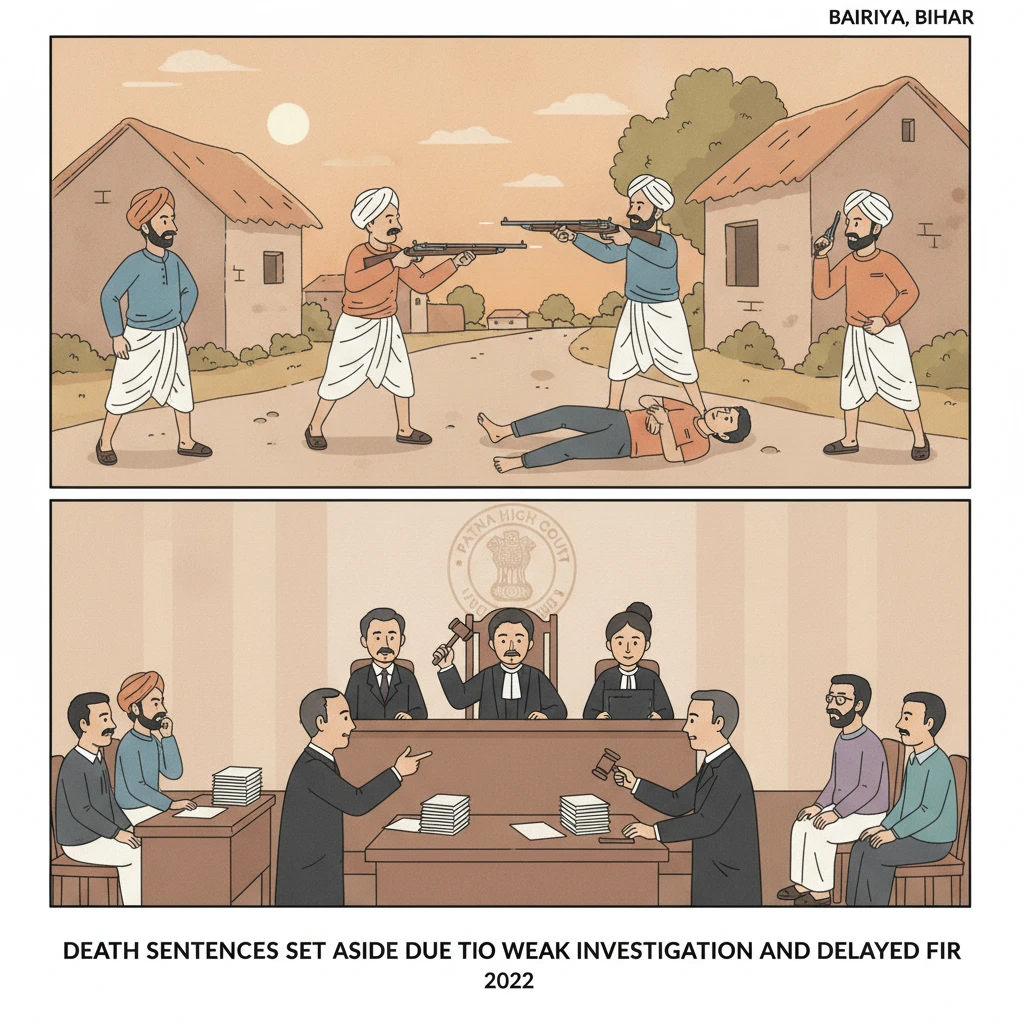
According to the prosecution, on 08.12.2013 at about 4:30 pm, there was a quarrel in village Bairiya. One side of the family alleged that the opposite side came armed with guns and pistols and fired indiscriminately on the village road near their house. The informant’s younger brother, Waheed, was said to have received a gunshot injury in his stomach and later died during treatment.
On the basis of the oral statement, Narpatganj P.S. Case No. 348 of 2013 was registered at 4:00 pm on 09.12.2013 under Sections 147, 148, 149, 302, 504 and 506 of the Indian Penal Code and Section 27 of the Arms Act.
The Investigating Officer submitted charge-sheet on 18.01.2014 under Sections 147, 148, 149, 302 and 506 IPC and Section 27 Arms Act against ten accused, keeping investigation open against the remaining FIR-named persons. The Magistrate took cognizance on 01.02.2014 and committed the case to the Sessions Court on 13.03.2014.
The 2nd Additional Sessions Judge, Araria framed charges on 03.05.2015 under Sections 147, 148, 302/149, 506/149 IPC and Section 27 Arms Act. Eight prosecution witnesses and two defence witnesses were examined. On 06.11.2019, the Trial Court convicted all appellants and on 16.11.2019 sentenced three of them to death under Section 302/149 IPC and others to life imprisonment.
Because a death sentence must be confirmed by the High Court, a death reference was registered as Death Reference No. 2 of 2021. The convicted persons filed three criminal appeals. All matters were heard together and decided by a common judgment dated 07.04.2022 by a Division Bench of the Patna High Court.
What the Court Examined and Decided
The Patna High Court closely scrutinised whether the prosecution had proved, beyond reasonable doubt, that the appellants formed an unlawful assembly, fired indiscriminately, and that one accused, Md. Moshim, caused the firearm injuries which led to Waheed’s death.
First, the Court accepted the medical finding that Waheed died a homicidal death due to firearm injuries. The autopsy doctor (P.W.5) found two separate antemortem firearm wounds: one circular wound over the right hypochondriac region with charring, and one lacerated wound over the mid-stomach. Death was due to haemorrhage and shock.
The key question was: who caused these injuries, and was the prosecution story reliable?
The prosecution mainly relied on four related eye-witnesses (P.W.1 to P.W.4). They stated that there was an altercation involving Irshad, that several accused arrived armed with guns and pistols, that Irshad exhorted them to fire, and that one co-accused, Md. Moshim, fired at Waheed’s abdomen. The witnesses also alleged earlier enmity between the families, including a prior murder case.
The defence argued that the case was false and motivated by longstanding enmity and sectarian disputes, and that actually the informant’s side fired, accidentally hitting Waheed. They highlighted several serious weaknesses in the prosecution case:
- no independent villagers were examined despite the incident allegedly happening on a village road surrounded by houses;
- the informant’s father, Jameel, who was allegedly present from the very beginning of the quarrel, was not examined at all;
- major and unexplained delay in lodging the FIR, even though the police and hospital had early information;
- no medical documents from Forbesganj, Purnea or Siliguri, though the prosecution claimed Waheed was treated there;
- no seizure of bloodstained soil or empty cartridges from the scene, despite allegations of indiscriminate firing by many armed men;
- post-mortem showing two firearm injuries from different weapons, while eyewitnesses spoke only of a single shot to the abdomen.
The State tried to justify the delay by saying the family’s priority was to save Waheed’s life, not to lodge an FIR. The State also argued that non-seizure of cartridges or blood was a defect in investigation which should not by itself lead to acquittal if eye-witnesses are trustworthy.
The Court began by clarifying the law on related witnesses. Citing Supreme Court decisions like Bhaskar Rao v. State of Maharashtra, the Bench held that being a relative does not automatically make a witness ‘interested’ or unreliable. A related witness can be a natural witness. But where there is admitted enmity between parties, courts must scrutinise such evidence closely to ensure that innocent persons are not roped in.
On non-examination of independent witnesses, the Court referred to precedents such as Sarwan Singh v. State of Punjab and Gulam Sarbar v. State of Bihar. The Court reiterated that law does not require the prosecution to examine every possible witness. Quality of evidence, not quantity, matters. However, where a truly material witness is withheld, the court may draw an adverse inference.
Applying these principles, the Court held that non-examination of independent village witnesses was not, by itself, fatal. But two particular omissions were extremely serious:
First, the failure to examine the Station House Officer, Krishna Kumar Jha, who had:
- received the first telephonic information about Waheed’s death from P.W.1 at Siliguri,
- called the family to Araria Police Station,
- interacted with them at around 7:30 am on 09.12.2013,
- sent the body for post-mortem, and
- recorded the informant’s oral statement and registered the FIR later at 4:00 pm.
The Court held that he was a material witness who could have explained why the FIR was not registered earlier, despite clear information of a cognizable offence. His non-examination, without explanation, seriously prejudiced the defence.
Second, the failure to examine Jameel, father of the deceased and the informant, who allegedly argued with Irshad at the start of the incident and was present throughout. He was “the most competent witness” according to the Court. Yet he was not even made a charge-sheet witness. The Court found this omission suspicious and damaging to the prosecution’s version.
The Court then turned to the delay and sequence of events between the incident and FIR. From the evidence of P.W.1, P.W.5 and P.W.8, the following picture emerged:
- Incident took place around 4:30 pm on 08.12.2013.
- Waheed was allegedly taken first to Forbesganj Referral Hospital, then to Purnea Sadar Hospital, and then towards Siliguri, where he died on the way.
- P.W.1 admitted that Waheed was given saline and medicines at Forbesganj and further treatment with blood transfusion and bandage change at Purnea.
- Despite this, there were no treatment papers produced, and no doctor from these hospitals was examined.
- After Waheed’s death, P.W.1 telephoned the Araria police. He brought the body to Araria Sadar Hospital by about 5-5:30 am on 09.12.2013.
- P.W.8, a Sub-Inspector at Araria Sadar Hospital, prepared the inquest report at 8:30 am on 09.12.2013, in presence of the informant and another witness. The post-mortem was done between 9:30 am and 10:30 am.
- Even at the inquest stage, the names of assailants were not disclosed, and no FIR was yet registered. Only later, at 2:00 pm, the SHO of Narpatganj went to the informant’s village and recorded his statement, leading to formal registration of FIR at 4:00 pm on 09.12.2013.
The Court noted that in medico-legal cases, doctors are legally bound under Section 39 CrPC to promptly inform the police. Medico-legal forms and related documents are expected to exist. Here, there was no trace of such records from Forbesganj or Purnea. This made the story of continuous treatment and referrals difficult to accept.
Relying on Supreme Court rulings in Dilawar Singh v. State of Delhi, P. Rajagopal v. State of Tamil Nadu and State of Punjab v. Ramdev Singh, the Bench held that unexplained and inordinate delay in lodging an FIR permits a strong inference of possible fabrication or embellishment. In this case, a substantial part of “investigation” — inquest, post-mortem, burial of the body — had happened before the FIR even came into existence. No satisfactory reason was offered.
The Court also evaluated the mismatch between ocular and medical evidence. All four eye-witnesses uniformly suggested that Waheed suffered one gunshot injury in the stomach. None mentioned any other firearm injury. Yet the post-mortem clearly showed two separate firearm injuries caused by different weapons and no exit wound. This, coupled with the prosecution’s story of indiscriminate firing by about seventeen armed men without any other injury or mark on surrounding structures, raised serious doubts.
The Investigating Officer (P.W.6) admitted that:
- no firearm used in the offence was recovered,
- no bullet marks were found on the walls of the informant’s house,
- no blood or bloodstained soil was seized from the supposed place of occurrence, and
- there were disputes between the parties over village pathway.
In many cases, such investigation lapses might be treated as mere defects and ignored if the substantive evidence is strong. However, here, the Court found that investigation was “suspicious” from the very beginning, given the delayed FIR and non-production of crucial medical and police witnesses.
Considering all these circumstances together — prior enmity, serious delay, suppression of initial version given to police, failure to examine key witnesses, inconsistent medical and ocular evidence, non-seizure of basic material from the scene — the Bench held it would be “highly unsafe” to rely on the prosecution evidence to uphold convictions for murder with common object.
The Court concluded that the Trial Court had “completely erred” in appreciation of evidence. The findings of guilt could not be sustained. Accordingly, all three criminal appeals were allowed, and the judgment of conviction dated 06.11.2019 and order of sentence dated 16.11.2019 were set aside.
All appellants were acquitted of the charges and directed to be released forthwith, unless required in any other case. As a natural result, the death reference (Death Reference No. 2 of 2021) for confirmation of the death sentences was rejected.
Why This Judgment Matters
This Patna High Court decision is important for both ordinary citizens and practitioners because it shows how carefully courts must examine criminal cases that rest mainly on related witnesses and delayed FIRs, especially in villages with strong local enmities.
Many families in Bihar face long-standing disputes over land, pathways or social and religious issues. In such situations, when a serious crime occurs, there is a real risk that more people may be falsely implicated. The judgment underlines that:
- Delay in reporting a murder case, without a clear and truthful explanation, weakens the prosecution story;
- Police must register FIRs promptly once they get information of a cognizable offence and should not wait until after inquest and post-mortem; and
- Courts will not uphold a conviction — even in a grave case involving death sentences — if basic evidence like treatment records, key police officers and prime eye-witnesses are missing.
For victims and accused alike, the case reinforces that criminal trials must be based on reliable, timely and transparent investigation. Where the investigation is doubtful and evidence does not firmly point to guilt, benefit of doubt will go to the accused, no matter how serious the charge.
Legal Issues and Answers
Issue: Did the prosecution prove beyond reasonable doubt that the appellants formed an unlawful assembly, fired at Waheed, and thereby committed murder under Sections 302/149 IPC and related offences?
Answer: No. The Court held that due to unexplained delay in FIR, non-examination of key witnesses (the SHO and Jameel), lack of medico-legal records, inconsistencies between medical and ocular evidence, and suspicious investigation, the prosecution failed to prove its case beyond reasonable doubt. All appellants were acquitted.
Issue: Whether the case justified confirmation of the death sentence as a “rarest of rare” matter?
Answer: No. Since the convictions themselves were set aside, the question of confirming death sentences did not arise. The death reference was rejected and the death sentences stood annulled.
Cases Cited by the Court
- Bhaskar Rao and Others v. State of Maharashtra, (2018) 6 SCC 591 (on appreciation of evidence of related witnesses).
- Dalip Singh v. State of Punjab, 1954 SCR 145: AIR 1953 SC 364.
- Masalti v. State of U.P., AIR 1965 SC 202.
- Darya Singh v. State of Punjab, AIR 1965 SC 328.
- Harbans Kaur v. State of Haryana, (2005) 9 SCC 195.
- Namdeo v. State of Maharashtra, (2007) 14 SCC 150.
- Sarwan Singh and Others v. State of Punjab, (1976) 4 SCC 369.
- Gulam Sarbar v. State of Bihar, (2014) 3 SCC 401.
- Dilawar Singh v. State of Delhi, (2007) 12 SCC 641.
- Thulia Kali v. State of T.N., (1972) 3 SCC 393.
- Ram Jag v. State of U.P., (1974) 4 SCC 201.
- P. Rajagopal v. State of Tamil Nadu, (2019) 5 SCC 403.
- Apren Joseph v. State of Kerala, (1973) 3 SCC 114.
- Mukesh v. State (NCT of Delhi), (2017) 6 SCC 1.
- State of Punjab v. Ramdev Singh, (2004) 1 SCC 421.
- Bachchan Singh v. State of Punjab, (1980) 2 SCC 284 (cited on sentencing by amicus).
- Machhi Singh v. State of Punjab, (1982) 3 SCC 470 (cited on sentencing by amicus).
- Panchhi and Others v. State of U.P., (1998) 7 SCC 177 (cited on sentencing by amicus).
Case Details
Case Numbers:
- Death Reference No. 2 of 2021 (arising out of Narpatganj P.S. Case No. 348 of 2013, District Araria).
- Criminal Appeal (DB) No. 1500 of 2019.
- Criminal Appeal (DB) No. 1504 of 2019.
- Criminal Appeal (DB) No. 1517 of 2019.
Case Title:
- Death Reference No. 2 of 2021: The State of Bihar v. Md. Irshad & Ors.
- Criminal Appeal (DB) No. 1500 of 2019: Md. Kari & Ors. v. The State of Bihar.
- Criminal Appeal (DB) No. 1504 of 2019: Md. Tajuddin & Anr. v. The State of Bihar.
- Criminal Appeal (DB) No. 1517 of 2019: Md. Irshad & Ors. v. The State of Bihar.
Coram:
- Hon’ble Mr. Justice Ashwani Kumar Singh.
- Hon’ble Mr. Justice Rajeev Ranjan Prasad.
Date of Judgment: 07.04.2022.
Citation: 2022 (2) PLJR 314.
Advocates:
- In Death Reference No. 2 of 2021:
- For the Petitioner (State): Not specified in the judgment text.
- For the Respondents: Mr. Santosh Kumar, Amicus Curiae.
- In Criminal Appeal (DB) No. 1500 of 2019:
- For the Appellants: Mr. Rajesh Kumar Singh, Senior Advocate; Mr. Manish Kumar Singh, Advocate; Mr. Dharmendra Kumar Singh, Advocate.
- For the Respondent-State: Mr. Dilip Kumar Sinha, APP.
- For the Informant: Mr. Sushil Kumar Singh, Advocate.
- In Criminal Appeal (DB) No. 1504 of 2019:
- For the Appellants: Mr. Rajesh Kumar Singh, Senior Advocate; Mr. Manish Kumar Singh, Advocate; Mr. Dharmendra Kumar Singh, Advocate.
- For the Respondent-State: Mr. Abhimanyu Sharma, APP.
- For the Informant: Mr. Sushil Kumar Singh, Advocate.
- In Criminal Appeal (DB) No. 1517 of 2019:
- For the Appellants: Mr. Rajesh Kumar Singh, Senior Advocate; Mr. Manish Kumar Singh, Advocate; Mr. Dharmendra Kumar Singh, Advocate.
- For the Respondent-State: Dr. Mayanand Jha, APP.
- For the Informant: Mr. Sushil Kumar Singh, Advocate.
Nature of the Case: Death reference under Section 366 CrPC and criminal appeals (Division Bench) against conviction and sentence in a Sessions Trial for offences under Sections 147, 148, 302/149, 506/149 IPC and Section 27 Arms Act, arising from a village firing incident.
Link to Judgment: https://patnahighcourt.gov.in/viewjudgment/MjgjMiMyMDIxIzEjTg==-u9HjfernBFo=
If you found this explanation helpful and wish to stay informed about
how legal developments may affect your rights in Bihar,
you may consider following Samvida Law Associates for more updates.







