

Case Background
The case arises out of serial bomb blasts at Patna Junction railway station and Gandhi Maidan, Patna, on 27.10.2013. A political “Hunkar Rally” of the Bharatiya Janata Party was scheduled at Gandhi Maidan, where the then Gujarat Chief Minister Shri Narendra Modi was to address a large gathering.
At about 9.30 A.M., a bomb exploded inside the Sulabh Sauchalaya adjoining Platform No. 10 of Patna Junction. Around two hours later, at 11.40 A.M., a second blast occurred at Gandhi Maidan near Udyog Bhawan, followed by five more explosions within minutes near Mona Cinema and inside the rally area. Six people died and 89 sustained splinter injuries.
Separate FIRs were registered: Patna G.R.P. Case No. 361 of 2013 for the station blast, Gandhi Maidan P.S. Case No. 451 of 2013 for the rally blasts, and later Hindpidhi (Kotwali) P.S. Case No. 985 of 2013 at Ranchi after recovery of bombs from a lodge. All three were later transferred to the National Investigation Agency (NIA), which filed charge-sheets in Special Case No. 05 of 2013.
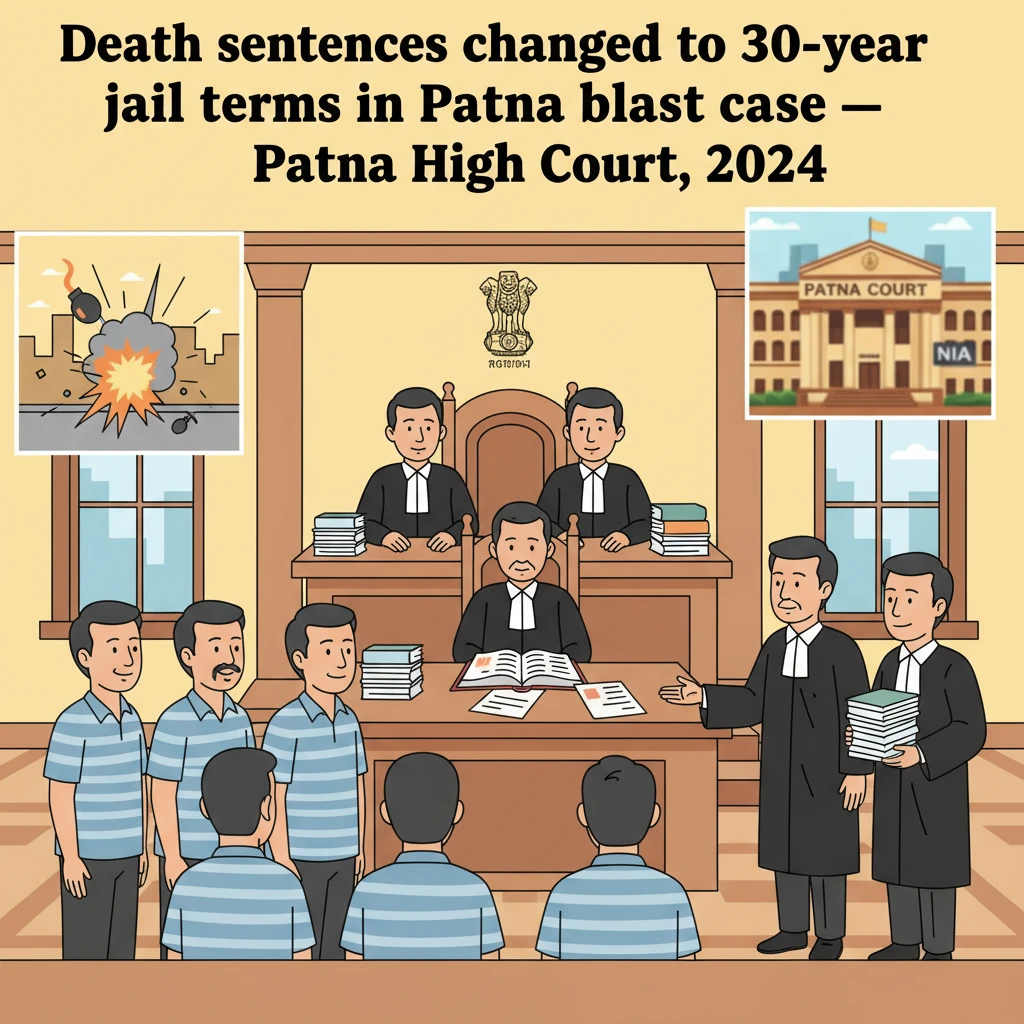
The NIA Special Court, Patna convicted nine of ten accused, acquitting one Fakhruddin Ansari. Four accused (A1–A4) were sentenced to death and two (A5–A6) to life imprisonment. The trial court also made a reference (Death Reference No. 10 of 2021) to the Patna High Court for confirmation of the death sentences. Six convicts filed separate criminal appeals, which were heard together with the death reference.
What the Court Examined and Decided
The Patna High Court (Division Bench of Hon’ble Mr. Justice Ashutosh Kumar and Hon’ble Mr. Justice Jitendra Kumar) undertook a detailed review of the entire evidence, the legal provisions on conspiracy and confessions, and the principles governing death penalty.
The chain of events started at Patna Junction. Inspector Rampukar Singh (PW1), posted at G.R.P. Patna, heard the blast at Sulabh Sauchalaya on Platform No. 10. On reaching there, he saw damage, smoke and one injured man lying on the toilet floor. Constable Md. Ejaj (PW4) had detained another man with a black bag, who tried to run away.
According to PW1, the detained man disclosed his name as Imteyaz Alam @ Ansari (A1) and the injured as Tarique. Two live bombs fixed to watches were found beneath Tarique and another bomb hidden in the toilet flush was recovered on A1’s disclosure. Tarique was sent to the Railway Hospital and later IGIMS, where he died on 01.11.2013. A1 allegedly told PW1 that he and Tarique had come from Sithio village near Ranchi to plant bombs at Gandhi Maidan and that his other associates had already gone there to disrupt the rally. PW1 recorded his self-statement at 11.25 A.M., leading to registration of G.R.P. Case No. 361 of 2013.
Almost simultaneously, Inspector-cum-SHO Raj Bindu Prasad (PW2) at Gandhi Maidan P.S. described the multiple blasts at 11.40 A.M. and thereafter, the panic, the injuries, and six deaths. He registered Gandhi Maidan P.S. Case No. 451 of 2013 at 9.00 P.M. that night, naming several accused including Haider Ali, Imteyaz Alam and Numan Ansari.
At Ranchi, Inspector Bashishth Narain Singh (PW39) received information the same day that an accused from village Sithio (Imteyaz) had been arrested at Patna. He searched A1’s house and recovered glass balls, gunpowder attached to a fuse, a small cooker, CDs, mobile phone, posters in Urdu and other materials. This led to further raids at Eram Lodge, Hindpidhi, where PW39 and other officers broke open locked Room No. 8, used by Haider Ali (A2) and Mujibullah Ansari (A4). Inside, they found cartons containing nine live elbow bombs fitted with Lotus brand watches, gelatin rods, detonators, iron nails, wires, and a political map of India with a sketch of Gandhi Maidan on the reverse. Newspapers reporting Bodh Gaya serial blasts were also recovered. Hindpidhi P.S. Case No. 985 of 2013 was registered on 04.11.2013.
Forensic evidence played a major role. Experts from CFSL, Kolkata reported that the explosives recovered from Sithio village, Eram Lodge and the spent remnants from Patna Junction and Gandhi Maidan all contained similar materials—ammonium nitrate, improvised gunpowder and metallic aluminium. Lotus quartz watches were repeatedly linked to the timers in the bombs. DNA profiling (Exhibit 40/14) from Room No. 8 at Eram Lodge confirmed A2 Haider and A4 Mujibullah as the occupants.
Medical evidence from doctors at PMCH and IGIMS (PW26, PW34) confirmed that the six deceased and the numerous injured had suffered typical bomb and splinter injuries. Tarique’s post-mortem showed close-range blast injuries consistent with his carrying the explosive himself.
Injured witnesses (PWs 11–24 and others) described how they were hit by splinters while walking in the area or attending the rally. Independent civilian witnesses (PWs 23, 25, 60, 63, 64 and others) corroborated key links: the accidental blast timing, stay of accused in lodges, movement of Numan Ansari (A3) with a black bag, and later recovery of that bag, which also tested positive for components like potassium nitrate and aluminium, matching the other explosives.
Protected witness PW45, a watch shop owner in Ranchi, identified A4 Mujibullah as having purchased 12–15 Lotus watches in July 2013, which matched the timers used in the IEDs. PW46, another protected witness, spoke of Haider Ali’s inflammatory speeches advocating violent “Jihad” and his efforts to recruit and motivate others, including meeting A1, A3 and others at his instance.
Regarding the wider conspiracy, evidence showed that the accused were linked with the banned organisation SIMI. Umer Siddiqui (A5) from Raipur was found to be a long-time SIMI member, who organised meetings and training camps. Azharuddin Qureshi (A6), also from Raipur, was closely associated with him and Haider Ali. Witnesses described meetings where A5, A6 and Haider showed videos and delivered talks praising violent jihad, including references to the 9/11 attacks and Al-Qaida’s “Inspire” magazine. A laptop seized from the room of Dr. Ejaz Hashmi at Idris Medical Hostel, Ranchi, on Haider’s disclosure, contained RTF files about Mr. Modi’s rallies and a copy of “Inspire” detailing how to make “elbow bombs”.
The NIA built a detailed picture of the conspiracy: A2 Haider, A1 Imteyaz, A3 Numan, A4 Mujibullah, the deceased Tarique, and juvenile Taufique allegedly agreed to target election rallies of Shri Narendra Modi. They conducted reconnaissance at various rallies, found security tight around the main stage, and decided instead to target crowded rally sites to cause mass casualties and panic. Patna’s Gandhi Maidan rally was chosen as a suitable target. Evidence showed that on 26.10.2013, six of them travelled from Ranchi to Patna by bus, got down at Patna Bypass and then split into two groups—A1 and Tarique towards Patna Junction; A2, A3, A4 and Taufique towards Gandhi Maidan. A2 and Taufique planted IEDs in toilets and near the dais at Gandhi Maidan; A3 and A4 activated the devices in the toilet complex; Tarique mishandled a device at the Sulabh Sauchalaya at Platform No. 10, leading to the accidental blast where he was injured and later died.
The Court also considered the confessional statements of A5 Umer and A6 Azharuddin recorded under Section 164 Cr.P.C. in the Bodh Gaya blast case (R.C. No. 7 of 2013). The High Court held, following Supreme Court precedent, that such legally recorded confessions could be used in this Patna blast case as well, especially since they described the same larger conspiracy and named the same co‑accused. In those statements, A5 admitted to being an active SIMI member and to the group’s making 30 IEDs at A1’s house, of which 18 were kept aside for Patna. A6 admitted he was trained by Haider to make bombs using ammonium nitrate, gunpowder, detonators, elbow pipes and Lotus watches, and that he helped shelter co‑accused at Raipur after the blasts.
The defence argued that the entire case rested impermissibly on confessions; that recoveries based on one accused’s disclosure could not be used against others; that evidence under Section 10 of the Evidence Act (conspiracy) was misapplied; and that DNA and CCTV evidence were unreliable. The High Court undertook a long survey of the law on confessions, conspiracies, Section 10 and Section 27 of the Evidence Act, and held that:
- Confessions to police are barred, but portions leading to discovery of new facts are admissible under Section 27.
- Confessions recorded under Section 164 Cr.P.C. by a Magistrate, after following proper safeguards, are admissible, though they must be corroborated.
- Acts and statements of conspirators during the life of the conspiracy are admissible against co‑conspirators under Section 10, but statements after arrest are not, as the conspiracy has then ended.
- In this case, there was extensive independent evidence—recovery of bombs, forensic reports, witness accounts, travel records, DNA reports—so the conviction did not rest solely on confessions.
The Court also considered Sections 15 and 43E of the Unlawful Activities (Prevention) Act, 1967, which define “terrorist act” and create a presumption when explosives are recovered from an accused and scientific evidence links them to the crime scene. Given the CFSL and CDFD reports, the Court held the presumption under Section 43E clearly applied.
On the charge of “waging war” against the Government under Sections 121 and 121A IPC, the Court referred to the Supreme Court’s decision in Navjot Sandhu (@ Afsan Guru) and held that “war” in this context is not limited to formal military hostilities. Selecting a packed election rally to carry out serial blasts, with the admitted political motive of punishing perceived wrongs by the State and targeting a prime ministerial candidate, was viewed as an act aimed at overawing and challenging the sovereign authority of the nation. Even though the object did not include overthrowing the government, it fell within the scope of “waging war” for these provisions.
After analysing the entire material, the High Court affirmed that A1 to A6 were rightly held guilty by the NIA Special Court for offences under Section 302 IPC, Sections 16, 18 and 20 UAPA, and Sections 3, 4 and 5 of the Explosive Substances Act, 1908. It also upheld A2’s conviction under Section 307 IPC, A1’s conviction under Section 151 of the Railways Act, and the convictions of all six under Sections 121 and 121A IPC.
The only major interference was with punishment. The Trial Court had sentenced A1 to A4 (Imteyaz, Haider, Numan and Mujibullah) to death, and A5 and A6 (Umer and Azharuddin) to life imprisonment. The High Court considered Supreme Court jurisprudence starting from Bachan Singh and Machhi Singh through to Manoj v. State of Madhya Pradesh on the “rarest of rare” doctrine and the need for individualised sentencing with concrete evidence on possibility of reform.
The Trial Court had assumed that because A1 to A4 were involved in both Bodh Gaya and Patna blasts and showed no remorse, they were “beyond reformation”. The High Court disagreed. It noted that all four were relatively young, with no established trans-border links; there was no record of misconduct in jail; there was no evidence of them obstructing investigation or inciting retaliatory violence. No psychiatric, psychological or jail-behaviour reports were produced to show they could not be reformed, as now required by the Supreme Court.
Invoking the “third option” recognised in Swamy Shraddananda and Union of India v. Sriharan, the High Court concluded that while the crimes were extremely grave terrorist acts, the proper sentence for A1 to A4 was not death but a fixed term of 30 years’ imprisonment without remission for the counts where death had been awarded. It maintained all other sentences under other sections. For A5 Umer and A6 Azharuddin, the life sentences imposed by the Special Court were found “condign” and left untouched.
Accordingly, all six criminal appeals were dismissed on conviction, but partly allowed on sentence for A1–A4. Death Reference No. 10 of 2021 was answered by commuting the death sentences of these four to imprisonment for a fixed term of 30 years. Directions were issued to transmit the judgment to the concerned jail authorities for compliance and to return the records to the trial court.
Why This Judgment Matters
This Patna High Court judgment is important for two main reasons.
First, it confirms that those who plan and execute terror attacks at crowded public places—such as political rallies and railway stations—will face the strictest punishment under IPC, the Explosive Substances Act and UAPA. The Court carefully relied on forensic science, witness testimony and electronic evidence to uphold convictions in a highly sensitive terror case.
Second, the judgment shows that even in terrorism cases, death penalty will not be imposed mechanically. The Court insisted that before branding someone “beyond reform”, concrete material like psychiatric and jail-behaviour reports must be placed on record. As this was not done, the Court commuted the four death sentences into long, fixed prison terms of 30 years, applying evolving Supreme Court standards on sentencing.
For families of victims and for the general public, the case underlines that the justice system can both punish harshly and still insist on fairness and careful reasoning before taking a life through capital punishment.
Legal Issues and Answers
- Issue: Were the six appellants properly proved to be part of a criminal and terrorist conspiracy responsible for the Patna Junction and Gandhi Maidan blasts?
Answer: Yes. The Court held that the conspiracy was proved through a chain of circumstances—recoveries of explosives and Lotus-timed IEDs, forensic reports showing identical materials, travel and accommodation records, protected witness testimony, and corroborated Section 164 confessions of two accused. - Issue: Could the accused be convicted for “waging war” under Sections 121 and 121A IPC in the context of these terror attacks?
Answer: Yes. Targeting a large election rally with serial blasts, motivated by hostility to the Indian State and its leadership, was held to be an act meant to overawe the government and create a war-like situation, falling within Sections 121 and 121A IPC. - Issue: Should the death sentences imposed on four appellants be confirmed as “rarest of rare” cases?
Answer: No. While affirming guilt, the Court found insufficient material to hold the four men beyond reform. Applying Supreme Court guidelines on sentencing, it commuted their death sentences to fixed terms of 30 years’ imprisonment, retaining all other sentences.
Cases Cited by the Court
- Bachan Singh v. State of Punjab; (1980) 2 SCC 684
- Jagmohan Singh v. State of Uttar Pradesh; (1973) 1 SCC 20
- Machhi Singh v. State of Punjab; (1983) 3 SCC 470
- Santosh Kumar Satishbhushan Bariyar v. State of Maharashtra; (2009) 6 SCC 498
- Shankar Kissanrao Khade v. State of Maharashtra; (2013) 6 SCC 546
- Swamy Shraddananda v. State of Karnataka; (2008) 13 SCC 767
- Union of India v. Sriharan @ Murugan; (2016) 7 SCC 1
- Manoj & Ors. v. State of Madhya Pradesh; (2023) 2 SCC 353
- State (NCT of Delhi) v. Navjot Sandhu @ Afsan Guru; (2005) 11 SCC 600
- Haricharan Kurmi v. State of Bihar; (1964) 6 SCR 623
- Mohd. Khalid v. State of West Bengal; (2002) 7 SCC 334
- State of Gujarat v. Mohammed Atik; (1998) 4 SCC 351
- Pulukuri Kottaya v. King Emperor; AIR 1947 PC 67
- Bhuboni Sahu v. The King; AIR 1949 PC 257
- State v. Nalini (Rajiv Gandhi assassination case); (1999) 5 SCC 253
- V.C. Shukla v. State (Delhi Administration); (1980) 2 SCC 665
- Noor Mohammad Mohd. Yusuf Momin v. State of Maharashtra; (1970) 1 SCC 696
- Major E.G. Barsay v. State of Bombay; AIR 1961 SC 1762
- Yash Pal Mittal v. State of Punjab; (1977) 4 SCC 540
- Rajesh Kumar v. State; (2011) 13 SCC 706
- Mohmed Inayatullah v. State of Maharashtra; (1976) 1 SCC 828
- State of Maharashtra v. Damu s/o Gopinath Shinde; (2000) 6 SCC 269
- Sardul Singh Kaveeshar v. State of Bombay; AIR 1957 SC 747
Case Details
Case Number: Death Reference No. 10 of 2021 with Criminal Appeal (DB) No. 757 of 2021; Criminal Appeal (DB) No. 769 of 2021; Criminal Appeal (DB) No. 18 of 2022; Criminal Appeal (DB) No. 48 of 2022; Criminal Appeal (DB) No. 58 of 2022; Criminal Appeal (DB) No. 83 of 2022; arising out of R.C. Case No. 10/2013 and connected FIRs.
Case Title: The State of Bihar v. Imteyaz Alam @ Ansari & Ors (Death Reference), with separate connected criminal appeals including Azharuddin Qureshi v. Union of India (NIA); Numan Ansari v. Union of India (NIA); Imteyaz Alam @ Ansari v. Union of India; Md. Umer Siddiqui v. Union of India (NIA); Md. Mujibullah Ansari v. Union of India (NIA); Haider Ali v. Union of India (NIA).
Coram: Hon’ble Mr. Justice Ashutosh Kumar and Hon’ble Mr. Justice Jitendra Kumar.
Citation: 2024(4) PLJR 462.
Advocates:
- For the State in Death Reference: Names recorded as Mr. Xxxxx (for petitioner) and Mr. Xxxxx (for respondent) in the judgment.
- For appellants in various appeals: Mr. Ansul, Mr. Ajay Kumar Thakur, Mr. Anshuman Sinha, Mr. Prakhar Prakash, Mr. Wasif Rahman Khan, Mr. Santosh Kumar Yadav, Mr. Shahbaj Alam, and others as recorded.
- For the Union of India / NIA: Dr. Krishna Nandan Singh, ASG; Mr. Manoj Kumar Singh, Spl. PP (NIA); Mr. Pramod Kumar, PP (NIA); Mr. Shivaditya Dhari Sinha, AC to ASG; Ms. Prakritita Sharma; Mr. Sriram Krishna; Mr. Abhijeet Gautam; Mr. Ankit Kumar Singh; Mr. Prabhat Kumar Singh.
Nature of the Case: Death Reference arising from NIA Special Court judgment in a special case; connected criminal appeals against conviction and sentence for terrorism-related offences under IPC, Explosive Substances Act, UAPA and Railways Act.
Link to the Judgment: Official Patna High Court Judgment
If you found this explanation helpful and wish to stay informed about
how legal developments may affect your rights in Bihar,
you may consider following Samvida Law Associates for more updates.







