

Case Background
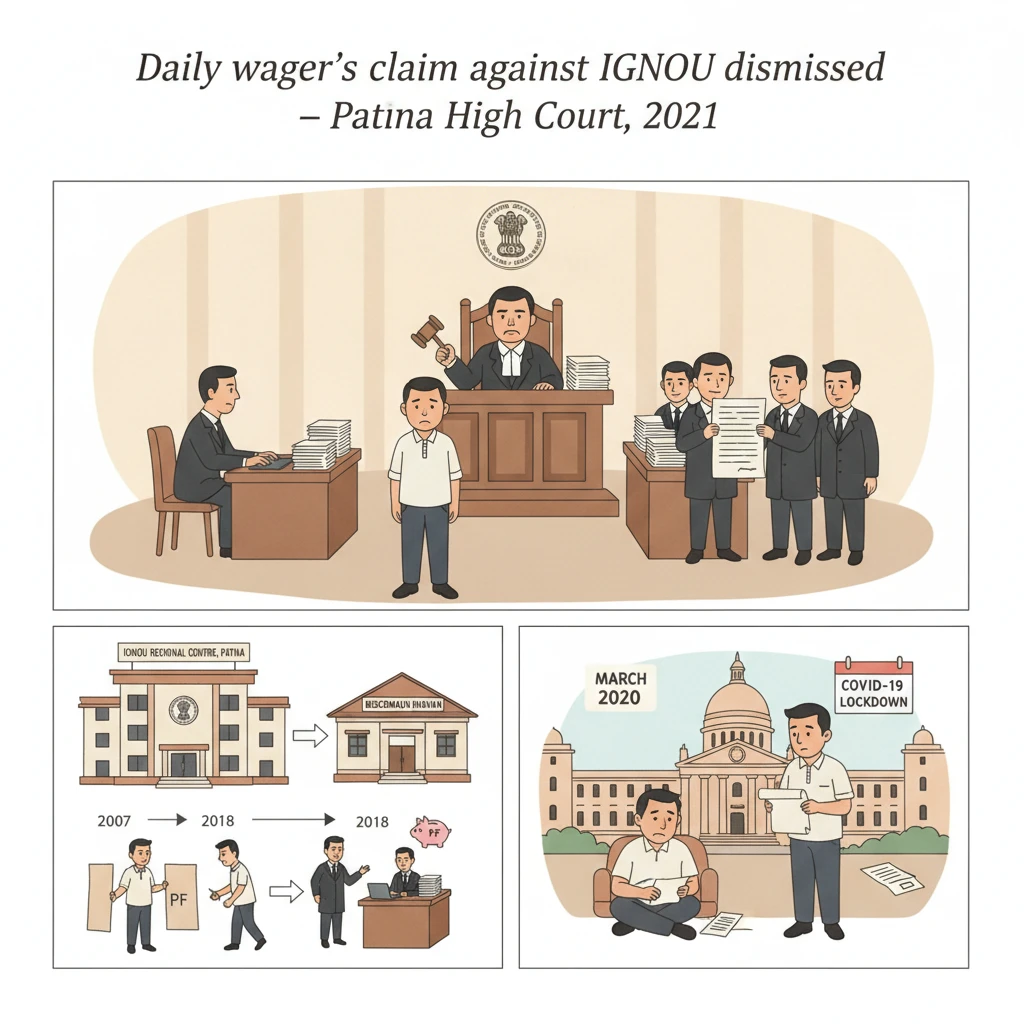
The petitioner filed a writ petition before the Patna High Court in Civil Writ Jurisdiction Case No. 7703 of 2020. He claimed that he had been working with the Indira Gandhi National Open University (IGNOU), Regional Centre, Patna, since 2007 on ministerial and orderly duties.
According to him, his engagement started with an order dated 15.12.2007 issued by the Regional Director, IGNOU Regional Centre, Patna. That order engaged him for 80 days from the date of joining to provide ministerial and orderly services.
He stated that his remuneration used to be credited in his bank account, and that an Employees’ Provident Fund Organisation (EPFO) account was opened for him with UAN 100027877256. On this basis, he claimed that he was effectively an employee of IGNOU.
The petitioner also pleaded that IGNOU’s Patna Regional Centre earlier functioned from the BISCOMAUN building and later shifted to an institutional area in 2018. At the time of the shift, he said his services were discontinued for 12 months, but on the intervention of the Regional Director he was taken back.
He further alleged that in March 2020 his services, along with those of others, were stopped without any formal termination letter. He claimed that two other persons were then engaged on a temporary basis in his place and described them as “blue-eyed” persons of one of the officials.
The petitioner said that due to health problems, and then the COVID-19 lockdown, he could not immediately approach the Court or the authorities. Later he sent representations, which he annexed to the writ petition.
On these facts, he asked the Court to declare the alleged termination order communicated on 01.03.2020 as bad in law, to direct his reinstatement on a ministerial post with consequential benefits, and to direct that appointments to the ministerial cadre in IGNOU be made permanent giving preference to existing temporary workers like him. He also prayed for interim financial relief during the pandemic.
What the Court Examined and Decided
The Patna High Court, through Hon’ble Mr. Justice Chakradhari Sharan Singh, first considered the stand of IGNOU and its officials, who filed a counter affidavit.
IGNOU’s position was that the petitioner was never its employee. He was initially engaged for 80 days as daily wage staff for ministerial and orderly work. Thereafter, IGNOU said, his services were made available only through three outside manpower supplying agencies:
Popular Sainik Securities Agency, M/s Intelligence Security of India, and M/s Kumar Shri Vikash.
According to IGNOU, these agencies supplied manpower from time to time. Any engagement, removal or replacement of the petitioner was done by these agencies, not by IGNOU. IGNOU stated that the petitioner worked on daily wages, depending upon when he was placed or replaced by the agencies, and that he never worked a full month for IGNOU as its own staff.
IGNOU also asserted that the petitioner received remuneration from these agencies, not from IGNOU, and that he had never been given any temporary employment in the ministerial cadre by IGNOU at the time when he claimed his services were discontinued.
In a supplementary affidavit, the petitioner attempted to meet this stand. He alleged that during the pendency of the writ case, the Personal Assistant to the Regional Director called him and asked him to meet Respondent No. 6, the Regional Director. According to the petitioner, when he met the Regional Director, he was informally offered to join duties from the next day, but no written order was issued. He said he requested a written office order since the matter was in Court.
IGNOU, however, denied this in another counter affidavit. It admitted that the petitioner did meet the Regional Director, but stated that no joining offer or assurance was given. On the contrary, it said that the Regional Director clearly expressed inability to allow him to join.
The Court then turned to the crucial question: whether the petitioner could show from documents that he was in fact being regularly paid by IGNOU and was its employee.
Earlier, the petitioner’s counsel had sought time to file a supplementary affidavit, after the Court noted that he was unable to point out such documents. In the supplementary affidavit, the petitioner alleged that IGNOU was suppressing the records through which salary was paid to him and others, and that the route of paying through private agencies was adopted only to defeat their rights.
He maintained that these agencies were not his real employers and that he was never appointed by them in their own establishments. He further said that whenever the agencies stopped working for IGNOU, IGNOU directly paid him his salary or remuneration, which according to him proved that IGNOU was his true employer.
To support this, he produced entries from his Andhra Bank passbook from 2017 till the date of his alleged termination. He explained that he could not obtain printouts for the period before 2017, but that the visible entries showed transfers made by IGNOU on various occasions, along with some entries showing salary from the agencies.
The Court closely examined this passbook. It found that the entries did not support the petitioner’s case. Instead, they contradicted it.
The Court noted that for a certain period, salaries credited in his account came from an account in the name of “intelligence”, which matched the name of one of the manpower agencies. It also saw that in March and May, sums of Rs. 8,000 and Rs. 10,400 were credited by IGNOU, and in June 2019, an amount of Rs. 2,000 was deposited by IGNOU through NEFT. In December 2012, Rs. 1,200 was also transferred by IGNOU.
However, barring these few payments for the specific months mentioned, there was nothing in the passbook to show that IGNOU was making regular payments to the petitioner. Most credits were from M/s Kumar Shri Vikash and from the “intelligence” account, which supported IGNOU’s plea that he was on the rolls of private agencies.
On this basis, the Court held that the petitioner had failed to establish that he was regularly receiving his emoluments from IGNOU for services rendered directly to it as its employee.
The Court then assessed whether, even if he had worked for IGNOU at some point on daily wages, he could seek regularisation or a writ for reinstatement.
The petitioner’s counsel relied on three Supreme Court judgments: State of Haryana and Ors. v. Piara Singh (1992) 4 SCC 118, BALCO Captive Power Plant Mazdoor Sangh and Anr. (2007) 14 SCC 234, and Secretary, State of Karnataka and Ors. v. Umadevi (3) and Ors. (2006) 4 SCC 1. He argued that long continuation of work creates a presumption of regular need. He submitted that, since IGNOU is “State” under Article 12 of the Constitution, after years of continuous work it could not simply discontinue him and replace him with others, as that would violate Article 14.
IGNOU’s counsel countered that the writ petition under Article 226 itself was not maintainable, because the petitioner had not shown he was ever on IGNOU’s rolls when his work allegedly stopped. He pointed out that IGNOU had outsourced all stopgap and temporary work to a contractor-cum-manpower service agency since July 2009, and that the petitioner was on the rolls of such agencies since then.
IGNOU argued that deployment of daily wagers was entirely at the discretion of the agencies, depending on IGNOU’s work requirement, and IGNOU had no choice in selecting or withdrawing particular persons. The petitioner himself, in his writ petition, had admitted that in 2018 his services were discontinued for about 12 months and then restored with the intervention of the Regional Director, which, according to IGNOU, also showed he was not on IGNOU’s permanent or temporary staff.
IGNOU further argued that no termination order, decision or communication had ever been issued by IGNOU regarding the petitioner. His grievance, if any, lay against the private agencies who were his employers and paid his salary and provident fund. For this, IGNOU relied on Supreme Court decisions in Mathura Refinery Mazdoor Sangh v. Indian Oil Corporation (1991) 2 SCC 176 and Dena Nath and Ors. v. National Fertilizers Ltd. and Ors. (1992) 1 SCC 695.
After weighing all this, the Patna High Court concluded that certain admitted facts were enough to decide the case, without going into every argument raised.
The Court held that, on the materials on record, the petitioner had not made out any case for the reliefs claimed. Even assuming that he had been engaged for some time on daily wages, that by itself did not give him a right to regularisation through a writ petition under Article 226.
Importantly, the Court held that the petitioner had not shown that he rendered uninterrupted service to IGNOU for a considerable period based on an engagement by IGNOU itself. Instead, the pleadings and documents showed that he was engaged by private manpower agencies, which had agreements with IGNOU to supply staff.
Because his connection with IGNOU was through these agencies, and because there was no clear termination order or regular employment with IGNOU, the Court found that he could not demand reinstatement or regularisation from IGNOU.
The Court finally observed that reliance on Piara Singh, Balco Captive Power Plant Mazdoor Sangh and Umadevi was “wholly misplaced” in the facts and circumstances of this case.
Accordingly, the writ petition was held to be meritless and was dismissed. No order as to costs was passed.
Why This Judgment Matters
This judgment is important for daily wage and outsourced workers who perform duties in government institutions or universities but are actually engaged through private agencies.
The Patna High Court made it clear that simply working for a long time in such an institution does not automatically make a person an employee of that institution. The Court will look closely at who actually appointed the person, who pays the salary, and what the documents show.
If the engagement is through a manpower agency and the person is on that agency’s rolls, then the institution which takes the services on contract may not be treated as the employer. In such a situation, asking the High Court to order reinstatement or regularisation against the institution, by filing a writ petition, may not succeed.
The judgment also shows that bank passbooks and payment records can play a crucial role. Here, the petitioner’s own passbook showed payments mainly from private agencies, which went against his claim.
For workers in Bihar and elsewhere who are engaged through contractors in universities, government offices or public sector bodies, this decision highlights the difficulty of claiming regular government employment without clear proof of direct appointment and continuous service.
Legal Issues and Answers
- Issue: Was the petitioner an employee of IGNOU entitled to challenge his alleged termination and seek reinstatement and regularisation through a writ petition?
Answer: No. The Court held that the petitioner failed to show he was directly employed or regularly paid by IGNOU. The records showed he was engaged and paid by private manpower agencies, so he could not claim such reliefs against IGNOU. - Issue: Could long service as a daily wager or outsourced worker, by itself, require IGNOU to regularise the petitioner’s services?
Answer: No. The Court held that even if the petitioner had worked on daily wage at some stage, that did not give him a right to regularisation under Article 226, especially when he had not proved uninterrupted service under IGNOU’s own employment. - Issue: Were Supreme Court decisions like Piara Singh, BALCO Captive Power Plant Mazdoor Sangh and Umadevi applicable to support the petitioner’s claim?
Answer: No. The Court found reliance on these judgments to be wholly misplaced in the specific facts, where the petitioner was not a direct employee of IGNOU but of manpower agencies.
Cases Cited by the Court
- State of Haryana and Ors. v. Piara Singh, (1992) 4 SCC 118 (referred by petitioner).
- BALCO Captive Power Plant Mazdoor Sangh and Anr., (2007) 14 SCC 234 (referred by petitioner).
- Secretary, State of Karnataka and Ors. v. Umadevi (3) and Ors., (2006) 4 SCC 1 (referred by petitioner).
- Mathura Refinery Mazdoor Sangh v. Indian Oil Corporation, (1991) 2 SCC 176 (relied upon by IGNOU).
- Dena Nath and Ors. v. National Fertilizers Ltd. and Ors., (1992) 1 SCC 695 (relied upon by IGNOU).
Case Details
Case Number: Civil Writ Jurisdiction Case No. 7703 of 2020
Case Title: Aditya Shankar Singh v. Union of India & Ors.
Citation: 2022 (1) PLJR 921
Coram: Hon’ble Mr. Justice Chakradhari Sharan Singh
Advocates:
- For the Petitioner: Mr. Ajit Kumar, Advocate
- For the State: Ms. Shilpa Singh, Advocate with Ms. Abhanjali, Advocate
- For the Union of India/IGNOU: Dr. K. N. Singh, Additional Solicitor General, with Mr. Tuhin Shankar, Advocate
Nature of the Case: Writ petition under Article 226 of the Constitution of India challenging discontinuation of work and seeking reinstatement and regularisation.
Link to Judgment: Click here to access the official Patna High Court judgment
If you found this explanation helpful and wish to stay informed about how legal developments may affect your rights in Bihar, you may consider following Samvida Law Associates for more updates.







