

Case Background
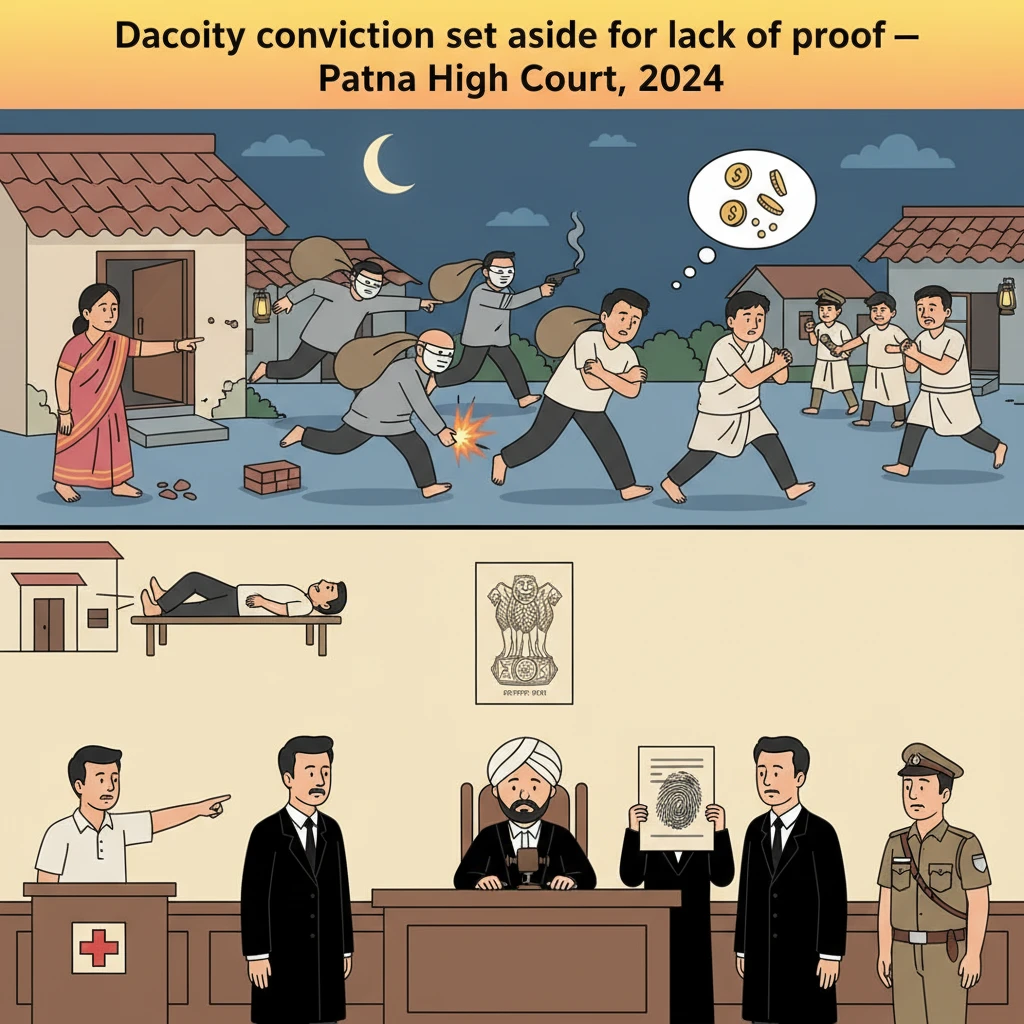
The case arises from a night-time dacoity that allegedly took place between 25 and 26 July 1998 in village Khesar under Madanpur Police Station, district Aurangabad.
According to the First Information Report (FIR), around 11:30 p.m. the informant was gossiping with her husband in the dalan (verandah) of their house. Six miscreants allegedly arrived. Two stayed outside while four caught hold of the informant and her husband and demanded that they open the door.
When the husband tried to question them, one of the miscreants allegedly hit him with a brick, causing head injuries. Four miscreants then entered the house and started taking away articles from inside.
On hearing the noise, co-villagers and relatives began reaching the house. The miscreants allegedly hurled a bomb, injuring one relative, Satyanarayan Yadav. When the couple’s son Manoj Yadav protested, the miscreants allegedly fired at him, causing injuries. After the neighbours rushed to the scene on hearing the cries and firing, the miscreants are said to have fled with articles worth about Rs. 15,000.
All injured persons were taken to the Primary Health Centre with the help of villagers. The informant’s statement was recorded at Madanpur Government hospital, where she gave her left thumb impression.
On this fardbeyan, Madanpur P.S. Case No. 92 of 1998 was registered against six unknown persons under Section 395 of the Indian Penal Code (IPC) and related provisions. Investigation followed, after which a charge-sheet was filed only against one person, the present appellant. The case was committed to the Court of Sessions, Aurangabad, and registered as Sessions Trial No. 270 of 1999 and 271 of 2006.
The Additional District and Sessions Judge, Fast Track Court V, Aurangabad, by judgment dated 26.12.2006, convicted the appellant under Section 395 IPC and on 27.12.2006 sentenced him to rigorous imprisonment for 10 years and a fine of Rs. 5,000, with a default sentence of 2½ years’ simple imprisonment.
Aggrieved by this conviction and sentence, the appellant filed Criminal Appeal (SJ) No. 79 of 2007 before the Patna High Court. The hearing concluded on 01.04.2024 and the judgment was delivered on 05.04.2024 by Hon’ble Mr. Justice Sunil Kumar Panwar.
What the Court Examined and Decided
The Patna High Court focused on a key question: whether the prosecution had proved the charge of dacoity under Section 395 IPC against the appellant beyond reasonable doubt.
During the trial, the prosecution examined twelve witnesses.
P.W. 3, an advocate’s clerk, formally proved the fardbeyan and FIR as Exhibits 1 and 2. P.W. 8, a Judicial Magistrate 2nd Class, proved the Test Identification Parade (TIP) chart as Exhibit 3. P.W. 9 turned hostile. The remaining witnesses were family members, relatives, and villagers.
The informant, P.W. 5 Rukmani Devi, wife of injured P.W. 4 Doman Yadav and mother of injured P.W. 2 Manoj Yadav, described the incident in detail. She stated that six dacoits came, assaulted her husband with a stone, entered the house, assaulted her son, and took away boxes containing articles worth Rs. 15,000–16,000. A bomb thrown by the dacoits allegedly injured P.W. 12. She confirmed that three injured persons were taken to Madanpur Government hospital.
However, in cross-examination, she admitted that her son Manoj Yadav and the appellant Sumant were friends from school days. Because of this friendship, the appellant used to visit her house. She, therefore, knew him from earlier.
P.W. 1 Vijay Yadav, another son of the informant, spoke about the dacoity but in cross-examination clearly stated that he did not identify the accused in court.
P.W. 2 Manoj Yadav and P.W. 4 Doman Yadav (both injured, as per prosecution) narrated the occurrence and said that they had identified the appellant in the Test Identification Parade conducted by P.W. 8. P.W. 8 confirmed that in the TIP, only P.W. 2 and P.W. 4 identified the appellant among the suspects.
P.W. 6 Matar Mala Devi (wife of P.W. 1) and P.W. 7 Radha Devi (wife of P.W. 2) both stated in their evidence that they did not identify the accused.
P.W. 9, another villager, did not support the prosecution and was declared hostile.
P.W. 10 Ramdeo Yadav @ Rajdeo Yadav deposed that he had not identified any of the persons who committed the dacoity.
P.W. 11 Dhananjay Singh admitted that he knew the appellant from much before the date of occurrence.
P.W. 12 Satyanarayan Yadav, alleged to have been injured by the bomb, said that he did not know who hurled the bomb on him. In cross-examination, he admitted that the appellant was his childhood friend and that the police (Daroga) had not even recorded his statement. He emphasised the friendship between himself and the appellant.
From this evidence, the defence highlighted several weaknesses:
- Most witnesses failed or refused to identify the appellant either in court or at all.
- P.W. 2, P.W. 4, and P.W. 12 all admitted that the appellant was already known to them as a friend or acquaintance from school days and village social life.
- Despite this prior acquaintance, the prosecution had conducted a Test Identification Parade, which, according to the defence, became meaningless because TIP is primarily meant for identifying strangers, not known persons.
- No stolen property was recovered from the appellant’s possession.
- The doctor who treated the alleged injuries to P.W. 2, P.W. 4, and P.W. 12 was not examined, so the medical evidence of their injuries was not proved.
- Critically, the Investigating Officer (IO), who had investigated the case and recorded witness statements, was not examined at all.
The amicus curiae for the appellant argued that these gaps severely weakened the prosecution case and caused prejudice to the defence. Without the IO’s evidence, the defence was unable to bring out contradictions between the witnesses’ earlier police statements and their testimony in court.
The Additional Public Prosecutor, on the other hand, supported the conviction, arguing that the evidence was consistent and cogent and that only minor contradictions had emerged which did not affect the core of the prosecution case.
The Patna High Court examined the entire record and weighed these rival submissions.
The Court noted that the FIR was originally against six unknown persons, and the appellant’s name came up only during investigation. Only two witnesses (P.W. 2 and P.W. 4) identified him in the TIP. Yet, several witnesses, including the informant and P.W. 12, accepted that the appellant was well known to the family and villagers from before the occurrence.
In this background, the Court held that the TIP identification by P.W. 2 and P.W. 4 had “no relevance”, as it was not a case of identifying a stranger. Moreover, these so-called prime witnesses did not attribute any specific overt act to the appellant during the dacoity. There was no recovery of stolen property from him.
The Court further highlighted that although three persons (P.W. 2, P.W. 4, and P.W. 12) were claimed to be injured, the treating doctor was never examined. As a result, their injuries and the alleged firing and bombing were not corroborated by medical evidence. This absence of medical proof, in the Court’s view, was “fatal” to the prosecution case.
The non-examination of the Investigating Officer was another serious defect. The Court stressed that cross-examining the IO is a “very valuable right” of the accused. Without the IO’s evidence, the defence could not place contradictions on record between trial testimony and earlier police statements. The Court inferred that the prosecution, by withholding the IO, had not come to court with “clean hands”.
Given these factors—prior acquaintance with the appellant, weak identification, absence of medical evidence, non-recovery of stolen property, and non-examination of the IO—the Court concluded that major contradictions had surfaced in the evidence, sufficient to discredit the prosecution witnesses.
On this basis, the Court held that the prosecution had failed to establish its case against the appellant beyond the shadow of all reasonable doubt. The appellant was therefore entitled to benefit of doubt.
Accordingly, the Patna High Court set aside the conviction dated 26.12.2006 and the sentence dated 27.12.2006 passed by the trial court in Sessions Trial Nos. 270/1999 and 271/2006 arising from Madanpur P.S. Case No. 92 of 1998. The appellant was acquitted of all charges and discharged from his bail bond obligations. The criminal appeal was allowed.
The Court also recorded its appreciation for the assistance of the amicus curiae, Mr. Vipul Sinha, and directed the Patna High Court Legal Services Committee to pay him Rs. 6,000 towards his professional fee.
Why This Judgment Matters
This judgment is important for anyone facing serious criminal charges such as dacoity, as well as for victims and witnesses of such crimes.
First, it shows that even in grave offences, the prosecution must still prove the case beyond reasonable doubt. Long sentences cannot be maintained if the basic requirements of fair trial are not met.
Second, the Patna High Court has underlined that Test Identification Parade has little value when the accused is already known to the witnesses. Police and courts cannot treat such identification as strong proof when there is prior friendship or village familiarity.
Third, the decision highlights how vital the Investigating Officer’s evidence is. When the IO is not examined, the accused loses the chance to confront the investigation and point out contradictions. This can give rise to benefit of doubt.
Fourth, the judgment stresses that medical evidence should support claims of injury. Where the doctor is not examined and injuries are not proved, the story of assault and firing becomes doubtful in law.
For villagers and ordinary citizens, this case shows that courts will not uphold convictions if the investigation is incomplete, witnesses are inconsistent, and proper proof is missing, even if the alleged incident is serious and frightening.
Legal Issues and Answers
- Issue: Did the prosecution prove beyond reasonable doubt that the appellant participated in the alleged dacoity under Section 395 IPC?
Answer: No. The Patna High Court found that key witnesses either did not identify the appellant or admitted prior friendship, the TIP had no relevance, no stolen property was recovered, medical evidence was not proved, and the Investigating Officer was not examined. Therefore, benefit of doubt went to the appellant and his conviction was set aside. - Issue: What is the effect of non-examination of the Investigating Officer in a criminal trial?
Answer: The Court held that the IO is a material witness. Non-examination of the IO deprives the accused of the valuable right to confront the investigation and prove contradictions, causes prejudice to the defence, and can lead to failure of the prosecution case. - Issue: Can Test Identification Parade be relied on where the accused is already known to the witnesses?
Answer: In the facts of this case, no. Since the appellant was known from childhood and through village relations, the Court held that identification in TIP by P.W. 2 and P.W. 4 had no relevance and could not safely support conviction.
Cases Cited by the Court
- The judgment does not mention or rely upon any other reported case law.
Case Details
Case Number: Criminal Appeal (SJ) No. 79 of 2007; arising out of Sessions Trial No. 270 of 1999 and 271 of 2006; Madanpur P.S. Case No. 92 of 1998.
Case Title: Sumant Singh v. State of Bihar
Coram: Hon’ble Mr. Justice Sunil Kumar Panwar
Citation: 2024 (2) PLJR 726
Advocates: For the appellant – Mr. Vipul Sinha (Amicus Curiae); For the State – Mrs. Anita Kumari Singh, A.P.P.
Nature of the Case: Criminal appeal against judgment of conviction and order of sentence under Section 395 IPC passed by the Additional District and Sessions Judge, Fast Track Court V, Aurangabad.
Link to Judgment: Click here to read the full judgment of the Patna High Court
If you found this explanation helpful and wish to stay informed about how legal developments may affect your rights in Bihar, you may consider following Samvida Law Associates for more updates.







