
Case Background
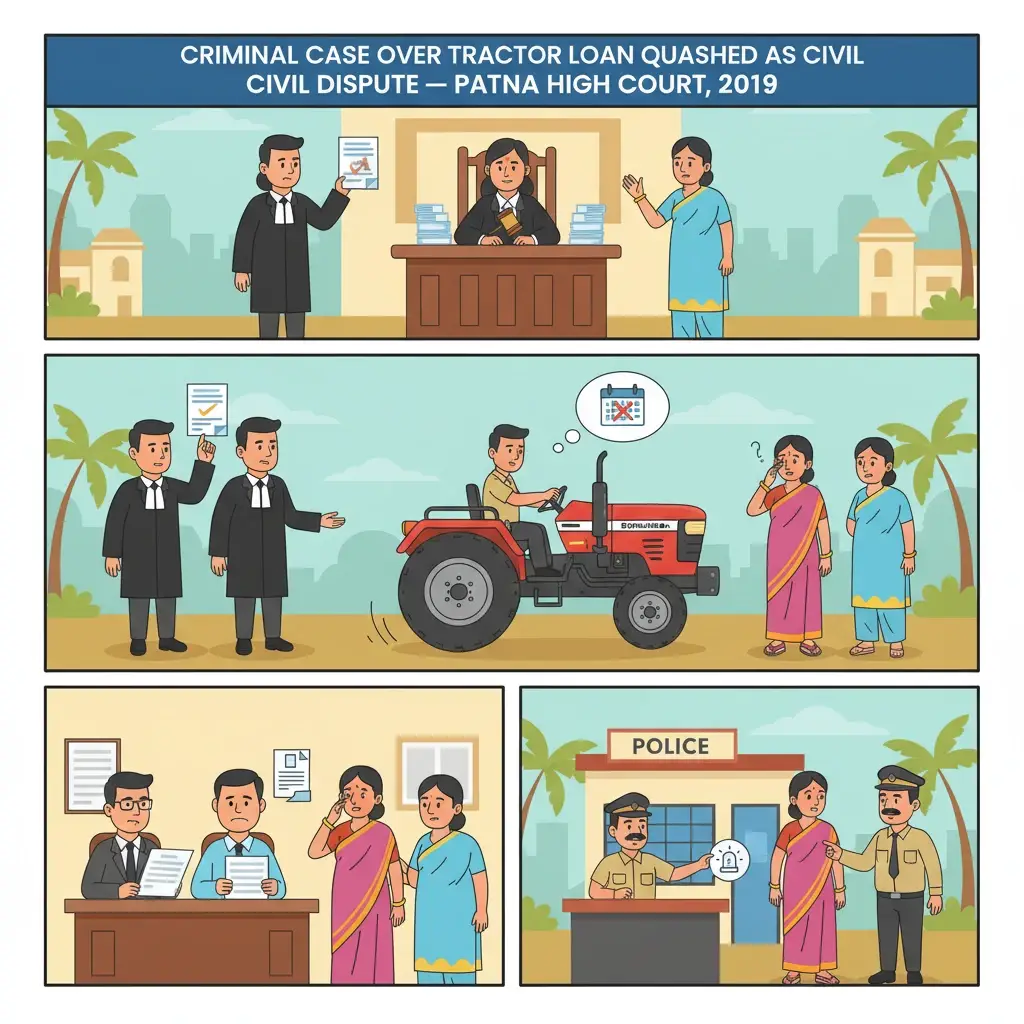
A woman (respondent no. 5) had purchased a Sonalika tractor with financial assistance from a finance company. An amount of Rs. 4,75,000/- was financed through a Loan Cum Hypothecation Agreement dated 25.08.2015. Under this agreement, she had to repay the financed amount in 60 monthly instalments of Rs. 13,200/- each.
She paid 23 instalments on time. After that, she defaulted in paying further instalments. The petitioners in this case were officers of the finance company, working in collection and branch management roles.
According to the petitioners, when the borrower defaulted, the company issued a demand notice dated 13.09.2017 in English and Hindi. This notice called upon her to clear the dues and warned that, in case of non-payment, the company would repossess the vehicle as per the Loan Cum Hypothecation Agreement.
The borrower did not make payment or reply to this notice. The company then repossessed the tractor by exercising powers under clause 9.2 of the agreement. Even after repossession, no payment was made. A pre-sale notice dated 27.02.2018 was issued, informing her of the outstanding amount and that, in case of non-payment, the vehicle would be sold.
As there was still no payment, the company sold the tractor. These pleadings by the petitioners were not controverted by respondent no. 5 through any counter affidavit.
Instead, respondent no. 5 filed a criminal complaint. On 19.03.2018, she lodged Complaint Case No. 615 of 2018 before the Chief Judicial Magistrate, Muzaffarpur under Sections 190 and 200 of the Code of Criminal Procedure. The date of alleged occurrence was stated as 06.03.2018 and the place of occurrence was shown as the company’s office at Chakkar Road, Kazi Mohammadpur.
In that complaint, she alleged that the tractor was taken away suddenly and without notice by company employees, including the two petitioners, and others. She further alleged that she was abused, assaulted, and threatened at the company’s office when she went with her husband and witnesses. She also claimed she was told that the tractor had already been sold on 03.03.2018.
The Magistrate referred this complaint to the police under Section 156(3) CrPC for investigation. On that basis, Kazi Mohammadpur P.S. Case No. 204 of 2018 was registered for offences under Sections 420, 406, 504, 506, 467, 468, 120B and 323 of the Indian Penal Code. Investigation commenced against the petitioners.
The petitioners approached the Patna High Court under Articles 226 and 227 of the Constitution of India in Criminal Writ Jurisdiction Case No. 1169 of 2019, seeking quashing of the FIR and the entire criminal prosecution.
What the Court Examined and Decided
The petitioners’ main stand was that the entire dispute arose from a loan and hypothecation agreement between the borrower and the finance company. They argued that using criminal law to attack actions taken under the contract was an abuse of the legal process.
First, they contended that the FIR, having been registered on court’s direction, violated the Supreme Court’s ruling in Priyanka Srivastava v. State of U.P. because, according to them, there was no affidavit from the complainant showing she had first approached the police under Sections 154(1) and 154(3) CrPC before seeking a direction under Section 156(3) CrPC.
They also argued that since the company itself was not made a party, a criminal case only against its employees was not maintainable, referring to R. Kalyani v. Janak C Mehta and others. Further, they relied on several Supreme Court decisions which held that repossession of vehicles under hire purchase or similar agreements is essentially a civil dispute and not a criminal offence. These included Sardar Trilok Singh v. Satya Deo Tripathi, K.A. Mathai v. Kora Bibbikutty, Charanjit Singh Chadha v. Sudhir Mehra, and Anup Sarmah v. Bhola Nath Sharma.
On the facts, they emphasized that the borrower had defaulted on instalments after paying 23 instalments, a demand notice was validly served, the vehicle was repossessed as per the agreement, and a pre-sale notice was issued before the tractor was sold. All these actions, they submitted, flowed from the contractual terms, not from any criminal intention.
The State, on the other hand, argued that the Supreme Court’s decision in Priyanka Srivastava did not apply here. The complaint before the Magistrate was under Sections 190 and 200 CrPC, not an application under Section 156(3) CrPC by the complainant herself. The Magistrate had used his own power to refer the matter to the police.
The State further submitted that the complaint allegations, particularly that the complainant was abused, assaulted and threatened in the office of the company, did disclose cognizable offences and therefore warranted investigation. It was argued that those additional facts took the matter outside the narrow scope of a mere contractual dispute.
Respondent no. 5 was represented by counsel before the High Court, but she failed to appear or contest the petition despite service of notice.
Justice Ashwani Kumar Singh carefully examined the admitted facts. The Court noted that there was no dispute that:
- The tractor was financed by the company for Rs. 4,75,000/-.
- The amount was to be repaid in 60 instalments of Rs. 13,200/- each.
- Respondent no. 5 paid only 23 instalments, then defaulted.
The Court also observed that while the complaint mentioned that she had gone to deposit money and was abused and assaulted, no specific date was given for this alleged visit or the alleged abuse and assault. This lack of detail weighed against the strength of the criminal allegations.
The Court then turned to the Loan Cum Hypothecation Agreement (Annexure-2). It particularly considered Clause 9, titled “Consequences of Default and Termination”. This clause allowed the lender to:
- Issue a default notice giving seven days to clear dues.
- On failure, take possession of the vehicle without court intervention.
- After taking possession, issue a pre-sale notice calling upon the borrower to clear the total outstanding.
- If the borrower still failed, sell the vehicle and adjust sale proceeds against outstanding dues.
- Recover any remaining balance from the borrower.
Based on the petitioners’ uncontroverted pleadings, the Court noted that the company followed these steps: demand notice, repossession, pre-sale notice, and then sale. Respondent no. 5 did not file any counter affidavit to deny these facts.
On the argument about Priyanka Srivastava, the Court agreed with the State that the case was distinguishable. The Supreme Court there had not taken away the Magistrate’s suo motu power to refer a complaint under Sections 190 and 200 CrPC to the police for investigation under Section 156(3) CrPC. The requirement of an affidavit and prior steps under Sections 154(1) and 154(3) applied where a complainant directly invoked Section 156(3) seeking a direction to police. That was not the situation here.
The High Court then examined the line of Supreme Court authorities on repossession under hire purchase and similar agreements. In Sardar Trilok Singh, the Supreme Court held that repossession of a truck by a financier, when instalments were unpaid, raised a civil dispute and criminal proceedings were an abuse of process. In K.A. Mathai, the Court recognised the financier’s right to resume possession on default, even if the agreement did not explicitly state it, and found no theft.
In Charanjit Singh Chadha, the Supreme Court held that repossession in terms of the agreement did not amount to a criminal offence, as the financier remained owner of the vehicle under a hire purchase arrangement. In Anup Sarmah, it was reiterated that in hire purchase, the purchaser is merely a trustee/bailee and the financier, as owner, is entitled to seize the vehicle without attracting criminal liability.
The Patna High Court also referred to G. Sagar Suri v. State of U.P. and Indian Oil Corporation v. NEPC India Ltd., where the Supreme Court expressed concern over the growing tendency to dress up civil disputes as criminal cases, particularly to pressurise the opposite party. The Supreme Court had cautioned that criminal proceedings are not a shortcut for civil remedies and that High Courts must use their powers to prevent abuse of process.
Applying these principles, Justice Ashwani Kumar Singh held that the present dispute was “predominantly civil in nature”. The core issue was the borrower’s default under a loan and hypothecation agreement and the finance company’s exercise of its contractual right to repossess and sell the vehicle. Using criminal law to challenge those contractual acts was held to be an abuse of the process of the court.
Therefore, in order to secure the ends of justice, the Court concluded that the FIR of Kazi Mohammadpur P.S. Case No. 204 of 2018 and the entire criminal prosecution against the petitioners must be quashed.
The criminal writ application was allowed and the prosecution stood terminated.
Why This Judgment Matters
This Patna High Court judgment is important for borrowers and finance company employees across Bihar. It makes clear that when a vehicle or asset is financed under a written agreement, and the borrower defaults, repossession done according to that agreement will usually be treated as a civil matter, not a criminal offence.
For borrowers, it means that if they have a grievance about repossession or sale of their vehicle, their remedy is generally through civil or consumer forums, not by filing criminal cases for cheating, theft, or forgery unless there is clear, specific criminal conduct.
For finance company staff, it provides some protection from harassment through criminal cases when they act within the four corners of the contract. However, it does not give them a licence to use violence, abuse, or illegal methods. Any such acts, if properly pleaded and proved, can still attract criminal liability.
More broadly, the judgment reinforces the Supreme Court’s warning against using criminal law as a pressure tactic in loan and business disputes. It supports quicker quashing of FIRs where the allegations are essentially about non-payment or enforcement of contractual rights.
Legal Issues and Answers
- Issue: Can a borrower’s complaint about repossession and sale of a financed vehicle, done under a loan cum hypothecation agreement after default, be pursued as a criminal case?
Answer: No. Where the finance company has acted under the terms of the agreement after admitted default, the dispute is predominantly civil in nature, and continuation of criminal proceedings amounts to abuse of process. The FIR was therefore quashed. - Issue: Does the Supreme Court’s ruling in Priyanka Srivastava bar a Magistrate from sending a complaint under Sections 190 and 200 CrPC to police for investigation under Section 156(3) in the absence of an affidavit by the complainant?
Answer: No. Priyanka Srivastava does not curtail the Magistrate’s suo motu jurisdiction to refer such complaints for investigation. The requirements laid down there apply where a complainant directly moves an application under Section 156(3) CrPC seeking such a direction.
Cases Cited by the Court
- Priyanka Srivastava and Anr. v. State of U.P. and Ors., AIR 2015 SC 1758
- R. Kalyani v. Janak C Mehta and Ors., (2009) 1 SCC 516
- Sardar Trilok Singh & Ors. v. Satya Deo Tripathi, AIR 1979 SC 850
- K. A. Mathai & Anr. v. Kora Bibbikutty & Anr., (1996) 7 SCC 212
- Charanjit Singh Chadha and Ors. v. Sudhir Mehra, AIR 2001 SC 3721
- Anup Sarmah v. Bhola Nath Sharma & Ors., (2013) 1 SCC 400
- G. Sagar Suri v. State of U.P., (2000) 2 SCC 636
- M/s Indian Oil Corpn. v. M/s NEPC India Ltd. & Ors., AIR 2006 SC 2780
Case Details
Case Number: Criminal Writ Jurisdiction Case No. 1169 of 2019; arising out of Kazi Mohammadpur P.S. Case No. 204 of 2018
Case Title: Anand Mishra & Anr. v. State of Bihar & Ors.
Citation: 2020 (2) PLJR 281
Court: High Court of Judicature at Patna
Coram: Hon’ble Mr. Justice Ashwani Kumar Singh
Date of Judgment: 07.11.2019 (Uploading Date: 13.11.2019)
Advocates:
- For the Petitioners: Ms. Somali Acharya, Advocate
- For the State-Respondents: Mr. Prabhat Kumar Verma, AAG-3; Mr. Saroj Kumar Sharma, AC to AAG-3
- For Respondent No. 5: Mr. Satya Prakash Parasar, Advocate (not present at final hearing)
Nature of the Case: Criminal writ petition under Articles 226 and 227 of the Constitution seeking quashing of FIR and criminal prosecution.
If you found this explanation helpful and wish to stay informed about
how legal developments may affect your rights in Bihar,
you may consider following Samvida Law Associates for more updates.







