

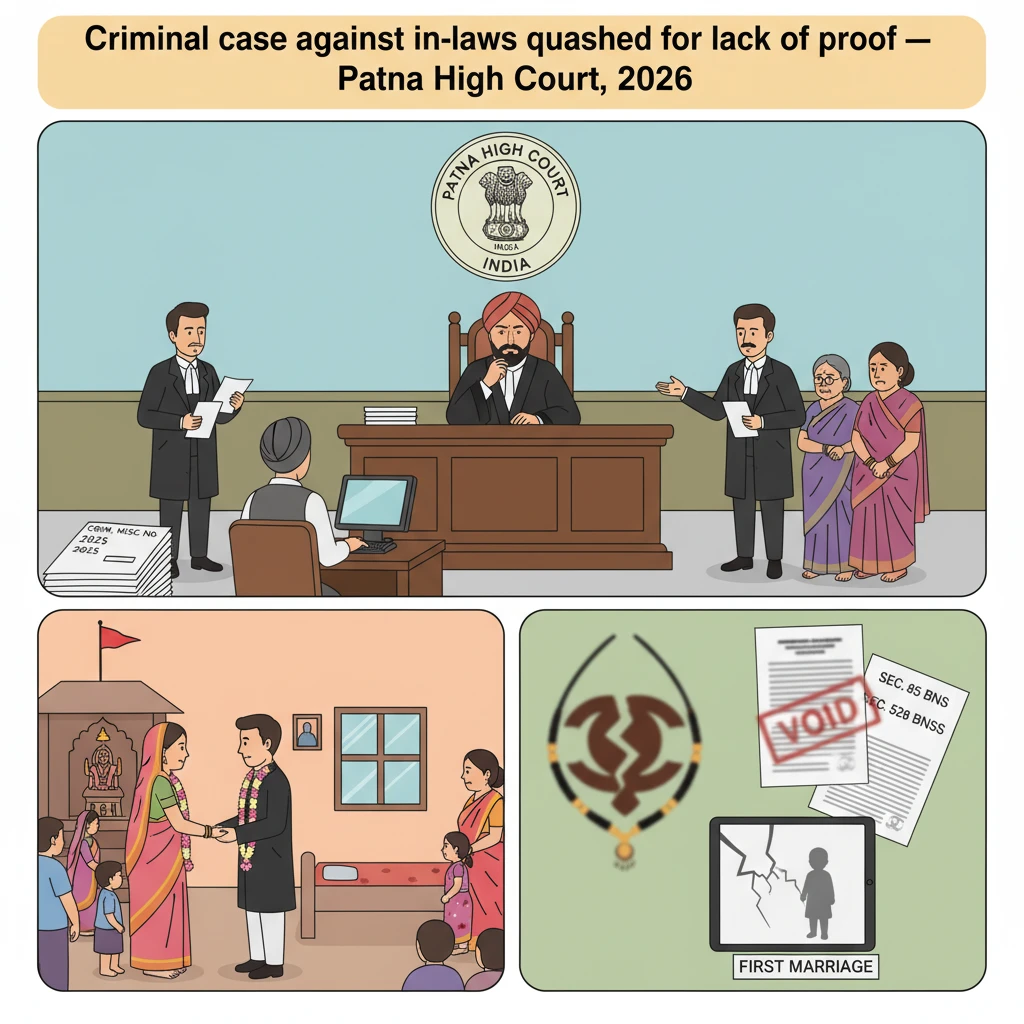
Case Background
A woman filed a complaint case (No. 1535 of 2024) in Begusarai, alleging cruelty and other offences under the Bharatiya Nyaya Sanhita, 2023 (BNS) against her husband and his family members.
According to her complaint, she solemnized marriage with Sumit Kumar at Kali Temple, Begusarai, following Hindu rites and rituals. She stated that she was a divorced woman from a different caste and had a minor son from her previous marriage, and that Sumit Kumar was fully aware of these facts when he agreed to marry her.
After the marriage, she was allegedly kept in a rented house. She claimed that Sumit Kumar and his family members subjected her to cruelty, including caste-based abuses and physical assaults. A specific allegation was made that one of the in-laws (petitioner no. 2) attempted to press her neck with an intention to cause harm.
On the basis of this complaint and the enquiry, the Judicial Magistrate First Class, Begusarai, on 03.01.2025 took cognizance and issued process against the petitioners and others for offences under sections 85, 115(2), 118(1) and 191(2) of the Bharatiya Nyaya Sanhita, 2023.
Aggrieved by this order, three family members of Sumit Kumar (his mother and siblings) approached the Patna High Court in Criminal Miscellaneous No. 36935 of 2025, invoking the Court’s inherent jurisdiction under Section 528 of the Bharatiya Nagarik Suraksha Sanhita, 2023 (BNSS). They sought quashing of the cognizance order and the entire criminal proceeding as against them.
What the Court Examined and Decided
The Patna High Court, through Hon’ble Mr. Justice Rudra Prakash Mishra, heard the petitioners and the State. The central question was whether the materials on record justified continuing criminal proceedings against the in-laws.
The petitioners argued that the case was a clear misuse of criminal law. They said the complaint contained only sweeping and general accusations, with no specific act of cruelty attributed to them. They relied on several Supreme Court judgments warning courts to be careful in matrimonial disputes where entire families are often roped in on vague allegations.
The petitioners also raised a crucial legal point about the very existence of a valid marriage. It was admitted that the complainant had been previously married and had a minor son from that marriage. However, no decree of divorce ending that marriage had been produced. On this basis, the petitioners argued that the alleged marriage with Sumit Kumar was void from the beginning, and therefore offences based on “matrimonial cruelty” could not legally arise.
The State, supporting the Magistrate’s order, submitted that the trial court had considered all materials available and had rightly taken cognizance under Sections 85, 115(2), 118(1), and 191(2) of the BNS.
The High Court first noted that its power under Section 528 BNSS is extraordinary and must be used sparingly. However, it is also meant to prevent abuse of the court process and to secure justice where continuation of a case is clearly unjustified.
The Court carefully read the complaint and the statements recorded during the enquiry. It found that the allegations against the petitioners, who were relatives of the husband, were “vague, omnibus, and generalized.” Except for a broad story of harassment, there were no clear details about what exactly each petitioner had done, when, or how.
The Court considered the Supreme Court decision in Preeti Gupta and Another v. State of Jharkhand and Another, (2010) 7 SCC 667. In that case, the Supreme Court had expressed serious concern about the growing practice of implicating distant and uninvolved relatives in matrimonial cases through exaggerated, sweeping allegations. The Supreme Court held that criminal law should not become a tool of harassment and that courts must be very cautious in such matters.
Applying this principle, the Patna High Court held that the lack of specific, concrete allegations against the petitioners was a serious defect. General statements of “harassment” were not enough to justify a criminal trial.
The Court then highlighted an important factual admission by the complainant herself. She had clearly stated that she had been residing separately from the petitioners for nearly three years and had never shared a household with them. This meant that she and the in-laws were not living together during the period of alleged cruelty.
The Court explained that, in matrimonial offences, “cruelty” usually presupposes some proximity, regular interaction, or cohabitation, which makes harassment possible. If the parties are not living together and have no meaningful day-to-day interaction, it becomes highly unlikely that the in-laws could be continuously subjecting the complainant to cruelty. On the admitted facts, the Court found no circumstances from which cruelty by the petitioners could reasonably be inferred.
Turning to the specific allegation against petitioner no. 2 about pressing the complainant’s neck, the Court examined it closely. This allegation did not appear in the original complaint. It surfaced for the first time during the enquiry stage through a witness statement. Moreover, there was no medical report, hospital document, or any independent evidence showing that such an assault had occurred.
Because this serious allegation appeared only later and lacked any supporting evidence, the Court treated it as an “improvement” made at a later stage. In the absence of corroboration, the Court found it doubtful and held that it was not enough to sustain criminal prosecution.
The Court then addressed the legal foundation of the entire prosecution. It reiterated that it was undisputed that the complainant had an earlier marriage and a minor child from that marriage, with no divorce decree on record. Therefore, in law, that earlier marriage continued to subsist.
In that situation, the Court held, any subsequent marriage with Sumit Kumar would be void-ab-initio, i.e., treated as no marriage in the eyes of law. Reliance was placed on the Supreme Court judgment in Dolly Rani v. Manish Kumar Chanchal, (2025) 2 SCC 587, where it was clearly laid down that a valid, subsisting marriage is a basic requirement before offences relating to matrimonial cruelty can be invoked. If the marriage itself is void or non-existent, the legal basis for such prosecution collapses.
The Court connected this principle with Section 85 of the Bharatiya Nyaya Sanhita, 2023. It held that this provision requires two essential things: first, a legally valid marital relationship; and second, cruelty arising out of that relationship. In the present case, neither requirement was met. The marriage itself was not legally valid, and the allegations of cruelty were vague and unsupported.
The Court also relied on Achin Gupta v. State of Haryana and Another, (2025) 3 SCC, where the Supreme Court reiterated that criminal proceedings in matrimonial disputes cannot continue when allegations are general, lack evidence, and show no active role of the accused. Similarly, in Rajesh Sharma and Others v. State of Uttar Pradesh and Another, (2018) 10 SCC 472, the Supreme Court had acknowledged misuse of Section 498A IPC and stressed that courts must protect relatives of the husband from unnecessary and baseless prosecution.
Further, the High Court referred to the celebrated decision in State of Haryana and Others v. Bhajan Lal and Others, 1992 Supp (1) SCC 335. In that case, the Supreme Court laid down illustrative categories where criminal proceedings can be quashed, especially when even taking the allegations at face value, the basic ingredients of the alleged offences are not disclosed or when the proceedings appear to be malicious.
The Court held that the present case clearly fell within those categories. Even if the complaint was accepted at its highest, it did not disclosure the essential ingredients required under Section 85 BNS or the other invoked provisions. Instead, the material pointed to mala fide use of criminal law and abuse of the court’s process against the in-laws.
While the Court acknowledged that quashing criminal cases at the initial stage should not be done routinely, it emphasized that when allegations do not show any offence and the case is legally unsustainable, interference is not only permitted but necessary to prevent injustice.
On this overall assessment, the Court held that the Magistrate’s order taking cognizance suffered from non-application of mind. Continuing the case against these petitioners would amount to grave miscarriage of justice.
Accordingly, the Patna High Court allowed the petition and quashed the cognizance order and the criminal proceedings insofar as they related to the petitioners.
Why This Judgment Matters
This judgment is important for families involved in matrimonial disputes where criminal cases are often filed against multiple in-laws. The Patna High Court has made it clear that relatives cannot be forced to face a criminal trial merely on the basis of general and vague allegations.
The decision also highlights that, for offences based on “matrimonial cruelty” under Section 85 of the Bharatiya Nyaya Sanhita, a valid, subsisting marriage is essential. If a complainant’s earlier marriage has not been legally dissolved, any later marriage may be treated as void, and such criminal charges may not stand.
For complainants, this judgment is a reminder that they must provide specific details, supporting evidence, and clarity about their marital status before approaching criminal courts. For accused family members, it shows that higher courts can step in to protect them from misuse of criminal law.
Legal Issues and Answers
-
Issue: Can criminal proceedings for matrimonial cruelty under Section 85 BNS continue against in-laws when allegations are vague and the complainant never lived with them?
Answer: No. The Court held that vague, omnibus allegations without specific acts or proof of cohabitation or interaction are insufficient, and prosecution in such circumstances amounts to abuse of process. -
Issue: Can matrimonial offence provisions be invoked when the complainant’s earlier marriage is still subsisting and no divorce decree is on record?
Answer: No. The Court held that in the absence of a legally valid and subsisting marriage with the accused husband, the very basis for prosecution under Section 85 BNS fails. -
Issue: When should the High Court use its inherent powers under Section 528 BNSS to quash criminal proceedings?
Answer: The Court held that where allegations, even if taken at face value, do not constitute the alleged offence and continuing the case would be a misuse of criminal law, interference is justified to secure the ends of justice.
Cases Cited by the Court
- Preeti Gupta and Another v. State of Jharkhand and Another, (2010) 7 SCC 667
- Achin Gupta v. State of Haryana and Another, (2025) 3 SCC
- Rajesh Sharma and Others v. State of Uttar Pradesh and Another, (2018) 10 SCC 472
- Dolly Rani v. Manish Kumar Chanchal, (2025) 2 SCC 587
- State of Haryana and Others v. Bhajan Lal and Others, 1992 Supp (1) SCC 335
Case Details
Case Number: Criminal Miscellaneous No. 36935 of 2025 (arising out of Complaint Case No. 1535 of 2024, P.S. F.C.I., Begusarai)
Case Title: Manju Devi & Ors v. The State of Bihar & Anr
Coram: Hon’ble Mr. Justice Rudra Prakash Mishra
Citation: 2026(2) PLJR 166
Advocates: Mrs. Vaishnavi Singh, Advocate for the petitioners; Mr. Pradeep Narain Kumar, APP for the State/opposite party
Nature of the Case: Criminal miscellaneous petition under Section 528 of the Bharatiya Nagarik Suraksha Sanhita, 2023, seeking quashing of cognizance order in a complaint case alleging offences under Sections 85, 115(2), 118(1), 191(2) of the Bharatiya Nyaya Sanhita, 2023.
Link to Judgment: Read full judgment on Patna High Court website
If you found this explanation helpful and wish to stay informed about
how legal developments may affect your rights in Bihar,
you may consider following Samvida Law Associates for more updates.







