

Case Background
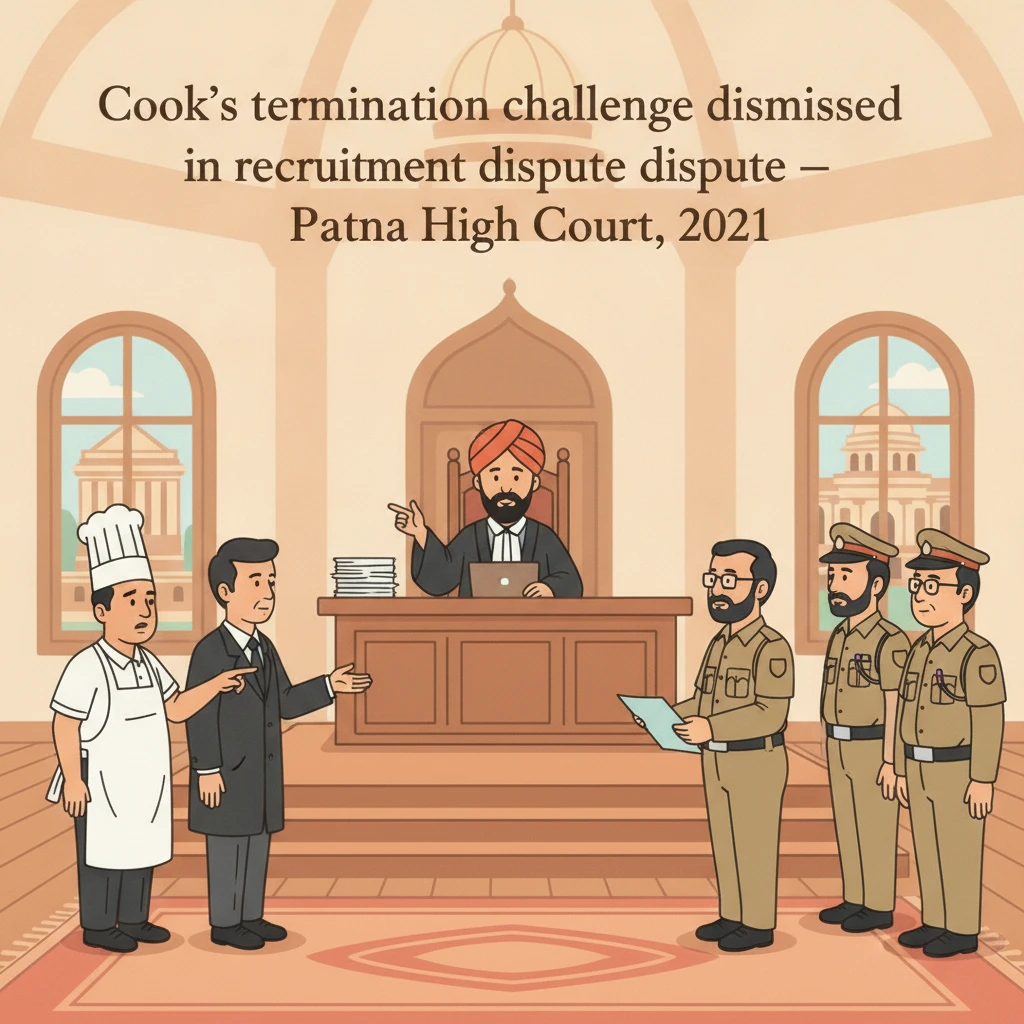
The case came before the Patna High Court in Civil Writ Jurisdiction Case No. 126 of 2018. The petitioner was a candidate for recruitment to the post of cook in the Bihar Military Police. Respondent authorities included the State of Bihar, senior police officials, and two other cooks working in the same battalion.
The petitioner was selected and appointed as a cook on 13.03.2013 in Bihar Military Police 13, Darbhanga. Later, the authorities reviewed the recruitment process and the marks awarded to different candidates, including the petitioner and respondent cooks.
On 29.01.2015, the competent authority issued memo no. 183/Ra Ka dated 29.01.2015, by which the petitioner’s appointment was treated as having come to an end automatically. This followed an earlier memo no. 129/go dated 30.12.2004 issued by the D.I.G., Military Police, North Zone, Muzaffarpur, regarding the pattern of awarding grades and marks to candidates.
The petitioner claimed that his termination was illegal because he was not given a chance to be heard before the order was issued. He also claimed that the original recruitment process and the award of marks were not in line with the prescribed procedure. He said he had not been given a copy of the memo dated 30.12.2004, yet his services were terminated based on it.
In 2018, the petitioner approached the Patna High Court by way of a writ petition under Article 226 of the Constitution. He sought quashing of both the memo dated 30.12.2004 and the termination memo dated 29.01.2015 and prayed for reinstatement as cook in B.M.P. 13, Darbhanga with all consequential benefits.
What the Court Examined and Decided
The single judge, Hon’ble Mr. Justice P. B. Bajanthri, heard the matter and recorded the specific reliefs sought by the petitioner. The petitioner requested the Court to direct the respondents to produce a copy of memo no. 129/go dated 30.12.2004, to quash that memo after production, and to quash memo no. 183/Ra Ka dated 29.01.2015 by which his appointment had allegedly come to an end automatically. He also asked the Court to direct the authorities to appoint him as cook and to remove either of the two private respondent cooks so that he could be appointed in their place.
The core complaint of the petitioner had two parts. First, he said that the termination dated 29.01.2015 was bad in law because no prior notice or opportunity of hearing was given to him. Second, he argued that the recruitment process, particularly the award of marks and grading, was not in accordance with the procedure that should have been followed during selection of candidates like him and the private respondents.
The Court asked the State’s counsel to produce the original records relating to the award of marks in the recruitment process. In response, the learned counsel for the respondents produced the relevant documents for the Court’s inspection.
On examining these records, the Court noted that the marks were awarded in the form of grades like A, B, C, and D. However, for administrative convenience, the respondents had also used sub-categories such as 1A, 2A and similar nomenclature while appointing selected candidates.
The respondents submitted that merely changing the nomenclature of the grading system from A, B, C, D to 1A, 2A etc., did not affect the validity of the selection procedure. They argued that the petitioner’s termination was not illegal just because he did not receive prior notice, as the core reason for termination was that he had scored fewer marks than respondents 5 and 6 in the recruitment test.
The Court then considered the undisputed factual position. All concerned agreed that the petitioner, as well as respondents 5 and 6, were candidates for the same post of cook in the Bihar Military Police. It was also undisputed that the petitioner had been appointed on 13.03.2013. However, this appointment had been made without properly referring to the original records relating to award of marks.
Later, the official respondents reviewed the records and realised that the petitioner had secured fewer marks than respondents 5 and 6. On that basis, the authorities treated the petitioner’s appointment as invalid or irregular and terminated his services on 29.01.2015.
The petitioner’s counsel argued that the termination was without notice and therefore violated principles of natural justice. Counsel also submitted that there were procedural irregularities in awarding marks during recruitment, which should render the termination unsustainable.
The Court analysed these contentions. Regarding the lack of notice, the Court recorded that in many cases, if an order affects an individual’s rights, the person should be given an opportunity to be heard. But in this specific case, the Court observed that even if such an opportunity had been given, it would not have changed the marks awarded to the petitioner in the recruitment process.
The documents showed that the petitioner had already been graded as “1A” while respondents 5 and 6 were graded “2A” respectively. The Court highlighted that even if the petitioner were heard, he would not be able to “improve” his grading or marks so as to match or overtake the marks of respondents 5 and 6. In other words, the petitioner’s relative low marks and grading were the factual reason behind his termination.
The Court then turned back to the petitioner’s challenge to the grading system itself. It held that mere changes in grading categories or nomenclature such as A, B, C, D, and then sub-categories like 1A, 2A did not, by themselves, make the selection process illegal. The official respondents had initially followed the grading procedure of A, B, C, D when shortlisting and appointing candidates.
From the evidence on record, Annexure E showed that the respondents had first followed the standard procedure for awarding grades. Subsequently, they re-labelled the grades or used different sub-categories for convenience. However, this did not disturb the core evaluation process that judged candidates’ performance and placed them into graded categories.
The Court concluded that the petitioner had not been able to demonstrate any illegality in the selection process. It emphasised that simply changing how grades were named or sub-divided did not invalidate the recruitment. Likewise, the petitioner’s own lower grading and lower marks were the very reason his services had been terminated.
Crucially, the Court held that even if a hearing had been given before issuing the termination order, it would not have enabled the petitioner to change or “improve” the grading that had already been assigned to him. In other words, his grievance about the termination arose from the undisputed fact that he had scored fewer marks and received a lower grade than the other candidates.
In the light of this analysis, the Court held that there was no infirmity in the termination order dated 29.01.2015. The order simply recorded the consequence of the petitioner having scored less than respondents 5 and 6. Because the petitioner lacked sufficient marks and was graded lower, there was no basis to interfere with the termination either on the ground of lack of notice or on alleged procedural irregularities.
Accordingly, the Court found that the petitioner had failed to make out any case for judicial interference. It therefore dismissed the writ petition and refused to grant any of the reliefs sought by the petitioner. No further directions regarding reinstatement or alteration of appointment were issued.
Why This Judgment Matters
This judgment is important for job seekers and government employees who challenge recruitment or termination decisions. The Patna High Court made it clear that if a candidate has scored fewer marks and is graded lower than others, he cannot later demand that his termination be set aside merely because he was not heard or because he objects to the grading pattern.
The Court treated the termination as flowing naturally from the petitioner’s relative lower performance compared to other candidates. It refused to interfere even though there was no prior notice and even though the petitioner alleged irregularities in grading and nomenclature.
Practically, this means that once recruitment marks and grades are finalised, a candidate who has scored less cannot expect the High Court to restore his appointment simply based on procedural complaints. Unless there is clear evidence that the selection process itself violated statutory rules or that there was bad faith or discrimination, courts may be reluctant to intervene.
For government recruiters, this judgment suggests that changing grading patterns or nomenclature from A, B, C, D to 1A, 2A and similar categories will not by itself invalidate the selection. As long as the underlying process of assessment is followed and properly recorded, the courts are likely to treat the recruitment as valid.
For low-educated job seekers, the key takeaway is that merely scoring lower marks than other candidates can lead to termination later if performance does not match expectations. This decision shows that courts may not rescue such candidates unless more serious legal faults are proven.
Legal Issues and Answers
Issue: Was the petitioner’s termination as cook in Bihar Military Police, based on lower marks and grading, illegal for want of notice and for alleged irregularities in the award of marks?
Answer: No. The Court held there was no infirmity in the termination dated 29.01.2015 because the petitioner had scored fewer marks and obtained a lower grade than respondents 5 and 6, and changing grading nomenclature from A, B, C, D to 1A, 2A did not vitiate the selection process.
Issue: Did the change in grading pattern and nomenclature used in recruitment of cooks in Bihar Military Police make the selection process invalid?
Answer: No. The Court found that the official respondents initially followed the standard procedure for awarding grades A, B, C, D, and later sub-grades like 1A, 2A for convenience, and that such change in nomenclature alone did not vitiate the selection.
Cases Cited by the Court
- No previous judgments have been cited or expressly relied upon in this decision.
Case Details
Case Number: Civil Writ Jurisdiction Case No. 126 of 2018
Case Title: Rajkishore v. The State of Bihar and Others
Citation: 2022 (1) PLJR 553
Court: High Court of Judicature at Patna
Coram: Hon’ble Mr. Justice P. B. Bajanthri
Date of Judgment: 29.11.2021
Nature of Case: Civil writ petition challenging termination from service and aspects of recruitment process for the post of cook in Bihar Military Police.
Advocates:
- For the petitioner: Mr. Shruti Sinha
- For the respondents: Mr. Sheo Shankar Prasad, SC-8
Link to Full Judgment: Patna High Court Judgment – CWJC No. 126 of 2018
If you found this explanation helpful and wish to stay informed about
how legal developments may affect your rights in Bihar,
you may consider following Samvida Law Associates for more updates.







