

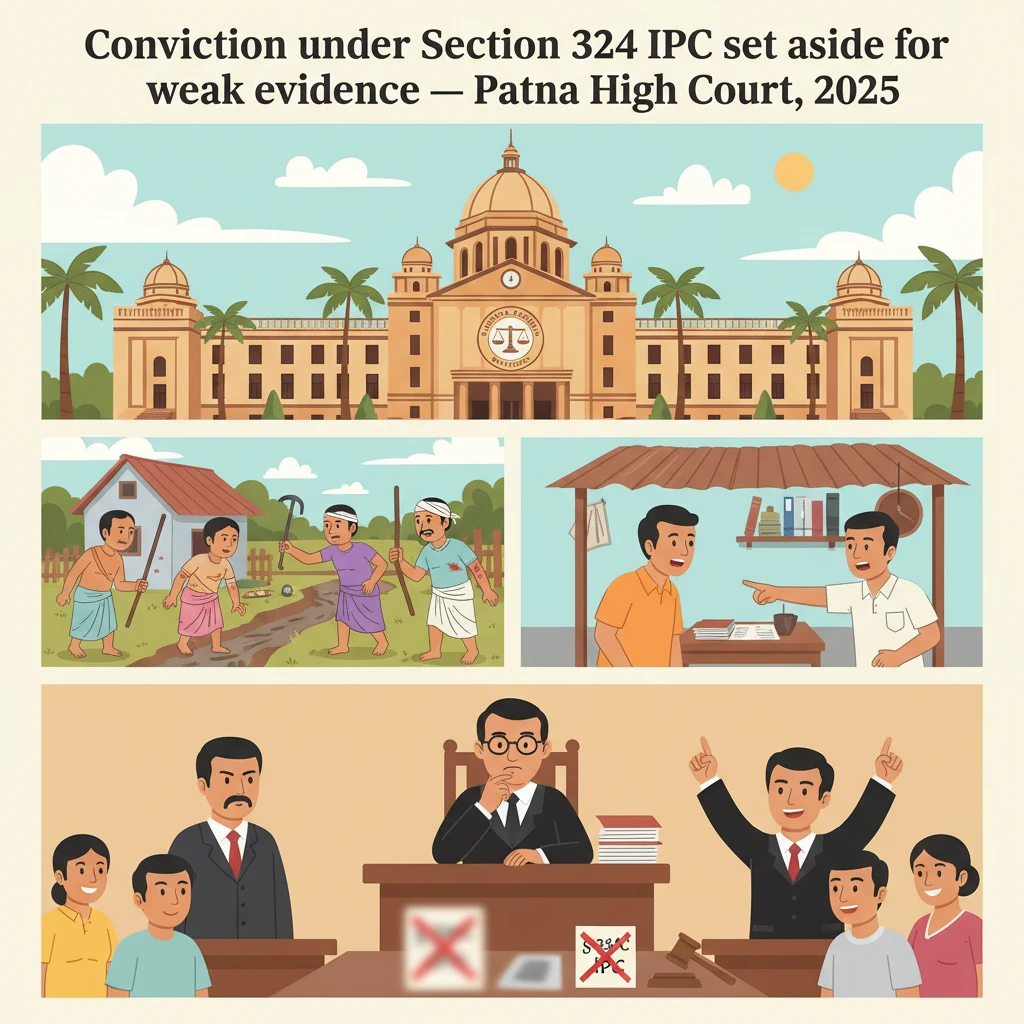
Case Background
The case arose from an incident in village Chaugai, Police Station Murar, District Buxar, in 1990. According to the prosecution, a quarrel broke out between two neighbouring families over drainage water that had been blocked. The informant, Kameshwar Singh, and his family members were allegedly assaulted by the appellants and other co-accused.
On the basis of the informant’s fardbeyan, Murar P.S. Case No. 25 of 1990 was registered for offences under Sections 452, 341, 323 and 324 of the Indian Penal Code. Later, on supervision by the police inspector, Sections 325 and 307 IPC were added. A charge-sheet was submitted and cognizance was taken for all these sections.
The case was committed to the Court of the Additional Sessions Judge-IV, Fast Track Court, Buxar, and registered as Sessions Trial No. 820 of 1992 / 37 of 2002. Charges were framed against the accused under Sections 325/34, 324, 307 and 452 IPC. The accused pleaded not guilty and claimed trial.
During trial, the prosecution examined five witnesses: the informant (PW-1), his mother (PW-2), his wife (PW-3), an alleged eye-witness (PW-4), and the doctor (PW-5). The only exhibited document was the First Information Report (Exhibit-1). No injury report or medical document was marked as an exhibit.
By judgment dated 26.03.2004, the Additional Sessions Judge-IV, F.T.C., Buxar convicted the present appellants under Section 324 IPC and sentenced each to rigorous imprisonment for one year. They already stood acquitted by the trial court under Sections 307 and 325 IPC. Aggrieved, the appellants filed Criminal Appeal (SJ) No. 291 of 2004 before the Patna High Court.
What the Court Examined and Decided
The Patna High Court, presided over by Hon’ble Mr. Justice Alok Kumar Pandey, heard the appeal on 06.12.2025. The main question framed by the Court was whether, on the facts and evidence available, an offence under Section 324 IPC was made out against the appellants.
Counsel for the appellants, appointed as amicus curiae, argued that the conviction was unsustainable because crucial prosecution evidence was either missing or unreliable. He pointed out that:
- The original injury report was not on record and no copy had been formally exhibited.
- The doctor (PW-5) admitted that he was deposing only on the basis of an attested copy of the injury report, which was not in his handwriting and whose signatory he could not identify.
- The Investigating Officer (I.O.), a key witness to prove the place and manner of occurrence and to confront witnesses with their earlier statements, was not examined.
- The three injured witnesses (PW-1, PW-2 and PW-3) gave divergent versions about the place and manner of assault, and their testimonies departed significantly from the original FIR.
According to the appellants, these defects created serious doubt not only about the nature of injuries and weapons used but also about where and how the incident occurred. They contended that, on the same set of evidence, the trial court had already found it unsafe to convict under Sections 307 and 325 IPC, and yet, without reliable proof of injuries, it still convicted under Section 324 IPC. This, they argued, was inconsistent and contrary to criminal law principles.
The State, represented by the learned A.P.P., supported the conviction. The State argued that there were three injured witnesses whose testimonies broadly supported the FIR. It was submitted that the doctor had described the injuries and their nature, and the trial court had rightly relied on this material to convict under Section 324 IPC. According to the State, the judgment was based on evidence and required no interference.
The High Court carefully examined the trial record, including depositions of all witnesses and the impugned judgment.
Assessment of Witness Testimony
The Court first scrutinised the evidence of the informant (PW-1). In the FIR, PW-1 alleged that appellant no. 1 Santosh Singh struck him on the head with a digging iron rod (Rami), co-accused Mantokhi Singh hit his wife on the head with a lathi, and the appellants and others assaulted his mother, brother and sister with lathis. However, in his examination-in-chief, PW-1 added and altered several details:
- He now stated that appellant no. 2 Karan Singh actually assaulted his wife on the head with a spade, not merely carried one as mentioned in the FIR.
- He newly alleged that co-accused Guddi Singh assaulted his mother’s arm with a lathi, though the FIR had no specific allegation of assault by Guddi Singh.
- He further stated that co-accused Mantokhi Singh assaulted him with a lathi when he fell, a detail missing from the FIR.
The Court found these to be material “improvisations” not present in the initial version. It held that such inconsistencies made PW-1’s testimony unreliable. Even on the place of occurrence, PW-1’s boundary description in cross-examination differed from that of other witnesses.
Next, PW-2 (the informant’s mother) described the cause of the quarrel as blockage of the house drain by the appellants; when her younger son opened it, appellant no. 1 allegedly slapped him. She claimed that when her elder son (the informant) came, Santosh Singh struck his head with a Rami and co-accused Mantokhi Singh hit his back with a lathi when he fell. She added that Guddi Singh broke her hand with a lathi and Karan Singh struck her daughter-in-law on the head with a spade.
The Court noted that these details again differed from the FIR: there was no earlier allegation of slapping Uma Shankar, of Mantokhi assaulting the informant, or of Guddi Singh’s role. Her boundary description of the place of occurrence was also quite different from PW-1’s. These discrepancies in both the manner and place of occurrence led the Court to doubt her credibility.
PW-3 (the informant’s wife) substantially repeated the reason for the dispute but gave yet another version of the assaults. She said that after an exhortation by Guddi Singh to kill the informant, Santosh Singh hit the informant’s head with a Rami and Mantokhi hit his back with a lathi. She claimed that Guddi Singh assaulted her mother-in-law’s hand, fracturing it, that Karan Singh hit her own head with a spade, and that Mantokhi struck her leg.
Here too the Court found that PW-3’s version clashed with the FIR and with others. For instance, while the FIR alleged that Mantokhi hit her head with a lathi, PW-3 now said he hit her leg. There was no original allegation against Guddi Singh, yet PW-3 introduced one. Her boundary description of the scene, with only the drain to the north and her own house to the south, differed from both PW-1 and PW-2. The Court held that such improvisation made her evidence untrustworthy.
PW-4, Mohan Ojha, was a chance witness from another village. He claimed that on hearing noise he went to the informant’s door and saw the appellants and others beating the informant, his mother and his wife. He added details such as Guddi Singh fracturing the mother’s hand with a lathi, Santosh Singh hitting PW-1’s head with a “Rama”, Mantokhi then striking PW-1’s head with a lathi, and Karan Singh assaulting PW-3’s head with a spade.
Once again, the Court found that PW-4’s description did not match the FIR and significantly changed who allegedly assaulted whom. He also could not properly indicate the place of occurrence. The Court therefore treated him as an unreliable chance witness.
Medical Evidence and Missing Injury Report
The doctor (PW-5), Satyendra Nath Sinha, deposed that on 13.07.1990 he examined three persons: Kameshwar Singh, Pandhari (Pardhano) Devi and Sudha Devi. He described a sharp injury and a bruise on the informant, swelling near the right wrist requiring X-ray in the case of the mother, and abrasions and bruises on Sudha Devi, noting that most injuries were simple and caused by hard and blunt objects. On perusal of an X-ray, he opined that the mother had a fracture, making that injury grievous.
However, in cross-examination, PW-5 admitted that he was giving evidence only on the basis of an attested copy of the injury report, which was not in his handwriting. He did not remember whose signature was on that copy. The original X-ray report and plate were not before him. Crucially, the prosecution never exhibited the injury report or X-ray report as evidence.
The High Court held that in the absence of a properly exhibited injury report, the doctor’s oral evidence had “no significance”. As an expert witness, the doctor’s role is to explain and authenticate medical documents already proved. When no such document was on record, and even the attested copy was not shown to be genuine, his testimony could not safely establish the nature, number or cause of injuries for the purpose of Section 324 IPC.
Effect of Non-examination of Investigating Officer
The Court emphasised that the Investigating Officer had not been examined. Citing the Supreme Court decision in Behari Prasad v. State of Bihar (1996) 2 SCC 317, the Court acknowledged that non-examination of the I.O. is not automatically fatal in every case. However, where it causes prejudice by preventing clarification of contradictions and proof of the place of occurrence, it becomes a serious infirmity.
Applying this principle, the Court held that in the present case the defence suffered real prejudice. There were many contradictions and omissions in the prosecution evidence, and only the I.O. could have confirmed what each witness stated in the investigation and precisely where the incident took place. Because the I.O. was absent, the prosecution failed to firmly establish the place of occurrence.
The Court referred to the Supreme Court judgment in Syed Ibrahim v. State of Andhra Pradesh (2008) 10 SCC 601, which held that when the place of occurrence itself is not established, it would not be proper to accept the prosecution case. Here, different witnesses gave conflicting boundary descriptions and even PW-4 could not point out the scene clearly. Thus, the place of occurrence remained doubtful.
Application of Section 324 IPC
The High Court reproduced Section 324 IPC, which punishes voluntarily causing hurt by dangerous weapons or means. It noted that to sustain a conviction under this section, the prosecution must prove, among other things, the nature of the injury, the weapon used and the circumstances of the assault.
In this case, since no injury report or medical document was exhibited, the nature and cause of injuries could not be reliably established. The doctor’s oral testimony, unsupported by authenticated records, could not fill this gap. At the same time, the appellants had already been acquitted of the more serious charges under Sections 307 and 325 IPC due to insufficiency of evidence. On the same weak material, the Court found it “difficult to assume” that Section 324 IPC could still be attracted.
Overall, the Court held that the prosecution evidence suffered from multiple serious infirmities: inconsistent and improved eyewitness accounts, unproved place of occurrence, non-examination of the I.O., and absence of proved medical records. These shortcomings meant that the prosecution had not proved its case beyond reasonable doubt, as required in criminal law.
Consequently, the High Court set aside the judgment of conviction and sentence under Section 324 IPC. The criminal appeal was allowed. As the appellants were already on bail, they were discharged from their bail bonds. The Court also directed that the trial court records be returned and ordered payment of Rs. 10,000 to the amicus curiae for his assistance.
Why This Judgment Matters
This judgment is important for ordinary people involved in criminal cases arising out of village disputes, especially where allegations of assault are made. It shows that even if injuries are claimed and several family members support the story, the Court will not sustain a conviction unless the prosecution proves every crucial point with reliable evidence.
The Patna High Court has made it clear that:
- Medical documents like injury reports and X-rays must be properly produced and proved.
- Witnesses cannot keep changing or “improvising” their versions between the FIR and court testimony.
- The exact place of the incident must be clearly shown, usually through the Investigating Officer.
If these requirements are not met, the benefit of doubt goes to the accused. For victims, this judgment underlines the importance of ensuring that the police investigation is complete and that all key documents are put before the court. For accused persons, it reaffirms that criminal conviction is not possible on shaky or half-proved evidence.
Legal Issues and Answers
Issue: Whether, on the facts and evidence on record, the offence of voluntarily causing hurt by dangerous weapons under Section 324 IPC was proved against the appellants.
Answer: No. The Patna High Court held that due to inconsistent witness testimonies, failure to prove the place of occurrence, non-examination of the Investigating Officer, and absence of a proved injury report or medical records, the prosecution failed to establish the ingredients of Section 324 IPC beyond reasonable doubt. The conviction and sentence were therefore set aside.
Cases Cited by the Court
- Behari Prasad v. State of Bihar, (1996) 2 SCC 317 – on the effect of non-examination of the Investigating Officer and when it causes prejudice to the accused.
- Syed Ibrahim v. State of Andhra Pradesh, (2008) 10 SCC 601 – holding that when the place of occurrence itself is not established, it is unsafe to accept the prosecution case.
Case Details
Case Number: Criminal Appeal (SJ) No. 291 of 2004
Case Title: Santosh Singh and another v. State of Bihar
Court: High Court of Judicature at Patna
Coram: Hon’ble Mr. Justice Alok Kumar Pandey
Date of High Court Judgment: 06.12.2025
Trial Court: Additional Sessions Judge-IV, Fast Track Court, Buxar in Sessions Trial No. 820/92 / 37/2002
Trial Court Judgment and Sentence: Dated 26.03.2004; appellants convicted under Section 324 IPC and sentenced to rigorous imprisonment for one year.
High Court Outcome: Appeal allowed; conviction and sentence under Section 324 IPC set aside; appellants discharged from bail bonds.
Citation: 2026 (2) PLJR 21
Advocates:
- For the appellants: Mr. Krishna Kant Singh, Amicus Curiae
- For the State: Mr. Ramchandra Singh, APP
Nature of the Case: Criminal appeal (against conviction under Section 324 IPC)
Statutory Provisions Involved: Sections 324, 325, 307, 452, 341, 323 IPC; Section 313 CrPC (for accused statement)
Link to Judgment: View full judgment on the Patna High Court website
If you found this explanation helpful and wish to stay informed about
how legal developments may affect your rights in Bihar,
you may consider following Samvida Law Associates for more updates.







