
Case Background
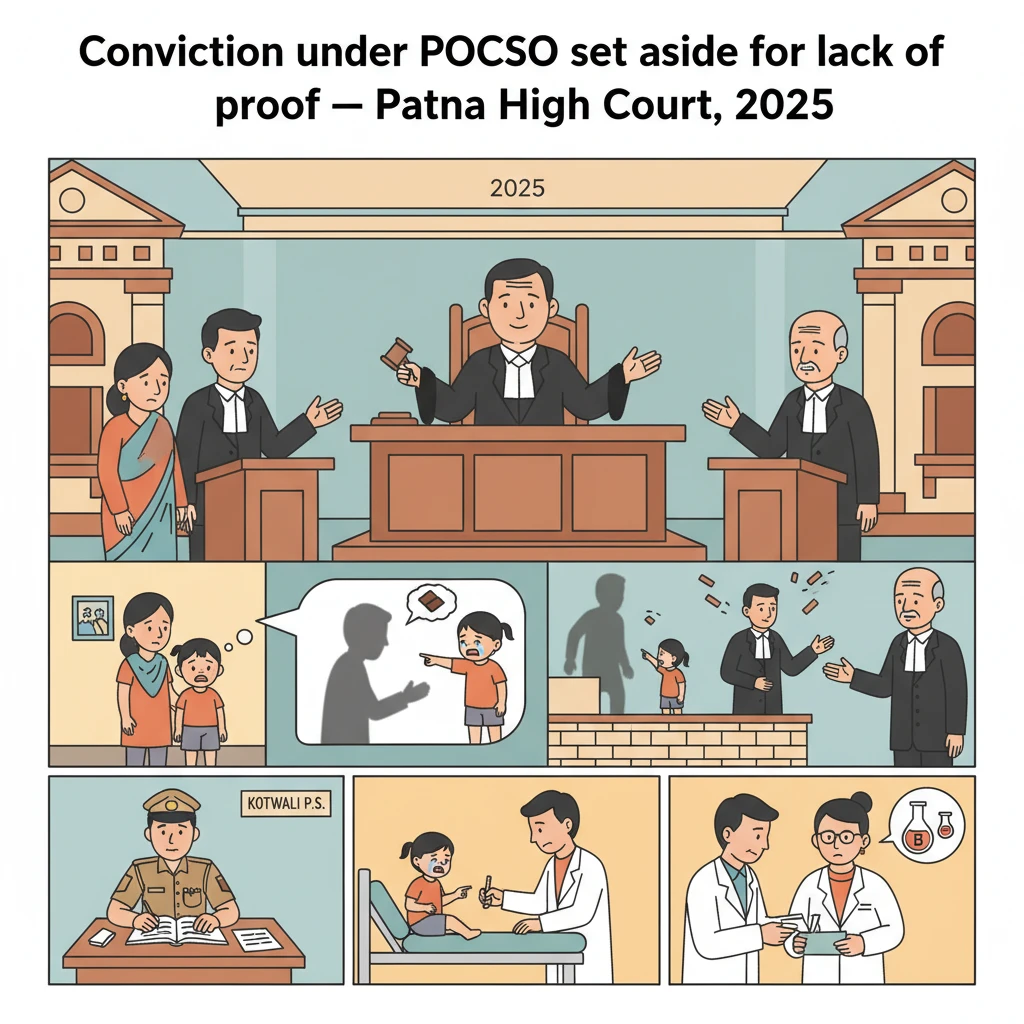
This case arose out of an allegation that a four-year-old girl was sexually assaulted in Bhagalpur on 22.03.2020. The informant, the child’s father, stated in his written complaint that around 7:30 P.M., the appellant, a distant relative, came to his house in a drunken state. According to him, the appellant took the child away on the pretext of giving her chocolate.
The father alleged that after 20–30 minutes, the appellant returned with the child and immediately left for his own house. The child was allegedly trembling, could not walk properly, and soon started crying loudly after hugging her mother. The parents claimed that the child then indicated, by pointing to her private parts, that the appellant had tried to commit an indecent act with her.
The informant said his daughter was in pain, and the family went to the appellant’s house, which was locked from inside. When neighbours gathered and called the appellant, he allegedly came onto the roof, abused them, and threw bricks and stones, injuring the informant’s brother.
On this written report, Kotwali (Tilkamanjhi) P.S. Case No. 211 of 2020 was registered under various sections of the IPC, POCSO Act, and Bihar Prohibition and Excise Act. Investigation followed. The victim and her mother’s statements were recorded under Sections 161 and 164 Cr.P.C. A charge sheet was submitted under Sections 363, 376, 337, 504 IPC, Sections 4/6 POCSO Act, and Section 37(c) of the Excise Act.
The Special POCSO Court at Bhagalpur took cognizance (excluding Section 37(c) of the Excise Act) and framed charges under Sections 363, 376, 337, 504 IPC, Sections 5(m)/6 and 18 of the POCSO Act, and Section 37(c) of the Excise Act. The appellant pleaded not guilty and faced trial.
During trial, the prosecution examined nine witnesses, including the victim, her mother, a doctor, police personnel, forensic science experts, and a Judicial Magistrate. The informant (father) died before his evidence could be recorded. The defence examined two witnesses.
The Special Court convicted the appellant under Section 376 IPC and Section 5(m)/6 of the POCSO Act, relying mainly on the medical evidence and the statements under Section 164 Cr.P.C. of the victim and her mother, and then drawing a presumption under Sections 29 and 30 of the POCSO Act. The appellant was sentenced to 20 years’ rigorous imprisonment with a fine of Rs. 50,000/- under the POCSO provision; no separate sentence was passed under Section 376 IPC due to Section 42 POCSO.
Aggrieved, the appellant filed Criminal Appeal (DB) No. 154 of 2023 before the Patna High Court. Respondent No. 2, the victim’s mother, though served notice, did not appear in the appeal.
What the Court Examined and Decided
The Division Bench of the Patna High Court (Hon’ble Mr. Justice Rajeev Ranjan Prasad and Hon’ble Mr. Justice Shailendra Singh) heard the appeal. The oral judgment was delivered by Hon’ble Mr. Justice Shailendra Singh on 22.07.2025.
On behalf of the appellant, it was argued that there was no reliable evidence connecting him to the alleged crime. Counsel pointed out that:
- The victim did not support the prosecution case in court.
- The trial court itself considered the victim not fit to be cross-examined and treated her as not competent, yet still relied on her earlier statement.
- The victim’s mother turned hostile and did not support the allegation in her evidence.
- No independent eyewitness supported the prosecution version.
- The doctor admitted that the injuries on the child’s private parts could have been caused by a fall.
- The Investigating Officer found nothing at the alleged place of occurrence confirming that the appellant committed any sexual act there.
The State, on the other hand, argued that the medical evidence clearly showed sexual assault, and the statements of the victim and her mother under Section 164 Cr.P.C. supported the FIR. On this basis, the prosecution claimed that the foundational facts were proved and that the presumption under Section 29 POCSO should operate against the appellant. According to the State, the appellant had failed to rebut this presumption and the conviction was justified.
The Patna High Court carefully examined the trial record, the medical evidence, FSL report, statements under Section 164 Cr.P.C., and the legal position regarding presumption under Sections 29 and 30 of the POCSO Act.
First, the Court noted that the trial court had mainly relied on Sections 29 and 30 POCSO to presume that the appellant committed the offence and had a culpable mental state. The High Court accepted that the FIR was promptly lodged and the medical examination was conducted without delay. The doctor (PW-4) found:
- Abrasions and redness on labia majora and labia minora;
- Vaginal tear with bleeding; and
- Presence of only 24 milk teeth, leading to an age estimate of 3 to 5 years.
The doctor’s opinion was that there was evidence of sexual assault and that the child was between 3 to 5 years of age. FSL report confirmed human semen of blood group B on a cut piece of the victim’s jeans pant.
However, the High Court stressed that even with such medical and forensic material, the prosecution still had to prove “foundational facts” connecting the appellant to the crime before the presumption under Section 29 POCSO could apply. The Court quoted and followed the principles laid down by the Delhi High Court in Veerpal v. State (2024 SCC OnLine Del 2686) and the Kerala High Court in Joy v. State of Kerala (2019 SCC OnLine Ker 783), which state that:
- The presumption under Section 29 operates only after the prosecution first proves basic facts beyond reasonable doubt.
- The presumption is rebuttable and cannot substitute for evidence.
- Courts must remain alert to inconsistencies, improbabilities or contradictions in the prosecution case.
Next, the Court examined the victim’s testimony. She was examined as PW-3 when she was about six years old. The doctor had earlier assessed her age between three to five years at the time of examination. The High Court found that the trial court did not properly test her competency as a witness under Section 118 of the Evidence Act. Very few questions were put to her, and she was not able to understand and answer properly. Significantly, the trial court did not permit the appellant to cross-examine the victim, considering it improper due to her age.
In these circumstances, the High Court held that the victim was not a competent witness at the time of her evidence. As a result, her court testimony could not be relied upon either for or against any side.
The Court then considered her Section 164 Cr.P.C. statement. That statement was recorded by a Judicial Magistrate when the child was only about four years old. Again, the Magistrate did not adequately examine her competency, and directly asked questions about the incident. The Court found this to be improper, particularly in light of Section 35 POCSO, which deals with evidence recorded by the Special Court, not with Section 164 Cr.P.C. statements. Relying on a Karnataka High Court judgment (Hanumantha Mogaveera v. State of Karnataka, 2021 SCC OnLine Kar 12300), the Court held that a Section 164 Cr.P.C. statement of a child is not evidence under Section 35 POCSO and cannot be treated as such.
The Court also reiterated that under the Evidence Act and Supreme Court precedent (State of Rajasthan v. Kartar Singh, (1970) 2 SCC 61), a statement under Section 164 Cr.P.C. is not a substantive piece of evidence. It can be used only to corroborate or contradict the testimony of that witness given later in court. Here, since the victim was treated as incompetent and her trial testimony was unusable, her Section 164 statement could not be used to support the conviction.
Turning to the victim’s mother, the Court noted important developments. She was the signatory on the written complaint but, in the witness box as PW-2, she clearly stated that nothing wrong had been done to her daughter. She deposed that the child came home weeping for some reason and that the case was lodged by her husband due to misunderstanding. In cross-examination, she expressed unwillingness to proceed with the case. The Court held that her evidence did not help the prosecution at all.
The Court then compared her Section 164 Cr.P.C. statement with the FIR and her court testimony. It found serious contradictions:
- The FIR alleged that the appellant came in a drunken state; the mother did not mention this before the Magistrate.
- The FIR stated that the child was taken on the pretext of giving chocolate; the Section 164 statement spoke of going to the market for “chaat”, and that parents had refused permission, after which the appellant allegedly entered the room and forcibly took the child. These facts did not appear in the written FIR.
- In her Section 164 statement, she said she was on bed rest after an operation when the appellant came. Yet, she had signed the written complaint as a witness, raising doubt as to how she accompanied her husband to the police station.
The High Court found that these contradictions were material and remained unexplained. Therefore, the Section 164 statement of the mother could not safely be used to convict the appellant, especially when her court testimony was completely different and did not support the prosecution.
The informant-father, who could have explained these events and confirmed the FIR contents, had died before he could testify. As a result, the FIR allegations remained unproved through oral evidence.
Regarding scientific evidence, although human semen was found on the child’s clothes, the Court pointed out that neither the Investigating Officer nor the prosecution took steps to match the semen with the appellant’s blood group or DNA. Therefore, the forensic report did not directly link the appellant to the crime.
Ultimately, the High Court concluded that, while the medical evidence supported that the child had been sexually assaulted, the prosecution had failed to establish the foundational facts that the appellant was the perpetrator. The ocular evidence of the crucial witnesses (victim and her mother) did not inspire confidence, and the FIR contents were not proved. In such a situation, the presumption under Section 29 POCSO could not be invoked to uphold the conviction.
On the contrary, the Court held that the material on record created reasonable doubt about the appellant’s involvement, entitling him to the benefit of doubt. Therefore, the conviction and sentence recorded by the Special POCSO Court were set aside, and the appeal was allowed. Since the appellant was in judicial custody, the High Court directed that he be released forthwith if not required in any other case.
Why This Judgment Matters
This judgment is important for both victims’ families and accused persons in POCSO cases. It shows that even in very sensitive cases involving small children, the Patna High Court insists on strict proof linking the accused to the offence.
The Court accepted that a sexual assault had taken place on a very young child. However, it refused to affirm a conviction when the victim was found incompetent as a witness, the mother turned hostile and contradicted herself, and the scientific evidence was not properly connected to the accused.
The decision reinforces that the presumption under Sections 29 and 30 POCSO is not automatic. The prosecution must first present clear and consistent basic facts. If key witnesses give contradictory versions or their statements are not recorded properly, the benefit of doubt goes to the accused.
For families, this case underlines the importance of truthful and consistent statements from the beginning. For lawyers and trial courts, it highlights the need to test a child’s competency properly, to respect the right of cross-examination, and to avoid treating Section 164 Cr.P.C. statements as full evidence.
Legal Issues and Answers
- Issue: Can a conviction under POCSO be sustained mainly on the basis of medical evidence and Section 164 Cr.P.C. statements when the victim is found incompetent and key witnesses do not support the prosecution in court?
Answer: No. The Patna High Court held that without reliable ocular evidence establishing foundational facts and proper competency of the child witness, Section 164 Cr.P.C. statements and medical evidence alone are insufficient, and the accused is entitled to benefit of doubt. - Issue: When does the presumption under Section 29 of the POCSO Act apply, and how strong is it?
Answer: The presumption under Section 29 applies only after the prosecution proves foundational facts beyond reasonable doubt. It is rebuttable and not a substitute for evidence. If there are serious contradictions and doubts in the prosecution case, the presumption cannot be used to uphold conviction. - Issue: What is the evidentiary value of a child’s Section 164 Cr.P.C. statement in a POCSO trial?
Answer: A Section 164 Cr.P.C. statement is not substantive evidence and cannot be treated as evidence under Section 35 POCSO. It can only be used to corroborate or contradict that witness’s competent testimony in court. If the child is not a competent witness, that statement cannot be the primary basis for conviction.
Cases Cited by the Court
- Veerpal v. State, 2024 SCC OnLine Del 2686 (Delhi High Court) – on the scope of presumption under Sections 29 and 30 POCSO.
- Joy v. State of Kerala, 2019 SCC OnLine Ker 783 (Kerala High Court) – on limits of the statutory presumption under Section 29 POCSO.
- Hanumantha Mogaveera v. State of Karnataka by Women Police Station, 2021 SCC OnLine Kar 12300 (Karnataka High Court) – on distinction between Section 164 Cr.P.C. statements and evidence under Section 35 POCSO.
- State of Rajasthan v. Kartar Singh, (1970) 2 SCC 61 (Supreme Court) – on Section 164 Cr.P.C. statement not being substantive evidence.
Case Details
Case Number: Criminal Appeal (DB) No. 154 of 2023; arising out of Kotwali (Tilkamanjhi) P.S. Case No. 211 of 2020; POCSO Case No. 41/2020
Case Title: Ajay Kumar Sah @ Ajay Kumar v. The State of Bihar & Anr.
Citation: 2025 (3) PLJR 808
Court: High Court of Judicature at Patna
Coram: Hon’ble Mr. Justice Rajeev Ranjan Prasad; Hon’ble Mr. Justice Shailendra Singh
Date of Judgment: 22.07.2025
Advocates:
- For the Appellant: Dr. Manoj Kumar, Advocate; Ms. Sweety Sinha, Advocate; Ms. Kshem Sharma, Advocate
- For the State: Mr. Parmeshwar Mehta, Additional Public Prosecutor
Nature of the Case: Criminal appeal (Division Bench) against conviction and sentence under Section 376 IPC and Sections 5(m)/6 of the POCSO Act, and other allied offences.
Outcome: Conviction and sentence set aside; appeal allowed; appellant directed to be released if not required in any other case.
Link to Judgment: Click here to view the official Patna High Court judgment
If you found this explanation helpful and wish to stay informed about
how legal developments may affect your rights in Bihar,
you may consider following Samvida Law Associates for more updates.







