

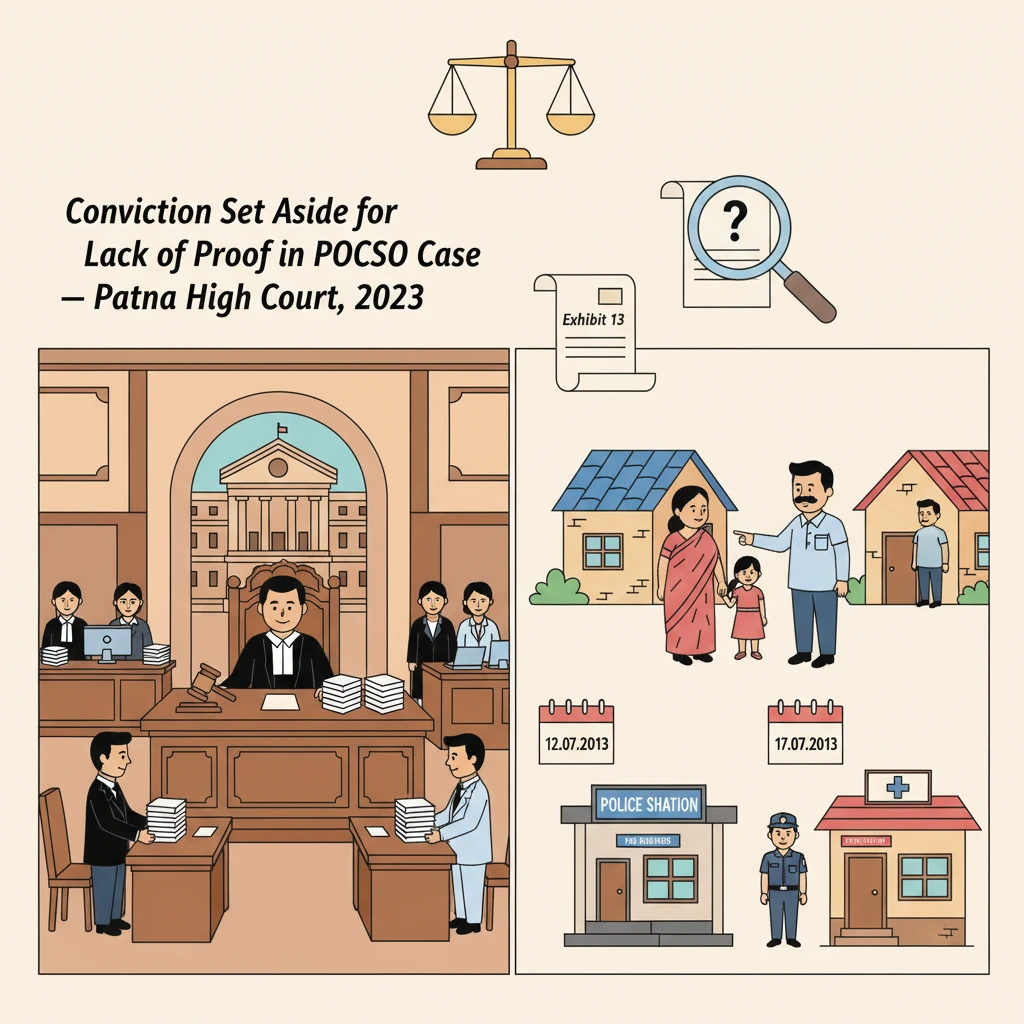
Case Background
This case arose from a written complaint filed on 12.07.2013 by the father of a minor girl (P.W.7) at Dumraon Police Station, District Buxar.
He alleged that around 7:30 p.m. that evening, the neighbour (later the appellant) took his seven-year-old daughter to his house and raped her. According to the complaint, the child returned home crying and narrated the incident to her mother (P.W.1). The mother then informed the father, who put the complaint in writing and submitted it to the police.
On that basis, Dumraon P.S. Case No. 137 of 2013 was registered on 12.07.2013 for the alleged offence under Section 376 of the Indian Penal Code.
The victim was sent for medical examination during the same night. Her statement under Section 164 of the Code of Criminal Procedure was recorded on 15.07.2013. She was again medically examined on 17.07.2013 by a medical board. Statements of other witnesses were taken under Section 161 Cr.P.C. and, after investigation, charge-sheet was filed for offences under Sections 376 and 377 IPC.
The trial court took cognizance on 26.07.2013 and committed the case to the Sessions Court. On 31.10.2013, charges under Sections 376(2)(f) and 377 IPC were framed. On 25.01.2016, a charge under Section 4 of the Protection of Children from Sexual Offences (POCSO) Act was added. The accused pleaded not guilty.
During trial, the appellant was first in custody from 12.07.2013 to 01.02.2014, when he was granted bail. He surrendered again on 14.12.2021. Bail was granted on 31.01.2022 but he was taken into custody on 07.02.2022 and remained in jail thereafter.
By judgment dated 07.02.2022 and sentence dated 09.02.2022 in POCSO Case No. 18 of 2015, the Additional District and Sessions Judge-VI-cum-Special Judge, POCSO Act, Buxar convicted the appellant under Section 376(2)(f) IPC, Section 377 IPC and Section 4 of the POCSO Act and imposed life imprisonment and other terms with fines. All sentences were to run concurrently.
The appellant filed Criminal Appeal (DB) No. 206 of 2022 before the Patna High Court challenging this conviction and sentence.
What the Court Examined and Decided
The Division Bench of the Patna High Court, speaking through Hon’ble Justice Smt. Gunnu Anupama Chakravarthy, heard arguments from both sides and re-examined the entire evidence produced during trial.
The key question before the Court was whether the prosecution had successfully proved, beyond reasonable doubt, that the appellant committed sexual assault/rape and unnatural offences on the minor girl, so as to justify conviction under Sections 376(2)(f) and 377 IPC and Section 4 of the POCSO Act.
The Court first focused on whether the medical evidence supported the oral testimony of the prosecution witnesses.
Evidence of the Mother (P.W.1)
P.W.1, the mother of the victim, stated that on 12.07.2013 at about 6:00 p.m. the victim was subjected to anal rape. She deposed that the accused took the victim to his house, removed her pant and raped her from behind. The child returned home limping. She claimed she removed the child’s pant and noticed blood and semen on it.
However, during cross-examination, P.W.1 made important admissions. She admitted that she had told the police inspector that she saw blood oozing from the genitals of the victim. She also admitted that there was no blood on the victim’s leg. She further admitted that the victim went to the police station wearing the same pant/underwear.
Thus, even within her own statement, there were inconsistencies about the nature and place of injury and the presence of blood.
Evidence of Aunt and Grandmother (P.W.2 and P.W.3)
P.W.2, the paternal aunt of the victim, said that between 6:30 p.m. and 7:00 p.m. on the same day she saw the child crying and coming out of the accused’s house. The child initially did not tell her anything, but at home told P.W.1 what had happened. P.W.2 claimed that when P.W.1 removed the child’s pant, she saw blood stains and sperms on the genitals.
P.W.3, the grandmother, also claimed that she saw blood and semen on the pant of the victim and swelling on the anus. She said she came to know of the incident through P.W.1 and P.W.2.
However, P.W.9, the grandfather of the victim, later stated that on the date of the incident he and his wife (the grandmother) were in Ranchi with other daughters. This statement made the presence of P.W.2 and P.W.3 at the place of occurrence highly doubtful in the eyes of the High Court.
Evidence of another relative (P.W.4)
P.W.4 stated that he saw women crying at the house of P.W.1 and noticed blood and semen on the private parts of the child, and that the back of the victim was scratched and swollen.
But these details did not match with the medical findings. The Court found P.W.4’s version inconsistent with the medical evidence.
Evidence of Panch Witnesses (P.W.5 and P.W.6)
P.W.5 and P.W.6 were panch witnesses to a seizure list dated 12.07.2013 relating to a bed-sheet seized from the accused’s house. Both turned hostile and did not support the prosecution.
Evidence of Father (P.W.7)
The father (P.W.7) confirmed that he was not present at the time of the incident and came to know of it from his wife. He said that his sister wrote the written complaint, and he signed it (Exhibit 2).
Importantly, in cross-examination, P.W.7 specifically admitted that he did not speak to his daughter after the incident. This meant that even he had no direct account from the child herself.
Evidence of the Victim (P.W.8)
The Sessions Judge first asked simple questions to P.W.8 to confirm that she could understand and give rational answers. Once satisfied, the court recorded her evidence.
However, P.W.8 did not say anything about the incident during her testimony in court. She was therefore declared hostile. The High Court noted that there was no substantive testimony from the victim supporting the prosecution at trial.
Medical Evidence (P.W.10 and P.W.11)
P.W.10, the doctor, examined the victim twice. The first examination was on the night of 12.07.2013. She found no injury on the vulva or vaginal wall. The vagina did not admit even the tip of a finger. Based on radiological findings, she assessed the victim’s age as 7–8 years and opined that rape had not been committed.
After the victim’s statement under Section 164 Cr.P.C. was recorded, she was again examined on 17.07.2013. P.W.10 checked the anus and found no injury or scratch marks and no sign of anal penetration.
Thus, medical evidence clearly did not support either a genital rape or anal penetration.
P.W.11, another doctor, examined the accused on 13.07.2013. He found the accused mentally and physically normal, with no injuries, and capable of performing sexual intercourse. The High Court noted that this, by itself, could not prove the charges.
Other Evidence (P.W.12 and P.W.13)
P.W.12 was the Investigating Officer, and P.W.13 was the Judicial Officer who recorded the Section 164 Cr.P.C. statement of the victim. The High Court noted their roles but focused on whether the Section 164 statement could, on its own, sustain the conviction.
Reliance on Section 164 Cr.P.C. Statement
The trial court had mainly relied on the victim’s earlier statement under Section 164 Cr.P.C. to convict the appellant, since the victim did not repeat these allegations in court.
The appellant’s counsel argued that such a statement can be used only for corroboration or contradiction, not as the sole basis for conviction, especially when the victim and key family witnesses did not support the prosecution and when medical evidence was negative. He also argued that there were contradictions between witnesses.
He relied on the Supreme Court judgment in R. Shaji v. State of Kerala, (2013) 14 SCC 266. The Supreme Court had clarified that evidence in court under oath is substantive evidence, while a Section 164 statement is mainly for corroboration or contradiction and cannot usually stand alone to convict.
The State argued that there was no error in the trial court judgment and that the Section 164 statement was clear enough to prove the offence.
High Court’s Reasoning
The Patna High Court examined the contradictions and gaps:
First, it found inconsistencies between P.W.1’s version of anal rape and the versions of P.W.2 and P.W.3, who spoke of genital rape. P.W.4’s account of scratches and swelling did not match the medical examination.
Second, the Court noted P.W.9’s statement that he and his wife were in Ranchi on the date of occurrence, which cast doubt on whether P.W.2 and P.W.3 were present at all.
Third, the victim herself turned hostile and gave no evidence about the incident during trial. The Court stressed that there was no eye-witness to the assault.
Fourth, the medical evidence, both regarding genital and anal examination, did not show any injury or sign of penetration and even contained a clear opinion that rape had not been committed.
In this situation, the Court held that, in the absence of substantive oral evidence supported by medical findings, the appellant must be presumed innocent. The Section 164 Cr.P.C. statement of the victim could not, by itself, form the sole basis for conviction, particularly when not supported by her testimony in court and when the medical evidence was contrary.
The Court concluded that there was no reliable evidence to prove commission of offences under Sections 376(2)(f) or 377 IPC, or to justify conviction under Section 4 of the POCSO Act, even with the presumption in Section 29 of the Act. The trial court’s reliance solely on the Section 164 statement was held unsustainable.
Therefore, the High Court set aside the judgment of conviction dated 07.02.2022 and the order of sentence dated 09.02.2022.
Since the appellant was in jail from 07.02.2022, the Court directed that he be released forthwith, if not required in any other case, and discharged him from all liabilities of bail bonds and sureties.
Why This Judgment Matters
This judgment shows how the Patna High Court checks whether a conviction in a sensitive POCSO matter is supported by solid and consistent evidence.
The Court emphasised that a statement recorded before a magistrate under Section 164 Cr.P.C. cannot be the only basis to send someone to jail for life, especially when the child witness does not support the story in court and medical reports do not show any sign of assault.
For families of victims, it underlines the importance of giving clear and consistent statements and ensuring that the child is properly supported to speak the truth in court. For accused persons, it shows that courts will look carefully at contradictions and will grant benefit of doubt if the prosecution case is not proved beyond reasonable doubt.
More broadly, the decision reinforces the principle that even in serious offences like POCSO and rape, the standard of proof remains high, and every conviction must rest on reliable, corroborated evidence.
Legal Issues and Answers
- Issue: Did the prosecution prove beyond reasonable doubt that the appellant committed rape and unnatural offences on the minor victim under Sections 376(2)(f) and 377 IPC and Section 4 POCSO?
Answer: No. The Patna High Court held that contradictions among witnesses, doubtful presence of key witnesses, the victim turning hostile, and medical evidence not supporting assault meant that guilt was not established and benefit of doubt had to go to the appellant. - Issue: Could the victim’s statement under Section 164 Cr.P.C. alone, without support from her testimony in court or medical evidence, sustain the conviction?
Answer: No. The Court held that a Section 164 statement can be used for corroboration or contradiction but cannot be the sole basis for conviction in the absence of substantive supporting evidence. - Issue: Was the trial court justified in invoking Section 29 of the POCSO Act to uphold conviction under Section 4 POCSO in these facts?
Answer: No. The High Court held that even with Section 29, the conviction could not stand without reliable evidence, and therefore the POCSO conviction was also set aside.
Cases Cited by the Court
- R. Shaji v. State of Kerala, (2013) 14 SCC 266.
Case Details
Case Number: Criminal Appeal (DB) No. 206 of 2022; arising out of Dumraon P.S. Case No. 137 of 2013; POCSO Case No. 18 of 2015.
Case Title: Satyamanu Kumar Singh v. The State of Bihar.
Citation: 2024 (1) 311.
Court: High Court of Judicature at Patna.
Coram: Hon’ble Mr. Justice Chakradhari Sharan Singh; Hon’ble Justice Smt. Gunnu Anupama Chakravarthy.
Date of High Court Judgment: 08.11.2023.
Trial Court Judgment and Sentence: Judgment of conviction dated 07.02.2022 and order of sentence dated 09.02.2022 by Additional District and Sessions Judge VI-cum-Special Judge, POCSO Act, Buxar.
Advocates: For the appellant – Mr. Bindhyachal Singh, Senior Advocate; Mr. Parijat Saurav, Advocate; Mr. Vipin Kumar Singh, Advocate. For the State – Ms. Shasi Bala Verma, A.P.P.
Nature of Case: Criminal appeal (Division Bench) against conviction and sentence under Sections 376(2)(f) and 377 IPC and Section 4 of the POCSO Act.
Final Outcome: Conviction and sentence set aside; appellant directed to be released if not required in any other case; bail bonds and sureties discharged.
Link to Judgment: Click here to read the full Patna High Court judgment
If you found this explanation helpful and wish to stay informed about
how legal developments may affect your rights in Bihar,
you may consider following Samvida Law Associates for more updates.







