

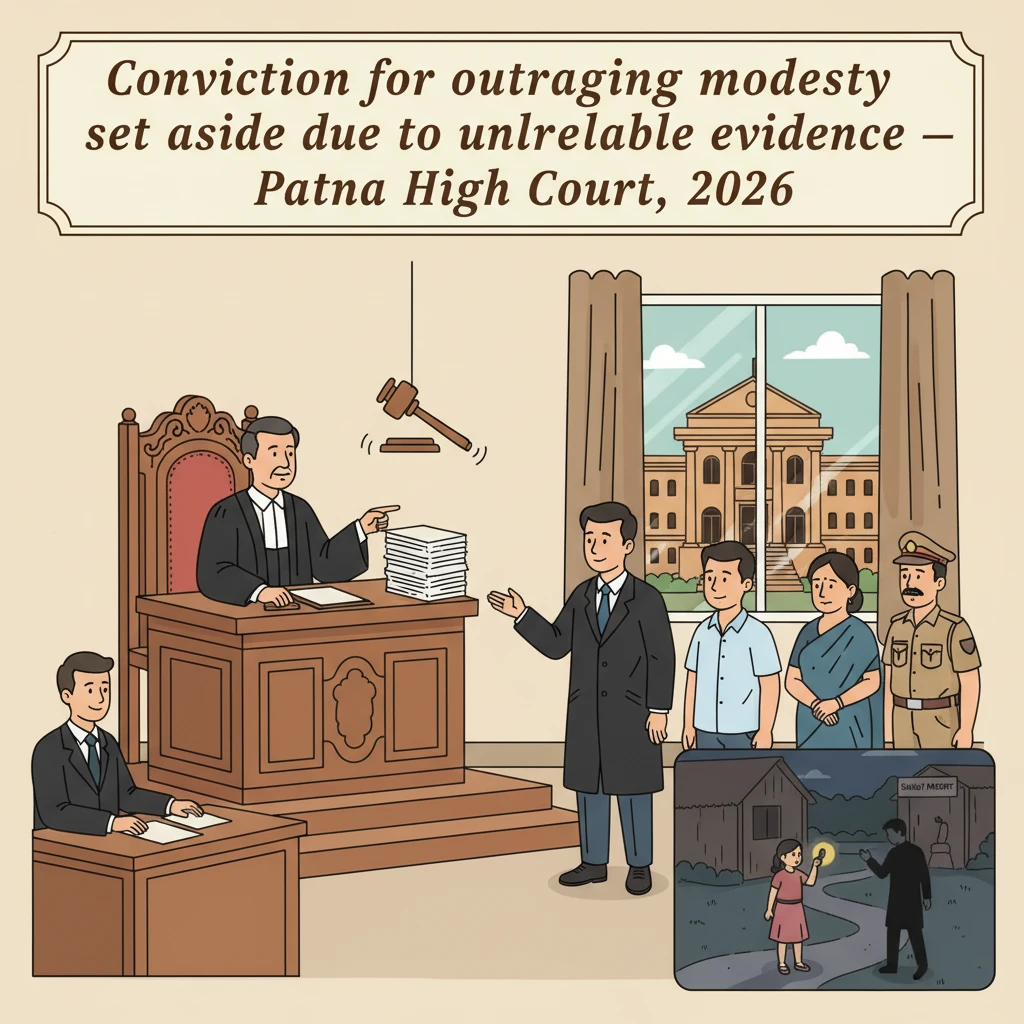
Case Background
This case arose from an incident said to have taken place in village Purhara, P.S. Chauri, District Bhojpur, on the night of 08.06.2021 at about 11:30 p.m.
According to the written report lodged by the victim, a 15-year-old girl, she was going to watch a dance programme at the house of a villager, Udhi (also written as Uddhav) Rai. On the way, near the house of one Sanjay Master, the appellant allegedly caught hold of her when nobody else was around and started talking in an indecent manner.
The victim stated that she freed her hand, raised alarm, and the appellant then slapped her when she threatened to inform her guardians and villagers. After returning home, she narrated the incident to her parents, leading to the lodging of the written complaint.
On this written application, Chouri P.S. Case No. 63 of 2021 was registered under Sections 341, 323, 354-B and 504 of the Indian Penal Code. The police conducted routine investigation, recorded statements, and submitted a charge-sheet against the appellant.
The Special POCSO Court at Ara took cognizance under Sections 323, 341, 354-A, 354-B, 504 of the IPC and Sections 8 and 12 of the POCSO Act, and later framed charges accordingly. The appellant pleaded not guilty and claimed trial.
After trial, by judgment dated 21.07.2025 in POCSO Case No. 50 of 2021, the Special Judge convicted the appellant under Sections 354-A and 341 IPC, while acquitting him of Sections 354-B and 504 IPC and Sections 8 and 12 of the POCSO Act. He was sentenced to rigorous imprisonment for one year and fine of Rs. 5,000 for Section 354-A IPC (with one month R.I. in default), and a fine of Rs. 500 and fifteen days’ simple imprisonment in default for Section 341 IPC.
The appellant challenged this conviction and sentence before the Patna High Court in Criminal Appeal (SJ) No. 3490 of 2025.
What the Court Examined and Decided
Hon’ble Mr. Justice Alok Kumar Pandey heard the appeal and examined both the trial court’s reasoning and the entire evidence on record. The central question framed was whether the offences under Sections 354-A and 341 IPC were made out on the given facts and circumstances.
The prosecution examined five witnesses: the victim’s father (P.W.1), the victim herself (P.W.2), her brother (P.W.3), her uncle (P.W.4) and the Investigating Officer (P.W.5). The defence did not lead any evidence and the appellant’s stand under Section 313 Cr.P.C. was a total denial of the allegations.
Key contradictions in witnesses’ versions
The Court carefully compared what the witnesses said in court with the original written report and with each other’s statements.
P.W.1, the victim’s father, was admittedly not present at the place of occurrence. He claimed that the incident was narrated to him by his daughter. However, in another part of his evidence (para 22), he stated that he came to know of the incident from his wife. He also introduced a new allegation that the appellant’s father came and abused, which did not appear in the FIR. The Court noted that his testimony suffered from infirmities and discrepancies.
P.W.2, the victim, was the sole eye-witness. In the written report, her case was that the appellant caught hold of her hand in a lonely place, spoke indecently, she raised alarm, freed herself, and was slapped when she threatened to disclose the incident. There was no mention in that written report of any torch, of her being thrown to the ground, clothes being torn, or specific injuries.
However, in her examination-in-chief before the Court, P.W.2 gave a much graver version. She said that on 18.06.2021 at about 11:30 p.m., she was going to watch the dance. She claimed she had a torch in her hand, that the appellant came from behind, tied her mouth, thrashed her on the ground, tore her clothes and assaulted her. She said she identified him in the light of the torch and, though she cried, no one came to rescue her. She then fled, went home and narrated the incident to her parents.
During cross-examination, several contradictions emerged:
- On permission to go out: In para 8 she stated that she informed her mother and went to watch the dance programme, though her mother refused permission and she went stealthily. This conflicted with her earlier claim of going with permission. The High Court found these different versions about how she left the house to be contradictory and questionable.
- On the torch: She said it was dark at the place of occurrence, that the torch broke when she fell, and that she did not show the torch or even the broken torch to the police. Later she claimed she showed the place of occurrence to the police but admitted that neither the torch nor its glass was there, and she did not tell the police about the torch at all. Crucially, she accepted that in her written application to the police, she had not mentioned the torch or identification of the appellant in its light.
- On injuries: She claimed injury only on her right leg, no other part of the body was injured, and she did not show this injury to the police.
- On sequence at home: She first informed her mother as her father had gone for a marriage function. Her father came half an hour later, after getting information. She said she then went to the police station with her father, his elder brother and her younger brother.
P.W.3, the victim’s brother, stated that his sister was returning from the dance when the appellant began to behave indecently. This version directly conflicted with the original FIR story where the assault allegedly happened while she was going towards the dance venue. He also admitted that he was not present at the place of occurrence and that the incident was not reported to the village Mukhiya or Sarpanch.
P.W.4, the victim’s uncle, said that she went alone to see the dance after getting permission from her guardians. In para 18, he said that when she was returning after watching the dance, the appellant scuffled with her and she started crying. This again contradicted the original prosecution version regarding the time and manner of occurrence.
Defective investigation and missing corroboration
The Investigating Officer, P.W.5, admitted several serious lapses. He stated that:
- He did not record the statement of boundary witnesses of the place of occurrence.
- He did not record the statement of Sanjay Master or his family members, although the alleged incident took place near their house.
- He recorded statements of Bhagwan and Bhikhari Singh, who said the mental condition of the appellant was not good and he was under treatment at Piro, yet no medical examination of the appellant was done.
- He did not get the victim medically examined.
- Though he said he conducted investigation regarding the victim’s age, this was not reflected in the case diary.
- No torn clothes were ever handed over to him during investigation.
The High Court observed that this investigation was full of infirmities. When a case involves serious allegations against a minor girl, the basic steps of medical examination, collection of clothes, and questioning of nearby residents are crucial. Their absence meant the truth of the case was not properly investigated.
Assessment of credibility and legal consequence
Having gone through all the evidence, the High Court concluded that the testimonies of all prosecution witnesses suffered from substantial infirmities, discrepancies and inconsistencies.
The Court placed particular emphasis on the victim’s changing versions. She had not mentioned in the FIR important later claims such as tearing of clothes, thrashing to the ground, and presence of a torch. These were introduced for the first time during her deposition in court, which suggested a twist in the prosecution story to make the offence appear graver. Her contradictory statements about permission from her mother and her own conduct raised further doubts about reliability. The Court found that her statement did not inspire confidence.
The Court also noted that, on the same set of facts, the trial court itself had already acquitted the appellant of the more serious charges under Sections 354-B and 504 IPC and Sections 8 and 12 of the POCSO Act, after holding that the allegations lacked cogent evidence and there was no mention of abusive language. In this backdrop, when the core testimony itself was doubtful, the High Court found no sound reason to uphold conviction even for Sections 354-A and 341 IPC.
Ultimately, the Court held that, in view of settled principles of criminal jurisprudence, where the prosecution case suffers from several infirmities and the main witness does not inspire confidence, it is not safe to maintain a conviction. Benefit of doubt must go to the accused.
Accordingly, the Patna High Court set aside the judgment of conviction and order of sentence dated 21.07.2025 and allowed the criminal appeal. The appellant, already on bail, was discharged from all liabilities of his bail bonds. All pending interlocutory applications were disposed of, and the trial court records were ordered to be returned.
Why This Judgment Matters
This judgment is important for families and victims as well as accused persons because it shows how closely courts examine the consistency of statements in sensitive criminal cases.
The Patna High Court made it clear that even in cases involving a minor girl, conviction cannot stand if the evidence is not reliable. Major changes between the written complaint and later statements in court, and a weak or careless investigation, can lead to an acquittal.
For police and prosecutors, the case underlines the need to conduct thorough investigation, record all relevant witness statements, arrange timely medical examinations, and collect physical evidence such as torn clothes or objects used during the incident. Failure to do so weakens the case in court.
For villagers and ordinary people, the case explains that while the law protects women and children against sexual harassment and wrongful restraint, the courts will still insist on trustworthy evidence before sending someone to jail.
Legal Issues and Answers
-
Issue: Whether, on the facts and evidence on record, the offences under Sections 354-A and 341 IPC were proved beyond reasonable doubt against the appellant.
Answer: No. The Patna High Court found the prosecution evidence full of contradictions and inconsistencies, the investigation defective, and the victim’s testimony unreliable. It held that this was not a fit case for conviction and therefore set aside the conviction under Sections 354-A and 341 IPC.
Cases Cited by the Court
- The judgment does not mention or rely upon any prior decided cases. The Court’s decision is based on an assessment of the evidence and general principles of criminal jurisprudence.
Case Details
Case Number: Criminal Appeal (SJ) No. 3490 of 2025, arising out of Chouri P.S. Case No. 63 of 2021, District Bhojpur.
Case Title: Vishal Kumar @ Raja v. The State of Bihar & Anr.
Citation: 2026(2) PLJR 224
Court: High Court of Judicature at Patna
Coram: Hon’ble Mr. Justice Alok Kumar Pandey
Date of High Court Judgment: 20.01.2026
Date of Trial Court Judgment under Appeal: 21.07.2025
Advocates:
- For the Appellant: Mr. Ashutosh Kumar, Advocate
- For the State (Respondent): Mr. Syed Ashfaque Ahmad, APP
Nature of the Case: Criminal appeal (single judge) against conviction and sentence under Sections 354-A and 341 IPC passed by the Special Judge, Exclusive POCSO Court-cum-ADJ-VI, Bhojpur at Ara, in POCSO Case No. 50 of 2021.
Link to Full Judgment: Click here to read the official Patna High Court judgment
If you found this explanation helpful and wish to stay informed about how legal developments may affect your rights in Bihar, you may consider following Samvida Law Associates for more updates.







