

Case Background
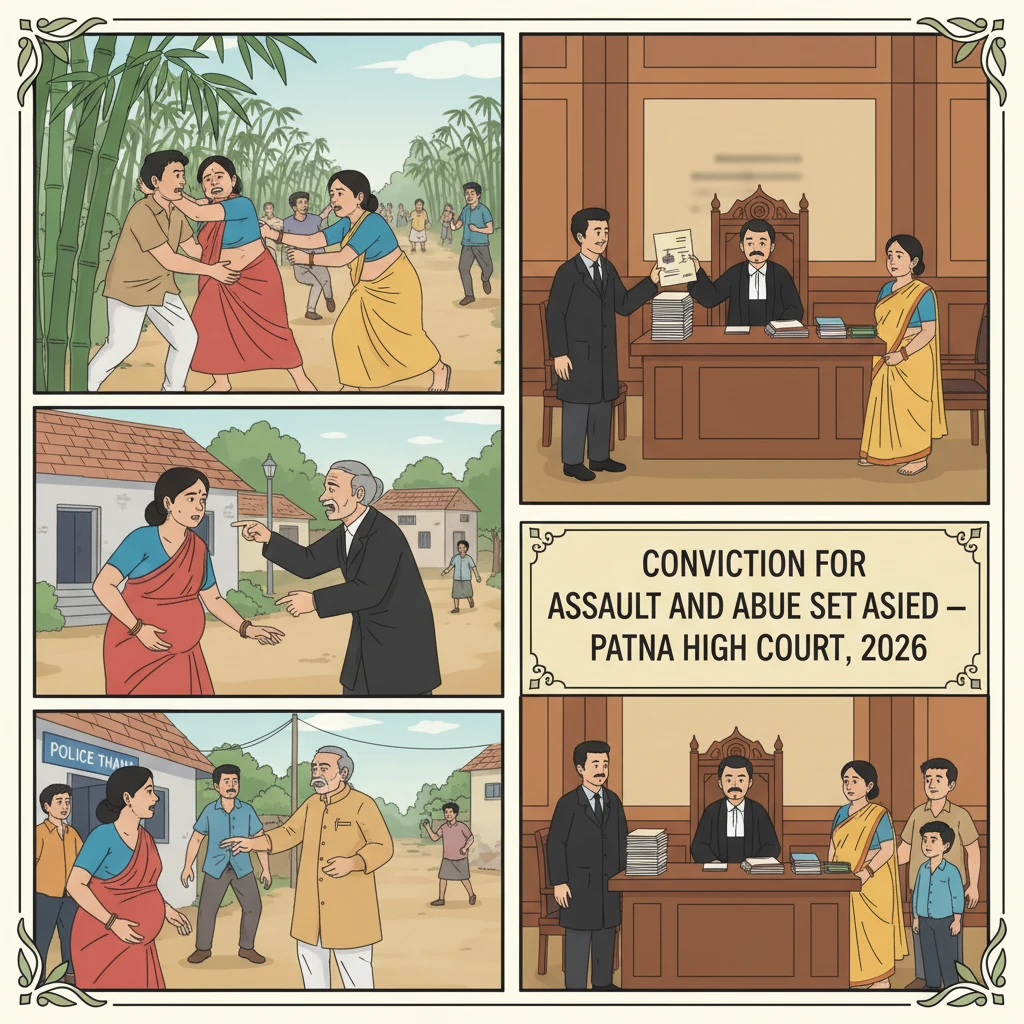
This case began with a complaint filed in 2002 in Darbhanga district. The complainant, a woman, alleged that she was assaulted early in the morning on 23.08.2002 near a bamboo orchard, about 50 laggis from her house. According to her, she had gone there along with her sister-in-law, Urmila Devi, to attend the call of nature.
In the complaint, she claimed that one accused, Mukesh Singh, first came there and called his uncle by saying that a bird had been trapped. Then appellant no.1 reached the spot, abused her and questioned what they were doing there. She stated that appellant no.1 caught hold of both her hands, while co-accused Mukesh Singh pressed her mouth.
The complainant further alleged that appellant no.1 tore her blouse, pushed her to the ground and tried to “commit wrong” with her by lifting her saree and petticoat. On her resistance, her sister-in-law reached there and raised an alarm, asking the accused why they were doing such an act with a pregnant woman. Both accused then allegedly assaulted the complainant by giving 2–3 leg blows on her abdomen.
She stated that when her sister-in-law tried to save her, she too was assaulted. On their cries, villagers allegedly arrived, at which point the accused ran away. Later, according to the complaint, her father and brother went to the guardian of the accused, appellant no.2, who allegedly abused and assaulted them and drove them away.
The complainant claimed that because of the assault, her two-and-half month pregnancy terminated. She also stated that a Panchayat meeting was called by the accused themselves to settle the matter, but they did not follow the decision of the Panchayat and again abused the complainant’s side. After her health improved, she went to the concerned police station, but, as per her claim, the Station House Officer refused to take her complaint and turned her out of the police station.
Since the police did not register a case as per her version, she approached the Sub-Divisional Judicial Magistrate with a complaint (Complaint Case No. 936 of 2002). The Magistrate, after recording statements under Section 200 Cr.P.C. and examining four witnesses on the complainant’s side, took cognizance of the offences and committed the case to the Court of Sessions.
The case was then tried as Sessions Trial Case No. 291 of 2009 before the 1st Additional Sessions Judge, Darbhanga. Appellant no.1 and co-accused Mukesh Kumar Singh were charged under Sections 313 and 316 read with Section 34 of the IPC, and appellant no.1 was also separately charged under Section 376 read with Section 511 IPC. Both appellants and Mukesh Kumar Singh were jointly charged under Section 323 IPC and Section 3(1)(x) of the SC/ST (Prevention of Atrocities) Act.
During the trial, co-accused Mukesh Kumar Singh was found to be a juvenile on the date of the incident. His case was separated and sent to the Juvenile Justice Board. The trial against the two appellants continued before the Sessions Court.
Ultimately, the trial court acquitted appellant no.1 of the graver charges under Sections 313, 316 and 376/511 IPC and acquitted both appellants of the charge under Section 3(1)(x) of the SC/ST Act. However, both appellants were convicted under Sections 323 and 504 IPC, and appellant no.1 was additionally convicted under Section 354 IPC. Each appellant was sentenced to six months’ imprisonment under Sections 323 and 504 IPC, and appellant no.1 was sentenced to one year’s imprisonment under Section 354 IPC, with all sentences to run concurrently.
Aggrieved by this conviction and sentence, both appellants filed Criminal Appeal (SJ) No. 37 of 2014 before the Patna High Court. The appeal was heard by Hon’ble Mr. Justice Shailendra Singh, who delivered an oral judgment on 31.01.2026.
What the Court Examined and Decided
The Patna High Court closely examined the evidence recorded by the trial court and the arguments made by both sides. The focus was on whether the prosecution had proved the offences under Sections 323, 504 and 354 IPC beyond reasonable doubt.
On behalf of the appellants, learned senior counsel Mr. Alok Kumar highlighted that there was an eight-day delay between the alleged incident on 23.08.2002 and the filing of the complaint. He argued that in cases like this, some delay of 3–4 days may be explained by medical treatment or family discussions, but here a major portion of the delay remained unexplained.
The defence stressed that, according to the complainant and PW-4 (sister-in-law), several villagers had reached the place of occurrence on hearing the alarm, yet none of them were produced as prosecution witnesses. No independent witness was examined to support the crucial parts of the story.
PW-1, the complainant’s father, claimed that the complainant was taken to a private doctor, Dr. Sunita Sinha, at Laheriyasarai and that medical papers were available. However, despite this admission, no medical prescription or document was produced before the trial court. The complainant herself had earlier stated that she would produce such documents, but they were never brought on record.
Defence counsel also argued that there were serious contradictions about who went to the house of appellant no.2, who went to the hospital, who was present at the hospital, and how long the complainant remained under treatment. These inconsistencies, according to the appellants, made the prosecution story doubtful.
Another important point raised was the existence of a prior dispute between the parties over a bamboo orchard. Prosecution witnesses admitted that there was a conflict regarding cutting of bamboo from the appellants’ orchard. The defence contended that this enmity was the real background and that a false case had been lodged due to this dispute.
On the other side, the State, represented by learned APP Mr. Bipin Kumar, supported the trial court judgment. He submitted that, for the offences actually resulting in conviction, the testimonies of PW-4 and PW-5 were the most relevant, as both claimed to be eye-witnesses to the incident at the bamboo orchard. He fairly accepted that PW-1, PW-2 and PW-3 were not eye-witnesses.
The High Court first analysed the issue of delay. From the depositions of PW-1 to PW-5, the main reasons put forward for the eight-day delay were: the complainant’s treatment at Laheriyasarai by Dr. Sunita Sinha, and the convening of a Panchayat meeting between the parties. However, there was no documentary evidence regarding treatment, nor any Panch or villager was examined to confirm that a Panchayat actually took place. Even if these grounds were accepted at face value, the Court noted that at least 5–7 days remained unexplained. This “inordinate delay” weakened the prosecution version.
The Court then moved to the alleged contradictions in the evidence. PW-1 deposed that on hearing commotion, he rushed to the spot along with villagers and claimed to be an eye-witness. But the complainant (PW-5) and PW-4 both stated that at the time of assault, only they were present, and that family members and villagers came later. In particular, PW-4 said in cross-examination that after the assault she attended to the complainant, the accused fled, and only about half an hour later did her father-in-law, mother-in-law and other villagers reach there.
This directly contradicted PW-1’s claim that he had witnessed the assault. PW-4 also said she remained with the complainant throughout the incident, which left no room for PW-1 being present at the exact time of occurrence. PW-1 further claimed he had informed various villagers and named them, yet none of them were examined by the prosecution, and there was no explanation for this failure.
Another important inconsistency related to PW-2, the complainant’s brother. PW-1 stated that during the occurrence his son (PW-2), wife (PW-3), Pramila Devi, and 10–12 other persons were with him. But PW-4’s testimony suggested that PW-2 was not present at home at the relevant time and came only half an hour after the complainant had been taken to hospital. This again raised doubt about PW-1’s version.
There were also conflicting statements about the treatment period. PW-1 said that the complainant regained consciousness about one-and-a-half hours after reaching Dr. Sunita Sinha’s clinic and that they returned home the next morning. In contrast, PW-5 stated that she regained consciousness three days after the incident. The High Court treated this as a “serious discrepancy” affecting PW-1’s credibility and the overall reliability of the prosecution story.
Considering these aspects, the Court found substance in the defence argument that there were “major contradictions” in the prosecution evidence. This was particularly important in the context of admitted enmity over bamboo cutting from the appellants’ orchard. Independent defence witnesses (D.W.1 to D.W.4) were examined and their evidence, according to the Court, further “supports the doubt”.
The High Court also made an important observation on how to treat the case when the main part of the incident is disbelieved. The trial court had already rejected the serious allegations about causing miscarriage (Sections 313 and 316 IPC), attempting rape (Section 376/511 IPC) and caste-based insult under the SC/ST Act. It had nonetheless relied on the same set of witnesses to convict for the “minor” offences of hurt (Section 323 IPC), insult (Section 504 IPC) and outraging modesty (Section 354 IPC).
The High Court disagreed with this approach. It reasoned that when the prosecution witnesses are not believed for the major allegations, and the occurrence is found doubtful in its crucial aspects, it is unsafe to rely on those very testimonies for the so-called minor offences. In this case, the alleged acts forming major and minor offences were “so interconnected that they cannot be separated”. If the main occurrence is in doubt, the entire story becomes unreliable.
On this basis, the Court concluded that it was improper to maintain the conviction of the appellants even for Sections 323, 504 and 354 IPC. The benefit of doubt had to go to the accused.
Accordingly, the High Court set aside the judgment of conviction and order of sentence dated 20.12.2013 passed by the 1st Additional Sessions Judge, Darbhanga in Sessions Trial Case No. 291 of 2009. The criminal appeal was allowed in full.
Since the appellants were already on bail during the pendency of the appeal, the Court cancelled their bail bonds and discharged both them and their sureties from all liabilities. It also directed that the trial court records, along with a copy of the High Court judgment, be sent back for necessary compliance.
Why This Judgment Matters
This decision of the Patna High Court is significant for criminal cases involving allegations of assault, outraging modesty and related offences. It shows that courts will look very carefully at delays in filing complaints and at contradictions in witness statements, especially when there is known enmity between parties.
For complainants and their families, the judgment underlines the importance of prompt legal action, preserving medical records and ensuring that independent witnesses are produced whenever possible. Where serious allegations like attempt to rape and causing miscarriage are made, the Court expects stronger and more consistent evidence.
For accused persons, the case demonstrates that if the prosecution relies only on related witnesses and their versions suffer from major contradictions, the benefit of doubt can lead to acquittal even after conviction by a trial court. It also clarifies that when the main part of the prosecution story is disbelieved, courts should be slow to pick and choose parts of the same story to convict for lesser offences.
Legal Issues and Answers
- Issue: Whether the eight-day delay in filing the complaint and lack of supporting evidence created serious doubt about the prosecution case.
Answer: Yes. The Patna High Court held that the delay remained largely unexplained and was not backed by medical documents or Panchayat witnesses, which weakened the prosecution version. - Issue: Whether convictions under Sections 323, 504 and 354 IPC could stand when the same witnesses were disbelieved regarding the major charges.
Answer: No. The Court held that since the major and minor allegations were part of one inseparable occurrence and the key witnesses were unreliable, it was unsafe to sustain convictions for the minor offences alone. - Issue: Whether the appellants were entitled to benefit of doubt in light of contradictions and admitted enmity between the parties.
Answer: Yes. The Court found serious contradictions in prosecution evidence and noted the background dispute over bamboo orchard, concluding that the appellants deserved acquittal.
Cases Cited by the Court
- The judgment text does not mention or rely upon any specific earlier case law by name or citation.
Case Details
Case Number: Criminal Appeal (SJ) No. 37 of 2014; arising out of Complaint Case No. 936 of 2002; Sessions Trial Case No. 291 of 2009; P.S. Case No. 936 of 2002, Darbhanga.
Case Title: Raj Kumar Singh @ Bhola Singh and another vs. The State of Bihar.
Coram: Hon’ble Mr. Justice Shailendra Singh.
Citation: 2026 (2) PLJR 445.
Advocates: For the appellants – Mr. Alok Kumar, Senior Advocate; Mr. Birendra Kumar Singh, Advocate; Mr. Raghwendra Pratap Singh, Advocate; Ms. Tanya Kumari, Advocate. For the State – Mr. Bipin Kumar, APP.
Nature of Case: Criminal appeal (single judge) against judgment of conviction and order of sentence passed by the 1st Additional Sessions Judge, Darbhanga.
Link to Judgment: Full text of Patna High Court judgment
If you found this explanation helpful and wish to stay informed about how legal developments may affect your rights in Bihar, you may consider following Samvida Law Associates for more updates.







