
Case Background
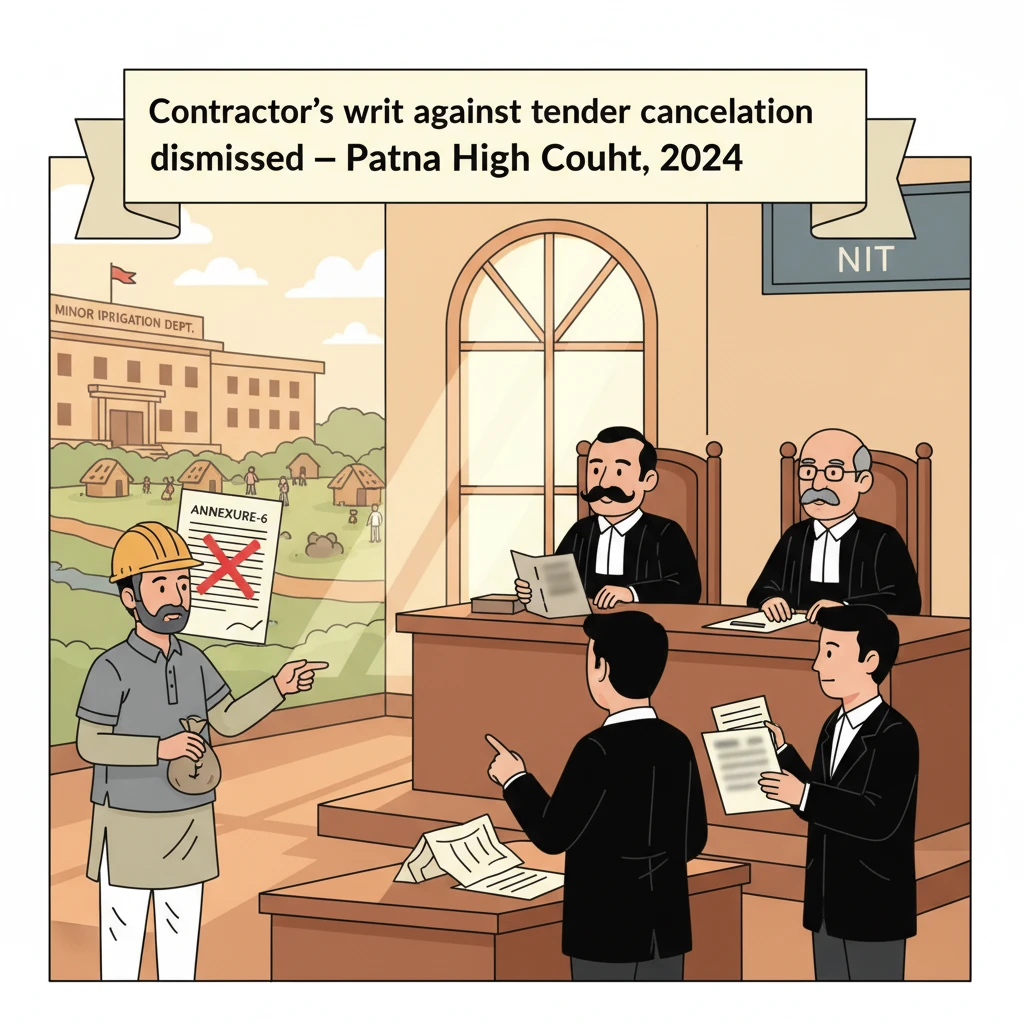
The case arose from a Notice Inviting Tender (NIT) issued by the Minor Irrigation Department, Government of Bihar, Patna. The tender related to work described as “Surangpur Ahar”.
The petitioner, a construction firm acting through its proprietor, submitted a bid under this NIT. The bid was successful and a work order was issued in favour of the petitioner.
However, the petitioner did not deposit the entire earnest money required under the NIT. Only a part of the earnest money deposit was paid. The agreement for execution of the work was also not signed.
The department then passed an order cancelling the work order and forfeiting the part earnest money that had been deposited. This cancellation order was placed on record as Annexure-6 in the writ petition.
Aggrieved by this cancellation and the forfeiture of the earnest money, the petitioner approached the Patna High Court by filing Civil Writ Jurisdiction Case No. 2611 of 2024. During this period, the department issued a fresh NIT for the same work, which was filed by the respondents as Annexure-P/7.
What the Court Examined and Decided
The oral judgment was delivered on 07-03-2024 by a Division Bench of the Patna High Court, comprising Hon’ble the Chief Justice and Hon’ble Mr. Justice Harish Kumar. The judgment was authored by Hon’ble the Chief Justice.
The core grievance of the petitioner was twofold: first, against the cancellation of the work order; second, against the forfeiture of the earnest money deposit that had been partly paid. The petitioner also sought refund of the forfeited amount.
The department’s cancellation order stated that the full earnest money deposit had not been made and that the agreement had not been executed. On this basis, the work order was cancelled and the part earnest money was forfeited.
Before the Court, the petitioner attempted to justify its conduct by relying on alleged encroachments at the work site. According to the petitioner’s counsel, a representation had been filed before the authorities seeking removal of encroachments. The petitioner argued that, without removal of these encroachments, the work could not have been carried out. On this ground, the petitioner did not deposit the full earnest money and did not execute the agreement.
The Bench carefully examined this line of argument. The Court noted that when a notice of tender is published, any intending bidder is expected to know the nature and location of the work. A responsible contractor is required to exercise “abundant caution” by inspecting the site before deciding to participate in the tender.
In this case, the petitioner voluntarily chose to bid under the NIT and was declared successful. Having done so, the Court held that the petitioner could not later turn around and say that, unless the encroachments were removed, it would neither deposit the earnest money in full nor sign the agreement.
The Bench made it clear that the proper course of action for the petitioner was different. After becoming the successful bidder, the petitioner first had to comply fully with the terms of the NIT: that is, to deposit the entire earnest money and execute the formal agreement with the department.
Only after fulfilling these basic contractual requirements could the petitioner lawfully raise any issue about encroachments or obstacles at the site. The Court emphasised that a contractor who has already bid and succeeded in the tender process “cannot dictate terms” to the awarding authority.
In simple terms, the Court said that the contractor cannot make its own conditions first and insist that the department clear the encroachments before it will even complete the formalities of the contract. Such conduct was treated as a breach of the tender terms by the petitioner.
The Court also took note of the fact that, due to the petitioner’s failure to deposit the full earnest money and execute the agreement, the work remained held up. Because of this default, the Minor Irrigation Department had to publish a fresh NIT for the same work. This meant extra time and expense for the department, apart from delay in execution of a public project.
In light of these facts, the Bench found “no infirmity” either in the order cancelling the earlier work order or in the issuance of the fresh tender, Annexure-P/7. The cancellation was therefore upheld as a valid exercise of power by the department in terms of the NIT.
During the hearing, learned counsel for the petitioner requested that, even if the cancellation was sustained, at least the earnest money already deposited be refunded. The Court firmly rejected this request.
The Bench explained that the petitioner’s failure to execute the agreement, despite being the successful bidder, amounted to a clear default. Because of this default, the department was justified in forfeiting the earnest money that had been deposited.
The Court also linked this forfeiture to the consequences of the petitioner’s non-performance. The work could not proceed, and the department was forced to incur additional expenditure by floating a fresh tender. The forfeiture of earnest money was therefore viewed as a legitimate consequence of the petitioner’s breach, not as a punishment without cause.
Having reached these conclusions, the Court dismissed the writ petition. No relief was granted to the petitioner either against the cancellation of the work order or regarding refund of the earnest money deposit. The cancellation order and the fresh tender remained in force, and the forfeiture of the part earnest money stood confirmed.
For contractors and government departments alike, this decision underscores that earnest money and tender conditions are not mere formalities. The Court treated them as binding commitments once a bidder has successfully participated in the NIT and been awarded the work.
Why This Judgment Matters
This judgment is significant for contractors who participate in government tenders in Bihar, especially in infrastructure and irrigation projects. The Patna High Court has clearly indicated that once a bidder becomes successful, they must strictly comply with all tender conditions, including depositing the full earnest money and executing the agreement.
If a contractor has doubts about site conditions, such as encroachments or other obstacles, the Court expects the contractor to inspect the site before bidding. Entering the bidding process without proper checks and then refusing to complete the formalities is treated as a serious default.
The decision also matters for government departments. It supports their right to cancel a work order and forfeit earnest money when a successful bidder fails to honour the basic terms of the tender. It also recognises that re-tendering causes delay and extra cost, and that forfeiture of earnest money is a justified response to such default.
For ordinary readers, especially small and medium contractors, the message is simple: if you win a government tender, you must be ready to deposit the full earnest money and sign the contract. Raising objections after winning, without first completing these steps, can lead to cancellation of the work and loss of the money already deposited.
Legal Issues and Answers
- Issue: Whether the Minor Irrigation Department acted lawfully in cancelling the work order and forfeiting the part earnest money deposit when the successful bidder failed to deposit the full earnest money and execute the agreement, citing encroachments at the work site.
Answer: Yes. The Patna High Court held that the petitioner, having bid and turned successful, was bound to first comply with the NIT by depositing the entire earnest money and executing the agreement. The petitioner could not impose conditions on the department or withhold compliance on the ground of encroachments. The cancellation of the work order, issuance of a fresh tender, and forfeiture of the earnest money were all upheld as valid.
Cases Cited by the Court
- No previous judgments or case law have been cited or relied upon in the text of this judgment.
Case Details
Case Number: Civil Writ Jurisdiction Case No. 2611 of 2024
Case Title: Shri Ganesh Laxhmi Ekta Construction through its proprietor Ajay Kumar Singh vs. The State of Bihar & Ors.
Citation: 2024(2) PLJR 199
Court: High Court of Judicature at Patna
Coram: Hon’ble the Chief Justice; Hon’ble Mr. Justice Harish Kumar
Date of Judgment: 07-03-2024
Advocates: For the petitioner – Mr. Manoj Kumar Singh, Advocate; For the respondents – Mr. Government Pleader 05
Respondent Authorities: Principal Secretary, Department of Minor Irrigation, Government of Bihar, Patna; Chief Engineer, Minor Irrigation Department, Bihar, Patna; Superintending Engineer, Riding Road, Sekhpura, Patna; Executive Engineer, Minor Irrigation Division, Ara, Bhojpur.
Nature of the Case: Writ petition challenging cancellation of work order, forfeiture of earnest money deposit, and issuance of fresh tender under a Notice Inviting Tender issued by the Minor Irrigation Department.
Link to Judgment: https://patnahighcourt.gov.in/viewjudgment/MTUjMjYxMSMyMDI0IzEjTg==-FxWdsNcuwKU=
If you found this explanation helpful and wish to stay informed about how legal developments may affect your rights in Bihar, you may consider following Samvida Law Associates for more updates.







