
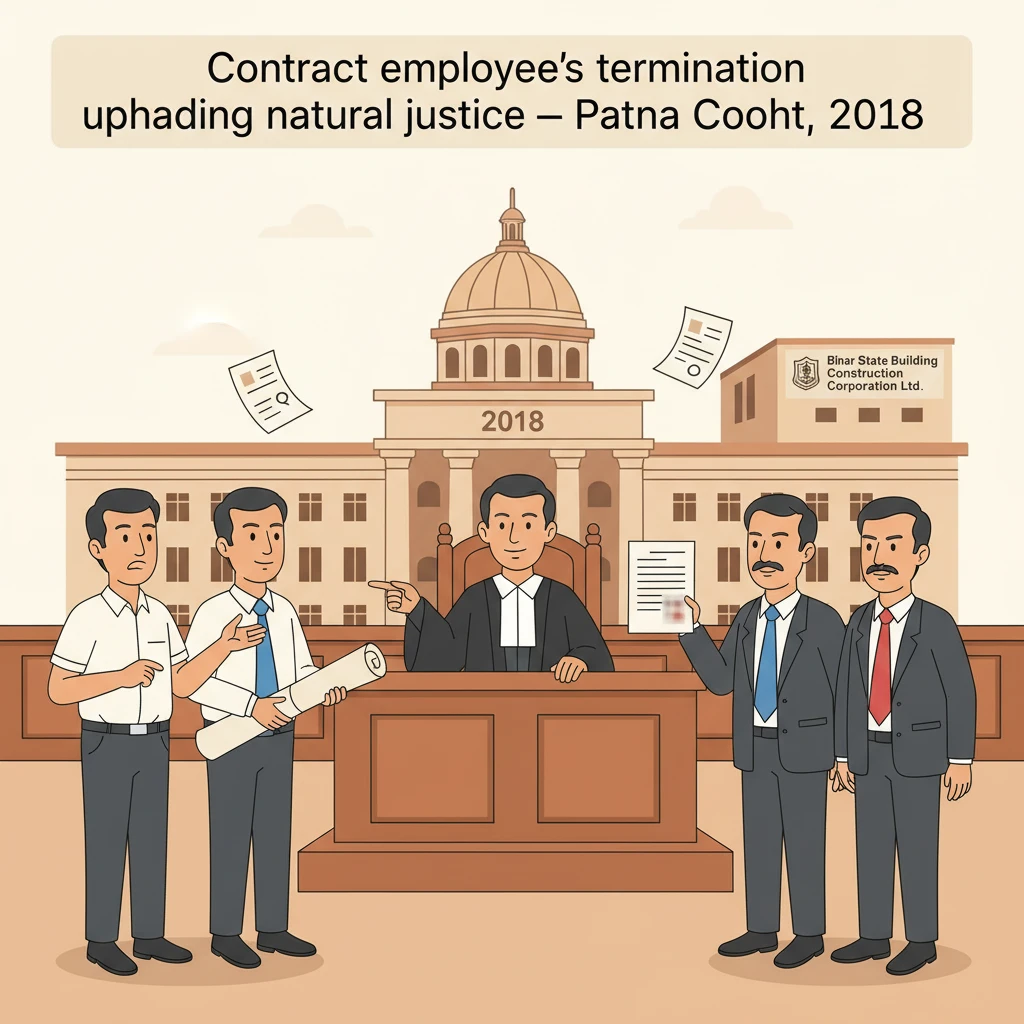
Case Background
The dispute arises from a contractual appointment made by Bihar State Building Construction Corporation Ltd. for the post of Assistant General Manager (Technical) at Jehanabad.
Following an advertisement, the petitioner was provisionally selected for this post by letter dated 11.04.2015. He was then appointed on a contractual basis for one year through Office Order No. 28/2015 dated 14.04.2015. The contract was to run till April 2016.
On 02.07.2015, before expiry of the one-year period, the General Manager (Administration) of the Corporation issued an order ending the petitioner’s contractual appointment with immediate effect. The order was passed on allegations of some dereliction in duty.
The petitioner challenged this first termination order dated 02.07.2015 in C.W.J.C. No. 14720 of 2015 before the Patna High Court. He argued that the order was cryptic, non-speaking and had been passed without properly considering his show-cause reply, thereby violating the principles of natural justice.
By order dated 16.10.2015 in that earlier writ petition, the Patna High Court accepted the grievance regarding violation of natural justice. It specifically quashed the termination order dated 02.07.2015 and directed that the petitioner would be entitled to be taken back in service. At the same time, the Court gave liberty to the Corporation to pass a fresh order on the basis of the show-cause reply already filed by the petitioner and to take a decision strictly in accordance with law.
On the question of salary for the period between termination and reinstatement, the Court in the earlier case observed that payment for that interregnum period would depend on the fresh decision taken by the Corporation on the petitioner’s show-cause reply.
After the earlier writ petition was disposed of, the Corporation reconsidered the matter. On 01.12.2015, the General Manager (Administration) issued Memo No. 3635, again bringing the petitioner’s contractual appointment to an end. This new order, referred to as Annexure 18, contained reasons which, according to the Court, had not been recorded in the earlier 02.07.2015 termination order.
The petitioner then filed the present writ petition, C.W.J.C. No. 19611 of 2015, challenging the fresh order dated 01.12.2015.
What the Court Examined and Decided
The Patna High Court, presided over by Hon’ble Mr. Justice Madhuresh Prasad, heard arguments from both sides. The petitioner’s counsel and the senior counsel for the Corporation were given full opportunity to present their positions.
The petitioner first argued that the order dated 01.12.2015 was “contemptuous” of the earlier High Court order dated 16.10.2015 in C.W.J.C. No. 14720 of 2015. His main grievance was that, despite the Court directing that he be taken back in service, the Corporation did not physically allow him to rejoin before passing the fresh order of 01.12.2015. According to him, this meant that the Corporation had failed to comply with the earlier directions.
To counter this, the Corporation’s senior counsel referred to its reply filed in M.J.C. No. 1252 of 2017. That miscellaneous jurisdiction case had been initiated by the petitioner himself, alleging non-compliance of the 16.10.2015 order, and was later disposed of by the High Court on 01.12.2017.
The Court quoted the relevant extract from its earlier order in the contempt proceedings. In that extract, the Court had already noted that, “soon after the order of quashing of the order of termination was passed, the opposite parties took steps to consider the show-cause of the petitioner as directed in the order and have passed the order dated 01.12.2015.” It was also recorded that non-permission to join before the fresh decision would not by itself amount to contempt because “no useful purpose would have served by bringing him back in service for a period of only one month.”
In the present writ, the Court accepted this reasoning. It treated the earlier contempt order as clarifying that the Corporation’s conduct was not contemptuous and that it had in fact proceeded to reconsider the show cause in line with the liberty granted on 16.10.2015.
The petitioner raised another important issue: he relied on Clause 10 of the Agreement dated 14.04.2015 (Annexure 9). According to him, under this clause the Corporation could not remove him from service without giving one month’s prior notice or paying one month’s salary in advance. Since no such notice or advance salary was given, he argued that his removal was illegal.
The Court examined this contention carefully. It found that the petitioner had been removed from the contractual service on the basis of certain charges, after consideration of his show-cause reply, and in compliance with the earlier High Court order dated 16.10.2015 in C.W.J.C. No. 14720 of 2015.
The Court also noted that in the earlier writ petition, the petitioner had not made any specific prayer regarding the one-month prior notice or one month salary in lieu thereof. This was evident from the order dated 16.10.2015, which had been passed after considering the petitioner’s entire defence in that earlier case.
Because no such claim had been pressed earlier, and the Corporation had now acted under the liberty granted by the Court, the present attempt to challenge the fresh termination order on this contractual notice clause was found unsustainable.
The petitioner further repeated his old argument that the original termination order dated 02.07.2015 was non-speaking and had been issued without considering his show-cause. The Court pointed out that this earlier order had already been set aside in the first round of litigation. Therefore, the challenge to the earlier termination was now irrelevant; only the legality of the new order dated 01.12.2015 was in question.
Turning to that new order, the Court observed that there was “substantive compliance” of its earlier order dated 16.10.2015 and also of the principles of natural justice. The very reasons which had been absent in the earlier order dated 02.07.2015 were now “elaborately” recorded in the order dated 01.12.2015. The Court described the 01.12.2015 order as a “well considered order” and one passed in compliance with natural justice and fair play.
The Court then considered the relief actually sought by the petitioner. By the time of this judgment on 14.03.2018, the petitioner’s contractual term had long expired. He had been appointed only for a specific one-year period from April 2015 to April 2016. On this factual position, the Court made it clear that “by any stretch of imagination” the petitioner was not entitled to reinstatement in service.
Even if one left aside the expiry of the contractual period, the Court still found no infirmity in the order dated 01.12.2015. The order was seen as a speaking, well-reasoned decision of the Corporation, passed after reconsidering the show-cause reply and in strict compliance with the earlier High Court directions.
In summary, the Court held that:
- The Corporation had complied with the earlier quashing order and the directions to reconsider the show-cause.
- The fresh order dated 01.12.2015 was reasoned, speaking, and in conformity with natural justice.
- The contractual nature and limited duration of the appointment meant that reinstatement was no longer possible once the contract period had lapsed.
On these grounds, the writ petition was dismissed.
Why This Judgment Matters
This judgment is important for contract employees working with government corporations and public bodies in Bihar and elsewhere.
First, it shows that even if a termination order is quashed for violating natural justice, the employer can issue a fresh, valid order after properly considering the employee’s reply, as long as it follows the directions of the Court.
Second, it highlights that contractual appointments for a fixed period do not generally give a right to long-term reinstatement. Once the contract period ends, courts are slow to interfere, especially where the employer’s decision is found to be reasoned and lawful.
Third, grievances about clauses like one-month notice or salary in lieu must be raised at the earliest opportunity. If such issues are not pressed when the Court first examines the dispute, it becomes harder to re-open them later.
For workers in similar positions, this case underlines the need to understand the limits of contractual employment and the importance of timely, complete pleading of all objections before the Court.
Legal Issues and Answers
-
Issue: Did the Bihar State Building Construction Corporation disobey the earlier Patna High Court order by issuing a fresh termination order without allowing the petitioner to rejoin?
Answer: No. The Court held that the Corporation complied with the earlier order by reconsidering the show cause and passing a detailed order on 01.12.2015. Non-permission to rejoin for a short remaining period did not amount to contempt. -
Issue: Was the fresh termination order dated 01.12.2015 invalid for not giving one month’s notice or salary as per Clause 10 of the agreement?
Answer: No. The Court found that the petitioner was removed on charges after considering his reply in compliance with the earlier High Court order, and that no prayer about notice or salary had been made in the earlier writ case. -
Issue: Was the petitioner entitled to reinstatement or continuation in service as Assistant General Manager (Technical)?
Answer: No. The Court held that his service was purely contractual for one year and had lapsed in 2016, and in any case there was no infirmity in the reasoned termination order of 01.12.2015.
Cases Cited by the Court
- The judgment refers to earlier orders of the Patna High Court itself in C.W.J.C. No. 14720 of 2015 (order dated 16.10.2015) and M.J.C. No. 1252 of 2017 (order dated 01.12.2017). No external case law from other reported decisions is cited.
Case Details
Case Number: Civil Writ Jurisdiction Case No. 19611 of 2015
Case Title: Satyendra Kumar Sinha v. Bihar State Building Construction Corporation Ltd. & Ors.
Coram: Hon’ble Mr. Justice Madhuresh Prasad
Date of Judgment: 14.03.2018
Citation: 2019(2) PLJR 895
Advocates:
- For the petitioner: Mr. Uday Chand Prasad, Advocate
- For the respondents: Mr. Teg Bahadur Singh, Senior Advocate; Mr. Brisketu S. Pandey, Advocate
Nature of the Case: Writ petition under civil writ jurisdiction challenging termination of contractual employment and seeking quashing of the order dated 01.12.2015.
Link to Judgment: Click here to read the full judgment of the Patna High Court
If you found this explanation helpful and wish to stay informed about how legal developments may affect your rights in Bihar, you may consider following Samvida Law Associates for more updates.







