

Case Background
The petitioner is the registered owner of a Splendor motorcycle bearing registration number BR26S-7652, chassis number MBLHAW110LHG10130 and engine number HA11EVLHG10049.
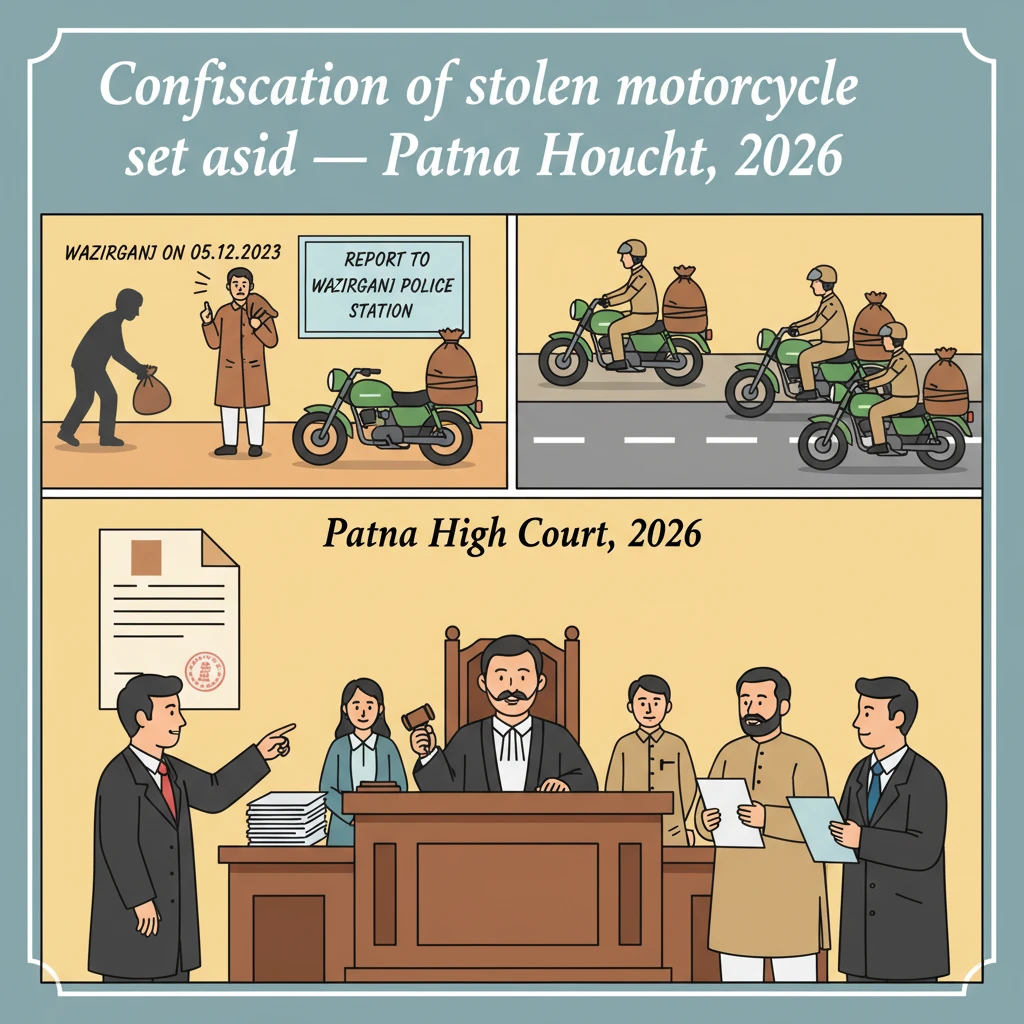
According to him, on 05.12.2023, two unknown miscreants snatched this motorcycle. The next day, on 06.12.2023, he lodged Wazirganj P.S. Case No. 723 of 2023 under Section 394 of the Indian Penal Code, reporting the snatching of his motorcycle.
The police could not trace the vehicle for some time. After around four months, on 30.03.2024, police on patrolling duty and vehicle checking intercepted four motorcycles. Each motorcycle was allegedly carrying 150 litres of illicit liquor in sacks.
One of the seized motorcycles had the same chassis and engine number as the petitioner’s motorcycle. On this basis, Sindhugarh P.S. Case No. 14 of 2024 was registered under Section 30(a) of the Bihar Prohibition and Excise (Amendment) Act, 2018.
After registration of the prohibition case, confiscation proceedings were started as Excise Confiscation Case No. 656 of 2024 before the Assistant Commissioner, Prohibition, Gaya. By order dated 07.02.2025, that authority directed confiscation of the motorcycle.
The petitioner then approached the Patna High Court in Civil Writ Jurisdiction Case No. 19471 of 2025, seeking quashing of the confiscation order and release of his motorcycle.
What the Court Examined and Decided
The writ petition was heard by a Division Bench of the Patna High Court comprising Hon’ble Mr. Justice Mohit Kumar Shah and Hon’ble Mr. Justice Arun Kumar Jha. The oral judgment was delivered on 07.04.2026 by Justice Mohit Kumar Shah.
The petitioner’s main case was simple. He said that his motorcycle had been snatched months before it was found carrying liquor. He had promptly lodged an FIR under Section 394 IPC regarding the snatching. He also pointed out that his name did not appear as an accused in Sindhugarh P.S. Case No. 14 of 2024.
On these facts, his counsel argued that there was no consent or connivance by him in using the motorcycle to transport illicit liquor. Without such involvement, the authorities had no legal power to confiscate his vehicle under the Bihar Prohibition and Excise law.
The petitioner’s counsel relied strongly on an earlier Division Bench judgment of the Patna High Court in Sunaina vs. State of Bihar & Ors., reported in 2024 SCC OnLine Pat 851, and on another decision dated 18.11.2025 in Ali Ashraf Siddique vs. The State of Bihar & Ors. (CWJC No. 16421 of 2025). These decisions held that if the owner of a vehicle was not involved in transporting illicit liquor, the vehicle could not be subjected to confiscation proceedings.
On the other side, the State’s counsel opposed the writ petition and supported the confiscation order. However, he could not dispute some key facts. He could not deny that the motorcycle had been snatched much before its seizure in the excise case.
The State’s counsel was also unable to produce any material to show that the petitioner had taken part, directly or indirectly, in the transportation of 150 litres of illicit liquor on the motorcycle. The counter affidavit filed by the State did not contain any document or statement linking the petitioner with the crime, either as an accused or as a conspirator.
The Bench carefully went through the records. They noted that the FIR for the snatching, Wazirganj P.S. Case No. 723 of 2023 dated 06.12.2023 under Section 394 IPC, had been filed promptly by the petitioner. The police had not recovered the motorcycle in that case till it was finally seized in the prohibition case four months later.
The Court also pointed out that the person arrested from the spot while driving the motorcycle carrying illicit liquor had no connection with the petitioner, as per the records placed before the Court.
Further, the Bench recorded that the State, in its counter affidavit, had brought no proof of the petitioner’s involvement in the alleged crime, nor any evidence of his connivance in the illegal use of the motorcycle. The State had not challenged the authenticity or lawfulness of the earlier FIR lodged by the petitioner about the snatching of the vehicle.
Having examined these facts, the Bench turned to the legal position settled in Sunaina. In that case, the Court had examined the scheme of the Bihar Prohibition and Excise Act, 2016. Important paragraphs (20 to 30) from Sunaina were quoted at length in the judgment.
From Sunaina, the Bench highlighted a crucial principle: two things are necessary before a vehicle can be seized and confiscated under the Bihar Prohibition and Excise Act.
First, the vehicle must actually be used for carrying or transporting liquor or intoxicant in commission of an offence under the Act.
Second, there must be consent or connivance of the owner of the vehicle in such illegal use. Without both elements, confiscation is not permissible and any such order would be without authority of law.
The earlier Division Bench in Sunaina had also noted that if the owner is directly involved, he is generally made an accused in the criminal case. Even if his involvement is indirect, for example through permission or connivance, he can be prosecuted under Section 47 of the Act. Therefore, when the owner is not even made an accused, it becomes very difficult to say that he was involved in the prohibited use of the vehicle.
In Sunaina, the Court had also taken note of a letter dated 07.02.2020 issued by the Additional Chief Secretary, Home Department-cum-Prohibition, Excise and Registration Department, Bihar. The letter stated that vehicles from which no liquor is recovered should not be confiscated, and that if only the driver is drunk but no liquor is recovered from the vehicle, only the driver should be prosecuted.
After analysing those legal principles, the Bench applied them to the present case. It found that, in this matter, the State itself admitted through its counter affidavit that there was no material showing the petitioner’s involvement. He had not been made an accused in Sindhugarh P.S. Case No. 14 of 2024, and there was no allegation that he knew about or permitted the use of his motorcycle for transporting liquor.
The Court emphasised that the petitioner had lodged an FIR about the theft of his motorcycle as early as 06.12.2023, which had not been questioned by the State. That FIR showed that he had already lost possession and control of the vehicle months before the liquor seizure on 30.03.2024.
In these circumstances, the Bench held that the essential condition of “consent or connivance of the owner” was completely absent. The confiscation authority, therefore, had no jurisdiction to confiscate the motorcycle.
The Division Bench observed that the case was squarely covered by the earlier decision in Sunaina. Applying that precedent, the Court concluded that the confiscation order passed in Excise Confiscation Case No. 656 of 2024 could not be sustained in law.
Finally, the Court allowed the writ petition. It set aside the impugned order dated 07.02.2025 passed by the Assistant Commissioner, Prohibition, Gaya. It also directed that the petitioner’s motorcycle be released within two weeks from the date of receipt or communication of a copy of the High Court’s order.
Why This Judgment Matters
This judgment of the Patna High Court is important for vehicle owners in Bihar, especially in the context of strict prohibition laws.
It makes clear that if a vehicle is stolen or snatched and later found carrying illicit liquor, the innocent owner cannot automatically be punished through confiscation. The authorities must show that the owner consented to or was somehow involved in the illegal transport.
The ruling reinforces that the Bihar Prohibition and Excise Act, 2016, cannot be used to take away someone’s property when there is no evidence of their participation in the offence. Confiscation is a serious step and must be based on clear material, not mere suspicion from the fact that liquor was recovered from a vehicle.
For ordinary people, this decision offers some protection. If they lose their vehicles to theft and those vehicles are later misused by others for illegal activities, they can rely on this judgment, along with Sunaina, to argue against unjust confiscation.
Legal Issues and Answers
- Issue: Can the State confiscate a motorcycle under the Bihar Prohibition and Excise (Amendment) Act, 2018 when the registered owner had earlier reported it stolen and there is no proof of his involvement in transporting illicit liquor?
Answer: No. The Patna High Court held that, in the absence of any material showing consent or connivance of the owner, and where the owner had already lodged an FIR about the theft and was not an accused in the prohibition case, the confiscation order was illegal and had to be set aside.
Cases Cited by the Court
- Sunaina vs. State of Bihar & Ors., 2024 SCC OnLine Pat 851
- Mohammad Basim Akram vs. State of Bihar, 2022 (6) BLJ 540 (referred within the quoted passage from Sunaina)
- Wilson C.C. vs. State of Kerala, 2022 LiveLaw (Ker) 627 (referred within the quoted passage from Sunaina)
- Thausif Ahammad Bengre vs. State of Kerala, 2018 SCC OnLine Ker 3905 (referred within the quoted passage from Sunaina)
- Ali Ashraf Siddique vs. The State of Bihar & Ors., CWJC No. 16421 of 2025 (cited by petitioner’s counsel)
Case Details
Case Number: Civil Writ Jurisdiction Case No. 19471 of 2025
Case Title: Rajeev Kumar vs. The State of Bihar & Ors.
Coram: Hon’ble Mr. Justice Mohit Kumar Shah and Hon’ble Mr. Justice Arun Kumar Jha
Citation: 2026 (3) PLJR 282
Advocates:
- For the petitioner: Mr. Indu Shekhar Dwivedi, Advocate
- For the State respondents: Mr. Mujtabaul Haque, GP 12; Mr. Pranoy Kumar, AC to GP 12
Date of Judgment: 07.04.2026
Nature of the Case: Writ petition (civil) challenging an excise confiscation order relating to a motorcycle seized in a prohibition case.
Link to Judgment: Full text of Patna High Court judgment
If you found this explanation helpful and wish to stay informed about
how legal developments may affect your rights in Bihar,
you may consider following Samvida Law Associates for more updates.







