
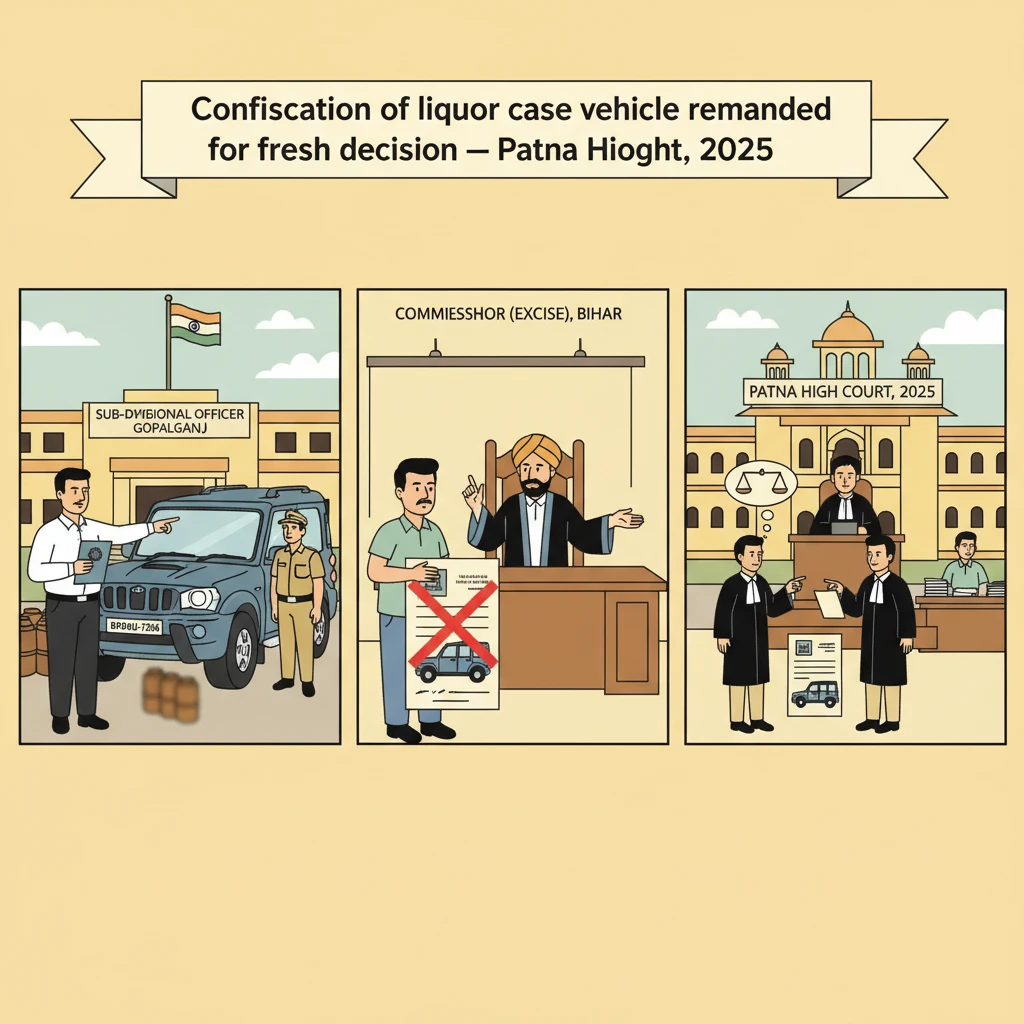
Case Background
The case arose from seizure of a Mahindra Scorpio vehicle bearing registration number BR09U-7286 in connection with a liquor offence under the Bihar Prohibition and Excise Act, 2016.
The vehicle belongs to the petitioner. After seizure, confiscation proceedings were taken up by the Sub-Divisional Officer, Gopalganj, who was authorised by the Collector to deal with such matters.
On 07.12.2024, the Sub-Divisional Officer passed an order confiscating the vehicle. Instead of ordering release on payment of penalty, he relied on a general direction issued by the Collector, Gopalganj, in Memo No. 4025/Excise dated 07.11.2023.
Under that memo, if a two-wheeler was found carrying more than five litres of liquor, or a four-wheeler more than ten litres, the vehicle was not to be released only on payment of penalty, as such release was said to hinder effective implementation of prohibition laws.
Aggrieved by confiscation, the petitioner filed Excise Appeal Case No. 25/2025 (Manjeet Kumar Yadav versus Collector, Gopalganj and Others) before the Commissioner (Excise), Bihar.
On 18.03.2025, the Commissioner (Excise) dismissed the appeal and refused to interfere with the confiscation order. This order is referred to as the impugned order in the writ petition.
The petitioner then approached the Patna High Court in Civil Writ Jurisdiction Case No. 10126 of 2025, challenging both the confiscation order dated 07.12.2024 and the appellate order dated 18.03.2025.
What the Court Examined and Decided
The Division Bench of the Patna High Court, comprising Hon’ble Mr. Justice Rajeev Ranjan Prasad and Hon’ble Mr. Justice Sourendra Pandey, heard the matter. The oral judgment was delivered on 13.11.2025 by Justice Rajeev Ranjan Prasad.
The main focus before the Court was Rule 12A of the Bihar Prohibition and Excise Rules, 2021, inserted by Amendment Rules 2022 through Notification No. 2458 dated 05.04.2022.
The petitioner’s counsel argued that Rule 12A was specifically introduced to allow release of seized vehicles, conveyances, vessels and animals on payment of penalty, instead of keeping them seized for long periods.
Under sub-rule (2) of Rule 12A, the authority can impose penalty, and while fixing the quantum, must consider certain factors. These include the quantity of intoxicant recovered, the involvement of the vehicle owner, and the latest insured value of the vehicle.
Sub-rule (3) of Rule 12A, however, creates an exception. It says that, notwithstanding the above, if on a report by a police officer or excise officer the Collector or authorised officer is satisfied that releasing the vehicle will not be in public interest, he shall proceed with confiscation and its subsequent auction or disposal.
The petitioner’s case was that the Collector, Gopalganj, invoked this “public interest” power in a mechanical way. In the confiscation order, no specific reason was given explaining how release of this particular vehicle would harm public interest.
Instead, the Sub-Divisional Officer relied on the Collector’s Memo No. 4025/Excise dated 07.11.2023. That memo laid down a blanket rule: if a two-wheeler carried more than five litres of liquor, or a four-wheeler more than ten litres, the vehicle should not be released on payment of penalty.
The petitioner argued that Rule 12A nowhere creates such a volume-based embargo. The words “public interest” are not defined in the Rules of 2021, and cannot be reduced to a fixed litre limit. Therefore, the authority misdirected itself and wrongly denied release.
The State, through its counsel, defended the orders, submitting that the Sub-Divisional Magistrate had acted as an authorised confiscating authority and that Rule 12A(3) does allow refusal to release a vehicle in public interest.
However, the State did not dispute two crucial points. First, the Rules of 2021 do not clearly define what amounts to “public interest” for the purpose of Rule 12A(3). Second, there is no specific rule that a vehicle cannot be released merely because it transported a certain quantity of liquor.
After hearing both sides and examining the record, the Patna High Court found the orders of the Sub-Divisional Officer and the Commissioner (Excise) unsustainable in law.
The Court observed that Rule 12A was inserted to address a serious practical problem. In the past, large numbers of vehicles seized under prohibition laws were lying outside police stations, occupying road areas, and getting damaged due to delay in confiscation cases and auction sales. These proceedings were often delayed and obstructed by legal challenges.
To resolve this situation, Rule 12A allowed for release of vehicles on payment of penalty. Sub-rule (2) clearly sets out the factors to be considered for fixing penalty, but does not say that vehicles carrying more than five or ten litres of liquor cannot be released.
The Collector’s general guideline, barring release of vehicles involved in transportation above those limits, was therefore seen as going against the scheme of Rule 12A.
The Court specifically asked the State counsel whether the Collector had any power under the Rules of 2021 to issue such directions regarding release of vehicles. The State counsel conceded that there was no such empowering provision allowing the Collector to issue binding guidelines of this nature.
The Court then examined how the term “public interest” should be understood. For this, it relied on the Supreme Court’s decision in Bihar Public Service Commission versus Saiyad Hussain Abbas Rizwi and Another, reported in (2012) 13 SCC 61.
In that case, the Supreme Court, referring to State of Bihar v. Kameshwar Singh, AIR 1952 SC 252, held that “public interest” must be viewed in its strict sense, taking colour from the statute in which it appears. It is an elastic term, not capable of precise definition, and relates to general welfare of the public that deserves recognition and protection.
Applying these principles, the Patna High Court noted that the legislature, in its wisdom, inserted Rule 12A with a conscious decision to generally permit release of seized vehicles on payment of penalty.
One of the factors for deciding penalty is the quantity of liquor loaded on the vehicle. Therefore, the Court held, the mere quantity of liquor cannot by itself be a ground to reject an application for release of the vehicle.
The Court clarified how “public interest” in Rule 12A(3) should practically work. It stated that the competent authority must look at several case-specific factors, such as:
- whether the vehicle has been caught in commission of offence repeatedly,
- whether the owner of the vehicle can be properly verified,
- whether the liquor found is spurious, and
- whether the owner is involved in multiple cases of similar nature under liquor laws or any other like considerations.
Only in such appropriate cases, after examining these types of factors, may the authority form an opinion that release of the vehicle is not in public interest.
If, instead, the authority simply rejects release in every case where a fixed quantity of liquor is involved, even on a first-time offence, it would undermine the very purpose of Rule 12A. Such rigid rejection would become a “stumbling block” to implementation of the Rule and would frustrate the mandate of law.
The Court repeated that the phrase “public interest” in sub-rule (3) cannot be given a rigid, mechanical meaning. It must be understood in the context of the statutory scheme and must take its colour from that scheme.
On this reasoning, the Court concluded that the impugned orders were legally flawed. It held that the confiscation order dated 07.12.2024 passed by the Sub-Divisional Magistrate, Gopalganj, and the appellate order dated 18.03.2025 passed by the Commissioner (Excise) were “bad in law”.
The Court therefore set aside both orders.
However, the Court did not itself order immediate release of the vehicle. Instead, it remitted the matter back to the Sub-Divisional Magistrate, Gopalganj, for fresh consideration in accordance with Rule 12A of the Rules of 2021.
The Court directed that an appropriate order be passed within one month from the date of receipt or production of a copy of its judgment.
With these directions, the writ application was allowed to the extent indicated.
Why This Judgment Matters
This decision is important for vehicle owners whose vehicles are seized in liquor-related cases under Bihar’s prohibition laws.
The Patna High Court has made it clear that authorities cannot deny release of a seized vehicle just because a fixed quantity of liquor was found. A blanket guideline from a Collector, without support in the Rules, cannot override Rule 12A.
The Court also explained that “public interest” under Rule 12A(3) must be applied carefully and case by case. It cannot be used as a shortcut to confiscate every vehicle, especially on a first offence, without looking into factors like repeat misuse, spurious liquor, or multiple similar cases.
Practically, this judgment reinforces that Rule 12A was introduced to avoid long-term parking and damage of seized vehicles and to allow release on payment of penalty in most cases. Confiscation in the name of public interest requires stronger, specific reasons.
Legal Issues and Answers
-
Issue: Can the confiscating authority refuse release of a seized vehicle under Rule 12A(3) solely on the basis of a Collector’s guideline fixing liquor quantity thresholds as “public interest”?
Answer: No. The Patna High Court held that such quantity-based guidelines have no support in Rule 12A, are against its scheme, and cannot by themselves justify refusal of release on grounds of public interest. -
Issue: How should “public interest” under Rule 12A(3) of the Bihar Prohibition and Excise Rules, 2021 be understood while deciding release or confiscation of vehicles?
Answer: It must be interpreted in light of the statute’s scheme, as explained by the Supreme Court. Authorities must consider case-specific factors like repeat offences, unverifiable ownership, spurious liquor, or multiple similar cases, rather than applying a rigid or mechanical standard. -
Issue: Were the confiscation order dated 07.12.2024 and the appellate order dated 18.03.2025 legally sustainable?
Answer: No. The Court found them bad in law for relying on an unauthorised Collector’s memo and for misapplying Rule 12A(3), and therefore set them aside and remanded the matter.
Cases Cited by the Court
- Bihar Public Service Commission versus Saiyad Hussain Abbas Rizwi and Another, (2012) 13 SCC 61.
- State of Bihar v. Kameshwar Singh, AIR 1952 SC 252.
Case Details
Case Number: Civil Writ Jurisdiction Case No. 10126 of 2025
Case Title: Manjeet Kumar Yadav v. The State of Bihar & Ors.
Citation: 2026(1) PLJR 320
Court: High Court of Judicature at Patna
Coram: Hon’ble Mr. Justice Rajeev Ranjan Prasad and Hon’ble Mr. Justice Sourendra Pandey
Date of Judgment: 13.11.2025
Advocates:
- For the petitioner: Mr. Masoom Raza, Advocate
- For the respondents (State): Mr. Ravi Ranjan, AC to SC-22
Nature of the Case: Writ petition under civil writ jurisdiction challenging confiscation and appellate orders in an excise matter (vehicle seizure under Bihar Prohibition and Excise Act, 2016).
Link to the Judgment: Patna High Court Judgment
If you found this explanation helpful and wish to stay informed about
how legal developments may affect your rights in Bihar,
you may consider following Samvida Law Associates for more updates.







