
Case Background
The petitioner is the son of a Bihar Police officer who was serving as a Trained Assistant Sub-Inspector of Police (Training) in the Police Line at Buxar.
The petitioner’s father had initially joined the Bihar Police as a constable in 1979 and was later promoted as Assistant Sub-Inspector of Police. He died in harness on 16.1.2020 while posted in the Police Line at Buxar.
After his father’s death, the petitioner applied for appointment on compassionate ground to the post of constable. His family, consisting of his widowed mother and two brothers besides him, was stated to be in financial difficulty.
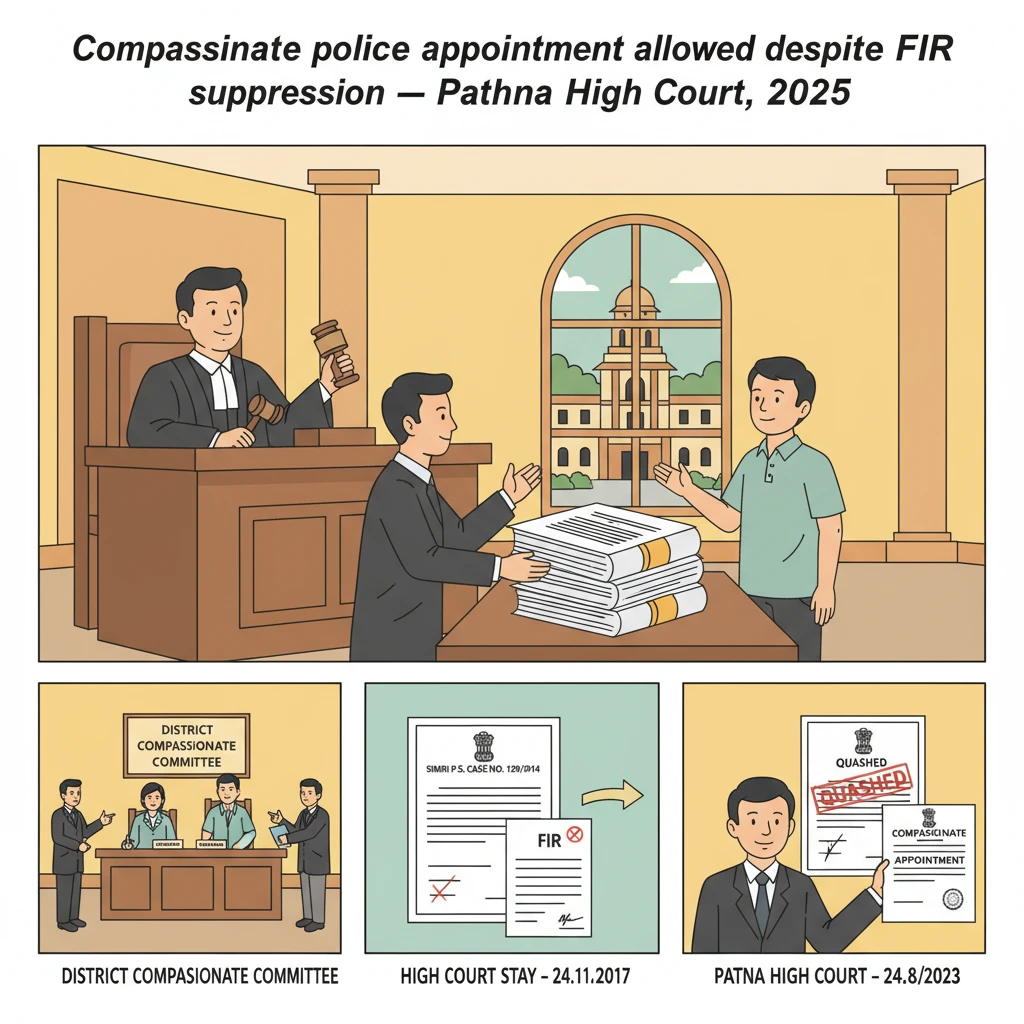
The application for compassionate appointment was placed before the District Compassionate Committee headed by the Superintendent of Police, Buxar. In its meeting held on 12.1.2021, the Committee recommended the petitioner’s case for compassionate appointment.
Despite this recommendation, the petitioner was not given appointment. During subsequent character verification, the police authorities discovered that the petitioner was an accused in Simri P.S. Case No. 129 of 2014, registered on 16.7.2014 under sections 341, 323, 379 and other sections of the Indian Penal Code, section 3 of the Scheduled Castes and Scheduled Tribes (Prevention of Atrocities) Act, 1989 and section 27 of the Arms Act, 1959.
In the compassionate appointment form, there was a specific question whether the petitioner was an accused in any case. He had answered in the negative. On verification, this was found to be incorrect.
After this came to light, the Superintendent of Police, Buxar, wrote a letter dated 23.8.2024 to the Deputy Inspector General of Police, Shahabad Range, Dehri-on-Sone, stating that in view of the said criminal case and its suppression in the form, it would not be advisable to appoint the petitioner on compassionate ground.
As a result, despite the earlier recommendation of the District Compassionate Committee, the petitioner was not appointed. He therefore approached the Patna High Court by filing Civil Writ Jurisdiction Case No. 18330 of 2022, seeking a direction to the respondents to appoint him as constable on compassionate ground.
What the Court Examined and Decided
Hon’ble Mr. Justice Partha Sarthy heard the writ petition. The main dispute was whether the petitioner’s non-disclosure of the criminal case justified denial of compassionate appointment, even though the case had been stayed and later quashed.
On behalf of the petitioner, it was submitted that the FIR was admittedly registered in 2014. The petitioner and other accused persons had approached the High Court in Cr. Misc. No. 18861 of 2017 challenging the order taking cognizance in that criminal case.
By order dated 24.11.2017 in Cr. Misc. No. 18861 of 2017, the High Court had stayed further proceedings in connection with Simri P.S. Case No. 129 of 2014. Later, by order dated 24.8.2023 in the same Cr. Misc. No. 18861 of 2017, the order taking cognizance was quashed, effectively ending the criminal case.
The petitioner’s counsel argued that, in several decisions, the Hon’ble Supreme Court has held that where there is suppression of information about a criminal case in employment forms, the employer should not mechanically terminate or refuse to appoint the candidate. Instead, the employer must look at the nature of the offence, the rules in force, and the overall circumstances.
They relied on three Supreme Court judgments: Avtar Singh vs. Union of India and Ors.; (2016) 8 SCC 471, Pawan Kumar vs. Union of India and Anr.; (2023) 12 SCC 317, and Ravindra Kumar vs. State of U.P. and Ors.; (2024) 5 SCC 264.
The petitioner’s side further contended that though this was not a regular recruitment after advertisement, it was still a case of fresh appointment into the police service, but on compassionate grounds. Because the family had been left without support due to the father’s death in harness, the authorities ought to have objectively considered whether the suppression justified refusing the job.
On the other hand, counsel for the State respondents argued that the facts were clear. In the compassionate appointment application, the petitioner had been specifically asked whether he was an accused in any case. He answered “no”, while he was in fact an accused in an FIR lodged back in 2014, and the criminal case was still pending on the date of his application.
Therefore, according to the State, there was a deliberate incorrect statement regarding his antecedents. On that basis, the Superintendent of Police, Buxar, by letter dated 23.8.2024, correctly recommended that the petitioner should not be appointed. There was, in their view, no illegality in the decision to deny compassionate appointment.
The Court first noted the factual sequence: the father’s death in harness on 16.1.2020; the petitioner’s application for compassionate appointment; the recommendation of the District Compassionate Committee on 12.1.2021; the subsequent discovery that he was an accused in Simri P.S. Case No. 129 of 2014; and the Superintendent of Police’s recommendation dated 23.8.2024 against appointment.
The Court then considered how the Supreme Court has dealt with suppression of criminal cases in employment forms.
In Avtar Singh, the Supreme Court observed that verification of character and antecedents is an important criterion to assess suitability, but any adverse action must be based on objective criteria after considering all relevant aspects. It held that suppression of “material” information presupposes that what is suppressed actually matters and is not merely technical or trivial.
The Supreme Court in Avtar Singh summarised several principles. Among them, it stressed that information given to the employer regarding conviction, acquittal or pendency of a criminal case must be true; that the employer may consider special circumstances while deciding on termination; that seriousness of the offence, nature of duties, and relevant rules must be kept in mind; and that before treating someone as guilty of suppression or false suggestion, knowledge of the fact must be attributable to that person.
In Pawan Kumar, the Supreme Court held that although a candidate must give correct details of character and antecedents, a person who has suppressed material information does not have an unfettered right to appointment, but also has a right not to be dealt with arbitrarily. The competent authority has to act reasonably and objectively. It was clearly stated that mere suppression of material or false information does not mean the employer can automatically terminate or discharge the employee “by a stroke of pen”.
In that case, the Supreme Court ultimately allowed the appeal, set aside orders of discharge, and directed reinstatement of the employee as constable, though without back wages but with notional benefits.
In Ravindra Kumar, after reviewing earlier judgments including Avtar Singh and Pawan Kumar, the Supreme Court emphasised that every case of non-disclosure cannot be treated as a disqualification. The Court held that broad-brushing all non-disclosures as fatal would be unjust and insensitive to ground realities. Each case has to be assessed holistically on its own special facts, using objective criteria and guidance from precedents.
With these principles in mind, the Patna High Court turned back to the petitioner’s case. It acknowledged that the FIR in which the petitioner was an accused had indeed been registered in 2014 and that his statement in the compassionate appointment form, denying involvement in any case, was not correct.
However, the Court gave weight to key circumstances. First, by order dated 24.11.2017 in Cr. Misc. No. 18861 of 2017, the Patna High Court had stayed further proceedings in the criminal case long before the petitioner’s father died. Second, the father died in harness on 16.1.2020, leaving behind the petitioner, his two brothers, and his mother facing financial hardship.
Third, later, by order dated 24.8.2023, the same criminal case was quashed. Thus, the case did not result in conviction and ultimately did not survive scrutiny.
In this backdrop, the Court considered whether the incorrect answer in the application justified refusing compassionate appointment to the petitioner, particularly for the post of constable.
The Court held that, considering these facts and the Supreme Court’s guidance, the incorrect statement in the form did not warrant denying the petitioner compassionate appointment. The family’s dire need following the death in harness, the prior stay of criminal proceedings since 2017, and the ultimate quashing of the case were all significant factors.
Therefore, the Court found that the opinion of the Superintendent of Police, Buxar, in his letter dated 23.8.2024 recommending that the petitioner not be appointed on compassionate ground, was not sustainable.
The High Court set aside that opinion, relied on the earlier recommendation of the District Compassionate Committee dated 12.1.2021, and directed the respondents to appoint the petitioner on compassionate ground. The Court also indicated that this should be done at the earliest, preferably within two months from the date of communication of its order.
With this direction, the writ application was allowed.
Why This Judgment Matters
This judgment is important for families of deceased government employees, especially in Bihar, who seek compassionate appointments but face rejection due to old or doubtful criminal cases against a family member.
The Patna High Court has made it clear that authorities cannot mechanically refuse compassionate appointment just because an applicant once faced a criminal case or made an incorrect statement about it.
Instead, they must look at the full picture: whether the case was serious, whether proceedings were stayed, whether it ended in acquittal or quashing, and what the family’s financial condition is after the death of the employee.
For applicants to police posts, this judgment shows that past involvement in a case, especially one later quashed, does not always mean permanent disqualification. The decision requires the State to act fairly and reasonably, following the approach of the Supreme Court in Avtar Singh, Pawan Kumar and Ravindra Kumar.
Legal Issues and Answers
-
Issue: Can the State deny compassionate appointment to an applicant for the post of constable solely because he suppressed the fact of being an accused in an earlier criminal case, when that case had already been stayed and was later quashed?
Answer: No. In the specific facts of this case, considering the stay and later quashing of the criminal case, the family’s financial hardship after the father’s death in harness, and Supreme Court precedents, the Patna High Court held that the incorrect statement did not justify refusal of compassionate appointment and directed the State to appoint the petitioner.
Cases Cited by the Court
- Avtar Singh vs. Union of India and Ors.; (2016) 8 SCC 471
- Pawan Kumar vs. Union of India and Anr.; (2023) 12 SCC 317
- Ravindra Kumar vs. State of U.P. and Ors.; (2024) 5 SCC 264
Case Details
Case Number: Civil Writ Jurisdiction Case No. 18330 of 2022
Case Title: Monu Kumar Pandey vs. The State of Bihar & Ors.
Court: High Court of Judicature at Patna
Coram: Hon’ble Mr. Justice Partha Sarthy
Date of Judgment: 01.12.2025
Citation: 2026(1) PLJR 126
Advocates:
For the petitioner: Mr. Rajendra Narain, Senior Advocate; Mr. Maya Shankar Mishra, Advocate
For the respondents: Md. Harun Quareshi, AC to SC-1
Nature of the case: Writ petition seeking direction for compassionate appointment to the post of constable after death in harness of a Bihar Police officer.
Final Direction: Superintendent of Police’s recommendation against appointment set aside; respondents directed to appoint the petitioner on compassionate ground at the earliest, preferably within two months from communication of the order; writ application allowed.
Link to the judgment: View original judgment on Patna High Court website
If you found this explanation helpful and wish to stay informed about
how legal developments may affect your rights in Bihar,
you may consider following Samvida Law Associates for more updates.







