
Case Background
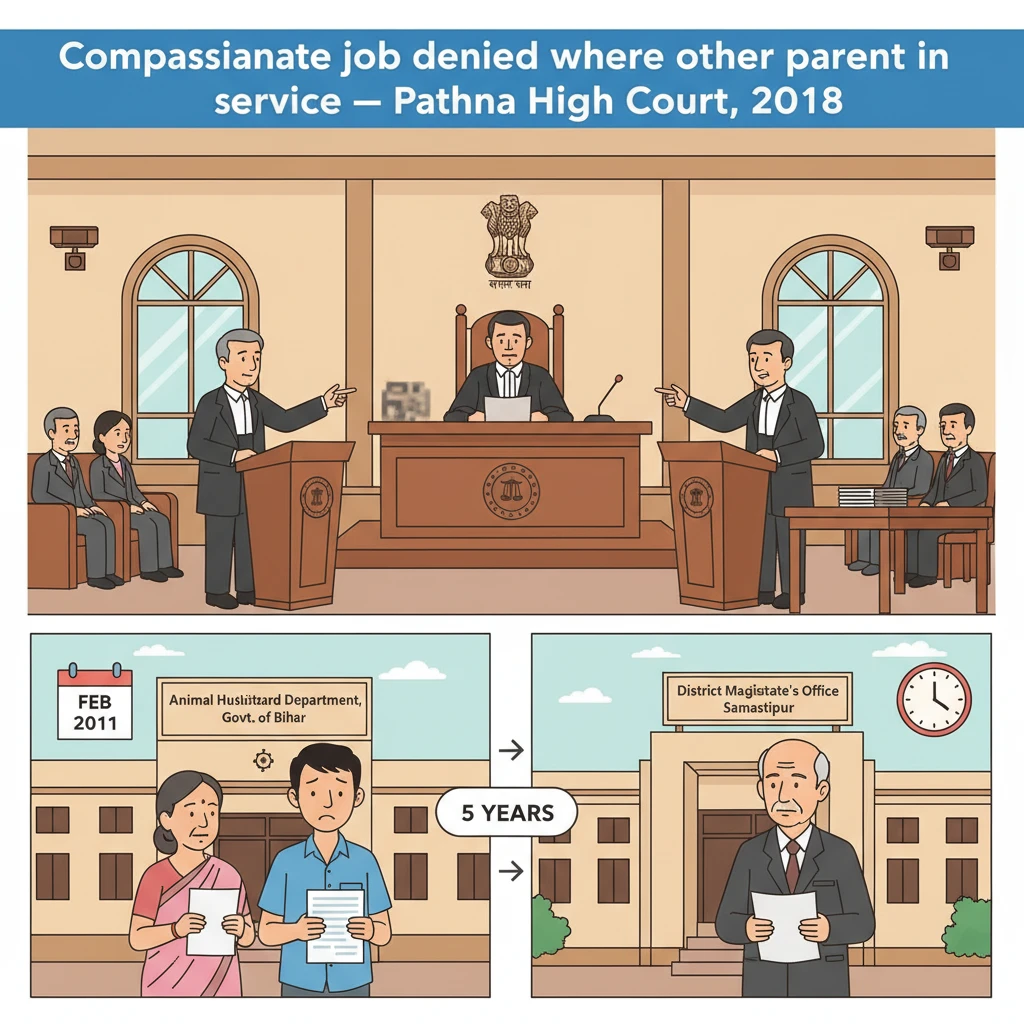
The petitioner is the son of a woman employee of the Animal Husbandry Department, Government of Bihar. His mother died in service on 21.02.2011.
On the date of her death, the petitioner’s father was also a government employee. He continued in service for almost three more years and superannuated on 31.01.2014.
After the father’s retirement, the petitioner applied for compassionate appointment on 01.04.2014, claiming that the family was in very bad financial condition after the mother’s death and subsequent retirement of the father.
When his claim did not result in appointment, the petitioner approached the Patna High Court by filing Civil Writ Jurisdiction Case No. 6742 of 2017. He sought a direction for compassionate appointment in the Animal Husbandry Department.
What the Court Examined and Decided
The Patna High Court, through Hon’ble Mr. Justice Shivaji Pandey, heard both sides. The key question was whether the petitioner was entitled to compassionate appointment on the basis of his mother’s death in service, even though his father was in government service at that time and retired only in 2014.
The petitioner’s main argument was based on a policy of the State Government and earlier court judgments. According to him, State policy says that where husband and wife are both in government service and one spouse dies, the family normally does not get compassionate appointment. However, an exception is recognized where within five years the other spouse either dies or superannuates.
The petitioner argued that this exception applied to his case. His mother, a government employee, died on 21.02.2011. His father, the other spouse, superannuated on 31.01.2014, within five years of her death. Therefore, according to him, the bar on compassionate appointment should not apply, and he should be considered for employment.
To support his stand, the petitioner relied on a judgment dated 05.04.2011 in C.W.J.C. No. 2059 of 2006. In that earlier case, the first spouse had already superannuated, and the other spouse died later. The Court there had considered the applicability of the policy and had referred to the decision in Dilip Kumar Das vs. The State of Bihar & Ors., reported in 2000(2) PLJR 203.
In Dilip Kumar Das, the Court had held the person entitled to compassionate appointment and discussed how State policy should be applied. The later case, C.W.J.C. No. 2059 of 2006, followed that reasoning and directed fresh consideration in terms of the Government policy prevailing on 20.11.2002.
However, the Patna High Court pointed out that the facts of the present case were different. In the earlier matters, the situation was that one spouse had already retired and the other died afterwards, raising the question of post-retirement financial hardship.
Here, the mother died first while the father was still serving. He continued to receive his salary until normal retirement in January 2014. Only after his retirement did the petitioner move for compassionate appointment in April 2014.
The Court focused on the basic purpose of compassionate appointment. It explained that such appointment is not a normal mode of recruitment. Rather, it is an exception meant to give immediate relief to a family that suddenly loses its sole or main breadwinner and falls into a state of penury.
The Court observed that when the petitioner’s mother died in 2011, his father was in government service and continued till 2014. Because the father was earning a regular salary, the Court held that the family could not be considered to be in a state of acute financial crisis following the mother’s death.
In simple terms, the Court said the family still had a breadwinner in service, so the main reason behind compassionate appointment — saving a family from sudden destitution — was absent.
The Court also noted that the writ application did not disclose what retirement dues or other financial benefits the family received after the father’s superannuation. There was no clear pleading about how much money came to the family by way of pensionary benefits or other support.
This lack of detail was important because the claim of “very bad shape” financially must be supported by facts. The Court found that the petitioner had not shown, through the writ petition, that the family had actually fallen into such hardship that compassionate appointment was necessary.
Another telling factor for the Court was the timing of the application. The mother died on 21.02.2011. The application for compassionate appointment was filed only on 01.04.2014, more than three years later, and after the father’s retirement.
The Court treated this delay as a strong indication that the family was not facing immediate financial emergency after the mother’s death. If the family had really fallen into penury because of the death, one would expect an early request for assistance, not an application after several years and after the second parent’s normal retirement.
To reinforce its view on the limited scope of compassionate appointment, the Patna High Court referred to the Supreme Court’s decision in Umesh Kumar Nagpal vs. State of Haryana & Ors., reported in 1994(4) SCC 138.
In that landmark judgment, the Hon’ble Supreme Court had clearly held that compassionate appointment is not a source of employment or a matter of right. It is a welfare measure, meant only to help the family of a deceased employee tide over a sudden financial crisis when the breadwinner dies.
Relying on this principle, the Patna High Court held that the object of compassionate appointment is to ensure that the family can “run its business peacefully seamlessly and without any problem” after the sudden loss of a breadwinner. It is not designed to provide employment to family members as a matter of course after every death in service.
Looking at the facts, the Court concluded that when the petitioner’s mother died, the family did not reach a state of penury because the father was still in service. The petitioner’s later application, after the father’s retirement, could not convert a normal retirement situation into a compassionate case based on the earlier death.
The Court thus distinguished the earlier judgments relied upon by the petitioner by emphasising the factual difference: in those cases the order of retirement and death of spouses was different, and the State policy then in force was considered accordingly. In the present matter, the policy could not be stretched to create a right where the basic requirement of sudden financial distress was missing.
After considering the pleadings, the policy, and the cited decisions, the Court held that there was no merit in the writ petition. It declined to issue any direction for compassionate appointment.
Accordingly, the Patna High Court dismissed Civil Writ Jurisdiction Case No. 6742 of 2017 and left the parties to bear their own consequences. No further directions were given.
Why This Judgment Matters
This judgment is significant for families of government employees in Bihar who hope for compassionate appointment after a death in service.
The Patna High Court has made it clear that if another parent or family member is already a government employee and continues in service, the family will normally not be treated as in sudden financial distress. In such cases, a compassionate job cannot be claimed as a matter of right.
The decision also underlines that delay in applying for compassionate appointment may go against the claim, because the very purpose is to provide immediate relief. Applying years later, especially after normal retirement of another earning member, weakens the plea of financial emergency.
For lawyers and affected families, this case reaffirms the Supreme Court’s line of reasoning in Umesh Kumar Nagpal: compassionate appointment is an exception to the regular recruitment rules, limited to genuine cases of penury caused by the sudden death of a breadwinner.
Legal Issues and Answers
Issue: Whether the petitioner, whose mother died in service while his father was still a serving government employee who later retired normally, was entitled to compassionate appointment under the State’s policy.
Answer: No. The Court held that the family was not in a state of penury at the time of the mother’s death, as the father remained in service and later superannuated, and the delayed application itself showed absence of immediate financial crisis.
Cases Cited by the Court
- Dilip Kumar Das vs. The State of Bihar & Ors., 2000(2) PLJR 203.
- C.W.J.C. No. 2059 of 2006, judgment dated 05.04.2011 (title not specified in the text).
- Umesh Kumar Nagpal vs. State of Haryana & Ors., 1994(4) SCC 138.
Case Details
Case Number: Civil Writ Jurisdiction Case No. 6742 of 2017
Case Title: Uday Shankar vs. The State of Bihar & Ors.
Coram: Hon’ble Mr. Justice Shivaji Pandey
Citation: 2019 (3) PLJR 289
Advocates:
- For the petitioner: Mr. Y.V. Giri, Sr. Advocate; Mr. Nikhil Kumar Agrawal, Advocate; Ms. Deepika Sharma, Advocate.
- For the respondents: Mr. Rishi Raj Sinha, SC-19; Mr. Akhilesh Kumar Sinha, AC to SC-19.
Nature of the case: Writ petition seeking compassionate appointment on death of a government employee (service matter).
Date of Judgment: 09.07.2018
Court: High Court of Judicature at Patna
Department involved: Animal Husbandry Department, Government of Bihar
Link to judgment: Click here to read the full Patna High Court judgment
If you found this explanation helpful and wish to stay informed about
how legal developments may affect your rights in Bihar,
you may consider following Samvida Law Associates for more updates.







