
Case Background
The dispute started when the proprietor of a school at Biharsharif received two letters dated 11.12.2013 from the Employees State Insurance Corporation (ESIC). One was a demand notice and the other was for recovery of contribution under the Employees’ State Insurance Act, 1948.
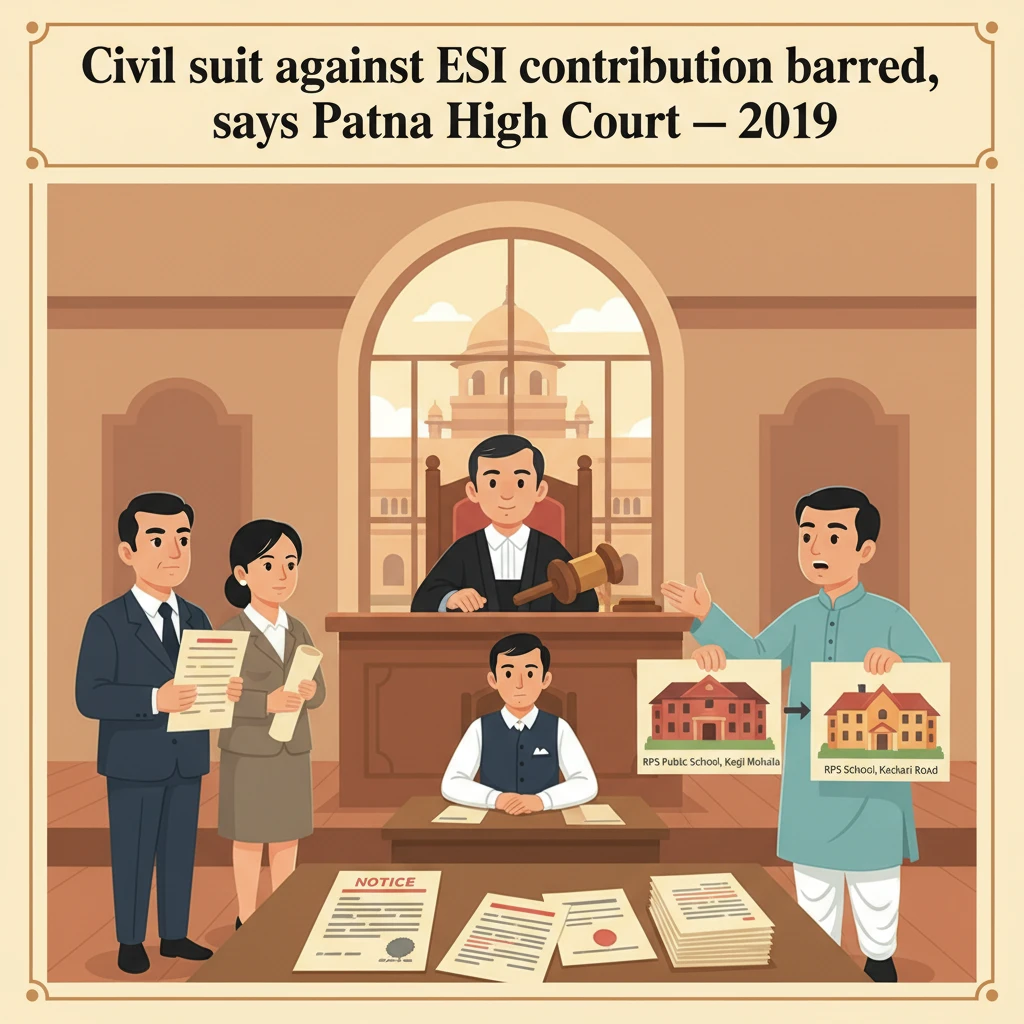
The plaintiff claimed that he was running R.P.S. Public School at Kagji Mohalla, Biharsarif. According to him, his brother was running another school named R.P.S. School at Kachari Road, Biharsarif. He stated that both schools were separate, located at different places, and he had no concern with the other school or with its income.
On receiving the demand and recovery notices, the plaintiff took the stand that the ESIC had wrongly fastened liability on him for contribution from July 2008 to March 2013. He asserted that he was not connected with the establishment against which the ESI dues were claimed.
The plaintiff therefore filed Title Suit No.371 of 2013 before the court of Sub Judge-II, Biharsarif, Nalanda. In the suit, he sought a declaration that the Employees State Insurance Corporation was not authorized to recover the demanded amount of Rs.7,45,666/- from him, and he also prayed for a permanent injunction restraining the Corporation from realizing the said contribution.
According to the plaintiff’s case in the plaint, before initiating recovery under Section 45 of the ESI Act, 1948, no verification of his school was done, no document was demanded, and no inspector visited his school. He further pleaded that none of the provisions of the ESI Act, 1948 had been followed and that no notice for recovery under Section 45(g) was served on him. On this basis, he claimed that the recovery proceedings from July 2008 to March 2013 were “illegal and without jurisdiction”.
The defendants in the suit were the Employees State Insurance Corporation and its officers. They entered appearance and filed a written statement contesting the plaintiff’s stand. They gave a different picture of the facts.
The defendants stated that the school in question had been visited by two Insurance Inspectors during a survey on 07.07.2008. In the visit note, the owner/occupier was recorded as the plaintiff, on the basis of information supplied by the Principal, Arvind Kumar Singh.
As per the written statement, the school was being run and managed by “Kunti Shiksha Sah Samaaj Vikash Sansthan”, which was represented by the plaintiff. This was recorded in the visit note of the Insurance Inspectors and acknowledged by the Principal, Arvind Kumar Singh.
The ESIC further stated that a letter dated 29.08.2008 in Form C-11 and a “speaking order” under Section 45A of the ESI Act, 1948 had been issued in the name of the plaintiff. According to them, this order was never disputed or challenged by the plaintiff at that time, and all subsequent correspondence was made in his name.
After filing the written statement, the defendants also filed an application under Order VII Rule 11 of the Code of Civil Procedure (CPC) seeking rejection of the plaint. Their stand was that the civil suit itself was not maintainable because of a specific bar under the ESI Act, 1948.
They argued that if the plaintiff had any grievance against the demand notice or the contribution determined under Section 45A, his effective remedy was to approach the Employees’ Insurance Court at Patna, which is a specialized court created under the ESI Act.
The trial court, however, dismissed the Order VII Rule 11 CPC application by order dated 19.05.2016. Aggrieved by this rejection, the ESIC and its officers approached the Patna High Court in Civil Revision No.163 of 2016.
What the Court Examined and Decided
The Patna High Court, through Hon’ble Mr. Justice S. Kumar, examined whether the civil court at Biharsarif had jurisdiction to entertain the plaintiff’s suit challenging the ESI demand and recovery proceedings.
The High Court focused on two main legal provisions: Section 9 of the CPC and Section 75 of the ESI Act, 1948.
Under Section 9 of the CPC, civil courts generally have jurisdiction to try all suits of a civil nature, except those which are expressly or impliedly barred. The question before the Court was whether the ESI Act contained such a bar for disputes like the present one.
The Court noted that Chapter VI of the ESI Act, 1948 lays down a special mechanism for deciding disputes and questions arising under the Act. Section 75 in particular specifies which matters are to be decided by the Employees’ Insurance Court.
The judgment reproduces Section 75(3) of the ESI Act, which states that “No civil court shall have jurisdiction to decide or deal with any question or to adjudicate on any liability which by or under this Act is to be decided by a medical board, or by a medical appeal tribunal or by the Employees’ Insurance Court.”
The Court then referred to Section 75(1), which lists various types of disputes that must be decided by the Employees’ Insurance Court. These include questions about whether a person is an employee, whether he is liable to pay the employee’s contribution, the rate of contribution payable by the principal employer, who is or was the principal employer, and, importantly, any other matter in dispute relating to contribution, benefit, or other dues under the Act.
Clause (g) of Section 75(1) was particularly relevant. It covers “any other matter which is in dispute between a principal employer and the Corporation, or between a principal employer and an immediate employer, or between a person and the Corporation or between an employee and a principal or immediate employer, in respect of any contribution or benefit or other dues payable or recoverable under this Act, or any other matter required to be or which may be decided by the Employees’ Insurance Court under this Act.”
Applying these provisions to the case at hand, the High Court first identified the real nature of the plaintiff’s claim. In the civil suit, the plaintiff had asked the civil court to restrain the ESIC from realizing the contribution already determined under Section 45A of the ESI Act, 1948. He also sought a declaration that the Corporation had no authority to recover the demanded amount from him.
The Court observed that these issues directly related to the liability of the plaintiff to pay ESI contribution and the validity of the contribution determined under Section 45A. In simple terms, the heart of the dispute was whether the ESIC could legally demand and recover the contribution from the plaintiff for the period July 2008 to March 2013.
According to the High Court, such a dispute clearly falls within Clause (g) of Section 75(1) of the ESI Act, 1948. It is a “matter in dispute between a person and the Corporation in respect of contribution or other dues payable or recoverable under the Act”. Therefore, under the statutory scheme, this issue must be decided by the Employees’ Insurance Court and not by a regular civil court.
The Court emphasized a broader principle: where a liability does not exist under general or common law but is created by a special statute, and that statute also creates a special and particular remedy for enforcing it, then the special remedy provided by the statute must be followed. In such a situation, it is not open to an aggrieved party to bypass the special forum and file a civil suit.
The ESI Act, 1948 is one such special statute. It creates the liability to pay ESI contribution and, at the same time, provides a dedicated forum—the Employees’ Insurance Court—for resolving disputes arising out of that liability.
By virtue of Section 75(3), the jurisdiction of civil courts is expressly excluded in respect of questions and liabilities that are to be decided by the Employees’ Insurance Court. Thus, whenever the dispute concerns contribution, coverage, principal employer, or other dues under the ESI Act, the correct forum is the ESI Court.
On this reasoning, the High Court held that the plaintiff’s civil suit, being a suit for permanent injunction aimed at restraining realization of contribution determined under Section 45A and questioning the applicability of Section 40 and other provisions, could not be entertained by the civil court.
The Court clearly stated that the issues raised by the plaintiff were matters “to be adjudicated under the forum created and remedy available within the provisions of ESI Act, 1948 and not the Civil Court.”
Once it was found that the suit was barred by Section 75 of the ESI Act, the Court concluded that the plaint ought to have been rejected under Order VII Rule 11 CPC as being barred by law. The trial court’s refusal to do so was therefore incorrect.
Accordingly, the Patna High Court set aside the order dated 19.05.2016 passed by the Sub Judge-II, Biharsarif, Nalanda in Title Suit No.371 of 2013. It rejected the plaint under Order VII Rule 11 CPC and held that the suit was dismissed as not maintainable.
The civil revision application filed by the Employees State Insurance Corporation and its officers was thus allowed.
Why This Judgment Matters
This judgment is important for school owners, small establishments, and other employers covered by the ESI Act. It clarifies that if they want to challenge an ESI contribution demand or recovery, they cannot file a case in an ordinary civil court.
Instead, they must approach the Employees’ Insurance Court, which is the special court created under the ESI Act to hear such disputes. Filing a civil suit in the wrong court will only lead to delay and dismissal of the case as not maintainable.
The decision also reminds employees and employers that when a special law like the ESI Act creates rights and liabilities and also sets up a special forum, that forum has exclusive power. Civil courts will step aside when the statute expressly or by necessary implication bars their jurisdiction.
For people in Bihar, this Patna High Court ruling provides a clear route: any dispute with the ESIC regarding contribution, coverage period, principal employer, or related dues must go before the ESI Court at Patna or the appropriate ESI Court, not before a regular civil judge.
Legal Issues and Answers
- Issue: Can a civil court entertain a suit seeking to restrain the Employees State Insurance Corporation from realizing contribution determined under Section 45A of the ESI Act, 1948 and challenging the liability to pay such contribution?
Answer: No. Such disputes fall within Section 75(1)(g) of the ESI Act, 1948 and must be decided by the Employees’ Insurance Court. By virtue of Section 75(3), the jurisdiction of the civil court is barred, and the plaint is liable to be rejected under Order VII Rule 11 CPC as not maintainable.
Cases Cited by the Court
- The judgment text provided does not mention or rely upon any other reported case law.
Case Details
Case Number: Civil Revision No.163 of 2016
Case Title: Employees State Insurance Corporation and Ors. v. Roy Umesh Chandra
Coram: Hon’ble Mr. Justice S. Kumar
Date of Judgment: 22.04.2019
Citation: 2019 (2) PLJR 1229
Advocates:
For the petitioners (ESIC and officers): Mr. Dr. Anshuman, Mr. Sanjay Kumar, Advocates
For the respondent (plaintiff): M/s Nitu Kumari, Yogendra Kr. Singh, Ratneshwar Prasad, Advocates
Nature of the case: Civil revision against order of Sub Judge-II, Biharsarif, Nalanda rejecting an application under Order VII Rule 11 CPC in a title suit seeking declaration and injunction against recovery of ESI contribution.
Link to Judgment: Click here to read the full judgment of the Patna High Court
If you found this explanation helpful and wish to stay informed about
how legal developments may affect your rights in Bihar,
you may consider following Samvida Law Associates for more updates.







