
Case Background
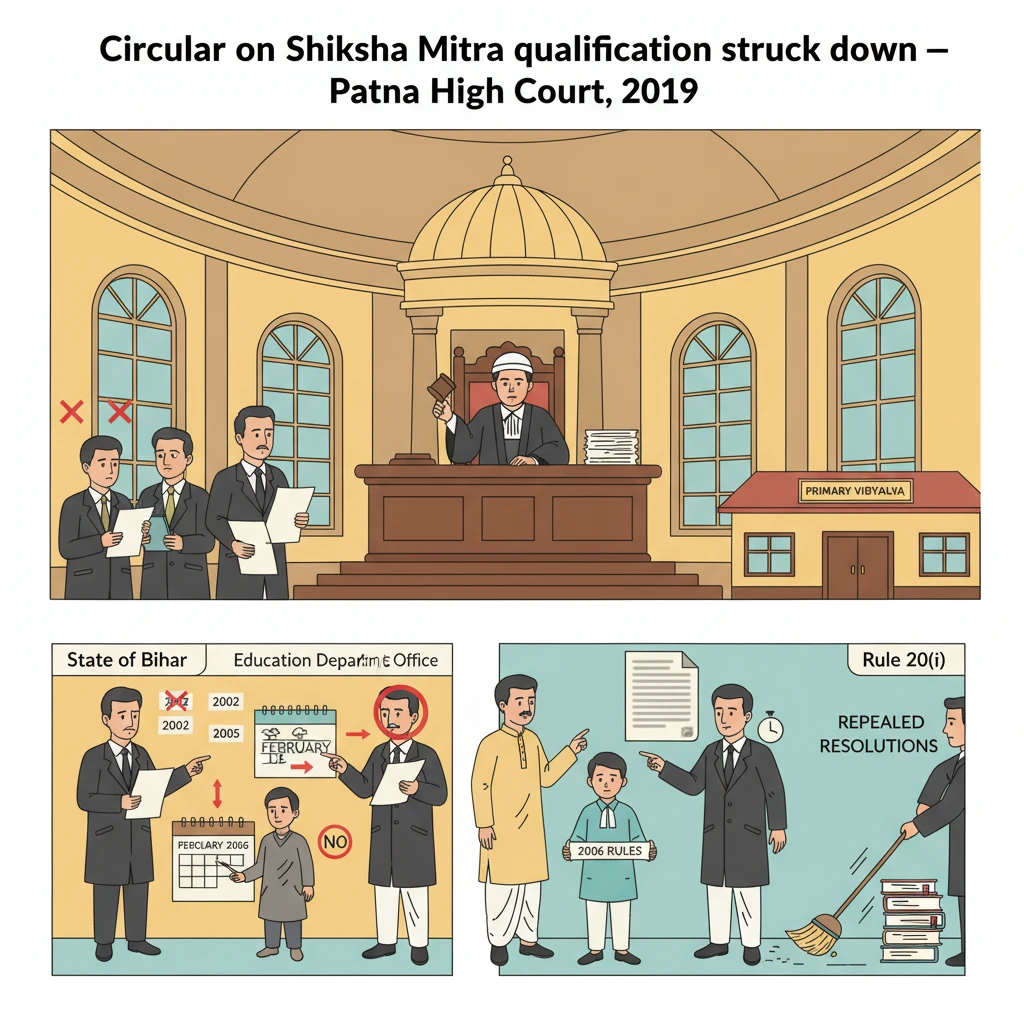
The appellant was appointed as Shiksha Mitra in 2003 in a primary school in Naubatpur, Patna, on contract for 11 months. His engagement was renewed once more. At that time, under the 2002 government resolution, matriculation with 45% marks was the minimum qualification.
On 11 August 2004, a fresh resolution raised the minimum qualification for Shiksha Mitra to Intermediate (10+2) with at least 45% marks. After this change, the appellant was allegedly stopped from working and marking attendance, though he produced no document to prove this before the Court. His second 11‑month term ended on 11 February 2005.
The appellant acquired Intermediate qualification in 2006, about four months after his disengagement, and within 33 months of his initial engagement. In 2006, the Bihar Panchayat Elementary Teachers (Employment and Service Conditions) Rules, 2006 came into force, abolishing the contractual Shiksha Mitra scheme and introducing permanent Panchayat and Block Teachers.
On 4 July 2008, the Human Resources Development Department issued a circular stating that persons engaged as Shiksha Mitra on matric qualification, who acquired Intermediate within 33 months or already had Intermediate (even with less than 45% marks), would be deemed to be Shiksha Mitra as on 1 July 2006 and would get the status of Panchayat/Block Teachers under the 2006 Rules.
In 2012, the appellant filed C.W.J.C. No. 4386 of 2012 seeking a direction to treat him as Shiksha Mitra from 2005 and as Panchayat Teacher from 1 July 2006 by relying on this 4 July 2008 circular. The learned Single Judge dismissed the writ petition on 12 March 2012, holding that the circular could not create a deemed re‑engagement for him from 2005.
The appellant then filed Letters Patent Appeal No. 87 of 2014. During hearing, a Division Bench noticed that earlier Division Benches had taken conflicting views on whether the 4 July 2008 circular operated from the date of circular or related back to the date of initial engagement. The matter was therefore referred to a Full Bench, which decided the reference in this judgment dated 20 June 2019.
What the Court Examined and Decided
The Full Bench first traced the history of the Shiksha Mitra scheme. In 2002, Bihar introduced engagement of Shiksha Mitra in Panchayat primary schools on 11‑month contracts, renewable up to a total of 33 months. Minimum qualification was matriculation with 45% marks, with age limits and modest honorarium.
In 2004, the government upgraded the minimum educational qualification to Intermediate with 45% marks. For Urdu posts, equivalent Urdu‑specific qualifications were prescribed. A key provision allowed Panchayats to try to fill 50% of Shiksha Mitra vacancies with women. For women only, a relaxation was given: if no qualified Intermediate‑pass women were available, matric‑pass women could be engaged, on the condition that they acquired Intermediate within three years, with District Magistrate approval.
Because of confusion in the field, the Department issued a clarification letter dated 21 April 2005. It clearly stated that contracts of existing Shiksha Mitras having only matriculation were not to be extended, since the minimum qualification had been raised to Intermediate. Only those already possessing Intermediate could have their contracts extended, and that too subject to satisfactory performance. The three‑year relaxation for acquiring Intermediate applied only to women engaged under the special female‑quota provision.
The Full Bench stressed that this relaxation was exclusively for women candidates, aimed at achieving 50% reservation for women Shiksha Mitras. Male candidates had no such relaxation. This point, according to the Court, was ignored or misunderstood in earlier litigation, leading to wrong assumptions that everyone had 33 months to improve qualifications.
In 2006, the legal position changed completely. Using powers under Article 243‑G of the Constitution and Section 146 of the Bihar Panchayat Raj Act, 2006, the State framed the Bihar Panchayat Elementary Teachers (Employment and Service Conditions) Rules, 2006. These Rules:
- Created statutory posts of Panchayat Teachers and Block Teachers for elementary schools.
- Prescribed Intermediate as the minimum educational qualification, with teacher‑training requirements.
- Allowed limited relaxation for “reserved category” candidates under Rule 4(3) (Matric candidates could be appointed only if no Intermediate‑pass reserved candidates were available, and then they had to acquire Intermediate within six years).
- Laid down a full procedure for employment through panels and selection committees under Rule 9.
- Contained Rule 20, which repealed all earlier circulars and instructions regarding Shiksha Mitra, saved service conditions of those already appointed under earlier schemes, and provided for automatic absorption of those Shiksha Mitras who were actually working as on 1 July 2006 as Panchayat Teachers.
The key point was that from 1 July 2006:
- All earlier Shiksha Mitra resolutions/circulars stood repealed.
- The post of Shiksha Mitra was abolished.
- Only those Shiksha Mitras genuinely working on 1 July 2006 could be absorbed as Panchayat Teachers under Rule 20(iii).
Despite this, disputes continued. Some Shiksha Mitras were terminated for not acquiring Intermediate within 33 months or for not achieving 45% marks. Others challenged their non‑absorption. In one such case, Kishori Prasad v. State of Bihar, the Division Bench accepted the view that Shiksha Mitras appointed on matriculation had 33 months from engagement to obtain Intermediate and quashed the termination because it came before the 33 months expired.
Acting on the judgment in Kishori Prasad, the Government issued the circular dated 4 July 2008. This circular declared that persons engaged as Shiksha Mitra on matric qualification who had obtained Intermediate within 33 months of engagement, or who already had Intermediate even with less than 45% marks, would be treated as Shiksha Mitra as on 1 July 2006 and deemed to have become Panchayat/Block Teachers from that date.
The Full Bench closely analysed this circular. It found that:
- By 1 July 2006, the 2006 Rules had already repealed all earlier Shiksha Mitra circulars and abolished the post of Shiksha Mitra.
- The 2008 circular tried to “give life” to a repealed scheme by deeming some people to be Shiksha Mitra on 1 July 2006 even if they were not actually working then.
- It also effectively created a new mode of entry into Panchayat Teacher posts by executive order, beyond the two modes allowed by the 2006 Rules: (a) direct recruitment under Rule 9 (and compassionate appointment under Rule 10), and (b) absorption of existing Shiksha Mitras actually working on 1 July 2006 under Rule 20(iii).
The Court held that executive instructions cannot override or amend statutory rules. They can only supplement or clarify them. Citing the Supreme Court decision in J&K Public Service Commission v. Dr. Narindra Mohan, the Bench reiterated that once statutory rules are in place, appointments must follow those rules. The government cannot use circulars to create additional routes into service or to regularise appointments outside the rules.
The Full Bench also noted that a larger Bench in Kalpana Rani v. State of Bihar, 2014(2) PLJR 665, had already declared the earlier Kishori Prasad judgment to be per incuriam (decided in ignorance of crucial law) and expressly overruled it. Kalpana Rani affirmed another Division Bench judgment in Renu Kumari Pandey, which had clearly held that:
- All prior Shiksha Mitra resolutions stood repealed by Rule 20 of the 2006 Rules.
- The posts of Shiksha Mitra were abolished from 1 July 2006.
- No one could thereafter be engaged as Shiksha Mitra, nor deemed to have been so engaged or absorbed as Panchayat Teacher by fiction.
The Supreme Court had refused to interfere with these Full Bench findings in Special Leave Petitions, making the legal position final.
Against this backdrop, the Full Bench in the present case concluded that the 4 July 2008 circular, which was based on the now‑overruled Kishori Prasad, could not stand. It attempted to amend repealed circulars and override the 2006 Rules by deeming appointments on abolished posts. The Court also explained the difference between legal “fiction” and “presumption”, observing that here the State was trying to create a fiction that people continued on posts which legally no longer existed, something a mere executive circular cannot do.
Coming to the appellant’s individual case, the Court highlighted:
- He was not working as Shiksha Mitra on 1 July 2006.
- His second contractual term ended on 11 February 2005, and he had no documents showing any continuation thereafter.
- He approached the Court only in 2012, about seven years after disengagement, whereas the Shiksha Mitra post had been abolished in 2006.
- Rule 20(iii) could not absorb him as Panchayat Teacher because that provision protects only those actually working as Shiksha Mitra on 1 July 2006.
- He could not rely on the 4 July 2008 circular because that circular itself was contrary to the 2006 Rules and based on a per incuriam judgment.
During the Full Bench hearing, the appellant even filed an interlocutory application seeking to amend his prayer and challenge the 4 July 2008 memo itself. The Court found this inconsistent stand unnecessary for deciding the reference and confined itself to answering the legal issue.
Ultimately, the Full Bench held that the 4 July 2008 circular cannot be given effect to at all. Because the circular is itself invalid and contrary to statutory rules, any question about whether it is prospective or retrospective becomes meaningless.
As a result, the appellant’s claim to be treated as Shiksha Mitra from 2005 and Panchayat Teacher from 1 July 2006 had no legal basis.
Why This Judgment Matters
This Full Bench decision is important for thousands of former Shiksha Mitra and Panchayat Teacher disputes in Bihar. It settles that the 4 July 2008 circular, which many candidates relied upon to claim deemed continuation or absorption, has no legal force because it conflicts with the 2006 Rules and rests on an overruled judgment.
For those who were not actually working as Shiksha Mitra on 1 July 2006, this judgment makes it clear that they cannot claim to be deemed Shiksha Mitra or Panchayat Teachers by relying on past engagement, improved qualifications within 33 months, or the 2008 circular.
The ruling also reinforces that once statutory recruitment rules exist, the State cannot use executive letters or circulars to open new back‑door entries into government service. Any such attempt, even if presented as a benefit or relaxation, will not survive judicial scrutiny.
For serving Panchayat Teachers and aspiring candidates, the judgment underlines that recruitment and absorption must strictly follow the 2006 Rules. For those considering litigation on old Shiksha Mitra engagements, it clarifies that long delay, abolition of posts, and absence of actual service on the cut‑off date will bar such claims.
Legal Issues and Answers
- Issue: Can the Government circular dated 4 July 2008 validly relax qualifications and deem former matric‑qualified Shiksha Mitras to have continued till 1 July 2006, so that they become Panchayat Teachers under Rule 20(iii) of the 2006 Rules?
Answer: No. The Full Bench held that the 4 July 2008 circular is contrary to the statutory 2006 Rules, seeks to amend repealed circulars and revive abolished posts by fiction, and is based on a per incuriam judgment. It cannot be given effect to, whether prospectively or retrospectively. - Issue: Can a person who was not working as Shiksha Mitra on 1 July 2006 claim deemed absorption as Panchayat Teacher or deemed re‑engagement on the basis of improved qualification within 33 months and the 2008 circular?
Answer: No. Only Shiksha Mitras actually employed and working on 1 July 2006 are covered by Rule 20(iii). There can be no deemed engagement or absorption on an abolished post by executive circular or on the basis of later qualification. - Issue: Did the appellant have any enforceable right to be treated as Shiksha Mitra after 11 February 2005 and as Panchayat Teacher from 1 July 2006?
Answer: No. His contractual term ended in 2005, he was not in service on 1 July 2006, he approached the Court belatedly, and his claim rested solely on an invalid circular. Therefore, he had no right to appointment or absorption.
Cases Cited by the Court
- The judgment refers to and relies upon earlier decisions of the Patna High Court, including:
- Kishori Prasad v. State of Bihar and Ors., 2008(2) PLJR 458 (later held per incuriam by a Full Bench).
- Kalpana Rani v. State of Bihar, 2014(2) PLJR 665 (Full Bench).
- Renu Kumari Pandey v. State of Bihar and Others, 2011(4) PLJR 297.
- Bhagwan Mahato v. State of Bihar and Ors., CWJC No. 7719 of 2010.
- Sakita Kumari v. State of Bihar and Ors., CWJC No. 11620 of 2010.
- State of Bihar and Ors. v. Indu Devi, LPA No. 1247 of 2009.
- Shashi Kant v. State of Bihar and Others, LPA No. 1470 of 2010.
- The Court also relies on:
- J & K Public Service Commission v. Dr. Narindra Mohan, (1994) 2 SCC 630, on the principle that executive instructions cannot override statutory rules.
- Bhuwalka Steel Industries Limited and Another v. Union of India and Others, (2017) 5 SCC 598, explaining the difference between legal fiction and presumption.
- State of U.P. and Others v. Arbind Kumar Srivastava and Others, (2015) 1 SCC 347, on laches and delay, cited by the State in argument.
- P. Mahendran and Ors. v. State of Karnataka, AIR 1990 SC 405, and A.A. Calton v. Director of Education and Another, AIR 1983 SC 1143, were cited by the appellant but held inapplicable.
Case Details
Case Number: Letters Patent Appeal No. 87 of 2014 in Civil Writ Jurisdiction Case No. 4386 of 2012
Case Title: Ram Ekwal Paswan v. The State of Bihar and Ors.
Citation: 2019 (3) PLJR 384
Coram: Hon’ble Mr. Justice Dinesh Kumar Singh; Hon’ble Mr. Justice Prabhat Kumar Jha; Hon’ble Justice Smt. Nilu Agrawal
Advocates:
- For the appellant: Mr. Dhananjay Kumar, Mr. Srikant Pandey
- For the respondents (State): Mr. Pushkar Narain Shahi, AAG 6; Mrs. Shilpa Singh, GA 12; Mr. Ranjan Kumar, AC to GA 12
Nature of the Case: Letters Patent Appeal (intra‑court appeal) arising out of dismissal of writ petition; Full Bench reference to resolve conflict between Division Bench judgments regarding effect and timing of Government Circular dated 4 July 2008 on Shiksha Mitra qualifications and absorption as Panchayat Teachers.
Date of Judgment: 20 June 2019
Court: High Court of Judicature at Patna (Full Bench)
Link to Judgment: Click here to read the full judgment on the Patna High Court website
If you found this explanation helpful and wish to stay informed about
how legal developments may affect your rights in Bihar,
you may consider following Samvida Law Associates for more updates.







