
Case Background
This case arises from recruitment against Advertisement No. 1 of 1998 for appointment of constables in Bihar Police.
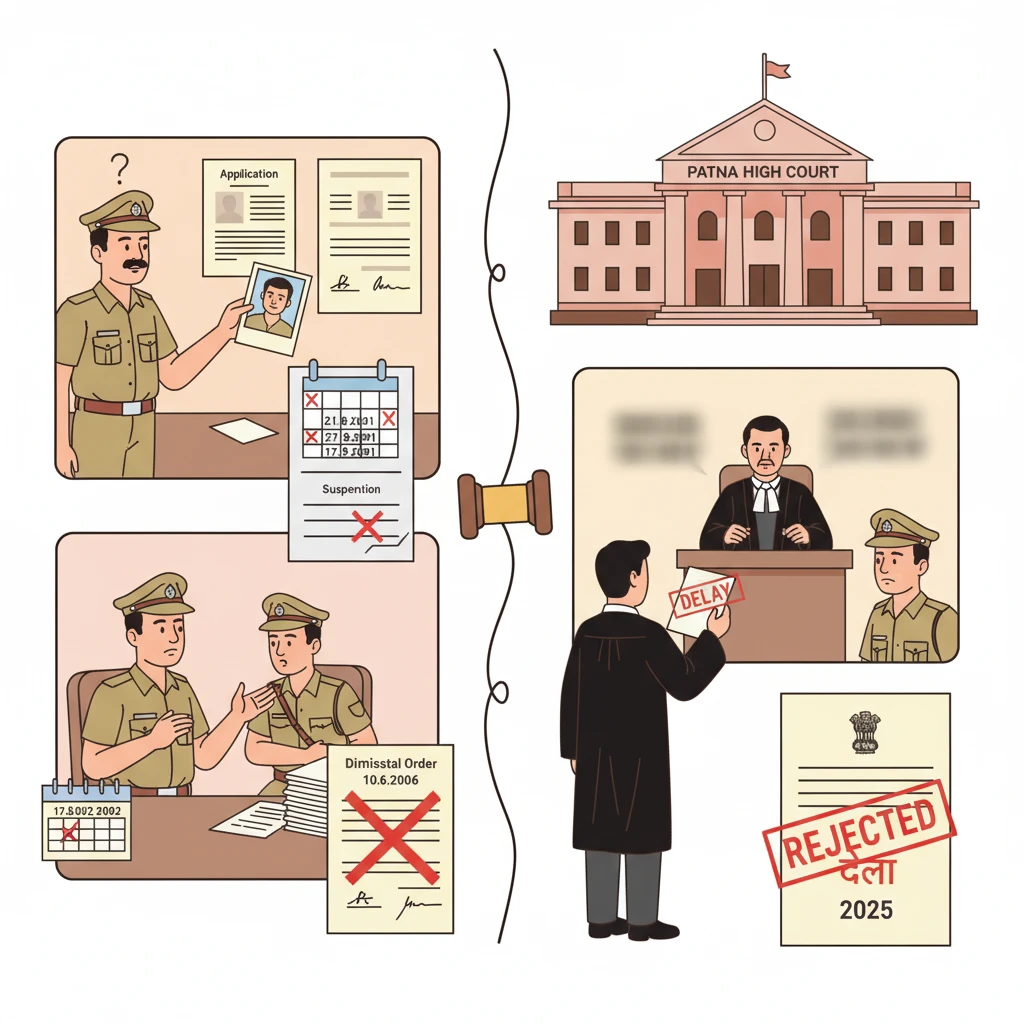
The petitioner was appointed as a constable. Later, doubts were raised about whether the person who wrote the application and appeared in recruitment was the same person who had actually joined service.
The Senior Superintendent of Police, Patna issued several letters, including dated 21.8.2001 and 27.8.2001, directing the petitioner to appear physically so that his photograph could be compared and matched with the photograph attached with his application form.
According to the authorities, despite repeated directions, the petitioner did not appear. As a result, he was suspended by order dated 17.9.2001. The departmental authorities treated his conduct as gross indiscipline and defiance of orders.
A charge-sheet dated 16.5.2002 was served on him, alleging that he had failed to appear for verification and that his photograph and signature on the recruitment application form did not match his actual photograph and signature. The petitioner submitted his reply and a departmental enquiry was conducted.
The Conducting Officer held that the charges were proved. On that basis, by order dated 10.6.2006, the Senior Superintendent of Police, Patna dismissed the petitioner from service and confined payment for the suspension period to subsistence allowance only.
The petitioner filed a departmental appeal before the Deputy Inspector General of Police, Patna. The appeal was rejected by order dated 5.12.2006.
Separately, a criminal case was also lodged on similar allegations. This led to Trial No. 521 of 2013 (G.R. No. 152 of 2003) before the Judicial Magistrate 1st Class, Patna. By judgment dated 30.1.2013, the petitioner was acquitted in that criminal case.
After the acquittal, the petitioner again approached the D.I.G., Patna by way of another appeal, which was rejected and communicated to him through letter dated 7.6.2013.
He then filed a memorial before the Director General of Police, Bihar against the earlier appellate order dated 5.12.2006. The Director General of Police rejected the memorial by order dated 27.5.2013 on the ground that it was time-barred.
Aggrieved by the dismissal order, the appellate order, the rejection of his second appeal communication, and the order rejecting the memorial, the petitioner filed the present writ application before the Patna High Court in 2013. The judgment was delivered on 12.12.2025.
What the Court Examined and Decided
The Patna High Court heard arguments from both sides.
The petitioner’s counsel argued that the departmental charges and the criminal charges were identical. According to him, the witnesses in the departmental enquiry and in the criminal trial were the same, and those witnesses did not support the prosecution story in the criminal court. This led to his acquittal on 30.1.2013.
On this basis, he claimed that there was no remaining material for the Enquiry Officer to hold the charges proved in the departmental proceeding. He argued that once he had been acquitted, the departmental punishment should not stand.
The petitioner also tried to explain his absence from the verification date of 27.8.2001. He said that he had applied for and obtained casual leave to take his wife for medical treatment and therefore he could not appear for physical verification on that date.
He further argued that the punishment of dismissal from service was disproportionate to the alleged misconduct. He also alleged that he was not given adequate opportunity to defend himself, and that the orders of the disciplinary and appellate authorities violated principles of natural justice.
The State opposed the writ petition. The State’s counsel pointed out that the dismissal and the rejection of the departmental appeal both took place in 2006, yet the petitioner moved his memorial before the D.G.P. only in 2013, about seven years later. Hence, according to the State, the D.G.P. rightly rejected the memorial as time-barred.
To support this, the State relied on the Supreme Court judgment in Mrinmoy Maity vs. Chhanda Koley & Ors.; (2024) 15 SCC 215 / 2024 LiveLaw (SC) 318, which stresses that extraordinary writ jurisdiction cannot be invoked after inordinate delay and that submitting memorials does not revive a “dead” cause of action.
On the issue of acquittal, the State submitted that a criminal acquittal does not automatically wipe out findings in a departmental proceeding. The standards of proof are different. In a criminal case, guilt must be proved beyond reasonable doubt, whereas in departmental proceedings, the test is only preponderance of probabilities.
For this principle, the State relied on the Supreme Court decision in Samar Bahadur Singh vs. State of Uttar Pradesh & Ors.; (2011) 9 SCC 94. There, the Supreme Court clarified that acquittal in a criminal case has no necessary bearing on departmental proceedings because of the different standards of proof.
The State further argued that, as seen from the criminal court judgment, this was not a case of “honourable acquittal”. The acquittal was because relevant prosecution witnesses were not examined, not because the court found the accusations false on merits.
For this distinction, the State referred to Deputy Inspector General of Police vs. S. Samuthiram; (2013) 1 SCC 598, which explains the concept of “honourable acquittal” and holds that every acquittal does not automatically entitle an employee to reinstatement.
After hearing both sides and examining the records, the Patna High Court summarised the core departmental allegation. The allegation was that the photograph and signature of the petitioner on the recruitment application form did not match his actual photograph and signature. Further, despite directions to appear for verification, he failed to participate in the process.
The Court noted that the petitioner had been served a memo of charge, he had filed a reply, and the departmental enquiry had proceeded on that basis. The Conducting Officer found the charges proved. The disciplinary authority, the appellate authority (D.I.G.) and the revisional authority (D.G.P.) had all upheld this conclusion.
On the petitioner’s argument regarding his acquittal, the Court reiterated the settled law. Referring to Samar Bahadur Singh, the Court stated that in criminal cases the prosecution must prove its case beyond all reasonable doubt, while in departmental inquiries the requirement is proof on a preponderance of probabilities.
Therefore, an acquittal in a criminal case does not by itself vitiate the findings in departmental proceedings. The Court quoted paragraph 7 of Samar Bahadur Singh, where the Supreme Court had clearly held that acquittal in the criminal case has no bearing on departmental proceedings.
Next, the Court examined whether the petitioner’s acquittal was an “honourable acquittal”. Relying on S. Samuthiram, the Court explained that the expressions “honourable acquittal”, “acquitted of blame”, and “fully exonerated” are not part of the Criminal Procedure Code but have been evolved in case law. An honourable acquittal happens when, after full consideration of the evidence, the court finds that the prosecution has completely failed to prove the charge.
Upon perusing the criminal judgment, the Patna High Court concluded that this was not such a case. The acquittal was mainly because relevant prosecution witnesses were not examined. Hence, the departmental findings could not be brushed aside on this ground.
The Court then looked closely at the conduct of the departmental enquiry. From the punishment order, it appeared that after the petitioner failed to appear for verification on 27.8.2001, the Conducting Officer sent him another notice and requested his presence in the enquiry.
On the petitioner’s request, the enquiry date was deferred from 17.8.2002 to 24.8.2002. The petitioner appeared on 24.8.2002 and again on 21.9.2002. However, according to the record, he did not produce any defence.
The Conducting Officer examined the materials, including the petitioner’s photograph and signature on the original application form and compared them with his actual photograph and signature. He came to a clear conclusion that neither the photograph nor the signature on the application form matched with that of the petitioner.
Thus, the High Court found that the petitioner was given opportunity to participate in the enquiry. He did appear on two dates but chose not to furnish a defence. In these circumstances, the Court did not accept the allegation that there was denial of natural justice.
Finally, the Court gave significant weight to the issue of delay. The petitioner had been dismissed on 10.6.2006 and his departmental appeal was rejected on 5.12.2006. Yet he moved a memorial to the D.G.P. only in 2013, about seven years later. He then approached the High Court by filing the writ petition after the rejection of that memorial.
Relying on Mrinmoy Maity and the earlier Supreme Court decision in Tridip Kumar Dingal & Others v. State of W.B. & Others; (2009) 1 SCC 768, the Court underlined that there is no fixed limitation period for writ petitions, but the remedy is discretionary. Courts can, and often must, refuse relief where there is inordinate delay and laches.
The Supreme Court had held that submitting memorials does not revive a cause of action that has already had a “natural death”, and that indolent litigants should not be allowed to gain from their own inaction. The Patna High Court echoed this principle.
In paragraph 21, the Court observed that counsel for the petitioner was unable to point out any procedural irregularity in the enquiry. It also stressed the roughly seven-year delay in filing the memorial and then the writ petition against the 2006 dismissal and appellate orders.
In these circumstances, the Court found that no case was made out for interfering with the impugned orders. It therefore dismissed the writ application, upholding the petitioner’s dismissal from service.
Why This Judgment Matters
This judgment is important for government employees, especially those in disciplined forces like the police, who face departmental proceedings.
First, it reinforces that a criminal acquittal does not automatically undo departmental punishment. If the departmental enquiry was conducted fairly and there is material on record, the punishment may stand even after acquittal by a criminal court.
Second, it highlights that delay can be fatal. Waiting for many years before challenging a dismissal, and then trying to revive the matter through memorials, may not help. The High Court can refuse relief purely on the ground of delay and laches.
Third, it shows that employees must actively participate in departmental enquiries. Simply appearing but not offering any defence, and later alleging lack of opportunity, is unlikely to succeed before the Court.
For constables and other lower-ranked staff, the decision warns that allegations of impersonation or mismatch of documents at the recruitment stage are treated very seriously and can lead to dismissal, which courts may uphold if proper procedure was followed.
Legal Issues and Answers
- Issue: Does acquittal in a criminal case on similar facts compel the Patna High Court to set aside dismissal from service imposed in departmental proceedings?
Answer: No. The Court held that criminal and departmental proceedings have different standards of proof, and the petitioner’s acquittal was not an “honourable acquittal”. Hence, the departmental finding could stand independently. - Issue: Can a writ petition be entertained against dismissal and appellate orders passed in 2006 when the employee approaches the High Court after about seven years, relying on a belated memorial?
Answer: No. Applying Supreme Court precedents, the Court held that such inordinate delay and laches bar relief, and memorials do not revive a dead cause of action. - Issue: Was there violation of natural justice in the departmental enquiry against the petitioner constable?
Answer: The Court found no such violation. The petitioner was served with a charge-sheet, replied to it, was given further notice, and appeared on multiple enquiry dates but did not present a defence. Hence, adequate opportunity was provided.
Cases Cited by the Court
- Mrinmoy Maity vs. Chhanda Koley & Ors.; (2024) 15 SCC 215 / 2024 LiveLaw (SC) 318
- Samar Bahadur Singh vs. State of Uttar Pradesh & Ors.; (2011) 9 SCC 94
- Deputy Inspector General of Police vs. S. Samuthiram; (2013) 1 SCC 598
- Tridip Kumar Dingal and Others v. State of W.B. and Others; (2009) 1 SCC 768 : (2009) 2 SCC (L&S) 119
- Earlier Supreme Court precedents referred within quoted passages: State of M.P. v. Bhailal Bhai; Moon Mills Ltd. v. Industrial Court; Bhoop Singh v. Union of India; Tilokchand Motichand v. H.B. Munshi; Durga Prashad v. Controller of Imports and Exports; Rabindranath Bose v. Union of India; and RBI v. Bhopal Singh Panchal.
Case Details
Case Number: Civil Writ Jurisdiction Case No. 16403 of 2013
Case Title: Anant Kumar Singh vs. The State of Bihar & Ors.
Coram: Hon’ble Mr. Justice Partha Sarthy
Date of Judgment: 12.12.2025
Citation: 2026(1) PLJR 354
Advocates:
For the Petitioner: Mr. Ajit Kumar Singh, Advocate
For the Respondents: Mr. Prashant Pratap, GP-2; Mr. Shadwal Harsh, AC to GP-2
Nature of the Case: Writ petition under civil writ jurisdiction challenging dismissal from service, departmental appellate order, and rejection of memorial.
Link to the Judgment: Read full judgment of Patna High Court
If you found this explanation helpful and wish to stay informed about
how legal developments may affect your rights in Bihar,
you may consider following Samvida Law Associates for more updates.







