

Case Background
A title partition suit, Title Suit No. 103 of 1952, was filed by the ancestors of the present petitioners before the court of the Munsif at Aurangabad. After contest, the suit was decided by a judgment dated 20.01.1954 and a preliminary decree was prepared on 02.02.1954.
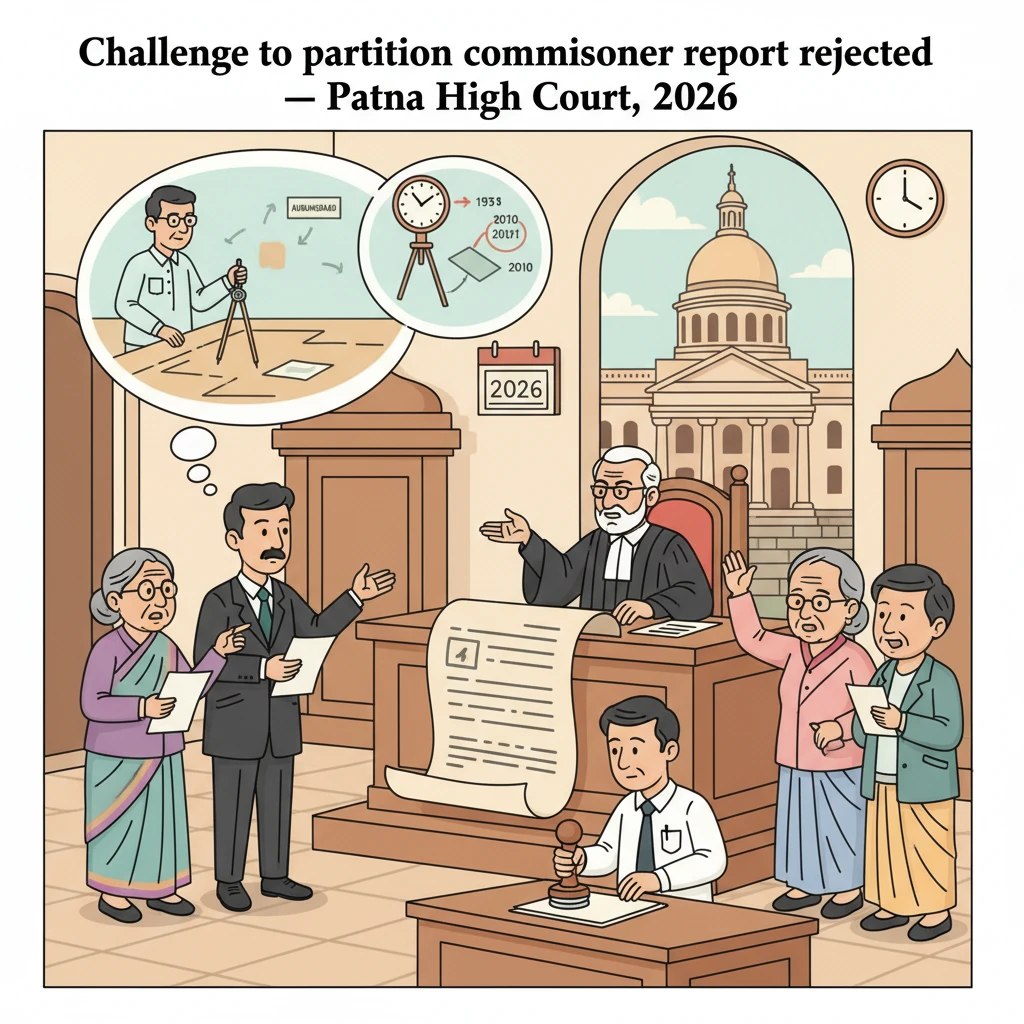
For dividing the joint family property as per the preliminary decree, the trial court appointed a survey-knowing Pleader Commissioner. The commissioner submitted his report on 19.11.1957. The trial court invited objections from all parties, but no objection was filed. The report was then confirmed by order dated 04.01.1958.
The petitioners later asserted that this order of confirmation did not bear the seal and signature of the Presiding Officer. Despite this, the suit itself was disposed of on 08.09.1958 with a direction to draw the final decree after filing the necessary stamp papers and depositing the balance of the commissioner’s fee.
On 06.04.2010, more than five decades later, the petitioners applied in the trial court for preparation of the final decree along with an application for condonation of delay. The trial court rejected this prayer by order dated 13.05.2010.
Against that rejection, the petitioners approached the Patna High Court in CWJC No. 10032 of 2010. By judgment dated 24.08.2018, the High Court set aside the trial court’s order and remitted the matter to the Munsif to reconsider preparation of the final decree. The High Court specifically recorded that the commissioner’s report had been submitted on 23.11.1957, confirmed on 04.01.1958, and that the suit was disposed on 08.09.1958 with a direction to draw the final decree on completion of requisite formalities.
After this remand, during the process of working out the final decree, the decree-holders filed a petition dated 23.11.2023 before the Munsif. They sought to set aside the long-standing survey-knowing Pleader Commissioner’s report dated 19.11.1957 and asked for appointment of a fresh survey-knowing Pleader Commissioner to carve out individual takhtas (separate shares) in light of the judgment, decree and alleged subsequent sales of land.
By order dated 12.12.2023, the learned Munsif, Aurangabad rejected this petition. Aggrieved, the decree-holders filed Civil Miscellaneous No. 107 of 2024 before the Patna High Court under its civil miscellaneous jurisdiction, leading to the present judgment dated 13.01.2026.
What the Court Examined and Decided
The Patna High Court, through Hon’ble Mr. Justice S. B. Pd. Singh, examined whether the trial court had erred in refusing to discard the commissioner’s report of 1957 and in refusing to appoint a fresh survey-knowing Pleader Commissioner in a partition suit that was already decreed long back.
The petitioners’ counsel first outlined the history of the partition suit. He stated that the suit had resulted in a preliminary decree in 1954, followed by appointment of a commissioner who submitted his report in 1957. According to him, even though objections had been invited, none were filed and the report was treated as confirmed on 04.01.1958.
A core plank of the petitioners’ argument was that the order confirming the commissioner’s report on 04.01.1958 was defective because it allegedly did not bear the seal and signature of the Presiding Officer. On this basis, they sought to reopen the issue of how the land should be divided and prayed for a completely new survey and report.
The petitioners also relied on the order passed in CWJC No. 10032 of 2010. In that earlier writ, the High Court had set aside the order rejecting their request for final decree and directed the trial court to consider preparation of the final decree afresh. The petitioners tried to draw strength from certain observations in that decision about the continued life of the lis until a final decree is passed.
In support of a wider and more flexible approach to final decree proceedings in partition suits, learned counsel for the petitioners relied on two Supreme Court decisions.
First, reliance was placed on Prasanta Kumar Sahoo & others vs. Charulata Sahu & others, reported in (2023) 9 SCC 641. The Patna High Court reproduced paragraph 74.3 of that judgment. The Supreme Court had held that under Mitakshara Hindu law, filing of a partition suit amounts to a clear declaration of intention to separate and brings about severance of status. However, the Court also explained that if, during the pendency of a partition suit or between the preliminary and final decree, a legislative amendment or other subsequent events alter the parties’ shares or rights, such changes must be considered while passing the final decree.
The Supreme Court had further emphasized, in paragraph 107 cited by the High Court, that the constitution of a coparcenary changes by birth or death and that shares must be worked out at the time of actual partition. The statutory fiction of partition does not itself achieve physical division. Therefore, even after severance of status, changes in law or circumstances before the final decree must be taken into account.
Second, the petitioners cited Venu vs. Ponnusamy Reddair (Dead) through legal representatives and another, reported in (2018) 15 SCC 254. The Patna High Court quoted paragraph 3 of that decision, where the Supreme Court held that a preliminary decree in a partition suit crystallises the right to seek partition, but equities are worked out in the final decree proceedings. It was also clarified that until actual partition and passing of the final decree, no period of limitation runs against the right to claim partition as per the preliminary decree, and even an application for appointment of a commissioner for final decree is not barred by limitation.
After extracting and considering these authorities, the Patna High Court drew a clear line. It held that the judgments relied on by the petitioners did not assist them in the facts of this case. The reason was that here the final decree had not been drawn for more than fifty years, not because of any legal bar or court refusal, but solely due to the fault and inaction of the parties, despite repeated efforts by the trial court to move the matter forward.
The Court placed weight on its own earlier decision dated 24.08.2018 in CWJC No. 10032 of 2010. In that judgment, it had already examined the record and given a specific direction to the Munsif to draw the final decree after the parties filed the necessary stamp papers and deposited the balance of the commissioner’s fee. The earlier order of 13.05.2010, by which the trial court had rejected the application for final decree, had been set aside for this purpose.
In the present round, the petitioners tried to sidestep that earlier High Court direction by attacking the old commissioner’s report and demanding a fresh survey, also taking into account alleged sale deeds executed over the decades in respect of the suit property.
The High Court firmly rejected this attempt. It recorded the submission that many transactions had occurred in relation to the suit land after the 1954 judgment. However, the Court clarified that such sale deeds had “no relevancy at present” because the preliminary decree in the partition suit had never been challenged. Therefore, the final decree must be prepared strictly on the basis of the preliminary decree and the shares allotted thereunder, and not according to any sale deeds executed by any party.
The Court also addressed the concern that some parties might have sold more than what would ultimately fall to their share in the partition. It observed that if the petitioners or any other party felt aggrieved on this score, they would have the opportunity to file a fresh suit regarding such alleged excess transfers. That issue could not be used to stall or reopen the partition suit itself, which had already attained finality.
The High Court emphasized that, in light of its earlier judgment in CWJC No. 10032 of 2010 and the findings recorded there, there was no scope for further interference with the old judgment and decree or with the confirmed commissioner’s report. The task now before the trial court was narrow: to draw the final decree based on the existing preliminary decree and the confirmed report, once the parties complied with the requirements of court fee and commissioner’s fee.
Summarising these reasons, the Court concluded that the civil miscellaneous application challenging the order dated 12.12.2023 was “devoid of merit.” It therefore rejected the petition and dismissed Civil Miscellaneous No. 107 of 2024.
Why This Judgment Matters
This judgment has practical importance for families involved in very old partition suits where final decrees have not yet been drawn. The Patna High Court made it clear that parties cannot indefinitely delay final decree proceedings and later demand that old commissioner reports be scrapped simply because decades have passed or because the parties themselves have entered into private sale transactions.
For decree-holders, the ruling underlines that once a preliminary decree is passed and not challenged, the partition suit is practically settled as to rights and shares. The final decree stage is mainly to convert those shares into actual separate plots, not to reopen questions already decided.
For buyers and others dealing with land that is still subject to an unworked preliminary decree, the judgment signals that such later sale deeds do not change the shares fixed by the court. If a seller transfers more than his share, affected persons may have to bring a separate suit, but the original partition decree will still be implemented as it stands.
For trial courts, the decision supports a firm approach in very old cases: where delays are due to party inaction, and the High Court has already directed that a final decree be drawn, the court should proceed on the basis of the existing commissioner’s report and not allow repeated attempts to reopen the partition.
Legal Issues and Answers
-
Issue: Can parties, after more than fifty years of inaction, seek to set aside a confirmed survey-knowing Pleader Commissioner’s report in a partition suit and demand appointment of a new commissioner on the basis of subsequent sale deeds?
Answer: No. The Patna High Court held that the commissioner’s report had long been confirmed, the preliminary decree stood unchallenged, and the final decree must now be prepared on that basis. Subsequent sale deeds are irrelevant to final decree proceedings in this suit. -
Issue: Do Supreme Court decisions allowing consideration of subsequent events in final decree proceedings justify reopening the partition process where delay is caused solely by parties’ inaction?
Answer: No. The Court held that those authorities do not apply in a case where, despite repeated efforts by the court, the final decree could not be drawn for more than fifty years due only to the parties’ fault and inaction.
Cases Cited by the Court
- Prasanta Kumar Sahoo & others vs. Charulata Sahu & others, (2023) 9 SCC 641.
- Venu vs. Ponnusamy Reddair (Dead) through legal representatives and another, (2018) 15 SCC 254.
Case Details
Case Number: Civil Miscellaneous Jurisdiction No. 107 of 2024
Case Title: Krishna Ram & another vs. Pramod Dusadh & others
Court: High Court of Judicature at Patna
Coram: Hon’ble Mr. Justice S. B. Pd. Singh
Date of Judgment: 13.01.2026
Citation: 2026(2) PLJR 112
Advocates:
- For the Petitioners: Mr. Lakmesh Marvind, Advocate
- For the Respondents: Not specified in the judgment
Nature of the Case: Civil miscellaneous application challenging an order in a long-pending title partition suit regarding commissioner’s report and appointment of new survey-knowing Pleader Commissioner (final decree proceedings)
Impugned Order: Order dated 12.12.2023 passed by the learned Munsif, Aurangabad in Title Suit No. 103 of 1952 rejecting petition dated 23.11.2023 for setting aside commissioner’s report dated 19.11.1957 and appointment of new commissioner
Earlier Related Proceeding: CWJC No. 10032 of 2010, Patna High Court judgment dated 24.08.2018 remitting matter to trial court for preparation of final decree
Link to Full Judgment: Click here to read the Patna High Court judgment
If you found this explanation helpful and wish to stay informed about
how legal developments may affect your rights in Bihar,
you may consider following Samvida Law Associates for more updates.







