
Case Background
This case arises from a long and complicated recruitment for the 1st Intermediate Level Combined Competitive Examination conducted by the Bihar Staff Selection Commission (BSSC).
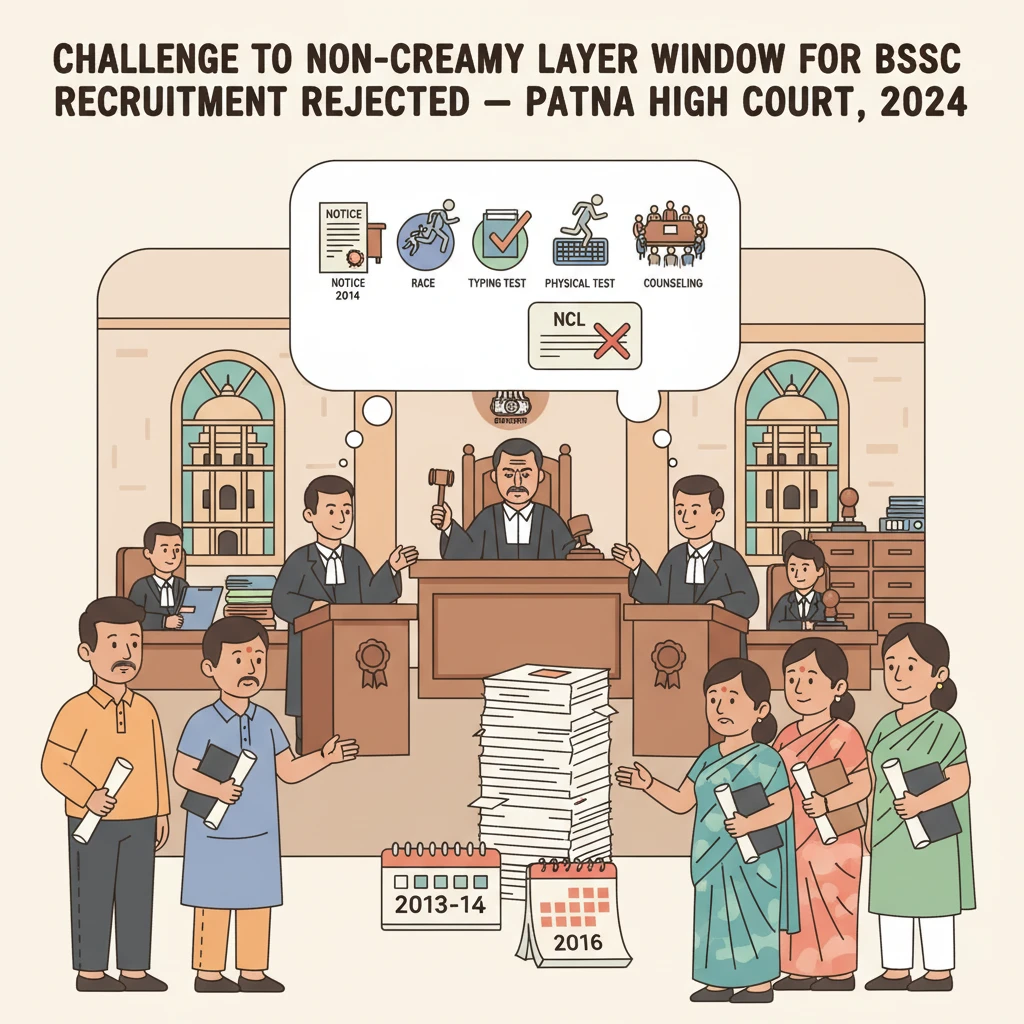
The first advertisement was issued on 01.09.2014 to fill 13,120 vacancies in Group-A and Group-B posts in various departments of the Government of Bihar. Group-A posts required a physical test, while Group-B posts did not.
The last date for submitting applications under this advertisement was 31.10.2014. Some candidates approached the Patna High Court in CWJC No. 17465 of 2014 seeking age relaxation. On 25.06.2015, the Court allowed that writ petition and directed that such candidates be given relaxation in age.
To implement this judgment, BSSC issued a further notice on 05.02.2016 (Annexure-P2 in the writ petition), allowing candidates who became eligible because of age relaxation to apply afresh up to 13.03.2016. This extension was specifically for those who gained eligibility due to the Court’s order. No candidate who had already applied under the 2014 advertisement challenged this 05.02.2016 notice.
A preliminary examination was conducted but later cancelled due to allegations and deficiencies. Fresh preliminary examinations were then held in two shifts between 08.12.2018 and 10.12.2018. A total of 63,739 candidates were declared successful in these prelims.
The main examination took place on 25.12.2020, and the results were declared on 25.02.2021. From this main exam, 52,784 candidates qualified. A typing test was conducted on 08.07.2021 and 13.07.2021. For Group-A posts, 4,634 candidates were called for the physical test.
On 19.09.2021, on finding discrepancies in the earlier preliminary exam, 1,218 additional candidates were held entitled to participate in the main exam. After giving them a main test, 727 more candidates were declared successful.
Ultimately, 14,410 candidates were called for counselling. At this stage, the issue of Non-Creamy Layer certificates for candidates seeking reserved category benefits came up. Specifically, about 3,500 candidates who had been allowed to apply on the basis of age relaxation did not possess NCL certificates reflecting their status in the year 2013–14, which was treated as the recruitment year.
Some of these candidates without NCL certificates had filed CWJC No. 20854 of 2021. That writ petition, however, was withdrawn on 28.04.2022, and any interim order granted earlier automatically came to an end.
Despite the withdrawal, the State Government issued two key communications: General Administration Department Letter No. 7591 dated 20.05.2022 (Annexure-P9) and Letter No. 1928 dated 23.05.2022 (Annexure-P10). Through these letters, District Magistrates were directed to take steps to issue NCL certificates as on 2013–14 to successful reserved-category candidates of the 2014 recruitment who had become eligible later due to age relaxation.
The letter dated 20.05.2022 instructed District Magistrates to act on a list of about 3,500 such successful candidates. The subsequent letter dated 23.05.2022 asked these candidates to apply for NCL certificates within 15 days and upload the certificates on the Commission’s website.
The present appellants, who were unsuccessful candidates, had originally approached the single judge in a writ petition. They sought cancellation of these NCL certificates and the underlying government directions, claiming that, if those 3,500 candidates had not been granted NCL certificates, the appellants would likely have been selected and appointed.
The learned single judge dismissed their writ petition, upholding the Government’s decision. Aggrieved by this dismissal, the appellants filed the present Letters Patent Appeal No. 470 of 2023, along with an interlocutory application seeking condonation of delay in filing the appeal.
What the Court Examined and Decided
The Division Bench, comprising Hon’ble the Chief Justice and Hon’ble Mr. Justice Nani Tagia, first dealt with Interlocutory Application No. 1 of 2023. The appellants had delayed filing the appeal by 169 days. After examining the affidavit, the Bench was satisfied that sufficient reasons had been shown and condoned the delay, allowing the interlocutory application.
The main focus then shifted to the challenge against the two government letters (Annexure-P9 and Annexure-P10) and the consequential NCL certificates issued to about 3,500 candidates.
The appellants’ central argument was simple but far-reaching. They contended that, without the benefit of these NCL certificates issued on a retrospective basis, many of the 3,500 candidates would not have been treated as reserved category candidates. According to the appellants, if those candidates had not been considered in reserved categories, the appellants would have had a better chance of securing appointment in the recruitment process.
However, the Court quickly noted a serious procedural flaw in the appellants’ case. None of the 3,500 candidates whose NCL certificates were being attacked were made parties to the writ petition before the single judge. They were neither individually impleaded nor represented in any collective or representative capacity.
The appellants’ counsel argued that they did not know the names of these candidates. The Division Bench rejected this as a sufficient excuse. The Court noted that the list of about 3,500 successful candidates, who had applied on the strength of age relaxation, had been provided to the District Magistrates. The appellants could have taken steps to obtain that list or, at the very least, sought directions from the Court for publication of notice regarding the pendency of the writ petition so that affected candidates could have had an opportunity to be heard.
Turning to the substance, the Court reviewed the detailed examination already undertaken by the single judge. The long recruitment history showed that the process was delayed due to litigation and deficiencies in exams. The category of 3,500 candidates consisted of persons who were initially over-age but later permitted to apply after this Court’s judgment in CWJC No. 17465 of 2014 granting age relaxation.
Because of this relaxation, the recruitment had two cut-off dates for applications: 31.10.2014 (original) and 13.03.2016 (after relaxation). The recruitment year, however, remained 2013–14. For reserved-category candidates, NCL status had to be verified with reference to that recruitment year.
Candidates who could only apply in 2016 due to age relaxation faced a practical problem. By that time, they could not possibly have NCL certificates issued as on 2013–14. As the single judge found, when the process was ongoing, the relaxation in age granted, and further tests conducted, no complaint was raised by the petitioners. The Government, in the single judge’s view, acted bona fide to ensure that this Court’s earlier directions on age relaxation were given full effect and not frustrated by procedural gaps concerning NCL certificates.
The Division Bench agreed with this reasoning. It noted that the Government, through Annexure-P9, identified that there had been two last dates for applications—31.10.2014 and 13.03.2016—and that candidates applying on the latter date lacked NCL certificates of 2013–14 purely due to passage of time. To remove this unfairness, the Government decided to give them a “window of benefit” so they could obtain NCL certificates reflecting their status as on the recruitment year.
Crucially, the Court emphasised what the Government orders actually did, and what they did not do. The orders did not automatically grant NCL certificates to anyone. Instead, they directed District Magistrates to accept applications from these candidates within 15 days and to consider their claims for NCL certificates as on 2013–14, strictly with reference to the financial status of their parents for that period.
The appellants never alleged that any particular candidate among the 3,500 was wrongly given NCL status, or that their parents’ income in 2013–14 was above non-creamy layer limits. They had no such case on facts, and the Court also pointed out that, in any event, they could not raise such a factual challenge because none of those candidates had been impleaded as respondents.
From a constitutional and administrative law standpoint, the Court saw no illegality or arbitrariness in the Government’s approach. The recruitment year remained fixed at 2013–14. The NCL certificates were to be assessed as on that year, not on any later date. So, the rights of other candidates remained protected. What the State did was remove a procedural disadvantage faced by a group of candidates who were allowed to enter the race only because of a Court-directed age relaxation.
The Division Bench underlined that there was no prejudice to other candidates. The move simply ensured that those who were validly in the field—thanks to a judicial order—were not denied the benefit of reservation only because of the time lag between the recruitment year and the extended application date.
After considering all aspects, the Bench concluded that there was “absolutely no anomaly” in the Government granting this window of benefit. It fully endorsed the single judge’s view that the Government had acted bona fide to give effect to the earlier age relaxation judgment and that the policy decision on NCL certificates was fair and reasonable.
Finally, the Division Bench held that, on both counts—the merits of the Government circulars and the procedural defect of non-joinder of affected candidates—the appeal could not succeed. The judgment of the learned single judge was found “perfectly in order”, and the writ petition itself, in the Court’s view, ought not to have been entertained without impleading the affected parties.
Accordingly, the Letters Patent Appeal was dismissed. Any pending interlocutory applications also stood closed.
Why This Judgment Matters
This judgment is significant for candidates and lawyers dealing with long-running government recruitments and reservation benefits.
First, it confirms that the State can take reasonable steps to implement court-ordered relaxations, such as age relaxation, in a way that ensures beneficiaries actually enjoy the rights given to them. Here, the Patna High Court accepted that creating a special window to obtain NCL certificates as on the recruitment year was a valid and fair measure.
Second, the judgment reinforces a basic but often overlooked rule of litigation: if you are challenging benefits given to others, you must make those persons parties to the case. Without giving them a chance to be heard, such challenges are unlikely to succeed.
Third, for reserved-category candidates in Bihar, the decision shows that the Government and the Court may look at the practical realities of delayed exams and shifting deadlines, so long as the core recruitment year and eligibility standards are respected.
For future recruitment disputes before the Patna High Court, this case will stand as an example that courts are reluctant to unsettle large sets of beneficiaries, especially where the State’s action is aimed at fairly implementing earlier judicial directions.
Legal Issues and Answers
- Issue: Could the Government of Bihar lawfully allow about 3,500 age-relaxed candidates to obtain Non-Creamy Layer certificates with reference to the recruitment year 2013–14, through its letters dated 20.05.2022 and 23.05.2022?
Answer: Yes. The Patna High Court held there was no illegality or anomaly in granting a limited window for such candidates to seek NCL certificates as on 2013–14, as this merely ensured that the earlier court-ordered age relaxation was effective and did not prejudice other candidates. - Issue: Was the writ petition, and therefore the appeal, maintainable when none of the 3,500 beneficiaries of the NCL window were impleaded as parties?
Answer: No. The Court held that the writ petition ought not to have been entertained because the affected candidates were not joined, either individually or in a representative capacity, and no steps were taken even to issue public notice. - Issue: Did the appellants show any specific illegality in the grant of NCL certificates to individual candidates?
Answer: No. The appellants did not allege, much less prove, that any candidate who obtained an NCL certificate under the impugned letters was factually ineligible as on 2013–14.
Cases Cited by the Court
- The Division Bench refers to earlier writ petitions by number (CWJC No. 17465 of 2014 and CWJC No. 20854 of 2021) but does not cite or rely on any reported case law by name or citation.
Case Details
Case Number: Letters Patent Appeal No. 470 of 2023 in Civil Writ Jurisdiction Case No. 9152 of 2022
Case Title: Kaushik Kumar & Ors. v. State of Bihar & Ors.
Citation: 2024(4) PLJR 613
Coram: Hon’ble the Chief Justice; Hon’ble Mr. Justice Nani Tagia
Date of Judgment: 05.08.2024
Advocates:
- For the appellants: Mrs. Nivedita Nirvikar, Senior Advocate; Mr. Arya Achint, Advocate; Ms. Supragya, Advocate
- For the respondent State: Mr. P.K. Verma, AAG-3; Mr. Sanjay Kumar Ghosarvey, AC to AAG-3
Respondent Authorities: State of Bihar through Chief Secretary; Additional Chief Secretary-cum-Principal Secretary, General Administration Department; Under Secretary, General Administration Department; Bihar Staff Selection Commission through its Secretary, Chairman, Secretary and Controller of Examination
Nature of the Case: Letters Patent Appeal arising out of dismissal of a writ petition (civil) challenging Government of Bihar circulars regarding issuance of Non-Creamy Layer certificates to candidates in a competitive recruitment.
Link to Full Judgment: Click here to read the official Patna High Court judgment
If you found this explanation helpful and wish to stay informed about
how legal developments may affect your rights in Bihar,
you may consider following Samvida Law Associates for more updates.







