

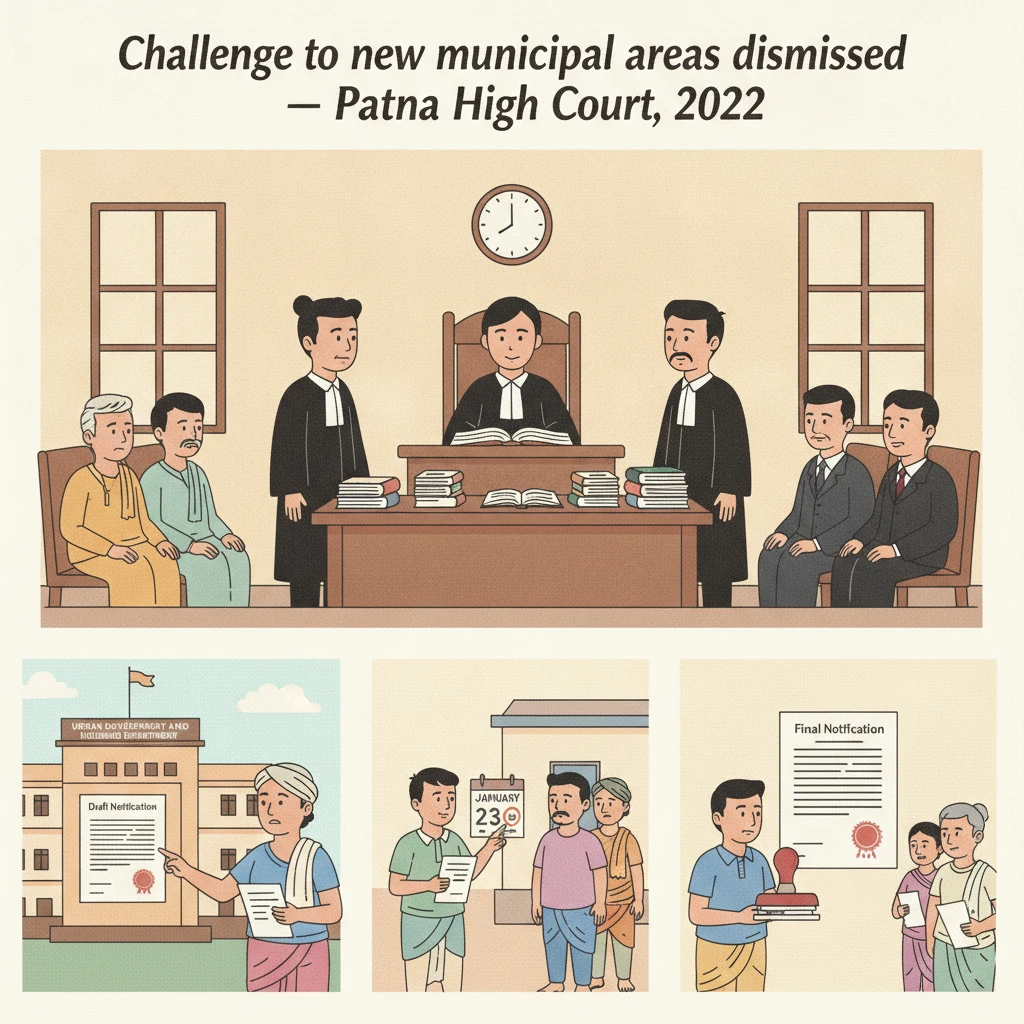
Case Background
Two sets of petitioners approached the Patna High Court. All of them were elected Mukhiyas of different Gram Panchayats in the districts of Supaul and Sitamarhi.
In Civil Writ Jurisdiction Case No. 7446 of 2021, four Mukhiyas from Triveniganj Block, Supaul challenged a draft notification dated 26.12.2020. Through this draft notification (No. 4335), the State Government expressed its intention to create Triveniganj Nagar Parishad by including four Gram Panchayats covering five villages.
The draft notification was issued under Sections 4 and 5 of the Bihar Municipal Act, 2007. It invited written objections from inhabitants likely to be affected, within one month of publication.
Earlier, in 2017, a similar draft notification for this area had been quashed in another writ petition (CWJC No. 6369 of 2017). At that time, the District Magistrate, Supaul had assured the Court that all statutory requirements would be followed before making a fresh recommendation. On that assurance, the earlier draft notification dated 13.04.2017 had been set aside so that the process could restart properly.
In CWJC No. 7446 of 2021, the petitioners again attacked the fresh draft notification of 26.12.2020 and, later through an interlocutory application, also sought quashing of the final notification dated 17.02.2021 constituting Triveniganj Nagar Parishad.
In Civil Writ Jurisdiction Case No. 7804 of 2021, another group of Mukhiyas from Sitamarhi district challenged a notification dated 13.04.2020. By this notification (memo no. 5UD/Gathan-07/2016-1485/UD & HD, Patna), several areas including existing Nagar Parishad Sitamarhi, Nagar Panchayat Dumra and multiple surrounding villages and panchayats were merged and upgraded into Nagar Nigam, Sitamarhi.
They claimed that this declaration of a larger municipal area was contrary to Article 243Q(2) of the Constitution of India and had been done without properly inviting and considering objections as required by Sections 4, 5 and 6 of the Bihar Municipal Act, 2007.
Because the legal questions were common in both cases, the Patna High Court heard them together and decided them by a common judgment dated 17.01.2022.
What the Court Examined and Decided
The Patna High Court carefully examined three broad aspects: compliance with Section 3 of the Bihar Municipal Act, 2007 (as amended in 2020), compliance with the objection procedure under Sections 4 to 6 of the Act, and the effect of the petitioners’ status as elected Mukhiyas under the Bihar Panchayat Raj Act, 2006.
First, the Court reproduced the amended Section 3 of the 2007 Act. This provision empowers the State Government to declare its intention to constitute a municipal area, having regard to population, population density, revenue for local administration, percentage of non-agricultural employment and economic importance, among other factors.
The second proviso to Section 3(1), inserted by the Bihar Municipal (Amendment) Act, 2020, states that the total population of main cultivator workers and marginal cultivator workers must be below fifty percent of the total population of workers in the area in all cases.
The petitioners in the Triveniganj case argued that, as per the 2011 census, more than 50% of the population of Triveniganj Block was engaged in agriculture, so the condition under Section 3 was not satisfied. They relied on data showing very high percentages of male and female population engaged in agricultural work.
The State, in its counter affidavit, challenged these figures. It pointed out that the total population of Triveniganj Block as per the 2011 census was 3,22,477, of which 1,39,287 were main and marginal workers. This meant total workers were less than 50% of the total population. Further, according to column 7 of the census extract (Annexure 3), only 28.92% of male population and 18.58% of female population were engaged in cultivation work. Taken together, cultivator workers formed only about 47.5% of all workers, which is below the 50% ceiling required by the second proviso to Section 3(1).
The Court noted that in their rejoinder the petitioners did not specifically deny these census-based figures. Instead, they gave an evasive response, merely asserting that their representation had been filed within time.
The Court then interpreted the second proviso to Section 3(1). It held that the law does not demand that 50% of the total population must be non-agricultural, as the petitioners claimed. Rather, it requires that the combined number of main cultivator workers and marginal cultivator workers should be less than 50% of the total number of workers in the area.
On the State’s unrebutted census figures, that condition was clearly satisfied. Therefore, the attack on the draft notification on this ground was held to be “misconceived and legally unsustainable”.
The Court also clarified that the statutory factors under Sections 3 and 7 must be satisfied in relation to “such area” – that is, the entire urban or municipal area proposed to be created – and not separately for each individual Gram Panchayat or village being merged. The petitioners’ attempt to demand separate compliance for each of the four individual Gram Panchayats at Triveniganj was therefore held to be “misconceived and fallacious”.
Next, the Court examined whether the petitioners who did not file objections at the draft stage could later challenge the notifications in writ jurisdiction. In the Triveniganj case, three out of the four petitioners had not submitted any objection within the one-month period. Only one petitioner had filed a representation dated 23.01.2021.
The Court held that, having chosen not to avail the statutory opportunity under Section 5 of the 2007 Act, those petitioners could not later complain that their objections were not considered. Relying on the Supreme Court decision in Board of Directors, Himachal Pradesh Transport Corporation and Another v. K.C. Rahi, the Court observed that a party who ignores a due notice and does not participate is deemed to have waived the plea of violation of natural justice.
On the Panchayat tenure issue, the petitioners argued that creation of a Nagar Parishad would cut short their five-year term as Mukhiyas under the Bihar Panchayat Raj Act, 2006. The Court rejected this argument. It referred to Section 1 of the 2006 Act (as amended in 2017), which states that the Act extends to the whole of Bihar “excepting the areas to which the provisions of the Bihar Municipal Act, 2007 or Cantonment Act, 1924 apply.”
Further, Section 14 of the 2006 Act, echoing Article 243E of the Constitution, provides that a Gram Panchayat shall continue for five years “unless sooner dissolved under any law for the time being in force”. The Court held that once an intention to constitute a municipal area is notified under Section 4 of the 2007 Act, and the provisions of that Act apply to the area, the Panchayat Act ceases to operate there. Dissolution of Gram Panchayats in such cases is by virtue of “law” itself. Therefore, Mukhiyas cannot insist on completion of their term as a bar against municipal upgradation.
Turning to CWJC No. 7804 of 2021 (Sitamarhi Nagar Nigam), the petitioners claimed that the notification creating Nagar Nigam Sitamarhi violated Article 243Q(2) and that objections were not properly invited or considered. They alleged that notification of intent was not published in required newspapers, and that their objections had been ignored.
The State, however, produced a paper publication dated 29.04.2020 (Annexure 5) — a draft notification clearly declaring the intention to constitute a larger municipal body by including Sitamarhi Nagar Parishad, Dumra Nagar Panchayat and 17 nearby mouzas. The petitioners themselves had annexed this publication in their writ petition.
The Court noted that, in fact, the petitioners had filed objections (Annexure 6), which were forwarded by the District Magistrate to the Urban Development and Housing Department. In the counter affidavit, the Department stated that after examination, the “received objections were not found worthy of consideration”.
The Court examined the actual content of Annexure 6 in detail. The objections mainly mentioned: proportion of agricultural and non-agricultural land within Punoura West Panchayat, numbers of farmers, ration card holders and labourers, the impact of COVID-19, absence of industries, and a general assertion that most of Sitamarhi district’s population was engaged in agriculture.
Crucially, the Court observed that these objections did not allege non-fulfilment of any statutory factor specified in Sections 3 or 7 of the 2007 Act for the new Nagar Nigam as a whole. They dealt mostly with local hardships, distance from the main road, and economic dependence on agriculture, and they related essentially to only one of the many areas included.
The Court held that Section 5’s requirement that the State “shall take such objection into consideration” means consideration of relevant aspects tied to statutory conditions. Relying on the Supreme Court decision in Bhikhubhai Vithlabhai Patel & Others v. State of Gujarat & Another, it emphasised that “consideration” involves active application of mind to relevant factors, not to every issue “under the sun”.
Since the objections in Annexure 6 were irrelevant to the legal criteria for declaring a municipal area, the State was justified in terming them “not worthy of consideration”. The Court therefore rejected the argument that the objections had been unlawfully ignored.
The Court then discussed the nature of notifications under Chapter II of the Bihar Municipal Act, 2007 in light of Article 243Q of the Constitution. Article 243Q(1) mandates constitution of different classes of urban local bodies, and Article 243Q(2) and its proviso leave it to the Governor to determine the necessary population, density, revenue and other factors for classifying an area as a transitional, smaller, or larger urban area.
The Court held that notifications issued under Sections 4 and 6 of the 2007 Act, though formally issued under Article 166 of the Constitution, are legislative in character, not administrative or adjudicatory. Therefore, they are not subject to the full rigour of natural justice, such as a duty to give personal hearing or pass detailed speaking orders on each objection.
For this proposition, the Court relied on the Supreme Court judgment in Sundarjas Kanyalal Bhatija & Others v. Collector, Thane, Maharashtra & Others. The Supreme Court had held that establishment of municipal corporations is a legislative process; courts may only see whether statutory procedures were followed, not substitute their own views for that of the Government.
Applying this principle, the Patna High Court held that once objections are invited, considered, and a final notification is issued, constitutional courts under Article 226 cannot sit in appeal over the Government’s decision to constitute or upgrade a municipal area, so long as statutory requirements are broadly met.
In conclusion, the Court held that: the Triveniganj Nagar Parishad and Sitamarhi Nagar Nigam notifications complied with Chapter II of the Bihar Municipal Act, 2007; the petitioners’ objections were either not raised at the proper time, or were legally irrelevant; and the fear of losing Mukhiya tenure could not block the statutory process of urban upgradation. Both writ petitions were therefore dismissed as devoid of merit.
Why This Judgment Matters
This decision is important for village representatives and residents across Bihar when rural areas are upgraded into Nagar Panchayats, Nagar Parishads or Nagar Nigams.
First, it clarifies that the Government can proceed with forming or upgrading municipal bodies if the conditions in the Bihar Municipal Act, 2007 are satisfied, even if some local representatives oppose it due to loss of their posts.
Second, it explains that objections must directly question the legal criteria in the Act—like population figures, percentage of cultivator workers or revenue—not just express general hardship or dislike of urban status. Objections based only on fear of higher taxes or loss of rural benefits are unlikely to succeed.
Third, the judgment shows that once a draft notification is issued, anyone affected must file objections within the one-month period. If they stay silent, they usually cannot later challenge the process in the High Court.
Finally, by treating these notifications as legislative in nature, the Court set a limit on how far judicial review can go. The High Court will not re-evaluate the Government’s policy choice on which areas should become municipalities; it will only check if the minimum legal procedure has been followed.
Legal Issues and Answers
- Issue: Did the State violate Section 3 of the Bihar Municipal Act, 2007 (as amended in 2020) by constituting Triveniganj Nagar Parishad despite a claimed majority agricultural workforce?
Answer: No. On the basis of 2011 census data, the Patna High Court held that cultivator workers formed only about 47.5% of the total workers, which is below the 50% ceiling in the second proviso to Section 3(1). - Issue: Were the notifications creating Triveniganj Nagar Parishad and upgrading Sitamarhi into a Nagar Nigam invalid for non-consideration of objections under Sections 4, 5 and 6 of the 2007 Act?
Answer: No. In Triveniganj, most petitioners did not even file objections. In Sitamarhi, objections were filed but were found irrelevant to statutory criteria. The Court held that Section 5 requires consideration only of relevant objections, and municipal formation is a legislative act not bound by detailed natural justice requirements. - Issue: Could elected Mukhiyas insist on completing their five-year tenure to stop or delay conversion of their Panchayat areas into municipal areas?
Answer: No. The Bihar Panchayat Raj Act, 2006 expressly does not apply to areas where the Bihar Municipal Act, 2007 applies, and Section 14 permits earlier dissolution of Panchayats by law. Therefore, municipal upgradation can lawfully curtail Mukhiya tenure.
Cases Cited by the Court
- Board of Directors, Himachal Pradesh Transport Corporation & Another v. K.C. Rahi, (2008) 11 Supreme Court Cases 502 – cited on waiver of natural justice when notice is ignored.
- Bhikhubhai Vithlabhai Patel & Others v. State of Gujarat & Another, (2008) 4 Supreme Court Cases 144 – cited on the meaning of “consider” and necessity of focusing on relevant aspects.
- Sundarjas Kanyalal Bhatija & Others v. Collector, Thane, Maharashtra & Others, (1989) 3 Supreme Court Cases 396 – cited to hold that creating municipal corporations is a legislative, not adjudicatory, act.
Case Details
Case Numbers: Civil Writ Jurisdiction Case No. 7446 of 2021; Civil Writ Jurisdiction Case No. 7804 of 2021
Case Title: Usha Devi & Others v. The State of Bihar & Others (with) Shambhu Kumar Yadav & Others v. The State of Bihar & Others
Citation: 2022 (1) PLJR 833
Court: High Court of Judicature at Patna
Bench (Coram): Hon’ble Mr Justice Chakradhari Sharan Singh and Hon’ble Mr Justice Madhuresh Prasad
Date of Judgment: 17.01.2022
Advocates in CWJC No. 7446 of 2021: For the petitioners – M/s Harsh Anuj, Prashant Kumar, Mithilesh Kumar, Advocates. For the respondents (State) – Mr Ravish Chandra, AC to SC VI.
Advocates in CWJC No. 7804 of 2021: For the petitioners – Mr Rajendra Narayan, Senior Advocate with M/s Anuj Kumar, Pratik Kumar, Advocates. For the respondents (State) – Mr Abbas Haider, SC VI with M/s Ravish Chandra, R.K. Singh, ACs to SC VI. For the Nagar Nigam – M/s Subodh Kumar, Surendra Kishore, Advocates.
Nature of the Case: Writ petitions under Article 226 of the Constitution challenging draft and final notifications constituting Triveniganj Nagar Parishad and upgrading Sitamarhi into Nagar Nigam under the Bihar Municipal Act, 2007.
Link to Judgment: Full text of judgment on Patna High Court website
If you found this explanation helpful and wish to stay informed about how legal developments may affect your rights in Bihar, you may consider following Samvida Law Associates for more updates.







