

Case Background
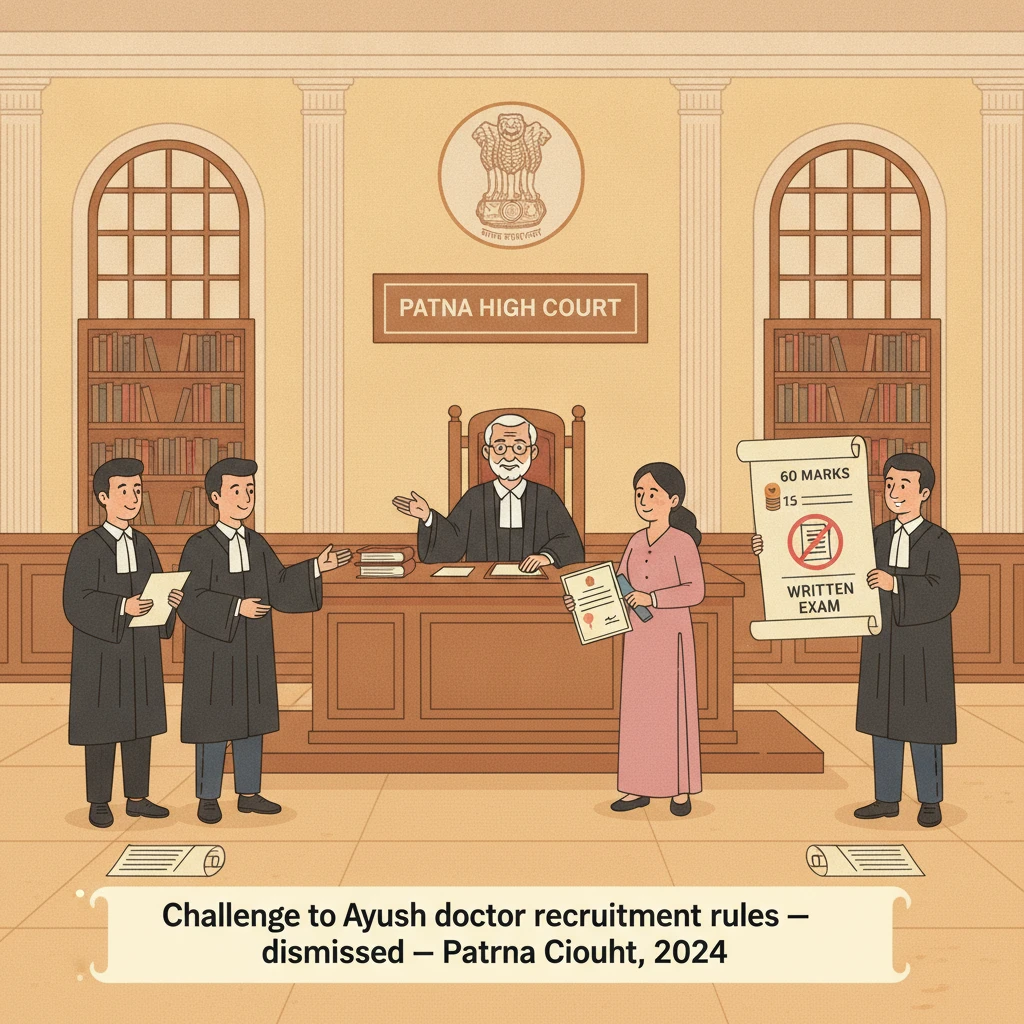
The petition was filed as Civil Writ Jurisdiction Case No. 8800 of 2020 before the Patna High Court under Article 226 of the Constitution of India.
The petitioners are qualified in Bachelor of Homeopathic Medicine and Surgery (B.H.M.S.) from recognised institutions. They questioned the recruitment process for Ayush Medical Officer and related posts under the Health Department, Government of Bihar, conducted by the Bihar Technical Service Commission.
On the basis of requisition from the Health Department, the Bihar Technical Service Commission issued Advertisement Nos. 4 of 2020 to 9 of 2020. These advertisements invited applications for 3270 posts of Ayurvedic Medical Officer, Unani Medical Officer, Homeopathic Medical Officer, Ayush Physician (Ayurvedic), Ayush Physician (Unani) and Ayush Physician (Homeopathy) in the pay scale of Rs. 9300-34800 with grade pay of Rs. 5400/L-9.
Clause 4 of the advertisements prescribed that selection would be based on preparation of a merit list. Marks were to be given for the qualifying degree (B.A.M.S./B.U.M.S./B.H.M.S.), for post-graduate or higher qualification (M.D./M.S. etc.) and for work experience on contractual engagement in recognised government hospitals/institutions.
The weightage prescribed was: 60 marks for the basic Ayush graduation degree, 15 marks for post-graduation or higher degree, and 25 marks for work experience (5 marks per completed year, maximum 25). Total marks were 100.
The petition came before a learned Single Judge, who, by order dated 01.10.2021, referred it to the Hon’ble the Chief Justice for consideration by a larger Bench. The reference was made because of doubts about the effect of earlier Division Bench decisions and about whether Rule 7 of the Bihar District Ayush Medical/State Ayush Medical Service (Appointment on Regular/Contract Basis and Service Conditions) Rules, 2010 (“2010 Rules”) still required an “open competitive examination”.
Hon’ble the Chief Justice placed the matter before the present Division Bench, which delivered its oral judgment on 08.05.2024.
What the Court Examined and Decided
The petitioners sought three main reliefs. First, they wanted a writ of mandamus directing the authorities to hold a competitive written examination instead of selection on marks basis for Ayush Medical Officer posts advertised under Advertisement Nos. 4/2020 to 9/2020. Second, they sought a writ of certiorari to read down or strike down Clause 4 of the advertisements which provided for marks-based selection. Third, they sought any other appropriate relief.
The core of their argument was that Rule 7 of the 2010 Rules mandated appointment to State Ayush Medical Cadre through an “open competitive examination”. According to them, this rule had never been amended even though Rule 4(e) was changed in 2017 and 2019. Therefore, they said, the advertisement was contrary to the statutory rules and violated Article 14 of the Constitution.
The petitioners pointed to the Bihar District Ayush Medical/State Ayush Medical Service (Appointment on Regular/Contract Basis and Service Conditions) (Amendment) Rules, 2017 (“2017 Amendment Rules”). Those rules amended Rule 4(e) of the 2010 Rules and introduced a marks-based selection scheme, including interview marks.
Later, the Bihar District Ayush Medical/State Ayush Medical Service (Appointment on Regular/Contract Basis and Service Conditions) (Amendment) Rules, 2019 (“2019 Amendment Rules”) again altered the distribution of marks. The 2019 Rules changed the weightage for undergraduate marks, higher education and work experience, and removed interview marks. However, they did not touch Rule 7 of the 2010 Rules.
The petitioners argued that since Rule 7, which spoke of “competitive examination”, had never been expressly amended, it continued to control recruitment. They submitted that the advertisements based solely on marks and experience, without any written examination, conflicted with Rule 7 and were invalid.
They further contended that two earlier Division Bench judgments, in C.W.J.C. No. 19278 of 2017 (Himanshu Shekhar & Ors. v. State of Bihar & Ors.) and C.W.J.C. No. 3471 of 2021 (Kumar Bhaskar & Ors. v. State of Bihar & Ors.), were per incuriam because those Benches allegedly proceeded on a wrong assumption that Rule 7 had been amended or deleted.
During hearing of the present case, it emerged from the State’s submissions that Rule 7 of the 2010 Rules had in fact been deleted by notification dated 15.06.2021 through the Bihar District Ayush Medical/State Ayush Medical Service (Appointment on Regular/Contract basis and Service Condition) (Amendment) Rules, 2021 (“2021 Amendment Rules”).
The petitioners argued that this deletion came after the advertisements were issued, so the 2021 amendment was prospective only and could not validate the earlier advertisement or selection. They relied on Supreme Court judgments including Secretary, A.P. Public Service Commission v. B. Swapna, Assam Public Service Commission v. Pranjal Kumar Sarma, Dr. Shah Faesal v. Union of India and a recent Division Bench decision in L.P.A. No. 238 of 2024 to press the principle that rules cannot be changed mid-selection and that amendments are generally prospective.
On behalf of the State, it was pointed out that the 2017 Amendment Rules had already been upheld by a Division Bench in C.W.J.C. No. 19278 of 2017, and that the 2019 Amendment Rules and the very advertisements under challenge had been upheld in C.W.J.C. No. 3471 of 2021. Copies of these orders were placed on record.
The State also relied on a second supplementary counter affidavit filed on 28.06.2021, disclosing that Rule 7 had been deleted on 15.06.2021 by the 2021 Amendment Rules. However, this crucial fact had not been brought to the notice of the learned Single Judge when he made the reference to a larger Bench on 01.10.2021.
The State emphasised that no interim protection had been granted to the petitioners in this writ case. Therefore, the selection process went ahead as per the advertised criteria. The Bihar Technical Service Commission completed the selection and, following directions of the Court in separate proceedings by the selected candidates, regular appointments were made. Intervenor respondents 5 to 11, who had earlier worked on contract, were among those appointed in February 2024.
The intervenors (respondents 5 to 11 and 13 to 14) added another line of argument. They drew a link between Ayush service rules and the general Bihar Health Service rules.
They pointed to the Bihar District Medical Cadre/Bihar Health Service Cadre (Appointment on Regular/Contract Basis and Service Condition) Rules, 2008 (“2008 Rules”) and the Bihar Health Service (Appointment and Service Condition) Rules, 2013 (“2013 Rules”). These framed similar structures of general and specialist sub-cadres, and provided for selection on the basis of educational qualification, experience and interview.
The 2013 Rules were later amended by the Bihar Health Service (Appointment and Service Condition) (Amendment) Rules, 2019, which removed interview marks and made selection purely on the basis of academic marks and work experience, with 60 marks for MBBS, 15 for post-graduation and 25 for experience.
Crucially, Rule 15 of the 2010 Ayush Rules states that any amendment in the rules made for determining service conditions of the State Medical Cadre shall be deemed to apply automatically to the Ayush sector. The intervenors argued that once the Health Service Rules adopted a marks-and-experience based system (through the 2013 and 2019 amendments), the same automatically applied to the Ayush service through Rule 15, even without an express amendment to Rule 7 of the 2010 Rules.
They also referred to the Bihar Technical Service Commission Selection Procedure Rules, 2018 framed under Section 14(1) of the Bihar Technical Service Commission Act, 2014. Rule 6 of the 2018 Rules provides that selection shall be based on marks in the minimum academic qualification and work experience as per the concerned service cadre rules. Rule 14 states that provisions related to selection process in the concerned service rules are deemed to be amended to this extent, and Rule 15 authorises the Commission to fix standards and procedure of selection subject to the Act and the rules.
On this basis, the intervenors contended that Rule 7 of the 2010 Ayush Rules had been impliedly repealed or rendered ineffective once the marks-based mechanism was adopted in the Health Service Rules and made applicable to Ayush through Rule 15, and later through the 2018 Selection Procedure Rules.
The Division Bench considered all these materials.
First, it reproduced the relevant parts of the 2010 Rules, including Rule 4 (structure of District Ayush Medical Cadre and conditions of contractual appointments), Rule 5 and 6 (State Ayush Medical Cadre), Rule 7 (appointment through competitive examination) and Rule 15 (automatic application of amendments in State Medical Cadre rules to Ayush).
The Court then traced the evolution of the selection process through the 2017 and 2019 Ayush amendments, which introduced and refined the marks-based selection, and noted that the impugned advertisement followed the 2019 scheme.
The Bench also set out the Health Service Rules of 2013 and their 2019 amendment, and linked them to Rule 15 of the 2010 Ayush Rules. It accepted the contention that, because of Rule 15 and the later 2018 Bihar Technical Service Commission Selection Procedure Rules, the effect and force of Rule 7 stood diluted and, in substance, impliedly repealed.
In the “Findings” section, the Bench reiterated the settled principle that it is for the recruiting agency to decide the procedure for selection. The Court can interfere only if the procedure is patently illegal. There is no legal requirement that selection must always be by written examination. It cited the Division Bench decision in Dr. Dharmbir Kumar & Ors. v. State of Bihar, 2015 (2) PLJR 916, which held that written test is not the only method and that giving weightage for experience is permissible.
The Bench also relied on the Supreme Court’s judgment in Dr. (Major) Meeta Sahai v. State of Bihar, (2019) 20 SCC 17, which upheld giving weightage to government hospital experience and broadly supported marks-and-experience based selection mechanisms.
In light of these authorities, the Bench concluded that the selection procedure adopted in the impugned advertisement cannot be called arbitrary or violative of Article 14.
Regarding the plea that the earlier Division Bench decision in Kumar Bhaskar was per incuriam, the Court referred to the Supreme Court’s explanation of the “per incuriam” rule in Dr. Shah Faesal v. Union of India and other cases. However, the Bench held it unnecessary to go into whether Kumar Bhaskar was per incuriam because of the subsequent deletion of Rule 7 on 15.06.2021.
The Bench noted that the 2nd supplementary counter affidavit filed in June 2021 had clearly stated that Rule 7 was deleted by the 2021 Amendment Rules. This fact was not highlighted before the learned Single Judge, leading to the reference being made in ignorance of that development. Nonetheless, the reality was that Rule 7 no longer existed.
The Court then considered the petitioners’ reliance on B. Swapna, Assam Public Service Commission and the recent L.P.A. No. 238 of 2024, where principles about non-retrospective application of new rules were discussed. The Bench held that those decisions did not assist the petitioners in the present factual setting.
Crucially, the Court stressed that: there was no interim stay in this writ petition; the entire selection under the 2019 Rules and the impugned advertisements had been completed; appointments had already been made pursuant to separate proceedings; and Rule 7 had since been deleted.
Even assuming, for argument’s sake, that the deletion of Rule 7 in June 2021 could not operate retrospectively, the Court reasoned that setting aside the advertisement now would be a futile exercise. If a fresh advertisement were to be issued today, the authorities could only act under the rules as they exist now. Those current rules do not contain any requirement for a competitive written examination. They provide only for selection based on merit list derived from academic marks and work experience — the very procedure followed in the impugned advertisement.
Therefore, even if the advertisement were cancelled and a fresh process ordered, the new process would again be marks-and-experience based, not a written exam as sought by the petitioners. In such circumstances, the Court was not inclined to interfere.
On this reasoning, the Division Bench dismissed the writ petition.
Why This Judgment Matters
This judgment has direct impact on Ayush doctors seeking government service in Bihar. It confirms that, for the large recruitment covered by Advertisement Nos. 4/2020 to 9/2020, the selection based on academic marks and work experience stands upheld. The appointments already made will not be disturbed in this writ case.
For future recruitments, the ruling clarifies that, under the present legal framework, the Bihar Technical Service Commission can rely on a marks-and-experience based merit list rather than a written competitive examination for Ayush Medical Officer posts, unless the rules are changed again by the State.
For candidates, this means that performance in the qualifying degree, higher qualifications, and government hospital work experience remain decisive factors. Those who hoped for a fresh written examination for this round of recruitment do not get that relief.
Legal Issues and Answers
Issue: Whether the recruitment of Ayush Medical Officers through a merit list based on academic marks and work experience, without a written competitive examination, was contrary to Rule 7 of the 2010 Ayush Rules and Article 14 of the Constitution.
Answer: No. The Court held that, in view of subsequent amendments, Rule 15 of the 2010 Rules, the Bihar Health Service Rules (2013 and 2019), and the Bihar Technical Service Commission Selection Procedure Rules, 2018, the marks-and-experience based selection was valid and not arbitrary. Rule 7 stood diluted and later stood deleted in June 2021.
Issue: Whether the impugned advertisement and selection process should be quashed and a fresh recruitment with written examination ordered, given the later deletion of Rule 7 in 2021.
Answer: No. The Court held that no interim relief had been granted, the selection was complete, appointments had been made, and present rules no longer require a written examination. Cancelling the advertisement would be futile because any fresh advertisement would again follow the current rules, which provide the same marks-based method.
Issue: Whether earlier Division Bench judgments upholding similar amendments and advertisements (notably in C.W.J.C. No. 3471 of 2021) were per incuriam for allegedly overlooking Rule 7 of the 2010 Rules.
Answer: The Court found it unnecessary to decide this question in view of the subsequent deletion of Rule 7 on 15.06.2021 and the overall legal position. The petition was dismissed without declaring the earlier judgment per incuriam.
Cases Cited by the Court
- Dr. Dharmbir Kumar & Ors. v. The State of Bihar through the Chief Secretary, Bihar, Patna & Ors., 2015 (2) PLJR 916
- Dr. (Major) Meeta Sahai v. State of Bihar & Ors., (2019) 20 SCC 17
- Municipal Council, Palai v. T.J. Joseph, AIR 1963 SC 1561
- Yogendra Pal Singh & Ors. v. Union of India & Ors., (1987) 1 SCC 631
- Dr. Shah Faesal & Ors. v. Union of India & Ors., (2020) 4 SCC 1
- Secretary, A.P. Public Service Commission v. B. Swapna & Ors., (2005) 4 SCC 154
- Assam Public Service Commission & Ors. v. Pranjal Kumar Sarma & Ors., (2020) 20 SCC 680
- A.A. Calton v. Director of Education, (1983) 3 SCC 33 (referred through quotation in L.P.A. No. 238 of 2024)
- L.P.A. No. 238 of 2024, The State of Bihar through the Additional Chief Secretary, Health Department, Bihar, Patna v. Archana Kumari & Ors. (order dated 29.04.2024, Patna High Court)
- C.W.J.C. No. 19278 of 2017, Himanshu Shekhar & Ors. v. The State of Bihar & Ors. (order dated 16.07.2018, Patna High Court)
- C.W.J.C. No. 3471 of 2021, Kumar Bhaskar & Ors. v. The State of Bihar & Ors. (order dated 31.05.2021, Patna High Court)
Case Details
Case Number: Civil Writ Jurisdiction Case No. 8800 of 2020
Case Title: Rajneesh Ranjan & Ors. v. The State of Bihar & Ors.
Citation: 2022 (1) PLJR 875
Court: High Court of Judicature at Patna
Date of Judgment: 08.05.2024
Coram: Hon’ble Mr. Justice Vipul M. Pancholi; Hon’ble Mr. Justice Ramesh Chand Malviya
Advocates for Petitioners: Mr. Mrigank Mauli, Senior Advocate; Mr. Rakesh Kumar Sharma, Advocate; Mr. Sanket, Advocate; Mr. Alok Anand, Advocate; Mr. Navin Kumar Singh, Advocate
Advocates for the State (Respondent Nos. 1 and 2): Mr. Birju Prasad, G.P. 13; Mrs. Shweta Anand, Advocate; Mr. Ravi Kumar, Advocate
Advocates for the Bihar Technical Service Commission (Respondent No. 3 and 4): Mr. Nikesh Kumar, Advocate
Advocates for Intervenor Respondent Nos. 5 to 11: Mr. Prashant Sinha, Advocate; Mr. Rishi Raj Ranjan, Advocate; Mr. Kunal, Advocate
Advocates for Intervenor Respondent Nos. 13 and 14: Mr. Chakrapani, Advocate; Mr. Madhuresh Singh, Advocate; Mr. Dipak Kumar, Advocate
Nature of the Case: Writ petition under Article 226 of the Constitution challenging recruitment advertisement and selection procedure for Ayush Medical Officer and related posts.
Link to Judgment: Click here to view the official judgment of the Patna High Court
If you found this explanation helpful and wish to stay informed about
how legal developments may affect your rights in Bihar,
you may consider following Samvida Law Associates for more updates.







