
Case Background
The dispute started over ownership and possession of certain land in Siwan district. The petitioner before the Patna High Court is the original plaintiff in Title Suit No. 510 of 2016, filed before the Sub Judge-1st, Siwan.
In that title suit, the plaintiff sought a declaration that he has right, title and interest over the suit land. He also asked the civil court to declare that the defendants have no right or title over the same land on the basis of their sale deed. He further prayed for confirmation of his possession.
Another important relief sought in the suit was a declaration that the sale deed dated 26.07.2013, under which defendant no.1 claims title, is illegal, void and executed without consideration.
According to the plaintiff, the land originally belonged to one Sheikh Hafiz Fakir, in whose name Khata No. 336 of R.S. Khatiyan was prepared. His only son died during Sheikh Hafiz Fakir’s lifetime. On 04.07.1945, Sheikh Hafiz Fakir executed a Hiba (gift) in favour of his wife, Bibi Takdiran, and handed over possession to her. Two other deeds were also executed by him on 01.06.1944 and 04.07.1945.
Disputes then arose in the family, leading to appointment of arbitrators by agreement of parties on 24.08.1947. The arbitrators decided the matter on 06.05.1948, giving a 2 anna share of the property to Bibi Takdiran. Shares from Schedule 1 property were also allotted to other relatives.
One co-sharer, Bibi Hamidan, sold her 2 anna share to Abdul Rahman by a registered sale deed dated 06.10.1948, and Abdul Rahman came into possession of that land. From this purchased land, Sheikh Abdul Rahman sold the disputed plot to one Basir Sah and Sheikh Abdul Aziz by a registered sale deed dated 16.03.1950.
The disputed plot of Kheshra No. 4948 was then divided into two equal halves between Basir Sah and one Jaubunisha, as Sheikh Abdul Aziz was described as only a name lender. Later, Basir Sah transferred his share in Plot No. 4948 to the present plaintiff by a registered sale deed dated 09.09.1967 and gave him possession.
The plaintiff claims that his name was mutated in the government records, and that he started paying rent to the State of Bihar. He also purchased 1 katha of land of Khata No. 329, Kheshra No. 4949, on 13.04.2011 from one Nuzhat Ara to secure a right of way.
According to the plaintiff, defendant no.1 started interfering with his right, title and possession. This allegedly forced him to file the title suit with the reliefs mentioned above.
The defendants, in their written statement, denied the plaintiff’s claim. They accepted only that a Hiba deed had been executed by Sheikh Hafiz Fakir in favour of his wife Bibi Takdiran, but they said it concerned 4 bigha 11 katha 15 dhur of land.
According to the defendants, Bibi Takdiran executed a sale deed on 05.05.1950 in favour of one Radha Krishna Prasad and one Maulivee Aziz Haque, and also delivered possession to them. Defendant no.2 is stated to be the son of Radha Krishna Prasad. He is said to have sold the land to defendant no.1 by sale deed dated 25.07.2013.
During the trial of the title suit, the plaintiff completed his evidence first. Thereafter, the defendants started their evidence. When the evidence of the defendants was about to close, they filed a petition on 27.09.2019.
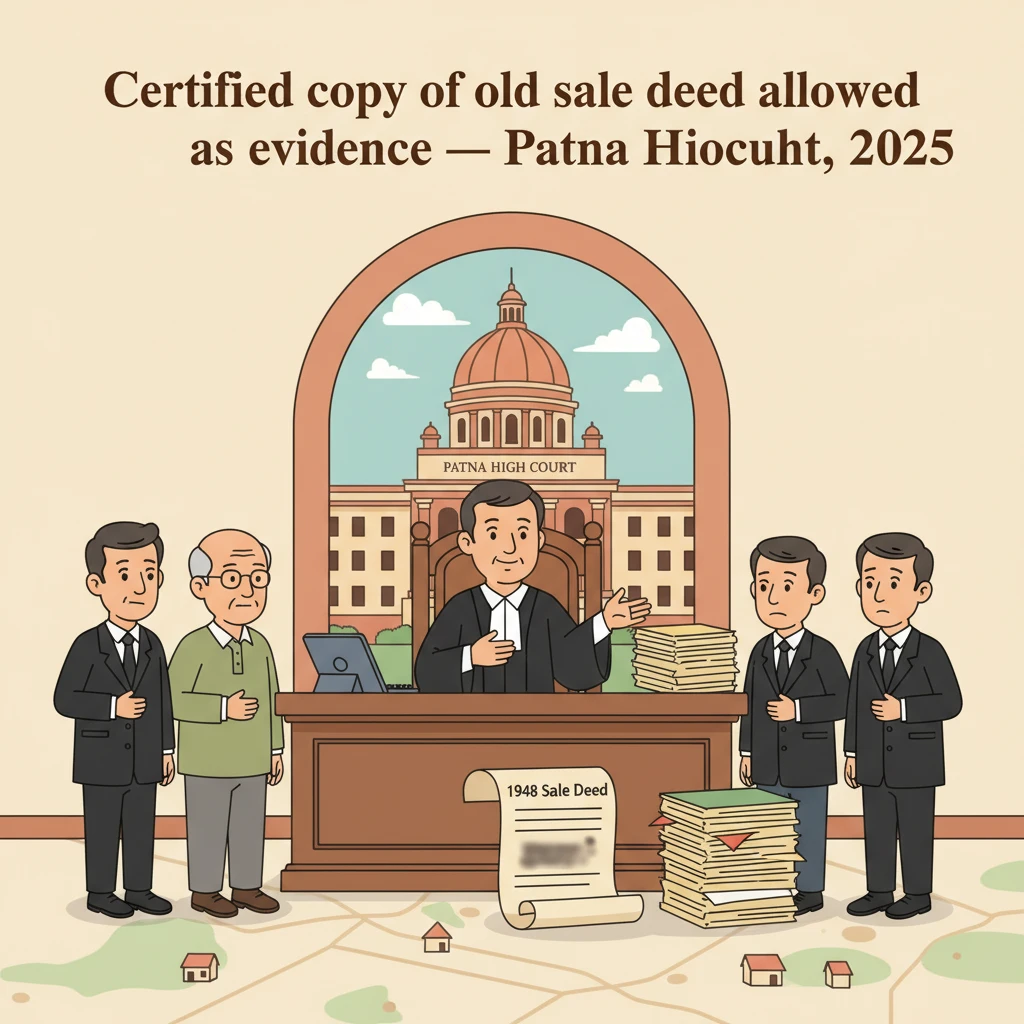
In that petition, the defendants stated that they had obtained a certified copy of the sale deed dated 05.05.1950 executed by Bibi Takdiran in favour of Babu Radha Krishna and others. They said the document could not be traced earlier, so it had not been filed before. They asked the trial court to take this certified copy on record as a public document and mark it as an exhibit.
The plaintiff filed a rejoinder opposing this request. However, after hearing both sides, the Sub Judge-1st, Siwan, allowed the defendants’ petition and ordered that the certified copy of the sale deed dated 05.05.1950 be taken on record and marked as an exhibit.
This order dated 17.10.2019 became the subject of the present Civil Miscellaneous petition before the Patna High Court, where the plaintiff (as petitioner) sought to get it set aside.
What the Court Examined and Decided
The Patna High Court, through Hon’ble Mr. Justice Arun Kumar Jha, examined whether the trial court was right in allowing the certified copy of the 05.05.1950 sale deed to be exhibited at that late stage.
The petitioner’s counsel argued that the trial court had passed the order without properly considering the facts and law, and without recording sufficient reasons. He contended that once the trial had commenced and especially after the plaintiff’s evidence had closed, no new document could be taken in evidence, as the plaintiff would then have no chance to rebut it.
He further argued that the defendants had to prove custody of the document before it could be marked as an exhibit. In his view, without proof of custody, the document could not be received in evidence.
Another major plank of the petitioner’s argument was that a certified copy of a sale deed is not a “public document” under the Indian Evidence Act. According to him, except for the special context of land acquisition proceedings, certified copies of sale deeds could not be treated as public documents in civil cases, nor could they be marked as exhibits merely on that basis.
The petitioner’s counsel criticized the trial court’s view that the sale deed dated 05.05.1950 was a public document which could be exhibited at any time before judgment. He said this finding was contrary to the law.
To support his position, he relied on the three-judge bench judgment of the Supreme Court in Deccan Paper Mills Company Limited vs. Regency Mahavir Properties & Ors., (2021) 4 SCC 786, which referred to Gopal Das vs. Sri Thakurji, AIR 1943 PC 83. In Gopal Das, it had been held that a certified copy of a registered instrument is not a public record of a private document under Section 74(2) of the Evidence Act, since the original document must be returned to the party under Section 61(2) of the Registration Act, 1908.
He also sought to distinguish the Supreme Court’s decision in Appaiya vs. Andimuthu @ Thangapandi & Ors. (Civil Appeal No. 14630 of 2015), where a Division Bench had observed that a certified copy of a private document, once entered in the registers of the Registrar, is a public document under Section 74(2). The petitioner argued that Deccan Paper Mills, being by a larger bench, was not considered in Appaiya, and therefore Appaiya could be seen as per incuriam.
He further referred to Smt. Rekha Rana & Ors. vs. Smt. Ratnashree Jain, AIR 2006 MP 107, a decision of the Madhya Pradesh High Court authored by Justice R.V. Raveendran, which was also noticed in Deccan Paper Mills. Finally, when the Patna High Court bench referred to the Constitution Bench decision in N.N. Global Mercantile (P) Ltd. vs. Indo Unique Flame Ltd., (2023) 7 SCC 1, the petitioner tried to say that it was sub silentio on this particular issue and thus should not guide the question of whether a certified copy of a registered document is a public document.
On the other side, the respondents’ counsel argued that there was no jurisdictional error in the trial court’s order. They submitted that even if the order was wrong on law, it would not automatically become a jurisdictional error requiring interference.
They supported the trial court’s view that a certified copy of a registered sale deed is a public document, relying on Smt. Rekha Rana & Ors. and Appaiya. They also invoked the Patna High Court’s own earlier decision in Ram Briksha Singh & Ors. vs. Ramashray Singh & Ors. (Civil Misc. No. 1824 of 2018).
In Ram Briksha Singh, this Court had held that certified copies of sale deeds kept in public records are to be considered public documents. They become admissible in evidence and can be produced to prove the contents of the public document or the relevant part of it, as secondary evidence, without laying the usual foundation. However, that decision also cautioned that such a certified copy proves only the contents of the document and not its execution.
The respondents also relied on Umashankar Singh & Anr. vs. Keshwa Singh & Ors., (2014) 3 PLJR 121, which was on similar lines.
The Patna High Court then framed the main questions before it:
(i) Whether, under the Evidence Act, a certified copy of a registered sale deed is a public document?
(ii) Whether the document was taken on record at a very late stage contrary to procedural rules, and whether proving custody was essential before marking it as an exhibit?
On the procedural point, the Court referred to Order 8 Rule 1A(3) of the Code of Civil Procedure. This provision states that a document which ought to have been produced earlier by the defendant shall not, without the leave of the court, be received in evidence at the hearing. The Court observed that the law does allow a document to be taken on record even after settlement of issues, provided the court grants leave.
The Court clarified that merely marking a document as an exhibit does not automatically make it admissible. Objections to admissibility can still be considered when the court evaluates the document’s relevance and other aspects. But this did not, in itself, make the trial court’s order illegal.
On the nature of the certified copy, the Court reproduced and relied heavily on its earlier analysis in Ram Briksha Singh. That judgment, after discussing Smt. Rekha Rana and Appaiya in detail, had concluded that while a sale deed is a private document, the certified copy of a registered document copied into Book 1 maintained by the Registration Office is a certified copy of a public document. It held that such a certified copy falls under Section 74(2) of the Evidence Act, and that, read with Section 57(5) of the Registration Act, it is admissible to prove the contents of the original.
The Court then examined Deccan Paper Mills and noted that there, the Supreme Court was mainly considering arbitrability and cancellation of instruments, and the nature of certified copies arose only incidentally. It also noted that Deccan Paper Mills quoted Smt. Rekha Rana with approval, including the clear finding that a registered sale deed is a private document and that entries in Book 1 of the Registration Office are public records, with certified copies of those entries being certified copies of public documents.
The Patna High Court then turned to the Constitution Bench decision in N.N. Global Mercantile (P) Ltd. In paragraph 141.2, the Supreme Court there had clearly stated that a sale deed between private parties, once registered, can be proved through a certified copy issued under Section 76 of the Evidence Act, because it forms part of “public records kept in any State of private documents.” The Court read this as confirming that a private document kept as a public record may qualify as a public document and that certified copies of such records can serve as secondary evidence.
On this basis, the Patna High Court rejected the petitioner’s claim that N.N. Global Mercantile was sub silentio on this point. It observed that if N.N. Global Mercantile were to be treated as sub silentio, the same criticism could equally apply to Deccan Paper Mills, since both discussed the issue only incidentally. In contrast, Appaiya directly turned on the question of proving a certified copy of a sale deed as evidence, and its reasoning, rooted in Sections 74, 76, 77 and 79 of the Evidence Act and Section 57(5) of the Registration Act, was consistent with the understanding in Deccan Paper Mills.
The Court harmonised the authorities by noting that:
- A registered sale deed itself is a private document.
- The entry in the registration book (Book 1) is a public document.
- The certified copy issued under Section 57 of the Registration Act is a certified copy of that public record and thus can be treated as secondary evidence of the contents of the original.
The Court further noted that the sale deed in question was more than 30 years old. Under Section 90 of the Evidence Act, such documents, if produced from proper custody, are presumed to be duly executed and attested. Section 79 also allows the court to presume the genuineness of certified copies of documents. Section 77 permits production of certified copies as proof of the contents of public documents.
Putting these statutory provisions and case law together, the Court held that the certified copy of the 05.05.1950 sale deed could be produced as secondary evidence of the public record and to prove the contents of the original document. It repeated the caution that this would not, by itself, prove execution of the original deed.
In conclusion, the Patna High Court refused to accept the petitioner’s argument that the trial court’s order was unsustainable. It affirmed the order dated 17.10.2019 passed by the Sub Judge-1st, Siwan in Title Suit No. 510 of 2016 and dismissed the Civil Miscellaneous petition.
Why This Judgment Matters
This judgment is important for people involved in old land disputes, especially where original sale deeds are lost or not easily available.
The Patna High Court confirms that a certified copy of an old registered sale deed, issued by the Registration Office, can be used in a civil suit to prove what the original deed contained. This is especially relevant when the deed is decades old, as in this case.
However, the Court also reminds litigants that such a certified copy proves only the text of the original document and does not automatically prove that the document was actually executed by the parties. Other evidence may still be needed for that.
The decision also clarifies that courts can, with proper leave, allow important documents to be brought on record even at a late stage of trial. Simply because the plaintiff’s evidence has closed does not mean that a relevant public record can never be considered.
For property holders in Bihar, this decision provides guidance on how registered sale deeds and their certified copies will be treated by the Patna High Court and by trial courts within its jurisdiction.
Legal Issues and Answers
- Issue: Can a certified copy of a registered sale deed be treated as a public record and admitted as secondary evidence of its contents under the Indian Evidence Act?
Answer: Yes. The Court held that while a sale deed is a private document, the registration entry in Book 1 is a public record, and a certified copy of that entry is a certified copy of a public document admissible to prove the contents of the original under Sections 65(e), 65(f), 74(2), 76, 77 of the Evidence Act and Section 57(5) of the Registration Act. - Issue: Was the trial court wrong in taking the certified copy on record and marking it as an exhibit at a late stage of the trial?
Answer: No. The Court held that under Order 8 Rule 1A(3) CPC, documents can be received in evidence with the leave of the court even after settlement of issues. Mere late production does not invalidate the order, and marking a document as an exhibit does not prevent the court from later examining its admissibility. - Issue: Does admitting such a certified copy automatically prove execution of the original sale deed?
Answer: No. The Court clearly held that the certified copy can prove only the contents of the original document and is not, by itself, proof of its execution, though presumptions under Sections 90 and 79 of the Evidence Act may apply to old certified copies from proper custody.
Cases Cited by the Court
- Deccan Paper Mills Company Limited vs. Regency Mahavir Properties & Ors., (2021) 4 SCC 786
- Gopal Das vs. Sri Thakurji, AIR 1943 PC 83
- Appaiya vs. Andimuthu @ Thangapandi & Ors., Civil Appeal No. 14630 of 2015 {@ SLP (C) No. 10013 of 2015}
- Smt. Rekha Rana & Ors. vs. Smt. Ratnashree Jain, AIR 2006 MP 107
- N.N. Global Mercantile (P) Ltd. vs. Indo Unique Flame Ltd., (2023) 7 SCC 1
- Ram Briksha Singh & Ors. vs. Ramashray Singh & Ors., Civil Misc. No.1824 of 2018 (Patna High Court)
- Umashankar Singh & Anr. vs. Keshwa Singh & Ors., (2014) 3 PLJR 121
Case Details
Case Number: Civil Miscellaneous Jurisdiction No. 1651 of 2019
Case Title: Abdul Rashid vs. Iftakhar Hussain @ Dablu & Ors.
Court: High Court of Judicature at Patna
Coram: Hon’ble Mr. Justice Arun Kumar Jha
Date of Judgment: 21.05.2025
Citation: 2025(3) PLJR 248
Advocates:
For the Petitioner: Mr. Chandra Kant, Advocate
For the Respondents: Mr. Surendra Kishore Thakur, Advocate; Mr. Brajesh Kumar Singh, Advocate; Mr. Ashutosh Kumar, Advocate
Nature of the Case: Civil miscellaneous petition challenging an interlocutory order in a title suit (order permitting exhibition of certified copy of sale deed)
Impugned Order: Order dated 17.10.2019 passed by Sub Judge-1st, Siwan in Title Suit No. 510 of 2016, allowing the defendants’ petition to take on record and mark as exhibit the certified copy of sale deed dated 05.05.1950
High Court Outcome: Petition dismissed; impugned order affirmed
Link to Judgment: https://patnahighcourt.gov.in/viewjudgment/NDQjMTY1MSMyMDE5IzEjTg==-NklHdbkriRQ=
If you found this explanation helpful and wish to stay informed about how legal developments may affect your rights in Bihar, you may consider following Samvida Law Associates for more updates.







