

Case Background
A succession case was filed in 2017 before the Civil Judge (Senior Division), VIII, Patna. The applicant in that case is the widow of late Rajneesh Yadav, who was serving as Joint Commissioner in the Income Tax Department at Lucknow.
She sought a succession certificate for the movable properties left by her deceased husband. These include dues such as General Provident Fund (G.P.F.) and other service-related benefits payable by government departments, banks and other establishments.
According to the judgment, the authorities concerned insisted that she produce a succession certificate before releasing these amounts. Because of that requirement, she filed Succession Case No. 234 of 2017 and claimed that she is the sole legal heir entitled to receive the dues as the legally wedded wife of the deceased.
During the pendency of this succession case, an opposite party in that case, Kaushalya Devi, died on 28.12.2022. She had earlier filed objections in the succession case.
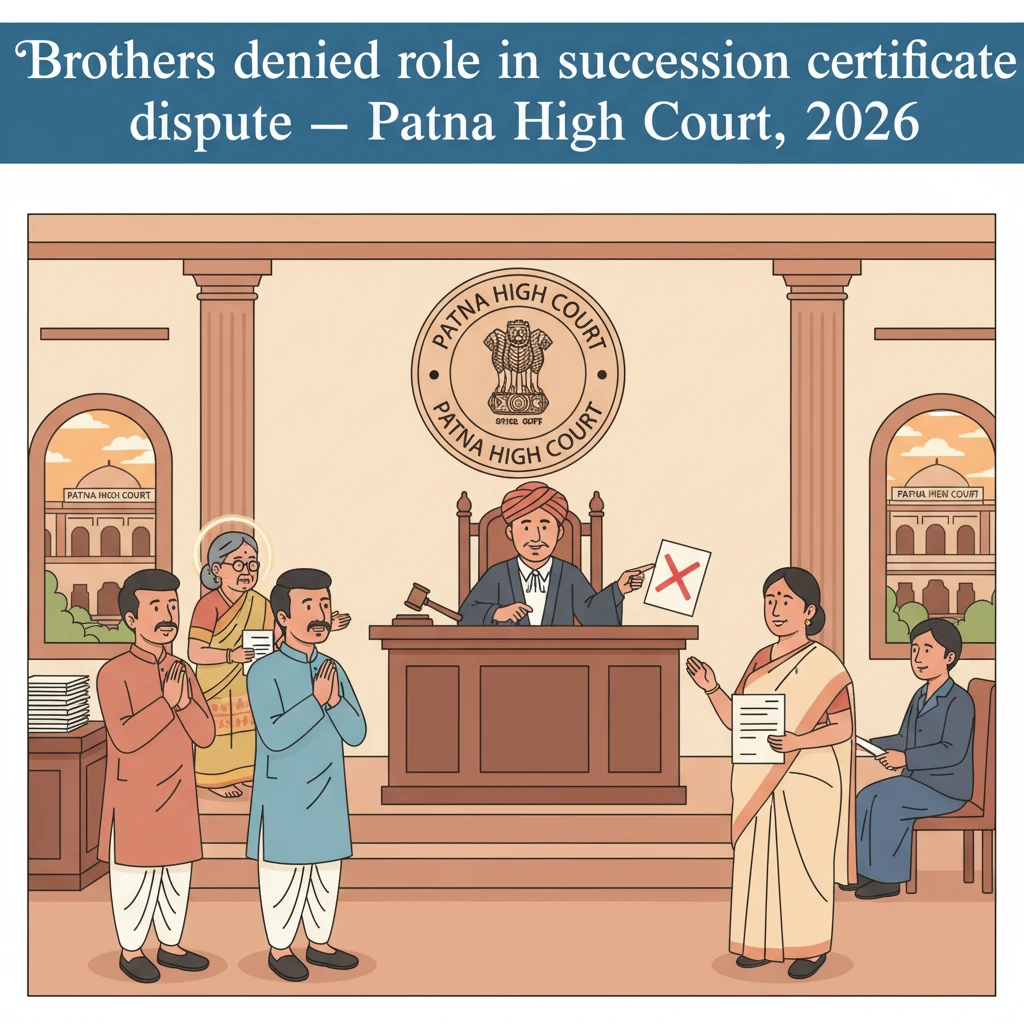
After her death, her sons (Sanjay Kumar, Niraj Kumar and Nitin Kumar) filed an application dated 01.05.2023 before the trial court. They claimed to be her Class I heirs and legal successors and sought to be added as opposite parties in the succession case to pursue the objections originally filed by their mother.
Their application was moved under Order XXII Rule 4 read with Section 151 of the Code of Civil Procedure (CPC). However, the Civil Judge (Senior Division), VIII, Patna, rejected this impleadment application by order dated 04.01.2025.
Aggrieved, the sons of late Kaushalya Devi approached the Patna High Court by filing Civil Miscellaneous No. 588 of 2025. They asked the High Court to set aside the order dated 04.01.2025 and to allow them to be brought on record in the succession case.
What the Court Examined and Decided
The matter was heard by Hon’ble Mr. Justice S. B. Pd. Singh. The core question was whether the sons of late Kaushalya Devi could be treated as necessary or proper parties in the pending succession proceedings relating to the movable estate of late Rajneesh Yadav.
Counsel for the petitioners argued that they are the sons and Class I legal heirs of Kaushalya Devi. Since she had been an opposite party in the succession case and had filed objections, they submitted that, after her death, they are entitled to step into her shoes and continue her objections by being impleaded under Order XXII Rule 4 CPC.
Order XXII Rule 4 of the CPC generally deals with bringing the legal representatives of a deceased defendant on record so that a proceeding does not abate. The petitioners relied on this provision, along with the inherent powers of the court under Section 151 CPC, to support their impleadment.
To decide whether they could be impleaded, the Patna High Court examined who, in law, is entitled to succeed to the movable properties of late Rajneesh Yadav.
For this, the Court referred to the Hindu Succession Act, 1956, particularly Sections 8, 9 and 10, and the Schedule attached to the Act.
Section 8 of the Act lays down the general rules of succession in the case of a male Hindu dying intestate (that is, without leaving a will). The Court reproduced the full text of Section 8 in the judgment. In simple terms, it provides the order in which property devolves:
First, on the heirs in Class I of the Schedule. Second, if there is no Class I heir, on the heirs in Class II. Third, if there are no heirs in Class I or II, on the agnates of the deceased. Lastly, if there are no agnates, on the cognates of the deceased.
Section 9 of the Act, also reproduced by the Court, states how heirs in the Schedule take in order of preference. Those in Class I take simultaneously and to the exclusion of all other heirs. Only if there is no Class I heir do Class II heirs get a chance, and so on.
Section 10 explains how the property is to be distributed among Class I heirs. The Court set out Rules 1 to 4 of Section 10, which say that the widow, surviving sons and daughters and the mother of the intestate each take one share, with further detailed rules for branches of pre-deceased children.
The Court then turned to the Schedule to the Hindu Succession Act. It reproduced the relevant portion showing who falls in Class I and Class II.
In Class I, the heirs include the son, daughter, widow, mother, and several categories of grandchildren and widows of pre-deceased sons.
In Class II, the first entry is “father.” Subsequent entries include “brother” and “sister” and several other relations such as brother’s son, sister’s son, father’s father, and so on.
After setting out these provisions, the High Court analysed the position of the petitioners. It observed that brothers of the deceased fall in Class II under the Schedule. They therefore get a right to succeed only if there is no Class I heir.
In the present case, the widow of late Rajneesh Yadav is alive and is herself the applicant in the succession case. As a widow, she is clearly a Class I heir under the Hindu Succession Act.
On that basis, the Court held that the movable property of the deceased must first be distributed among Class I heirs only. Class II heirs, such as brothers, cannot claim any share or right during the lifetime of a Class I heir.
The Court further noted that the four brothers seeking impleadment in the succession case have, therefore, no right, interest or share in the movable estate of the deceased during the lifetime of his widow. As a result, they could not be considered “necessary” or even “proper” parties for the purpose of deciding the succession certificate application.
A necessary party is one without whom no effective order can be passed. A proper party is one whose presence may help the court completely and effectively settle the questions in dispute. The Court found that, in view of the statutory scheme of succession, the brothers did not satisfy either test.
Because of this legal position, the Court upheld the trial court’s view. The impugned order dated 04.01.2025, by which the Civil Judge (Senior Division), VIII, Patna, had rejected the application for impleadment, was found to be correct.
Consequently, the Patna High Court dismissed Civil Miscellaneous No. 588 of 2025. The brothers of late Rajneesh Yadav will not be added as parties to Succession Case No. 234 of 2017, and the succession proceedings will continue with the widow as the applicant.
Why This Judgment Matters
This judgment is significant for families disputing service benefits, provident fund, and other movable assets after the death of a government employee or any male Hindu who dies without a will.
The Patna High Court has clearly reinforced that, under the Hindu Succession Act, a widow as a Class I heir has priority over brothers and other Class II relatives. So long as a Class I heir like the widow exists, brothers do not have a legal share in the estate.
For widows, this decision provides reassurance that distant relatives cannot easily interfere in succession certificate proceedings for movable properties when the law clearly recognises the widow’s priority.
For other relatives, it serves as a reminder that their right to be heard in such proceedings depends on their position in the legal order of heirs. Mere desire to contest or suspicion about the widow’s claim is not enough if the statute itself does not give them a present right or share.
Legal Issues and Answers
Issue: Are the brothers of a deceased male Hindu entitled to be impleaded in a succession certificate case concerning his movable properties when his widow, a Class I heir, is already an applicant?
Answer: No. The Court held that brothers fall under Class II heirs and can succeed only in the absence of Class I heirs. As the widow, a Class I heir, is alive and is the applicant, the brothers have no present right, interest or share in the movable property and are neither necessary nor proper parties.
Cases Cited by the Court
- No earlier judicial precedents are cited in the text of this judgment. The Court relied directly on the provisions of the Hindu Succession Act, 1956.
Case Details
Case Number: Civil Miscellaneous Jurisdiction No. 588 of 2025
Case Title: Sanjay Kumar & Ors. v. Supriya Shailja & Ors.
Coram: Hon’ble Mr. Justice S. B. Pd. Singh
Citation: 2026 (2) PLJR 220
Advocates:
- For the petitioners: Mr. J.S. Arora, Senior Advocate
- For the respondents: Mr. Raj Shekhar, Advocate
Nature of the case: Civil miscellaneous application challenging an order of the Civil Judge (Senior Division) in a succession certificate proceeding (Succession Case No. 234 of 2017), concerning impleadment of parties.
Date of High Court judgment: 13.01.2026
Trial court order under challenge: Order dated 04.01.2025 passed by Civil Judge (Senior Division), VIII, Patna, in Succession Case No. 234 of 2017
Link to judgment: Click here to view the official Patna High Court judgment
If you found this explanation helpful and wish to stay informed about
how legal developments may affect your rights in Bihar,
you may consider following Samvida Law Associates for more updates.







