
Case Background
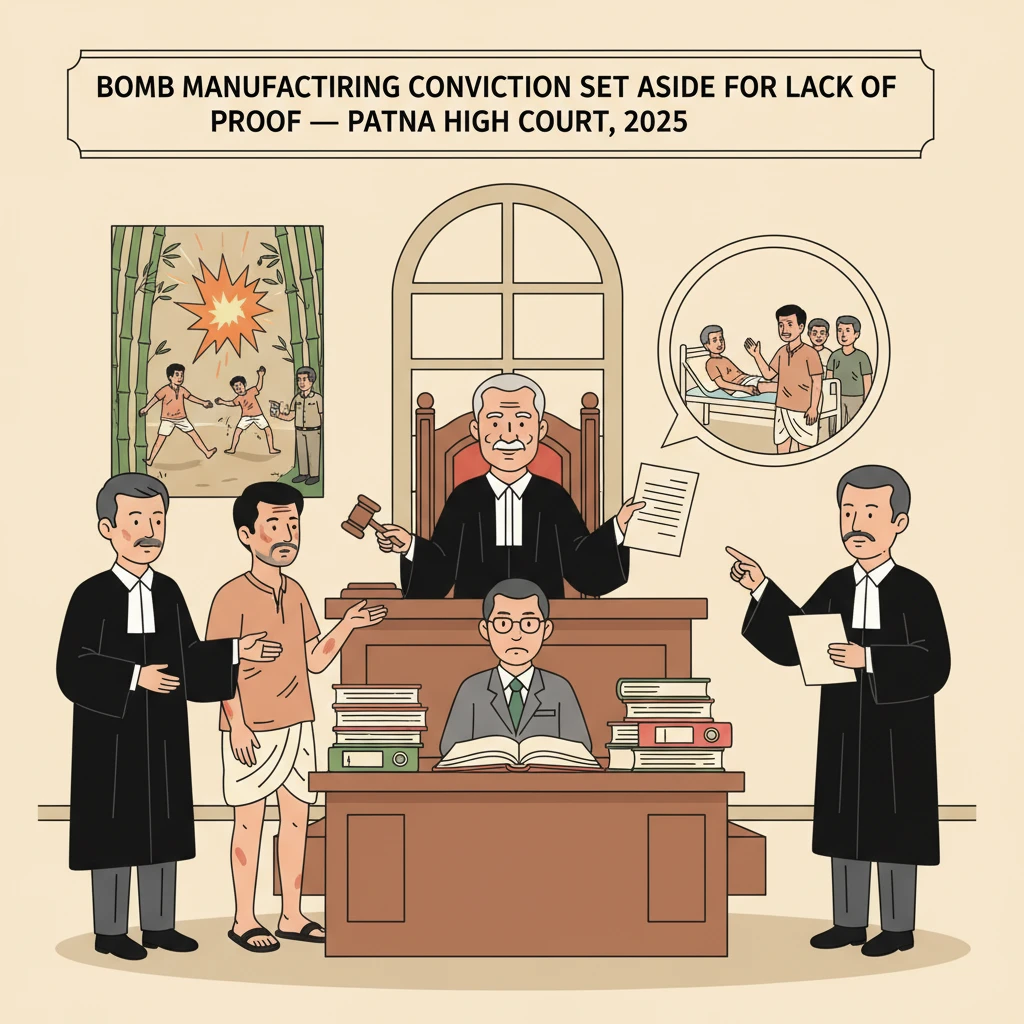
This case arose from a police station case registered at Bajpatti, District Sitamarhi, in the year 2001. The incident allegedly took place on 27.04.2001 at about 8 A.M. in a bamboo clump in village Madhurapur.
The informant, a village chowkidar named Ram Ekbal Rai (P.W.2), was patrolling his area when villagers informed him that a bomb had exploded in the bamboo clump. He then sent another chowkidar, Gonu Das (P.W.3), to the police station to inform the authorities.
According to the informant, the villagers told him that the appellant, Mahesh Sah, along with two unknown associates, had been manufacturing bombs in the bamboo clump. During this alleged manufacturing activity, a bomb exploded and all three were badly injured. It was further stated that they fled from the spot to get treatment.
On the basis of the informant’s fardbeyan, Bajpatti P.S. Case No. 32 of 2001 was registered against the appellant and two unknown persons under the Explosive Substances Act. After investigation, a charge-sheet was filed against the appellant under Sections 3 and 5 of the Explosive Substances Act, 1908.
The Magistrate took cognizance on 04.02.2003 and committed the case to the Court of Sessions on 30.04.2003. The Sessions Trial was registered as Sessions Trial No. 229 of 2003 (112 of 2013). Charges were framed against the appellant, who pleaded not guilty and claimed to be tried.
The Trial Court, after recording evidence, convicted the appellant under Section 3/5 of the Explosive Substances Act. By judgment dated 11.03.2014 and sentence dated 15.03.2014, the 1st Additional Sessions Judge, Sitamarhi, sentenced him to rigorous imprisonment for 10 years and a fine of Rs. 10,000/- under Section 5(a) of the Act, with six months further rigorous imprisonment in default of payment of fine.
Being aggrieved by this conviction and sentence, the appellant filed Criminal Appeal (SJ) No.146 of 2014 before the Patna High Court. The appeal was heard by Hon’ble Mr. Justice Sunil Dutta Mishra, who reserved the judgment and delivered it on 29.08.2025.
What the Court Examined and Decided
The Patna High Court closely examined the entire trial record, including oral and documentary evidence, to determine whether the prosecution had proved the charges beyond reasonable doubt.
The prosecution examined eight witnesses:
P.W.1 – Baidyanath Mahto (seizure list witness)
P.W.2 – Ram Ekbal Rai (informant and chowkidar)
P.W.3 – Gonu Das (chowkidar and seizure list witness)
P.W.4 – Tapeshwar Sah @ Ram Taleshwar Sah (hostile)
P.W.5 – Hari Narayan Sah (hostile)
P.W.6 – Dr. Anil Kumar Singh (doctor who examined the appellant)
P.W.7 – Kalika Ram (first Investigating Officer)
P.W.8 – Ram Pravesh Ram (subsequent Investigating Officer)
The prosecution also produced documents including seizure lists, fardbeyan, injury report, requisition, sanction order, and FSL report.
The defence examined one witness, D.W.1, Janki Sharan Mandal, and produced two documents: a carbon copy of the I.O.’s application dated 16.02.2002 (Exhibit A) and a carbon copy of an order dated 05.05.2001 in the same police case (Exhibit B).
The Trial Court had concluded that the appellant’s injuries were caused by a bomb explosion while preparing bombs, relying mainly on the doctor’s opinion and the recovery of materials from the bamboo clump.
Before the High Court, the appellant’s counsel argued that there was no eye-witness to the alleged bomb-making. The conviction, it was said, rested essentially on the medical evidence of P.W.6, the doctor, who opined that the injuries were caused by an explosion. The defence case was that the appellant had sustained burn injuries due to a stove burst on 27.04.2001 and had become blind. It was also argued that no independent witness had directly named the appellant as present at the scene, and that there was existing litigation between the appellant and one local Mukhia, Sitaram Mandal, who allegedly had reasons to implicate him.
The State, on the other hand, supported the conviction. The learned A.P.P. submitted that the circumstances and materials recovered from the spot gave rise to a reasonable inference that the appellant was involved in bomb manufacturing, and that he was seriously injured in that process. According to the State, this inference remained unrebutted.
The High Court then carefully evaluated the testimonies.
P.W.1, seizure witness Baidyanath Mahto, stated that he heard of a bomb explosion in Mandal Tola during the night in which three persons, including the appellant, were injured. At the place of occurrence, he saw blood, blood-stained cloth, a pair of sandals, remnants of a bomb, six bundles of sutari, pieces of sulphur (gandhak), nails in a container smelling of kerosene, glass pieces, stove parts, and burnt materials. He signed the seizure list prepared by the police. He also said he came to know that bombs were being prepared for use in elections to create terror and for sale. He admitted in cross-examination that the wife of Sitaram Mandal was the Mukhia of the Gram Panchayat.
P.W.2, informant chowkidar Ram Ekbal Rai, deposed that villagers told him about the bomb explosion and that the appellant and two others were manufacturing bombs and were injured. The police came, seized materials such as exploded bomb parts, white chemicals, stone chips, and blood, and recorded his fardbeyan. In cross-examination, he admitted there was litigation between the appellant and Sitaram Mandal, and that the appellant had filed a case against Sitaram. He also said that when the Investigating Officer came at about 9 A.M., Sitaram Mandal was present with him. Importantly, he admitted that he could not remember who told him that the appellant had exploded the bomb, and that there was no earlier case against the appellant before this occurrence.
P.W.3, chowkidar Gonu Das, confirmed that he informed the police based on instructions from P.W.2 and that the police came and seized materials at the spot. He said it “came to be known” that the appellant was preparing the bomb, which then exploded, and that the appellant fled. In cross-examination, he admitted he could not describe the seized materials in detail, and stated that the appellant’s eyes were damaged since before. He also admitted that there was litigation between the appellant and Mukhia Sitaram Mandal and that he could not say who told him the appellant’s name in connection with the incident.
P.W.4 and P.W.5 did not support the prosecution case and were declared hostile.
P.W.6, Dr. Anil Kumar Singh, examined the appellant on 27.04.2001 at about 10 A.M. at Jialal Kalawati Hospital, Sitamarhi. He found burn injuries characterized by roasted patches of skin, singeing of body hair, deposits of carbonaceous material, vesicles and blisters. He assessed 42% burns, of more than three hours’ duration, and opined that the injuries were grievous and caused by “dry hit such as explosion of bomb.” In cross-examination, he stated that the appellant was treated as a private patient, not at the instance of police, and admitted that carbonaceous material may also be found on the body in case of a stove burst.
P.W.7, first Investigating Officer Kalika Ram, stated that on receiving information from the chowkidar, he went to village Madhurapur where he “came to know” that the appellant and two others were preparing bombs when one exploded. He recorded the informant’s fardbeyan and seized multiple items: sutari bundles, a plastic container with nails and kerosene smell, sulphur-like pieces, white stones, glass pieces, blood-stained clothes, a pair of plastic sandals with yellow powder, a blood-stained burnt gamchha, a steel lota, and remnants of the exploded bomb. Later, he got information that the appellant was admitted in an injured condition at the hospital, where he found him with a burnt face and black patches and arrested him.
In cross-examination, P.W.7 admitted that there was litigation between the appellant and Mukhia candidate Sitaram Mandal, with a Bajpatti P.S. case and a complaint case pending between them. Crucially, he admitted that no comparison was made between the blood of the appellant and the blood found on the seized clothes, and that no blood-stained earth was seized from the spot. He further admitted that no eye-witness was found.
P.W.8, the subsequent Investigating Officer, proved the sanction order and FSL report and stated that he submitted the charge-sheet.
On the defence side, D.W.1, Janki Sharan Mandal, stated that the appellant had received injuries due to a stove burst on 27.04.2003 (as recorded in evidence). In cross-examination, he said that he heard the sound of an explosion at about 6 hours, went there, and saw that the accused was in distress from burn injuries.
After reviewing this material, the High Court framed the central question: whether the prosecution had proved the charge beyond reasonable doubt in a case resting entirely on circumstantial evidence.
The Court referred to the settled legal position on circumstantial evidence, particularly the five golden principles laid down by the Supreme Court in Sharad Birdhichand Sarda v. State of Maharashtra, and followed recently in Pradeep Kumar v. State of Haryana. These principles require that:
• The circumstances must be fully established.
• They must be consistent only with the guilt of the accused.
• They must be of a conclusive nature and tendency.
• They must exclude every possible hypothesis except guilt.
• There must be a complete chain of evidence leaving no reasonable ground for a conclusion consistent with innocence.
Applying these principles, the Patna High Court found serious gaps in the prosecution case. It held that:
• There was no eye-witness to the alleged bomb-making or the appellant’s presence at the bamboo clump when the explosion occurred.
• P.W.1, P.W.2, and P.W.3 were all hearsay witnesses regarding the appellant’s alleged role; none disclosed the specific source from whom they got the information naming the appellant.
• The Investigating Officer did not undertake basic forensic steps, such as matching the appellant’s blood with blood on seized clothes or seizing blood-stained earth from the spot, thereby failing to establish any scientific link between the appellant and the place of occurrence.
• There was admitted prior enmity and litigation between the appellant and Mukhia Sitaram Mandal, who was present with the Investigating Officer at the spot soon after the incident, casting doubt on the possibility of false implication.
• The appellant’s admission to a private hospital with a claim of stove burst injuries was not properly investigated, even though the doctor accepted that similar burn characteristics could appear in a stove burst.
The Court concluded that the chain of circumstances was incomplete and not conclusive in pointing to the appellant’s guilt. Suspicion, however strong, could not replace proof beyond reasonable doubt.
Therefore, the High Court held that the prosecution had “miserably failed” to prove the charges against the appellant beyond all reasonable doubts. The conviction was set aside, and the appellant was acquitted. As he was already on bail, he was discharged from the liabilities of his bail bonds and sureties, and the appeal was allowed. Trial Court records were ordered to be returned, and any interlocutory applications were disposed of.
Why This Judgment Matters
This judgment of the Patna High Court is important for people accused in serious criminal cases, especially where there is no direct eye-witness.
It reinforces that a person cannot be sent to jail for long periods merely on the basis of rumours or “it came to be known” type statements. Witnesses must either have seen the incident themselves or the prosecution must build a strong chain of circumstances that clearly points only to the accused’s guilt.
The Court also highlighted that when there is an old dispute or enmity between the accused and influential local persons, the courts must look at the case with extra care. Here, the admitted litigation between the appellant and the Mukhia, and the Mukhia’s presence with the Investigating Officer at the spot, created a serious doubt about the fairness of the case against the appellant.
Further, the judgment shows that medical opinion alone, without proper investigation linking injuries with the crime scene, is not enough to convict. The doctor himself admitted that similar burns could occur from a stove burst. Without forensic linking of blood and seized materials to the accused, the law requires that benefit of doubt be given.
Practically, this decision reassures citizens that even in sensitive offences like those under the Explosive Substances Act, the standard of proof remains the same: guilt must be proved beyond reasonable doubt. Suspicion, local politics, or incomplete investigation cannot take away a person’s liberty.
Legal Issues and Answers
-
Issue: Whether the prosecution proved beyond reasonable doubt that the appellant was manufacturing bombs and suffered injuries in a bomb explosion at the place of occurrence, so as to sustain conviction under Sections 3/5 of the Explosive Substances Act, 1908?
Answer: No. The Patna High Court held that there was no direct evidence, the circumstantial chain was incomplete, the witnesses were hearsay regarding the appellant’s involvement, prior enmity raised serious doubt, and the investigation failed to scientifically link the appellant to the seized materials. Hence, the conviction and sentence were set aside and the appellant was acquitted.
Cases Cited by the Court
- Sharad Birdhichand Sarda v. State of Maharashtra, (1984) 4 SCC 116 : AIR 1984 SC 1622
- Shivaji Sahabrao Bobade v. State of Maharashtra, (1973) 2 SCC 793 : 1973 SCC (Cri) 1033 : 1973 Crl LJ 1783 (quoted in Sharad Birdhichand Sarda)
- Pradeep Kumar v. State of Haryana, AIR 2024 SC 518
- Pritinder Singh v. State of Punjab, (2023) 7 SCC 727 : AIROnline 2023 SC 575
Case Details
Case Number: Criminal Appeal (SJ) No.146 of 2014; arising out of Bajpatti P.S. Case No. 32 of 2001; Sessions Trial No. 229 of 2003 (112 of 2013)
Case Title: Mahesh Sah v. State of Bihar
Court: High Court of Judicature at Patna
Coram: Hon’ble Mr. Justice Sunil Dutta Mishra
Date of High Court Judgment: 29.08.2025
Trial Court: 1st Additional Sessions Judge, Sitamarhi
Trial Court Judgment and Sentence: Judgment of conviction dated 11.03.2014 and order of sentence dated 15.03.2014
Statutory Provisions Involved: Section 3/5, including Section 5(a), Explosive Substances Act, 1908; Sections 342, 307, 379/34 IPC and Section 27 Arms Act mentioned as prior litigation background (not the subject of conviction in this case)
Citation: 2025(4) PLJR 223
Advocates:
For the Appellant: Mr. Mahendra Thakur, Advocate; Mr. Sanjay Kumar, Advocate
For the State (Respondent): Mr. A.M.P. Mehta, A.P.P.
Nature of the Case: Criminal appeal (single judge) against conviction and sentence under the Explosive Substances Act
Outcome: Appeal allowed; conviction and sentence set aside; appellant acquitted and discharged from bail bond liabilities.
If you found this explanation helpful and wish to stay informed about
how legal developments may affect your rights in Bihar,
you may consider following Samvida Law Associates for more updates.







