

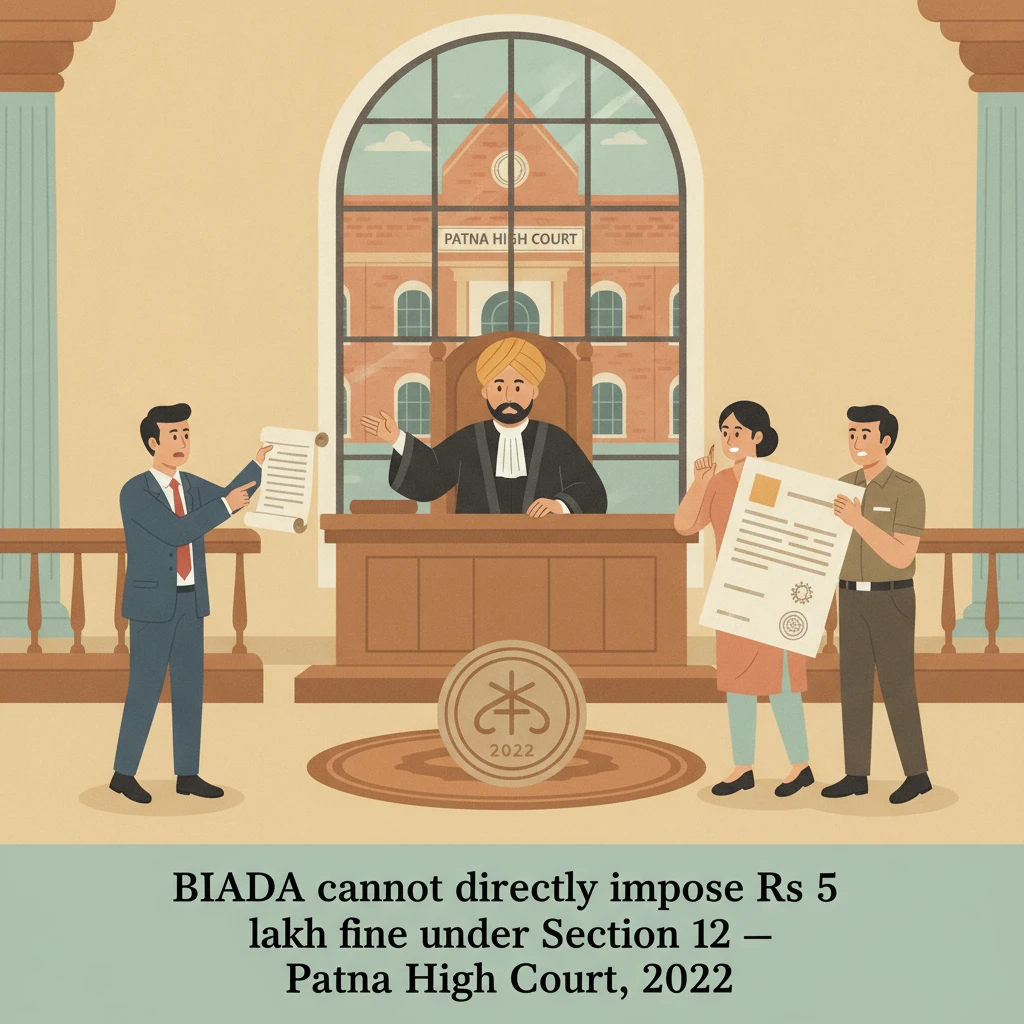
Case Background
The writ petition was filed by M/S Chhatra Industries through its partner, challenging a communication dated 28.09.2020 issued by the Development Officer of the Bihar Industrial Area Development Authority (BIADA).
By that communication, BIADA informed the petitioner that a penalty of Rs. 5 lakhs had been imposed for allegedly continuing to illegally occupy BIADA land for 13 years after cancellation of the allotment. The action was stated to be under Section 12 of the Bihar Industrial Area Development Authority Act, 1974.
When the matter came before the Patna High Court, the Bench initially expressed that, since the petitioner had been found to be an illegal occupant, the Court might not be inclined to exercise its equitable writ jurisdiction in his favour. The petitioner’s counsel then clarified that the challenge was limited: the petitioner was questioning BIADA’s jurisdiction to impose a penalty under Section 12, not asking the Court to decide on the correctness of the cancellation or the factual allegations of encroachment.
In view of this limited challenge, the Court permitted BIADA to file a counter affidavit specifically on the issue of its power under Section 12 to impose a fine directly through its own authority.
What the Court Examined and Decided
The core question before the Patna High Court was narrow but important: whether BIADA itself could impose a monetary penalty of Rs. 5 lakhs for alleged encroachment by the petitioner, on the strength of Section 12 of the BIADA Act.
On behalf of the petitioner, it was argued that Section 12 is a penal provision. It prescribes punishment for offences under the Act, but it does not authorise BIADA to act as a court or to directly impose punishment. According to the petitioner, only a criminal court of competent jurisdiction, after trial and conviction, could impose such punishments.
The petitioner did not ask the Court to decide whether the cancellation of his allotment or the allegation of encroachment was right or wrong. The case put forward was that, even if BIADA considered him an encroacher, the Authority could not by itself levy a criminal fine of Rs. 5 lakhs under Section 12.
BIADA’s stand, as recorded particularly in paragraph 26 of its counter affidavit, was different. BIADA argued that:
For violation of any order of BIADA relating to removal of structures or encroachment, it was “well within its jurisdiction” to impose a fine of Rs. 5 lakhs as per the first part of Section 12. According to BIADA, only the part of Section 12 dealing with simple imprisonment up to six months required the involvement of a Magistrate of the First Class. On this basis, it justified the fine imposed for what it called the petitioner’s squatting on the land for about 15 years, which, according to BIADA, obstructed industrial growth and deprived other entrepreneurs of land in the industrial area.
The Court then carefully examined Section 12 of the BIADA Act. It reproduced the provision in full:
Section 12(1) provides that any person who violates any order of the Authority in respect of removal of any structure or encroachment, or uses any land or building in contravention of any regulation framed by the Authority, “shall be punishable” with:
(1) a fine of Rs. five lakhs or 300% of all costs incurred by the Authority, whichever is higher; or
(2) simple imprisonment for a term which may extend to six months; or
(3) both; and, in case of a continuing offence, with further fine which may extend to Rs. 5,000 per day after conviction.
Section 12(2) states that all fines realised in connection with prosecution under this Act shall be paid to the Authority.
Section 12(3) clearly states that no court below the rank of a Magistrate of the First Class shall try any offence under the Act.
The Court highlighted two crucial expressions in the section:
First, that the punishments under Section 12(1) apply to “any person who violates” the specified orders or regulations, and these punishments are to be imposed “after conviction” for “any offence.” Second, that Section 12(3) explicitly mandates that offences under the Act shall be tried only by a court not below the rank of a Magistrate of the First Class.
Reading these provisions together, the Court observed that Section 12 contemplates a criminal process. There must first be a prosecution, then a trial before a Magistrate of the First Class, and only after conviction can any punishment be imposed, whether that is a fine, imprisonment, both, or a daily fine for a continuing offence.
The Court expressly noted that Section 12(1) prescribes three forms of punishment, but all of them are tied to the phrase “after conviction” for “any offence.” The power to impose these punishments, therefore, lies exclusively with a criminal court, not with BIADA acting on its own administrative side.
On BIADA’s argument that it could at least impose the fine, if not imprisonment, the Court found “no foundation in the penal provision.” The language of Section 12 does not create a split where BIADA can impose the monetary part of the punishment and the court deals only with imprisonment. Instead, the entire spectrum of punishments is placed within the criminal court’s jurisdiction, post-conviction.
The Court also revisited the factual accusation that the petitioner had illegally encroached on the land for 13 years after cancellation of allotment. It recorded that, as per the impugned communication dated 28.09.2020, this was the alleged offence. However, the petitioner contended that cancellation of allotment or additional land was unjustified and unsustainable. These claims involved factual disputes.
The Bench clearly stated that it was consciously refraining from expressing any opinion on whether the petitioner was indeed an encroacher on BIADA land or not. Those factual controversies were left open to be decided in appropriate proceedings. The Court limited itself strictly to the question of jurisdiction to impose the fine.
Having interpreted Section 12 in this manner, the Court concluded that BIADA did not have jurisdiction to impose any of the punishments specified in Section 12. All such punishments can only be imposed “after conviction” by a competent criminal court, i.e., a court not below the rank of a Magistrate of the First Class.
Accordingly, the communication dated 28.09.2020, to the extent it purported to impose a fine of Rs. 5 lakhs on the petitioner under Section 12, was held to be “clearly without jurisdiction and thus unsustainable in law” and was set aside.
At the same time, the Court took care to clarify that this setting aside of the penalty did not in any way absolve the petitioner of the allegations levelled by BIADA. Nor did it interfere with the factual findings recorded by BIADA regarding encroachment. Those issues were expressly left open to be “agitated/considered in appropriate proceedings in accordance with law.”
In conclusion, the writ petition was allowed, but only to the extent of quashing the fine of Rs. 5 lakhs imposed through the impugned BIADA communication.
Why This Judgment Matters
This judgment is important for all allottees and occupants of industrial plots under BIADA and similar development authorities in Bihar. It clarifies that BIADA cannot act as judge and punishing authority under Section 12 of the BIADA Act.
If BIADA believes that an allottee has violated an order, encroached upon land, or misused it in breach of regulations, it may take steps available to it under law, such as cancellation of allotment or initiating prosecution. But when it comes to criminal punishment under Section 12, including a hefty fine of Rs. 5 lakhs, BIADA must approach a criminal court and secure a conviction. It cannot unilaterally impose such penalties by issuing administrative communications.
At the same time, the judgment sends a clear message to allottees that quashing of a penalty order on jurisdictional grounds does not equal a clean chit on facts. Allegations of encroachment or illegal occupation can still be pursued by BIADA through proper legal channels, including criminal prosecution before a Magistrate of the First Class or other appropriate proceedings.
For citizens and small industries, this ruling of the Patna High Court emphasises that authorities must follow the procedure laid down in penal statutes. Even where allegations are serious, punishment has to come only after a fair trial in a competent court, not by direct administrative orders.
Legal Issues and Answers
-
Issue: Whether BIADA has jurisdiction under Section 12 of the Bihar Industrial Area Development Authority Act, 1974, to directly impose a fine of Rs. 5 lakhs on an allottee for alleged encroachment.
Answer: No. The Patna High Court held that all punishments under Section 12, including fine, can be imposed only “after conviction” by a court not below the rank of a Magistrate of the First Class. BIADA cannot itself levy such penalties. -
Issue: Whether setting aside the penalty of Rs. 5 lakhs under Section 12 amounts to exoneration of the petitioner from allegations of illegal encroachment.
Answer: No. The Court expressly clarified that it did not decide on the correctness of the findings regarding encroachment. Those issues remain open to be contested in appropriate proceedings.
Cases Cited by the Court
- No prior judgments are cited or relied upon in the text of this decision.
Case Details
Case Number: Civil Writ Jurisdiction Case No. 8123 of 2021
Case Title: M/S Chhatra Industries through its partner Sanjay Kumar Mishra v. State of Bihar & Ors.
Coram: Hon’ble Mr. Justice Chakradhari Sharan Singh and Hon’ble Mr. Justice Madhuresh Prasad
Citation: 2022(2) PLJR 211
Nature of the Case: Writ petition challenging BIADA communication imposing penalty under Section 12 of the Bihar Industrial Area Development Authority Act, 1974.
Advocates:
For the Petitioner: Mr. Prakash Chandra
For the State of Bihar: Mr. Abbas Haider (SC-6)
For the Respondent BIADA: Mr. Devesh Shankaran with Mr. Pankaj Kumar Sinha
Link to the Judgment: View full judgment on Patna High Court website
If you found this explanation helpful and wish to stay informed about
how legal developments may affect your rights in Bihar,
you may consider following Samvida Law Associates for more updates.







