
Case Background
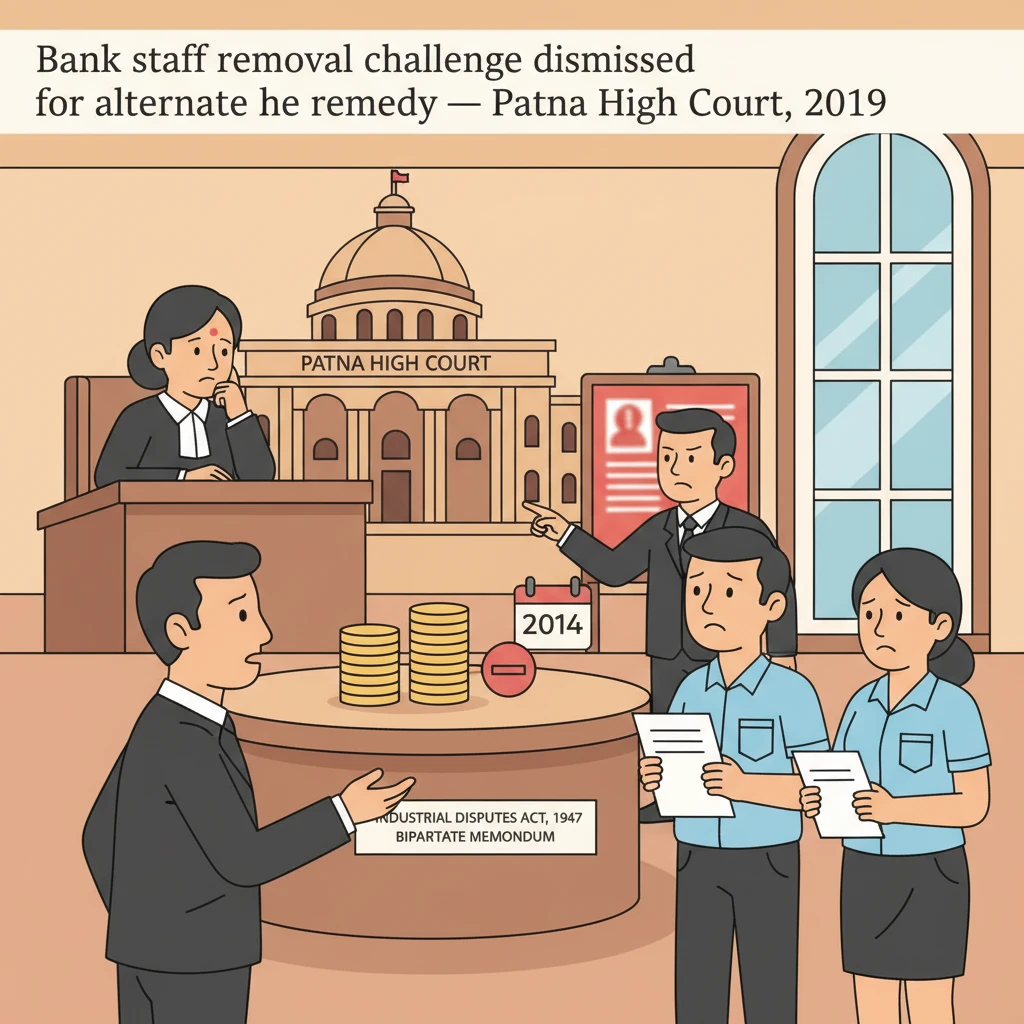
The judgment arises from three connected writ petitions filed by bank employees working as Assistants at the Bodh Gaya Branch of State Bank of India. All three were posted as Single Window Operators at the counter.
Departmental proceedings were started against them for acts said to have taken place between 25.08.2014 and 29.04.2014. After enquiry, the Regional Manager-cum-Disciplinary Authority, Regional Business Office, State Bank of India, Gaya, passed punishment orders dated 09.06.2016.
By these orders, each petitioner was removed from service with superannuation benefits as would otherwise be due under the rules. They were not disqualified from future employment, in terms of paragraph 5(j) of the Memorandum of Settlement dated 10 April 2002 relating to workman staff in banks. Their suspension period was treated as suspension only, not as duty.
The petitioners filed departmental appeals. The Deputy General Manager-cum-Appellate Authority, Zonal Office, State Bank of India, Bhagalpur, dismissed their appeals by orders dated 14.11.2016 and 15.11.2016, thereby affirming the punishment. Aggrieved, the employees approached the Patna High Court under its civil writ jurisdiction.
What the Court Examined and Decided
The Patna High Court, presided over by Hon’ble Mr. Justice Ashutosh Kumar, heard all three writ petitions together and passed a common judgment on 01.05.2019. Counsel for the petitioners and for the respondent Bank were heard.
The central dispute concerned the nature of the petitioners’ conduct and the legality of the disciplinary punishment. Two main allegations were levelled against the petitioners.
First, while working as Single Window Operators at the Bodh Gaya Branch, during the period from 25.08.2014 to 29.04.2014, the petitioners received cash towards bank commission. This commission related to receipt of Bihar Government Staff Selection Commission fees or application money.
The total commission they had collected from customers was to be deposited into a specified Commission Account of the bank. However, the amount that was actually deposited was, in varying degrees for each petitioner, less than what had been collected. It was alleged that this difference had been misappropriated by the petitioners.
The record shows that the petitioners deposited the remaining amounts only later, after they were served with a memorandum regarding the short deposit. This led to the second allegation: because the full commission amounts were not deposited on the same date as received, the bank remained out of those funds during the intervening period.
On this basis, the bank charged that the conduct of the petitioners amounted to mala fide action and breach of trust in performance of duties. It was said to be highly prejudicial to the bank’s interest and treated as “Gross Misconduct” under paragraph 5(j) of the Memorandum of Settlement dated 10 April 2002.
The petitioners attacked the disciplinary and appellate orders on several grounds. They claimed that there was non-application of mind by the authorities to the points they had raised in defence.
They stressed alleged differential treatment compared with two other employees, namely, Kunal Bhushan and Kumari Megha Gupta. According to the petitioners, those two employees faced similar charges but were given only minor punishment, whereas the petitioners faced the extreme penalty of removal from service. This, they argued, was discriminatory and showed lack of parity.
The petitioners further argued that the procedure for dealing with the challans and accepting cash was complex and involved several stages. In such a system, some challans could escape notice when the amounts were deposited into the commission account. They stated that, while working as Single Window Operators, they were simultaneously handling many different types of work.
Because of a heavy volume of transactions in the branch, they contended that any lapse was unintentional and was rectified immediately once noticed. On this basis, they submitted that imposition of the maximum punishment of removal from service was disproportionate to the alleged misconduct.
They also pointed to other supposed lapses in the conduct of the departmental proceedings and complained of lack of transparency and fairness, though the judgment does not spell out those lapses in detail.
On the other hand, counsel for State Bank of India defended the punishment orders. The Bank argued that the explanations given by the petitioners were unsatisfactory and that as bank employees handling public money, their conduct had to be beyond doubt.
The Bank emphasised that the petitioners deposited the missing commission amounts only after they were asked to do so. The lapse therefore could not be brushed aside as a mere clerical error. It was further argued that the cases of the two other employees, Kunal Bhushan and Kumari Megha Gupta, were substantially different from the petitioners’ cases.
The Bank pointed out that those employees had been punished with lowering of the scale of pay for one year without cumulative effect under Clause 6(e) of the Memorandum of Settlement dated 10.04.2002 for workman staff. According to the Bank, the quantum of commission not deposited by them was much less than that involved in the petitioners’ cases. Hence, the allegation of unequal treatment was said to be baseless.
The Bank also relied heavily on Clause 5(j) of the Bipartite Settlement dated 10.04.2002. This clause defines “gross misconduct” as “doing any act prejudicial to the interest of the bank or gross negligence or negligence involving or likely to involve the bank in serious loss”. The Bank argued that keeping the bank out of its commission amount for any period clearly fell within this definition, especially given the possibility of such conduct being repeated.
However, the Patna High Court did not finally decide whether the petitioners’ conduct amounted to gross misconduct, or whether the punishment was disproportionate. Instead, the Court examined whether it should entertain these writ petitions at all.
The Bank argued that because the petitioners were “workmen” and the Bank was an industrial undertaking, any dispute about disciplinary punishment was an “industrial dispute” under the Industrial Disputes Act, 1947. Therefore, the appropriate remedy for the petitioners was to approach the Labour Court or Industrial Tribunal.
The Court accepted this position. It recorded that the petitioners were workmen within the meaning of Section 2(s) of the Industrial Disputes Act, 1947. It also accepted that the Bank was an industrial undertaking as defined under Section 2(j), and that the dispute was in the nature of an industrial dispute under Section 2(k) of the Act.
Given this legal position, the Court held that the petitioners were required to exhaust the alternative and efficacious remedy available to them before the Labour Court or Tribunal. The Court further observed that the present case was not one where a writ petition should be entertained straight after conclusion of the disciplinary proceedings.
Importantly, the Court made it clear that it was not going into the merits of the allegations or the defences. Without commenting on the correctness of the punishment or the fairness of the enquiry, the Court simply directed the petitioners to pursue their remedies under the Industrial Disputes Act, 1947.
With these observations and directions, the writ petitions were disposed of. The removal orders remained in effect, but the petitioners retained the right to challenge them before the competent Labour Court or Tribunal.
Why This Judgment Matters
This judgment is significant for bank employees and other workmen facing departmental punishment. It highlights that when an employee falls within the definition of “workman” under the Industrial Disputes Act, the primary forum for challenging dismissal or removal is the Labour Court or Industrial Tribunal, not the High Court through a writ petition.
For workers accused of misconduct, especially in public sector banks, this decision shows that the High Court will usually not intervene directly at the writ stage. Instead, it will insist that the specialised labour forum be approached first, unless there are exceptional circumstances clearly shown in the record.
The judgment also underlines how allegations of keeping the employer out of funds, even temporarily, can be treated as “gross misconduct” under service settlements. At the same time, it leaves open to the Labour Court to examine whether the punishment was too harsh or whether the enquiry suffered from any infirmity. Thus, the real factual and legal debate is expected to take place before the Labour Court or Tribunal.
Legal Issues and Answers
-
Issue: Can bank workmen directly challenge orders of removal from service in the Patna High Court through writ petitions, without first approaching the Labour Court or Industrial Tribunal under the Industrial Disputes Act, 1947?
Answer: No. Since the petitioners are workmen, the Bank is an industrial undertaking, and the dispute is an industrial dispute under Sections 2(s), 2(j) and 2(k) of the Industrial Disputes Act, they must first exhaust the alternative and efficacious remedy before the Labour Court or Tribunal.
Cases Cited by the Court
- The judgment does not mention or rely upon any specific earlier case law by name or citation.
Case Details
Case Numbers: Civil Writ Jurisdiction Case No. 1112 of 2017; Civil Writ Jurisdiction Case No. 1665 of 2017; Civil Writ Jurisdiction Case No. 1039 of 2017
Case Titles: Ravi Shankar Sinha v. State Bank of India & Ors.; Vijay Ram v. State Bank of India & Ors.; Nagendra Singh v. State Bank of India & Ors.
Coram: Hon’ble Mr. Justice Ashutosh Kumar
Date of Judgment: 01.05.2019
Citation: 2019(3) PLJR 268
Advocates for Petitioners: Mr. Gautam Kumar Kejriwal, Advocate; Mr. Atal Bihari Pandey, Advocate; Mr. Alok Kumar Jha, Advocate
Advocates for Respondent/Bank: Mr. Kaushlendra Kumar Sinha, Advocate; Mr. Sanjiv Kumar, Advocate
Nature of the Case: Writ petitions under civil writ jurisdiction challenging disciplinary and appellate orders of removal from service passed by State Bank of India against workman employees.
Link to Judgment: Click here to read the full judgment of the Patna High Court
If you found this explanation helpful and wish to stay informed about
how legal developments may affect your rights in Bihar,
you may consider following Samvida Law Associates for more updates.







