

Case Background
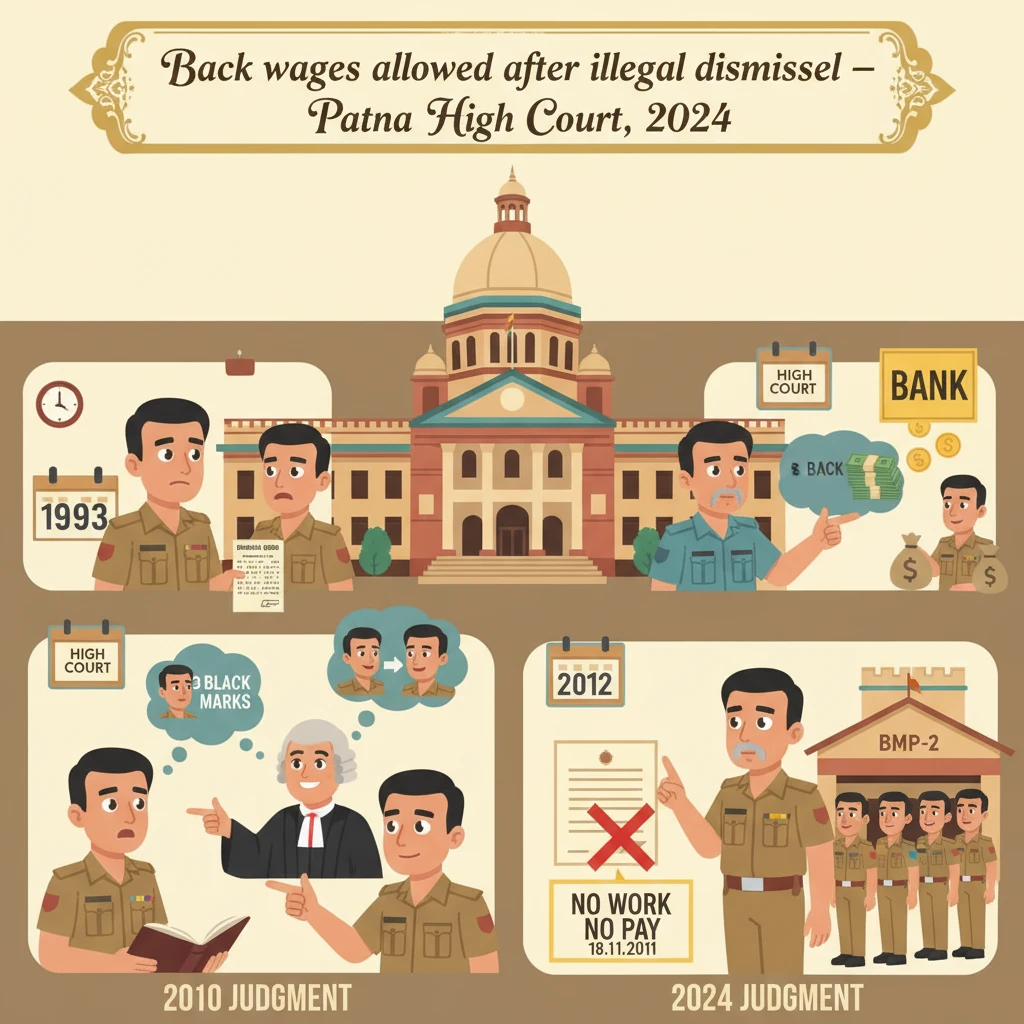
The petitioner was appointed as a Constable in Bihar Military Police. There was some dispute about his exact date of appointment. He claimed that he was appointed on 27.01.1991, while the State authorities in their counter affidavit stated that his appointment in B.M.P.-9, Jamalpur was from 18.01.1991. After appointment, he served at different places.
During his training period, departmental proceedings were started against him. He was accused of breaking or opening the locks of boxes of other constables, stealing money, and illegally or unauthorisedly staying in the barrack and being part of merry-making. After the enquiry, he was dismissed from service with effect from 18.04.1993.
The petitioner challenged this dismissal before the Patna High Court in CWJC No. 9266 of 1997. By order dated 12.08.2010, the High Court quashed the dismissal order. The Court held that there was no evidence that he had broken the locks or stolen money, or that he was illegally staying in the barrack. It also noted that in an almost identical case of another constable, Binod Gond, the authorities had imposed only a lesser punishment of withholding increment for two years (three black marks), not dismissal.
Finding the dismissal disproportionate, the Court set aside the punishment order, the appellate order and the rejection of the memorial. It remanded the matter to the disciplinary authority with a direction to pass any other order of punishment keeping in mind the punishment imposed on Binod Gond. There was no order regarding costs.
Following this 2010 judgment, the disciplinary authority set aside the earlier punishment memo and reinstated the petitioner. He was taken back in service as a constable on 16.03.2012 on the initial pay scale. His salary was fixed with effect from 01.01.1996 and was subsequently revised from time to time.
However, the department denied him any salary for the long period between his dismissal and reinstatement, that is from 18.04.1993 to 16.03.2012, relying on the principle of “no work no pay”. This denial was contained in Memo No. 4907/R,ka. dated 18.11.2011 issued by the Commandant, Bihar Military Police-2, Dehri.
Aggrieved, the petitioner filed the present writ petition (CWJC No. 16967 of 2012) before the Patna High Court. He sought quashing of Memo No. 4907/R,ka. to the extent it denied him salary for 18 years, grant of the same reliefs as granted to Binod Gond, and all consequential benefits such as promotion, salary and allowances flowing from the setting aside of his dismissal.
What the Court Examined and Decided
The matter was heard by Hon’ble Mr. Justice Purnendu Singh on 20.08.2024. Counsel for both sides addressed the Court on whether the petitioner should get back wages for the period of his dismissal.
On behalf of the petitioner, it was argued that he was not dismissed for his own fault. In the earlier writ (CWJC No. 9266 of 1997), the High Court had already held that there was no evidence of him breaking open boxes, stealing money or illegally staying in the barrack. The Court had also found that two different punishments were given in an identical situation: a minor punishment for Binod Gond and the extreme punishment of dismissal for the petitioner. The earlier judgment had, therefore, held the dismissal to be disproportionate and had quashed it.
It was submitted that once the dismissal was set aside and the petitioner was reinstated, denying him pay for 18 years was itself a form of punishment. According to the petitioner, this went against the spirit of the earlier judgment which had already corrected the disproportionate punishment. He claimed that he was entitled to salary from the date of his dismissal (18.04.1993) till the date of his reinstatement (16.03.2012).
The petitioner’s counsel relied on the Supreme Court judgment in Pradeep, S/o Rajkumar Jain vs. Manganese Ore (India) Limited & others, reported in 2022 (3) SCC 683, especially paragraphs 14 to 16, to support the claim that denial of back wages in such circumstances was not justified.
On the other side, the State’s counsel accepted that the petitioner had been dismissed and later reinstated, but defended the denial of back wages. He argued that since the petitioner had not worked during the dismissal period, the principle of “no work no pay” rightly applied. The State submitted that from the date of reinstatement (16.03.2012), the petitioner was getting his fixed pay and admissible dearness allowance, and his pay scale had been revised from time to time.
It was contended that the petitioner was not entitled to any salary or even a percentage of salary for the dismissal period. For this view, reliance was placed on the Supreme Court decision in J. K. Synthetics Ltd. vs. K. P. Agrawal and others (Civil Appeal No. 7657 of 2004), particularly paragraphs 18 and 19.
The Court framed three broad questions:
(i) Whether the petitioner was entitled to arrears of pay for the dismissal period from 18.04.1993 to 16.03.2012.
(ii) Whether the principle of no work no pay applied where a dismissal order was later interfered with by the Court, especially when co-delinquents received a lesser punishment.
(iii) Whether, in exercise of writ jurisdiction, the Court could interfere with the State’s administrative decision when the petitioner’s legal right stood defeated.
The Court noted that in the earlier writ, it had already held that the authorities could not apply two different yardsticks for similar misconduct. While charges of breaking boxes and stealing money were also levelled against Binod Gond, he was given only the punishment of withholding increment for two years. In contrast, the petitioner was dismissed. That dismissal was quashed as disproportionate, and the authorities were directed to pass a fresh order of punishment keeping Binod Gond’s case in mind.
In compliance with that order, the disciplinary authority had set aside the original punishment memo dated 19.04.1993 and reinstated the petitioner at an initial pay scale. However, by applying the principle of no work no pay, they refused him any salary for the entire 18 years.
The Court observed that, in effect, the petitioner had suffered a more serious penal consequence because of this decision. Although his dismissal was held illegal and disproportionate, the refusal to pay him any salary for 18 years amounted to a fresh and heavy punishment. It was also noted that the respondents had not pleaded that, following the quashing of the dismissal, the petitioner would not be entitled to be treated as reinstated from the date of dismissal. The only reason given for non-payment was “no work no pay”.
The Court emphasised that the petitioner had not voluntarily remained absent from duty. He had been kept out of service due to the dismissal order, which was later set aside. Therefore, his case was not comparable to a situation where an employee wilfully abstains from work.
On the case law cited, the Court found that both Pradeep, S/o Raj Kumar Jain and J. K. Synthetics Ltd. related to disputes under the Industrial Disputes Act. Since the present case was not an industrial dispute of that nature, those decisions were not directly relevant.
Instead, the Court relied on other Supreme Court decisions dealing with reinstatement and back wages. It referred to Krishna Murari Lal Sehgal vs. State of Punjab (AIR 1977 SC 1233), where in similar circumstances the Supreme Court had held that the only way to implement its judgment was to pay the due salary to the employee.
The Court also cited the detailed discussion in Deepali Gundu Surwase vs. Kranti Junior Adhyapak Mahavidyalaya (D.Ed.) & others, reported in (2013) 10 SCC 324. There the Supreme Court explained the meaning of “reinstatement” and held that reinstating an employee after finding the employer’s action illegal normally entitles the employee to full back wages. It stressed that denial of back wages to an employee who had suffered due to an illegal act of the employer would indirectly punish the employee and reward the employer by relieving it of its financial obligation.
Another case relied upon was Managing Director, ECIL, Hyderabad & others vs. B. Karunakar & others, reported in (1993) 4 SCC 727. The Supreme Court had held that where an order of dismissal is set aside for procedural reasons and a fresh enquiry is ordered, the authority has to decide, according to law and depending on the final outcome, how to treat the period between dismissal and reinstatement and what benefits to grant.
Applying these principles, the Patna High Court held that once the removal of the petitioner had been set aside, the Government’s liability to pay him salary and increments for the period covered by the dismissal order became automatic. His penalty had been brought down to the level of that imposed upon Binod Gond. In such a situation, refusal to pay salary for the 18-year period could not be justified merely on the basis of “no work no pay”.
The Court concluded that non-payment of salary for the entire 18 years, for which the petitioner could not be held responsible, required reconsideration by the respondents. It therefore set aside Memo No. 4907 dated 18.11.2011 to the limited extent that it denied the petitioner’s due salary for the total period of 18 years on the principle of no work no pay. The remaining parts of that order were left intact.
Accordingly, the writ petition was allowed to this extent, meaning that the department must now reconsider and process the petitioner’s salary for the dismissal period in line with the Court’s findings.
Why This Judgment Matters
This judgment is important for government and police personnel who have been wrongly dismissed and later reinstated. It shows that simply bringing an employee back into service is not enough when the original dismissal was illegal or disproportionate.
The Patna High Court has made it clear that the State cannot hide behind the phrase “no work no pay” when it was the State’s own wrongful action that kept the person out of work. In such cases, denying back wages can become a fresh punishment, even though the earlier punishment has already been set aside.
The decision also highlights that when co-workers face the same charge, authorities cannot treat one harshly and the other leniently without good reason. If a Court later corrects such unequal treatment, the employee is entitled not only to reinstatement but also to proper financial compensation for the period of exclusion from service.
For ordinary employees, especially in disciplined forces like the police, this ruling reinforces that they can approach the Patna High Court to challenge decisions that strip them of salary for long periods after a dismissal is found invalid.
Legal Issues and Answers
- Issue: Is a reinstated government employee entitled to salary for the period between an illegal dismissal and reinstatement, when the dismissal has been quashed as disproportionate?
Answer: Yes. The Court held that once the dismissal is set aside and the employee is reinstated, the Government’s liability to pay salary and increments for the dismissal period is automatic, and denial of back wages on “no work no pay” in such circumstances must be reconsidered. - Issue: Can the State apply the principle of “no work no pay” where the employee did not work only because of an unlawful dismissal order later quashed by the Court?
Answer: No in the present facts. The Court held that where the employee was out of service due to an illegal and disproportionate dismissal, and not due to voluntary absence, “no work no pay” cannot be used to deny salary for that period. - Issue: Can a disciplinary authority impose much harsher financial consequences on one employee than on another for similar misconduct, after the Court has directed parity of punishment?
Answer: No. After the earlier direction to keep in mind the punishment of the co-delinquent, the authority could not, in effect, impose a more severe penalty by denying 18 years of salary; such denial was set aside.
Cases Cited by the Court
- Pradeep, S/o Rajkumar Jain vs. Manganese Ore (India) Limited & others, 2022 (3) SCC 683 (held not directly relevant as it arose under the Industrial Disputes Act).
- J. K. Synthetics Ltd. vs. K. P. Agrawal and others, Civil Appeal No. 7657 of 2004, judgment dated 01.02.2007 (also held not directly relevant for the present service law dispute).
- Krishna Murari Lal Sehgal vs. State of Punjab, AIR 1977 SC 1233 (relied upon).
- Deepali Gundu Surwase vs. Kranti Junior Adhyapak Mahavidyalaya (D.Ed.) & others, (2013) 10 SCC 324 (relied upon).
- Managing Director, ECIL, Hyderabad & others vs. B. Karunakar & others, (1993) 4 SCC 727 (relied upon).
Case Details
Case Number: Civil Writ Jurisdiction Case No. 16967 of 2012
Case Title: Mahendra Prasad Chauhan vs. The State of Bihar & others
Citation: 2024 (4) PLJR 242
Coram: Hon’ble Mr. Justice Purnendu Singh
Advocates:
- For the petitioner: Mr. Satya Ranjan Sinha, Advocate; Ms. Seema Kumari, Advocate; Mr. Dhananjay Kumar, Advocate
- For the respondents: Mr. Mithlesh Kumar Singh, Advocate
Nature of the case: Writ petition under Article 226 challenging denial of back wages and seeking consequential service benefits after reinstatement.
Link to judgment: View full judgment on Patna High Court website
If you found this explanation helpful and wish to stay informed about how legal developments may affect your rights in Bihar, you may consider following Samvida Law Associates for more updates.







