

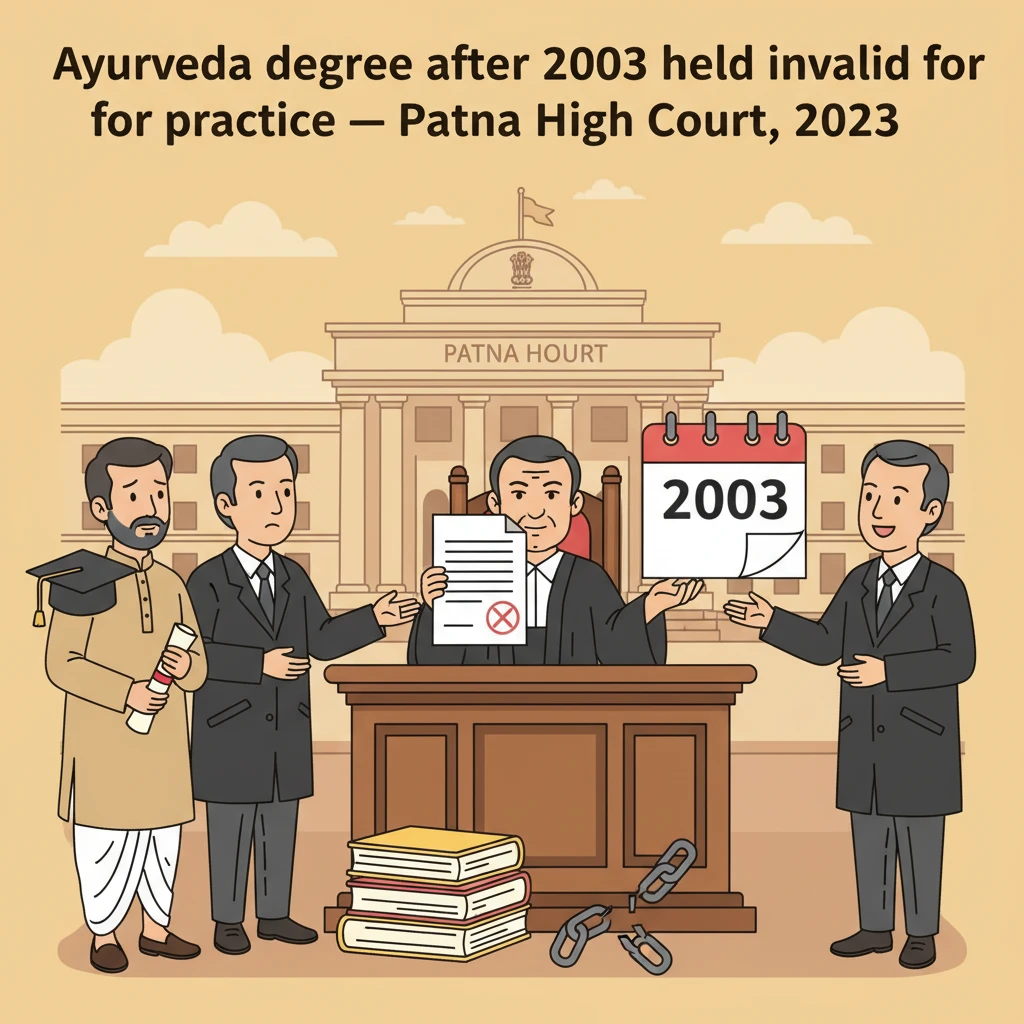
Case Background
The petitioner stated that he studied the Graduate of Ayurvedic Medicine and Surgery (G.A.M.S.) course at Shrihari Shakuntalayam Ayurvedic Medical College and Hospital, Muzaffarpur, Bihar. According to him, this college had permanent recognition and affiliation with effect from the academic year 1992 under Sections 13, 14 and 15 of the Bihar Development of Ayurvedic and Unani System of Medicine Act, 1951.
He took admission to the G.A.M.S. course in the academic year 1996, for a five-year course, described in the judgment as the 1996–2001 batch. The first, second and fourth year examinations were conducted by the college. The third and fifth year examinations were conducted by the State Faculty of Ayurvedic and Unani Medicines under the Bihar State Ayurvedic and Unani Medicines Council, Patna, and were known as preliminary and final examinations respectively.
The petitioner appeared in all the four years’ examinations. However, before he could participate in the fifth year examination, a writ petition was filed (by others) challenging the validity of the courses conducted by institutes under the aegis of the State Medicines Council. That dispute went up to the Supreme Court and was decided in Bihar State Council of Ayurvedic and Unani Medicine v. State of Bihar, reported in (2007) 12 SCC 728.
After this Supreme Court decision, the Ministry of Health and Family Welfare, Government of India, issued a notification dated 25.06.2010 under Section 14(2) of the Indian Medicine Central Council Act, 1970 (Act of 1970). By this notification, Schedule II applicable to the State of Bihar was amended. The validity of the G.A.M.S. course conducted under the State Faculty of Ayurvedic and Unani Medicines, Patna, Bihar was restricted to qualifications obtained between 1953 and 2003.
According to the petitioner, after the 2010 notification, the State Faculty conducted an examination in April 2012. He claimed that he participated in this examination and qualified. He further claimed that he underwent internship and was issued a completion certificate on 15.01.2013. On this basis, the State Faculty granted him a provisional certificate, followed by registration with the Bihar State Council of Ayurvedic and Unani Medicines.
Later, on the basis of a complaint, the Council constituted a committee to inquire into the matter. The committee reportedly found that the institute from which the petitioner claimed to have qualified was a fraudulent one. Based on the report dated 09.03.2016, the registration of the petitioner was cancelled. This cancellation order and the related issues were challenged in the present writ petition.
What the Court Examined and Decided
The Division Bench of the Patna High Court, comprising Hon’ble the Chief Justice and Hon’ble Mr. Justice Rajiv Roy, delivered a common judgment (CAV judgment) on 05.12.2023.
On behalf of the petitioner, learned Senior Advocate submitted that once registration was granted, the petitioner had started practicing medicine. According to him, cancellation at a later stage was arbitrary. He relied on the 2010 amendment to the Act of 1970 and argued that the notification recognised G.A.M.S. courses carried out till 2003. He contended that, based on this amendment, the fifth year examination conducted in 2012 by the State Faculty conferred a valid degree on him, enabling him to practice.
The petitioner further argued that the Supreme Court’s decision in Bihar State Council of Ayurvedic and Unani Medicine v. State of Bihar permitted continuance of practice by him and by similarly situated persons.
On the other side, learned Senior Advocate appearing for the National Commission for Indian System of Medicine (which superseded the Central Council of Indian Medicine, respondent no. 8) submitted that the Supreme Court decision actually went against the petitioner. He pointed out that the petitioner was not a person who had qualified before 2003. Therefore, if any qualification obtained after 2003 was to be recognised and registration granted, the institution from which the petitioner studied must have obtained recognition from the erstwhile Central Council of Indian Medicine within three years from 2003, as required by the Act of 1970 after its amendment.
The Court also recorded that another Division Bench judgment in CWJC No. 20544 of 2019 was cited by learned Senior Counsel as regulating the issue. The Bench, however, clarified that this earlier case was a Public Interest Litigation concerning ongoing admissions in G.A.M.S. courses in two colleges. In that case, the Division Bench had noticed the Supreme Court judgment and observed that an institute could continue courses if it sought and obtained permission from the Central Government for the medical qualifications it issued, and that such requirement did not invalidate qualifications already conferred by previously established colleges.
The present Bench carefully examined the Supreme Court decision in Bihar State Council of Ayurvedic and Unani Medicine. The Supreme Court decision dealt with the eligibility of six writ petitioners, who had obtained G.A.M.S. degrees from the State Faculty established under Section 17 of the State Act of 1951, to appear for postgraduate entrance examinations in Ayurveda.
The Supreme Court had analysed the 2003 amendments to the Act of 1970, which introduced Sections 13-A, 13-B and 13-C. These provisions required that:
Section 13-A regulated the opening of indigenous medical colleges and required prior permission of the Central Government, operating through a non obstante clause. Section 13-B declared that medical qualifications granted by colleges established without such prior permission would not be recognised. Section 13-C gave existing colleges, which had been operating without prior Central Government permission, three years from commencement of the amending Act to regularise their status.
The Supreme Court held that the phrase “on or before” in Section 13-C clearly required existing colleges also to seek permission and that no exemption could be claimed. It clarified that new colleges and existing colleges were put on the same footing. Importantly, the Supreme Court made a distinction between degrees already conferred before commencement of the 2003 amendments and degrees granted thereafter.
As summarised by the Patna High Court, the Supreme Court held that:
Even though existing colleges had to seek permission, the medical qualifications already granted by them before the 2003 amendment would not be rendered unrecognised merely because the colleges subsequently failed to obtain permission within the three-year period. In other words, students who had legally been conferred degrees before commencement of the 2003 amendment were protected, and their degrees remained recognised under the Act of 1970.
However, for degrees granted after the 2003 amendments, the position was different. All medical colleges, whether old or new, had to compulsorily seek permission from the Central Government. If they failed to do so within the prescribed time, any medical qualification conferred by such colleges after the amendment would not be a recognised qualification for purposes of the Act of 1970.
Applying this reading of the Supreme Court decision, the Patna High Court held that even colleges established prior to 2003 had to obtain recognition or permission from the Central Government. Only those obtaining medical qualifications after 2003 from such recognised institutions could validly practice medicine.
The Court then looked at the petitioner’s specific case. It noted that the petitioner did not claim to have been conferred a degree prior to 2003. His claim was that the degree was conferred following an examination held in April 2012, long after the 2003 amendment. On the basis of the binding declaration of the Supreme Court, such a degree could be treated as a valid qualification enabling medical practice only if the institute which conducted the course and conferred the degree had been recognised by the Central Government within three years from commencement of the 2003 amendment, even if that institute had been established earlier.
There was no such contention in the writ petition that the institute had obtained Central Government recognition within the three-year window after 2003. In addition, the inquiry committee of the Council had already found the institute to be fraudulent. Though the High Court did not go into the factual details of that finding, it relied on the legal position that, without Central Government recognition within the stipulated period, the petitioner’s degree could not be a recognised medical qualification under the Act of 1970.
The Court also referred to the 2010 notification under Section 14(2) of the Act of 1970, by which the validity of G.A.M.S. degrees granted by the State Faculty of Ayurvedic and Unani Medicines in Bihar was restricted to qualifications conferred between 1953 and 2003. The Court emphasised that this change was made only to bring the Act in line with the Supreme Court decision. In its view, G.A.M.S. degrees granted by the State Faculty would be recognised only if the degree was granted in the period 1953–2003. This did not help the petitioner, whose alleged degree was of 2012.
Further, the Court held that the examination conducted in 2012 could not be treated as one carried out pursuant to the 2010 notification, which clearly limited recognition to degrees granted up to 2003. Therefore, the petitioner’s reliance on that notification also failed.
In conclusion, the Bench found no reason to interfere with the amendments made to the Act of 1970 and no basis to accept the petitioner’s challenge to cancellation of his registration. The writ petition was dismissed, with parties left to bear their own costs.
Why This Judgment Matters
This judgment is important for Ayurvedic and Unani practitioners in Bihar and elsewhere who obtained their degrees after 2003 from institutions linked to the State Faculty of Ayurvedic and Unani Medicines.
The Patna High Court makes clear that:
First, only those G.A.M.S. degrees granted between 1953 and 2003 by the State Faculty are recognised under the Act of 1970, in line with the 2010 Central Government notification. Second, students who obtained degrees after 2003 can rely on their qualifications only if their colleges obtained Central Government permission within three years of the 2003 amendment.
For individuals who studied in institutes that never secured such recognition, their degrees may not qualify them for valid registration and practice, even if they briefly obtained provisional or permanent registration. Regulatory bodies can cancel such registrations, and courts are likely to uphold such decisions when they are consistent with the statutory scheme and the Supreme Court’s interpretation.
Legal Issues and Answers
- Issue: Whether the petitioner’s G.A.M.S. degree, allegedly conferred in 2012 by a State Faculty–linked institute, was a recognised medical qualification enabling him to practice and retain registration.
Answer: No. Since the degree was conferred after 2003 and there was no claim that the institute obtained Central Government recognition within three years of the 2003 amendment, the qualification could not be recognised under the Act of 1970. The cancellation of registration was therefore upheld. - Issue: Whether the 2010 notification and the Supreme Court decision in Bihar State Council of Ayurvedic and Unani Medicine protected the petitioner’s post-2003 degree and practice.
Answer: No. The Supreme Court decision protected only degrees conferred before the 2003 amendment. The 2010 notification restricted recognition of G.A.M.S. degrees of the State Faculty to the period 1953–2003. Neither extended recognition to degrees conferred in 2012.
Cases Cited by the Court
- Bihar State Council of Ayurvedic and Unani Medicine v. State of Bihar, (2007) 12 SCC 728.
- The Court also referred to a Division Bench decision in CWJC No. 20544 of 2019 but clarified that it did not govern the present case.
Case Details
Case Number: Civil Writ Jurisdiction Case No. 20683 of 2019
Case Title: Rakesh Kumar Singh v. Union of India & Ors.
Coram: Hon’ble the Chief Justice; Hon’ble Mr. Justice Rajiv Roy
Citation: 2024 (1) PLJR 460
Advocates:
For the petitioner: Mr. Rajendra Narayan, Senior Advocate; Mr. Lalan Kumar, Advocate; Mr. Vivek Amritesh, Advocate.
For C.C.M./National Commission for Indian System of Medicine: Mr. Janardan Prasad Singh, Senior Advocate; Mr. Deepak Kumar, Advocate.
For Union of India: Mrs. Punam Kumari Singh, Central Government Counsel.
For respondents 6 and 7 (Bihar State Council of Ayurvedic and Unani Medicine and its Registrar): Mr. Vishwaroop Jha, Advocate; Mr. Manoj Kumar Jha, Advocate.
For the State of Bihar (respondent nos. 4 and 5): Government Advocate (name not specified).
Nature of the Case: Writ petition under civil writ jurisdiction challenging cancellation of Ayurvedic medical registration and related recognition of qualification.
Link to Judgment: Patna High Court Judgment in CWJC No. 20683 of 2019
If you found this explanation helpful and wish to stay informed about
how legal developments may affect your rights in Bihar,
you may consider following Samvida Law Associates for more updates.







