

Case Background
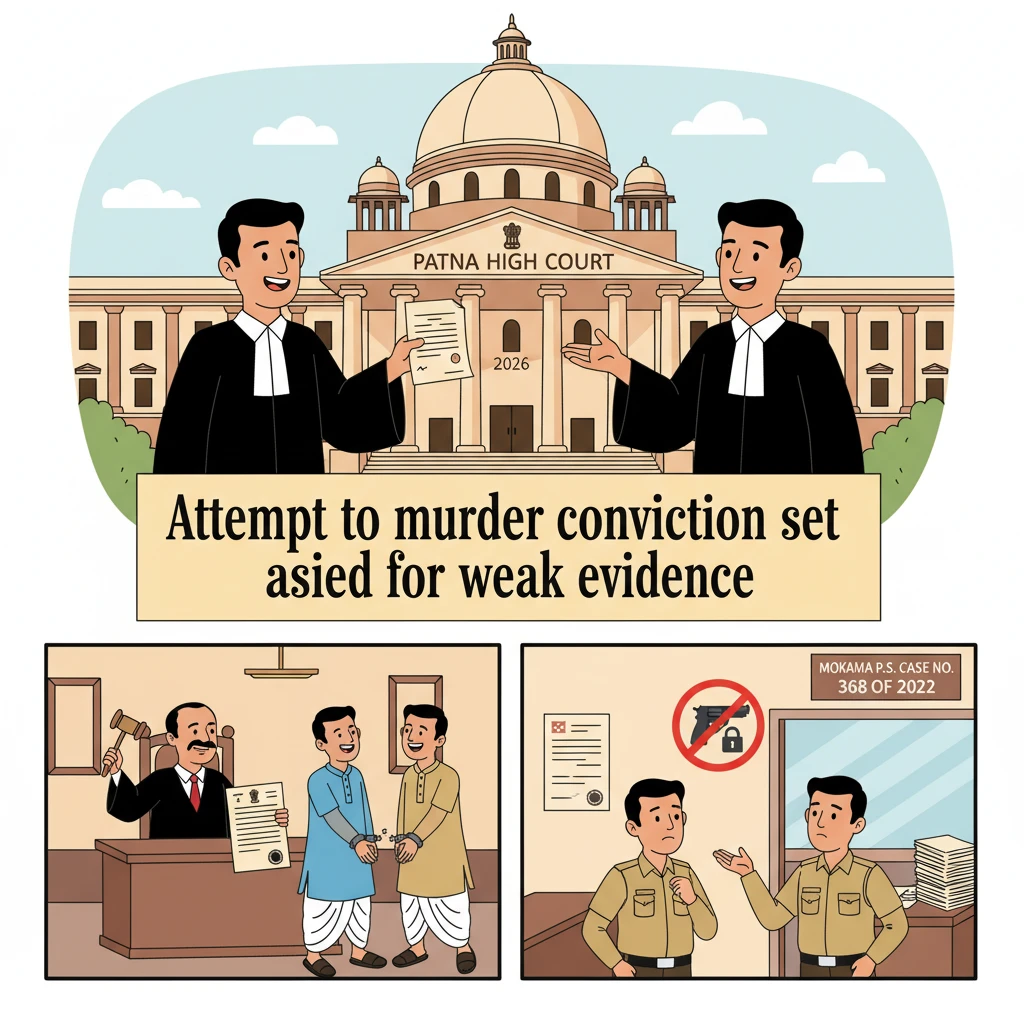
The case arises from Mokama P.S. Case No. 368 of 2022, District Patna. The First Information Report (FIR) was lodged on 25.11.2022 by informant Abhinash Kumar (PW-6).
According to the written report, around 7:20 PM on 25.11.2022, while the informant was sleeping in his house, 5–6 persons allegedly entered, abused him and fired 3–4 rounds. While retreating, they allegedly fired again, and one bullet hit the informant on his left arm. On his alarm, the assailants allegedly fled. The informant claimed he recognised the attackers, including the present appellants, being co-villagers of village Mekra. He also mentioned a dispute over seeding of crops and threats as the motive and alleged that the firing was with an intention to kill him.
On the basis of his written report, Mokama P.S. Case No. 368 of 2022 was registered under Sections 448, 326, 307, 34 of the Indian Penal Code (IPC) and Section 27 of the Arms Act. Investigation followed, statements of witnesses were recorded and, after completion of investigation, charge-sheet was submitted against the appellants under Sections 448, 326, 307/34 IPC and Section 27 of the Arms Act. Investigation continued against the other named persons.
The Magistrate took cognizance against the appellants and, after following committal procedures, the case was sent to the Court of Session. The trial court framed charges under Sections 307/34, 326/34, 448/34 IPC and Section 27 Arms Act, which were read over to the accused. They pleaded not guilty and claimed trial.
Seven prosecution witnesses were examined: PW-1 Chintu Kumar @ Karu, PW-2 Pawan Devi, PW-3 Ranju Devi, PW-4 Ghuran Rai @ Ghus Rai, PW-5 Anita Devi, PW-6 Abhinash Kumar (informant-injured) and PW-7 Chandra Bhushan Sinha (Investigating Officer). Several documents, including the written report, formal FIR, discharge ticket, injury report and earlier FIRs between the parties, were exhibited. The defence led no evidence and the stand of the appellants, including in their Section 313 CrPC statements, was of total denial.
The Additional District and Sessions Judge-IV, Barh, Patna, in S.T. Case No. 423 of 2023, by judgment dated 06.03.2025 and order dated 11.03.2025, convicted both appellants under Sections 307, 448 read with 34 IPC and Section 27 Arms Act. They were sentenced to one year rigorous imprisonment and fine for Section 448/34 IPC, five years rigorous imprisonment and fine for Section 307/34 IPC, and three years rigorous imprisonment and fine for Section 27 Arms Act, with all sentences to run concurrently.
Aggrieved, each convicted person filed a separate criminal appeal (Criminal Appeal (SJ) Nos. 1412 and 1524 of 2025). Since both appeals challenged the same common judgment, the Patna High Court heard them together and decided them by a common judgment dated 20.01.2026.
What the Court Examined and Decided
The central question framed by the Patna High Court was whether offences under Sections 307 and 448 read with 34 IPC and Section 27 of the Arms Act were made out on the facts and evidence on record.
The Court carefully evaluated the testimony of each prosecution witness and compared it with the FIR and investigation records. The focus was on consistency about three crucial aspects: who fired, where the firing took place, and what evidence supported the alleged gunshot injury.
Evidence of the informant (PW-6)
PW-6 stated in court that on 25.11.2022 at about 7:00 PM, while he was sleeping in his house, 5–6 persons including Rahul Rai, appellant Bipin Rai, appellant Manoj Rai, Pampam Rai and Lolin Rai suddenly intruded into the house. Rahul allegedly had a pistol and the others had rifles. Rahul allegedly fired at him, the bullet hitting his left hand between the elbow and wrist. He fell to the ground and the accused left while firing and abusing. He claimed the incident was seen by his parents, cousin and aunts. He also stated that electric light was available at the time and that the reason for the attack was that he was a witness in an earlier firing case where his aunt Ranju Devi had been injured.
However, in cross-examination, PW-6 gave conflicting statements about who was present in his room and admitted that he had not told the police about the electric light being on. Importantly, on a comparison with the FIR, the High Court noted that in the initial written report PW-6 had not named any specific person as the shooter. There he had merely alleged that the appellants and others collectively fired and were recognised while fleeing. The later assertion in court that Rahul alone fired the shot that hit him was treated as a material improvement.
The Court also highlighted that the informant’s later claim that his parents, cousin and aunts witnessed the occurrence was not mentioned in the FIR. The stated motive also changed from a crop seeding dispute (in the FIR) to threats regarding an earlier firing case (in evidence). These omissions and improvements were found to be serious inconsistencies affecting his credibility.
Evidence of the Investigating Officer (PW-7)
PW-7, the investigating officer, stated that the place of occurrence was not inside a room but a “Chabutra” situated in barren land in front of the informant’s house in village Mekra. He gave a clear boundary of this Chabutra: north – house of Ravindra Rai; south – barren land of Mantu Rai; east – house of Rahul Rai; west – house of Bhuran Rai.
In cross-examination, PW-7 reiterated that the Chabutra was outside the house and that no firing material, such as empty cartridges, was seized from the spot. He also clarified that no witness had told him that the informant suffered firearm injury inside the house. According to him, the informant was lying on the Chabutra. He admitted he did not record who exactly helped him identify the place of occurrence and that he recorded a re-statement of the informant much later, on 16.12.2022, within the police station premises, which the Court considered a sign of unfair investigation. He also did not investigate the motive mentioned in the FIR.
Thus, the investigating officer’s evidence clearly contradicted the informant’s testimony that the firing occurred inside his room and raised questions about the very location of the attack.
Evidence of other prosecution witnesses
The High Court then compared the statements of the remaining witnesses.
PW-1, the informant’s cousin, claimed in examination-in-chief that the accused came abusing and, after pressurising them to withdraw an earlier case relating to firing on his mother, entered the house and fired at the sleeping informant. He even claimed to have handed over 11 empty cartridges to the police. But during cross-examination he admitted that when the firing took place he and family members went inside their house and that no firing occurred at the place where they had earlier sat on the Chabutra. His description of the boundaries of the place of occurrence did not match that of the I.O. The claim about handing over cartridges was contradicted by PW-7, who categorically stated that no firing material was seized.
PW-2, the informant’s mother, initially said her son was near the Chabutra, went inside the house when the accused arrived, and was then shot inside the house by Rahul while the appellants and others remained outside. She mentioned 5–6 rounds being fired outside the house and later stated there was a land dispute regarding erection of a pole with appellant Bipin. Her description of the boundaries of the place of occurrence again differed from the I.O.’s and from PW-1’s version. The Court found it unbelievable that she could clearly see and identify those firing multiple shots outside the house at 7:20 PM when even the source of light was not established by the investigation.
PW-3, Ranju Devi, said in court that she was in her house, heard abuses, and saw the accused firing at the informant when he forbade them from abusing. However, she admitted that in her police statement she had only said that she heard firing, came out and found the informant injured; she had not seen the actual firing. She also admitted that the informant was a witness in an earlier case in which she had been injured by firing allegedly by some of the same accused. The Court held that PW-3 was not an eyewitness and had a strong reason to depose against the appellants, making her testimony unreliable.
PW-4, the informant’s father, deposed that he was on the verandah when the accused came, abused and fired, and that Rahul’s shot hit his son. Yet in cross-examination he said that there was no Chabutra in front of his house and that after hearing the sound of firing from the verandah, he went into his son’s room and found him unconscious. This meant he had not actually seen who fired at his son. His boundary description of the place of occurrence again conflicted with that of the I.O. He also admitted pre-existing disputes with the accused side regarding erection of a pole and alleged loot of wheat.
PW-5, Anita Devi, stated that she was cooking in her house when she heard abuses and firing, went to the informant’s house and saw the accused firing at him while he was taking food on his bed. But in cross-examination she admitted that in her police statement she had only said she went there after hearing noise and found the informant already injured. She further stated that when she reached there only two women, PW-2 and her daughter-in-law, were present. This directly contradicted PW-1 to PW-4, who all claimed to be present and eyewitnesses. She also did not tell the police about the Chabutra in front of the informant’s house, even though the I.O. treated that as the place of occurrence.
Failure to prove injury through medical evidence
The High Court gave special attention to the injury report. The injury report of the informant, allegedly prepared by Dr. Rakesh Kumar, had been marked as an exhibit. However, the doctor who authored this report was never examined during trial.
The Court observed that, pragmatically and prudently, the doctor who prepared the injury report must enter the witness box so the injuries can be proved and the report can be authenticated. Without the doctor’s testimony, the injury report was treated as a mere formality and not reliable legal proof against the accused. This omission became even more serious in a case of alleged firing where the nature and location of the wound are crucial for offences like Section 307 IPC and Section 27 Arms Act.
Overall assessment and outcome
Taking all these factors together, the Court concluded that the prosecution story was riddled with major contradictions and improvements:
- Critical changes between the FIR and later evidence regarding who fired, where the firing occurred, and who witnessed it.
- Contradictory descriptions of the place of occurrence, with the I.O. placing it on an outside Chabutra and several witnesses claiming it was inside the house.
- Conflicting accounts about the presence of witnesses at the time of firing and about the boundary of the place of occurrence.
- Different motives being suggested: crop seeding dispute in the FIR, pressure to withdraw an earlier firing case, and disputes about erection of a pole and alleged loot of wheat during evidence.
- No seizure of cartridges or other firing material, despite one witness claiming to have handed over 11 cartridges.
- Non-examination of the doctor who allegedly treated the informant, making the injury report unreliable.
The High Court emphasised that, in criminal law, the prosecution must prove its case beyond reasonable doubt. In the presence of such serious discrepancies, it was not safe to uphold a conviction.
Accordingly, the Court held that it was not a fit case where conviction could have been recorded. It found that the trial court had erred in law and in appreciation of facts. The judgment of conviction and order of sentence were set aside and both criminal appeals were allowed. As the appellants were in custody, the Court directed that they be released forthwith, if not required in any other case. Directions were issued to send a copy of the High Court judgment to the concerned jail and to return the trial court records.
Why This Judgment Matters
This judgment of the Patna High Court is important for people facing serious criminal charges, especially in rural settings where there are long-standing land and family disputes.
First, it shows that courts will not blindly accept every statement made by witnesses. If a witness changes the story between the FIR and the courtroom, or adds new details later, the Court can treat such evidence with suspicion. People who lodge FIRs must understand that the first version matters a lot.
Second, the judgment underlines the importance of proper investigation and medical evidence. In a firing case, the police should seize cartridges or other materials from the spot and the prosecution should examine the doctor who treated the injured. Without this, even a genuine victim may find it hard to secure conviction.
Third, the Court recognised that where there are pre-existing disputes between families, there is a real possibility of false implication or exaggeration. This is particularly relevant for villages where multiple cases are often going on between the same sets of people.
Finally, the decision reinforces the basic rule that no one can be sent to jail unless the case is proved beyond reasonable doubt. Mere suspicion or doubtful evidence is not enough for conviction under serious sections like Section 307 IPC and Section 27 Arms Act.
Legal Issues and Answers
- Issue: Whether the prosecution proved, beyond reasonable doubt, that the appellants committed house-trespass and attempted to murder the informant by firing at him with firearms, attracting Sections 307, 448 read with 34 IPC and Section 27 of the Arms Act.
Answer: No. The Patna High Court held that due to serious contradictions about the place of occurrence, manner of firing, identity of the shooter, number and presence of eyewitnesses, different alleged motives, absence of seized firing material and failure to examine the doctor who prepared the injury report, the prosecution version was unreliable. The conviction and sentence were therefore set aside and the appellants were acquitted.
Cases Cited by the Court
- No previous judgments have been cited or relied upon in the text of this decision.
Case Details
Case Number: Criminal Appeal (SJ) No. 1412 of 2025 with Criminal Appeal (SJ) No. 1524 of 2025; arising out of Mokama P.S. Case No. 368 of 2022; Sessions Trial No. 423 of 2023.
Case Title: Bipin Rai @ Bipin Ray vs. State of Bihar; Manoj Rai vs. State of Bihar.
Citation: 2024(2) PLJR 492.
Court: High Court of Judicature at Patna.
Coram: Hon’ble Mr. Justice Alok Kumar Pandey.
Date of Patna High Court Judgment: 20.01.2026.
Trial Court Judgment Under Challenge: Judgment of conviction dated 06.03.2025 and order of sentence dated 11.03.2025 passed by the learned Additional District and Sessions Judge-IV, Barh (Patna) in S.T. No. 423 of 2023.
Advocates:
In Criminal Appeal (SJ) No. 1412 of 2025: For the appellant – Mr. Rananjay Kumar, Advocate. For the State – Mrs. Anita Kumari Singh, Additional Public Prosecutor.
In Criminal Appeal (SJ) No. 1524 of 2025: For the appellants – Mr. Giridhar Gopal Tiwary, Advocate; Mr. Prem Ranjan Kumar, Advocate; Mr. Brajesh Prasad Gupta, Advocate. For the State – Mrs. Anita Kumari Singh, Additional Public Prosecutor.
Nature of the Case: Criminal appeals (single judge) against conviction and sentence in a sessions trial for offences under Sections 307, 448 read with 34 IPC and Section 27 of the Arms Act.
Link to Full Judgment: Click here to read the full Patna High Court judgment.
If you found this explanation helpful and wish to stay informed about how legal developments may affect your rights in Bihar, you may consider following Samvida Law Associates for more updates.







