

Case Background
The case started from an incident dated 25.08.2014 at about 4 P.M. in village Dhanpuri under Govindpur Police Station, District Nawada.
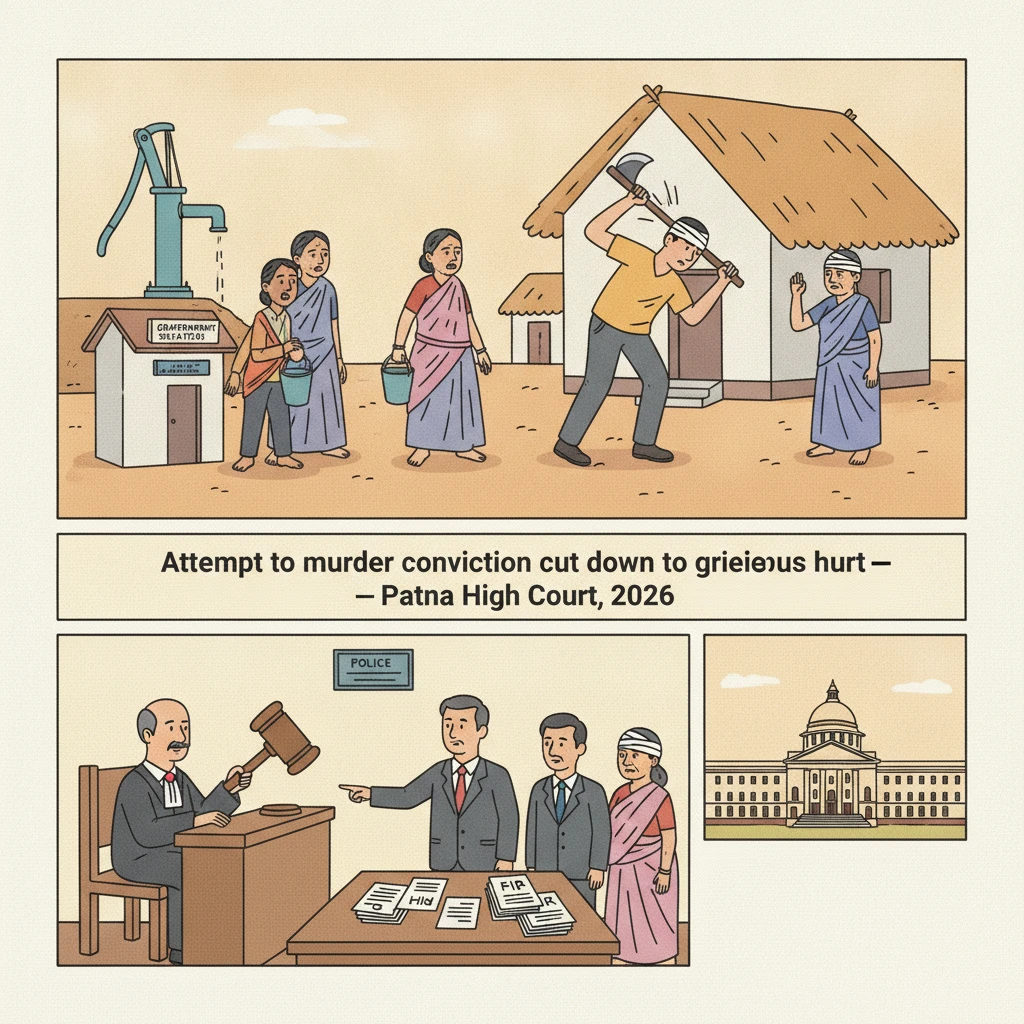
According to the prosecution, the wife and daughter of the informant, namely Kalo Devi and Asho Devi, had gone to fetch water from a government hand-pump in the village.
It was alleged that the appellant came to the spot and stopped them from taking water from that hand-pump.
The prosecution further stated that after this quarrel at the hand-pump, the appellant entered the house of the informant.
Inside the house, he allegedly assaulted the informant’s daughter, Asho Devi, on her head with a tangi (a sharp weapon similar to an axe), causing a bleeding cut injury.
It was also alleged that he pelted stones at her.
After the assault, the informant took his injured daughter to the local police station and gave his fardbeyan.
On the basis of this fardbeyan, Govindpur P.S. Case No. 84 of 2014 was registered for offences under Sections 323, 324, 341, 448 and 307 of the Indian Penal Code.
After investigation, the police submitted charge-sheet under the same sections. The Magistrate took cognizance and, in due course, the case was committed to the Court of Sessions.
The Sessions Trial was numbered as Sessions Trial No. 139 of 2015 before the Sessions Judge, Nawada.
After trial, by judgment of conviction dated 10.02.2016 and order of sentence dated 12.02.2016, the Sessions Judge convicted the appellant under Sections 452 and 307 of the IPC.
For Section 452 IPC (house trespass), the appellant was sentenced to rigorous imprisonment for two years.
For Section 307 IPC (attempt to murder), he was sentenced to rigorous imprisonment for ten years and to pay a fine of Rs. 10,000/-, with a further six months’ rigorous imprisonment in default of payment.
Both sentences were ordered to run concurrently.
Aggrieved by this conviction and sentence, the appellant filed Criminal Appeal (SJ) No. 197 of 2016 before the Patna High Court.
What the Court Examined and Decided
The appeal was heard by Hon’ble Mr. Justice Prabhat Kumar Singh of the Patna High Court.
The Court heard the learned counsel for the appellant, the learned APP for the State, and the learned counsel for the informant.
The Patna High Court first took note of the evidence led during the trial.
The prosecution examined nine witnesses in total.
The injured daughter, Asho Devi, was examined as P.W.1. Her mother, Kalo Devi, was P.W.2.
The injured’s brother, Mukesh Rajbanshi, was P.W.3.
A neighbour common to both sides, Bhola Yadav @ Bhola Prasad Yadav, was P.W.4.
All these four witnesses supported the prosecution version of the incident.
Dr. Basudeo Prasad Verma, Incharge Medical Officer of Primary Health Centre, Govindpur, who prepared the injury report, appeared as P.W.5.
Jamuna Rajbanshi, brother of the informant, was P.W.6.
Ravi Shankar Paswan @ Ravinandan Paswan, a co-villager of both parties, was P.W.7.
Both P.W.6 and P.W.7 corroborated the prosecution story.
Jagdish Paswan, Sub-Inspector of Police and Investigating Officer, was examined as P.W.8. He proved various documents and submitted the charge-sheet.
The informant himself was examined as P.W.9, and he supported his accusations in his examination-in-chief.
The prosecution also produced several documents.
These included the injury report of the injured (Exhibit 1), the supplementary injury report (Exhibit 1/1), endorsement of the S.H.O. on the written report (Exhibit 2), formal FIR (Exhibit 3), requisition for medical examination (Exhibit 4), bed head ticket of PMCH, Patna (Exhibit 5) and discharge ticket of PMCH, Patna (Exhibit 6).
On the defence side, a certified copy of the FIR of a counter case was produced and marked as Exhibit A.
After considering this evidence, the trial court had convicted the appellant under Sections 452 and 307 IPC.
In the High Court, the appellant’s counsel attacked this conviction on multiple grounds.
First, he argued that even if the entire prosecution story was treated as true, the legal ingredients of Section 307 IPC (attempt to murder) were not satisfied.
He pointed out there was no allegation that the appellant repeatedly assaulted the injured.
According to him, the act, as described, might at best fall under Section 325 IPC, which deals with voluntarily causing grievous hurt.
Secondly, he argued that the prosecution had failed to establish the exact place and manner of occurrence.
He drew attention to discrepancies in the evidence about the location of assault.
As per P.W.1 (the injured), the assault occurred in the angan (courtyard).
P.W.2 (her mother) stated that the assault took place inside the house.
P.W.7 deposed that the assault occurred in the verandah.
On this basis, the defence argued that the very place of occurrence was not firmly established.
It was also submitted that there were contradictions between the statements of P.Ws. 1, 2 and 4 about how the incident started.
Relying on these arguments, the defence claimed the conviction and sentence deserved to be set aside.
On the other side, the learned APP for the State and the counsel for the informant opposed the appeal.
They argued that the evidence on record clearly showed the appellant’s guilt.
According to them, the prosecution witnesses proved the charges beyond reasonable doubt.
They accepted that some minor contradictions existed regarding the exact place of occurrence, but argued that these were insignificant.
In their view, such small inconsistencies are natural in human testimony and did not affect the core of the prosecution case.
They contended that the trial court was right in convicting the appellant under Sections 452 and 307 IPC and that the High Court should not interfere.
After hearing both sides and examining the material on record, the Patna High Court took a balanced view.
The Court agreed with the general claim of the prosecution that the appellant was the assailant and that the injured had indeed suffered a serious head injury due to his act.
However, the Court accepted the specific legal argument of the defence concerning Section 307 IPC.
The Court noted that there was no allegation that the appellant repeatedly assaulted the informant’s daughter.
Despite the serious nature of the injury, the Court observed that there were no intervening circumstances mentioned, yet the life of the informant’s daughter was ultimately saved.
In these circumstances, the Court held that the facts did not establish an “attempt to murder” under Section 307 IPC.
Instead, the Court concluded that the case clearly fell under Section 325 IPC, relating to voluntarily causing grievous hurt.
Therefore, the High Court decided to convert the conviction under Section 307 IPC to a conviction under Section 325 IPC.
At the same time, the conviction under Section 452 IPC (house trespass) was maintained.
On the question of sentence, the Court considered the time elapsed and the custody undergone.
The incident was of the year 2014. The Court specifically recorded that there had been no complaint against the appellant after the registration of this FIR.
The Court further noted that the appellant had remained in custody from 26.08.2014 and was granted bail by a coordinate Bench of the High Court on 27.04.2016.
Thus, he had already spent about one year and eight months in custody.
Taking these factors into account, the Court reduced the sentence to the period already undergone by the appellant.
Finally, the Court modified the trial court’s judgment of conviction and order of sentence.
Instead of conviction and sentence under Sections 452 and 307 IPC, the appellant was to stand convicted and sentenced under Sections 452 and 325 IPC, with the sentence limited to the period already undergone.
In view of this, the appellant was discharged from the liability of his bail bond in this case, and the appeal was disposed of.
Why This Judgment Matters
This judgment is important for both accused persons and victims in assault cases.
It shows that the Patna High Court closely examines whether the facts truly fit an “attempt to murder” charge, or whether they amount to “grievous hurt”.
A label of attempt to murder under Section 307 IPC carries very heavy punishment and serious social stigma.
By converting the conviction to Section 325 IPC where repeated or clearly life-threatening attacks are not proved, the Court reinforces that punishment must match the exact nature of the act.
At the same time, the Court did not let the appellant go free.
The conviction for house trespass and grievous hurt was maintained, and the time he had already spent in jail was treated as sufficient punishment, keeping in mind the age of the case and his custody period.
For ordinary people, this judgment underlines that violent entry into someone’s house and causing serious injuries will still result in conviction, even if the highest charge of attempt to murder is not made out.
Legal Issues and Answers
- Issue: Whether the facts of the case justified conviction of the appellant under Section 307 IPC (attempt to murder).
Answer: No. The Patna High Court held that Section 307 IPC was not made out as there was no allegation of repeated assault and the victim’s life was saved; the case fell under Section 325 IPC (grievous hurt). - Issue: What modification, if any, should be made to the sentence imposed by the trial court.
Answer: The conviction was altered from Section 307 to Section 325 IPC, and the sentence was reduced to the period of custody already undergone by the appellant, while maintaining conviction under Section 452 IPC.
Cases Cited by the Court
- The judgment, as extracted, does not record any previous case law or citations relied on by the Court.
Case Details
Case Number: Criminal Appeal (SJ) No. 197 of 2016; arising out of Govindpur P.S. Case No. 84 of 2014 (G.R. Case No. 2388 of 2014); Sessions Trial No. 139 of 2015.
Case Title: Dharmendra Rajbanshi v. The State of Bihar.
Coram: Hon’ble Mr. Justice Prabhat Kumar Singh.
Citation: 2026(3) PLJR 604.
Advocates: For the appellant – Mr. Sheo Kumar Prasad, Advocate and Mr. Vakil Kumar, Advocate. For the State – Mr. A.M.P. Mehta, APP. For the informant – Mr. Ram Pravesh Kumar, Advocate.
Nature of the case: Criminal appeal against judgment of conviction and order of sentence passed by the Sessions Judge in a sessions trial.
Date of Patna High Court Judgment: 07.05.2026.
Link to the Judgment: Click here to read the full Patna High Court judgment.
If you found this explanation helpful and wish to stay informed about how legal developments may affect your rights in Bihar, you may consider following Samvida Law Associates for more updates.







