
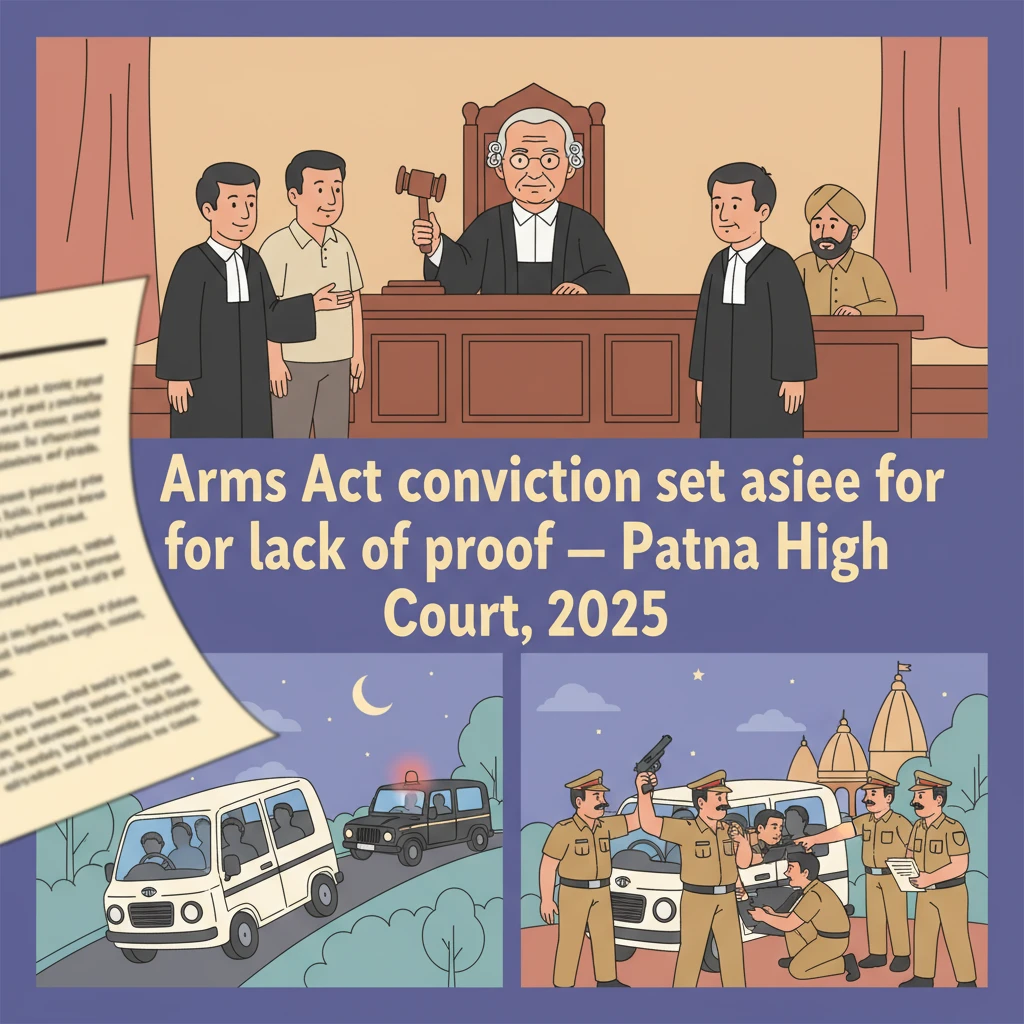
Case Background
The case began with Nokha P.S. Case No. 98 of 2014. On 10.07.2014 at about 11:00 PM, the Station House Officer of Nokha Police Station, S.I. Mohd. Akram Ansari, claimed to have received secret information.
According to him, 6–7 armed persons were moving in a white Tata Magic vehicle on Nokha–Rajpur road to commit a cognizable offence. Acting on this information, he formed a police party and went to the spot.
The police allegedly found a white Tata Magic vehicle standing near Srikhand Kali Asthan. On seeing the police, the persons inside allegedly tried to run away, but five of them were caught.
On search, the police claimed recovery of several country-made firearms and cartridges from different accused persons and from inside the vehicle. A country-made pistol was said to have been recovered from the possession of the present appellant, and another country-made pistol was allegedly found beneath the seat of the Tata Magic vehicle bearing Registration No. BR‑2T‑3494.
A seizure list was prepared and, as per the record, copies were given to all accused. On the basis of the SHO’s self-statement, Nokha P.S. Case No. 98 of 2014 was registered on 11.07.2014 under Sections 399 and 402 of the Indian Penal Code and Sections 25(1‑B)(a), 26 and 35 of the Arms Act.
Routine investigation followed. Statements of witnesses were recorded. The Investigating Officer later submitted a charge sheet against the appellant and others under Sections 399, 402 IPC and Sections 25(1‑B)(a), 26 and 35 of the Arms Act.
The Magistrate took cognizance and committed the case to the Sessions Court. The trial court framed charges under Sections 399 and 402 IPC and Sections 25(1‑B)(a) and 26 of the Arms Act. The appellant pleaded not guilty and claimed trial.
After trial in Sessions Trial No. 189 of 2015, the District and Additional Sessions Judge‑IV, Rohtas at Sasaram, by judgment dated 21.07.2025, convicted the appellant under Sections 25(1‑B)(a) and 26 of the Arms Act.
The trial court sentenced him to rigorous imprisonment for three years with a fine of Rs. 250/- under Section 25(1‑B)(a), and further three years with a fine of Rs. 250/- under Section 26, with 15 days’ simple imprisonment in default of each fine.
Aggrieved, the appellant filed Criminal Appeal (SJ) No. 3487 of 2025 before the Patna High Court. The appeal came up before Hon’ble Mr. Justice Alok Kumar Pandey and was decided on 13.11.2025.
What the Court Examined and Decided
The High Court first looked at what exactly the trial court had relied upon. The prosecution had examined five witnesses:
PW‑1 Shashi Kant Kumar, PW‑2 Sheo Parsan Singh, PW‑3 Raj Deo Singh, PW‑4 S.I. Mohd. Akram Ansari (informant and SHO), and PW‑5 Bigan Sahu (Investigating Officer). Documentary evidence included the seizure list, written report, endorsement, and the sanction order of the District Magistrate.
The appellant’s defence, as gathered from the cross‑examination and statement under Section 313 Cr.P.C., was total denial. He led no defence evidence, but attacked the reliability of the prosecution case.
Key arguments by the appellant
The appellant’s counsel argued that the conviction was based on an improper appreciation of the material on record. He pointed out several weaknesses:
First, both seizure list witnesses (PW‑1 and PW‑3) undermined the seizure itself. PW‑1 admitted in cross‑examination that the weapons were not sealed at the place of occurrence and that all paperwork was done at the police station, where he signed. PW‑3 said he had signed a plain paper and had no knowledge of where the seized articles were recovered from.
Second, counsel argued that there was no compliance with Section 103 of the Bharatiya Nagarik Suraksha Sanhita (BNSS) while preparing the seizure list.
Third, the seized arms and ammunition were never sent to a ballistic expert, so there was no proof that these were functional arms or ammunition as defined in the Arms Act.
Fourth, the sanction of the District Magistrate was allegedly granted in a routine manner, without any discussion of facts or application of mind.
Counsel also pointed to contradictions between the written report and the depositions, including that of the informant, to argue that the prosecution had failed to prove the case beyond reasonable doubt.
Stand of the State
The Additional Public Prosecutor submitted that the informant (PW‑4), the Investigating Officer (PW‑5) and other prosecution witnesses had supported the case. On this basis, he argued that the trial court’s judgment was legal and required no interference.
Evaluation of witness evidence
The Patna High Court carefully scrutinised each witness.
PW‑1, a member of the raiding team and a seizure witness, admitted that the weapons allegedly recovered at the spot were not sealed there. He further stated that all documents regarding seized items were completed at the police station, where he signed. The Court held that this admission cast a serious doubt on the very seizure, because if weapons were truly recovered at the spot, they should have been sealed there and a proper seizure list prepared on the spot.
PW‑2, another member of the patrolling party, stated only that five miscreants were caught and that he did not recognise any of the accused in court. His evidence did not link the appellant to any specific weapon.
PW‑3, also a member of the raiding team and seizure witness, could not remember the date of the occurrence and claimed no knowledge of the incident. In cross‑examination, he admitted he did not know from where the seized articles were recovered and that he had signed on a plain paper. This, in the Court’s view, further shattered the reliability of the seizure list.
PW‑4, the SHO and informant, in cross‑examination stated that before the search he got himself searched, but he did not think it necessary to search others. He did not prepare any document regarding his search. He also could not remember the vehicle number.
He said he had handed over the weapons to the Malkhana In‑charge but there was no receipt; entries were only in the station diary. He admitted that no photographs of the seized items were taken. At another point he stated that it took about one and a half hours to prepare the report and seizure list at the place of occurrence.
This statement of PW‑4 conflicted with PW‑1’s version that documentation was done at the police station. The Court noted this inconsistency as a serious weakness in the prosecution story.
PW‑5, the Investigating Officer, stated that he recorded the re‑statement of the informant and visited the place of occurrence. He moved an application for sanction before the District Magistrate on 22.07.2014 and received sanction on 06.08.2014. He submitted charge sheet under Sections 399, 402 IPC and Sections 25(1‑B)(a), 26 and 35 of the Arms Act.
In cross‑examination, PW‑5 admitted that he did not note the date and time of the re‑statement of the informant. He said the seized items were produced before him but he had not recorded their details in the case diary. Although he applied for sanction on 19.07.2014, he did not explain in the case diary why sanction was not obtained between 11.07.2014 and 22.07.2014. After depositing the seized articles in the Malkhana, he had never seen them again.
He also admitted that though he examined private witnesses, none of them told him what exact offence the accused intended to commit. PW‑5 himself had been a member of the raiding team, blurring the line between the roles of complainant and investigator.
Doubts about seizure and production of material objects
From the statements of PW‑1 and PW‑3, the Court concluded that the prosecution story about seizure at the spot became doubtful. If the weapons had indeed been seized at Srikhand Kali Asthan, they should have been sealed there and recorded properly.
The Court also noted that the seizure list contained no special remarks, and there was no clear evidence that the seized materials were ever produced before the trial court during evidence.
Additionally, when a question was asked about the vehicle’s description, PW‑4 said that only the Investigating Officer could answer. Yet, the Investigating Officer never mentioned the registration number in his deposition. On this point, the Court found the evidence of both PW‑4 and PW‑5 to be “quite shaky”.
Sanction under the Arms Act found invalid
The High Court then examined the sanction order (Exhibit‑5) issued by the District Magistrate, Rohtas at Sasaram. From the text of the order, it appeared that the District Magistrate had merely agreed with the recommendation of the Superintendent of Police and the application of the Investigating Officer.
The sanction order did not specify from whose possession which weapon was recovered, whether those weapons were effective, who was the informant, or how the weapons came within the definition of “arms” under the Arms Act. It was a typed and printed proforma, leaving no space even for basic facts.
The Court held that such a sanction order could not be treated as having been passed after due application of mind. It described the sanction as “vitiated” and unfit to be relied upon by any court to justify conviction under Sections 25 or 26 of the Arms Act.
The Court emphasised that sanction for prosecution is not like issuing a routine licence. It is a quasi‑judicial function. The order itself must show that the sanctioning authority was aware of the facts — such as date of offence, manner of search and seizure, and recovery of arms. None of this was visible from the sanction order in this case.
Failure to prove that seized items were “arms”
The Court also stressed that the prosecution had not examined any ballistic expert. No evidence was led to show whether the seized items were functional firearms or ammunition, whether they were prohibited items, or whether they were even capable of firing.
A co‑ordinate Bench decision of the Patna High Court in Criminal Appeal (SJ) No. 664 of 2013 and its analogous case, decided on 10.12.2014, was cited. In that judgment, the Court had held that without examination of the Sergeant Major or expert from Forensic Science Laboratory, and without proper proof and production of seized articles, conviction under the Arms Act or explosive laws could not be sustained.
Relying on that reasoning, the Court in the present appeal observed that in absence of expert examination and clear evidence regarding the seized weapons, it was difficult to hold that the recovered articles were firearms within the meaning of the Arms Act.
Final conclusion of the Patna High Court
After considering all these infirmities — unreliable seizure evidence, contradictions between witnesses, lack of ballistic examination, and defective sanction — the Court held that the prosecution had failed to prove its case beyond reasonable doubt.
The Court found that the judgment of conviction and sentence passed by the trial court was neither justified nor legal. It concluded that this was not a fit case for recording conviction under Sections 25(1‑B)(a) and 26 of the Arms Act.
Accordingly, the Patna High Court set aside the conviction and sentence. The appeal was allowed. As the appellant was already on bail, he was discharged from the liabilities of his bail bonds. Any pending interlocutory application was disposed of, and directions were given to transmit a copy of the judgment to the concerned jail superintendent and to return the records to the trial court.
Why This Judgment Matters
This decision is important for people who are accused in Arms Act cases, especially in Bihar. It shows that a conviction cannot be sustained merely because the police say they recovered a weapon.
The Patna High Court has made it clear that the prosecution must strictly prove how and where the weapon was recovered, that it was properly sealed and documented, that an expert has confirmed it is a firearm, and that the District Magistrate granted sanction after applying his mind to the facts.
If seizure witnesses say they signed blank papers, if there is confusion about where the seizure happened, or if the sanction order is just a pre‑printed form without case details, courts may treat the prosecution story with serious doubt.
For ordinary citizens, this judgment underscores that criminal trials must follow proper procedure. Secret information and untested weapons are not enough to send someone to jail. For police and prosecutors, it is a reminder to conduct searches carefully, maintain records honestly, and seek sanction orders with full facts placed before the authority.
Legal Issues and Answers
- Issue: Whether, on the evidence led, the offence under Sections 25(1‑B)(a) and 26 of the Arms Act was made out against the appellant.
Answer: No. Due to doubtful seizure, lack of ballistic expert evidence, non‑production and non‑marking of seized articles, and an invalid sanction order, the prosecution failed to prove the case beyond reasonable doubt, and the conviction was set aside. - Issue: Whether the sanction order under the Arms Act was valid and based on due application of mind by the District Magistrate.
Answer: No. The sanction order did not mention basic facts like whose possession the arms were recovered from, whether they were effective, or how they met the definition of “arms”. It appeared to be a routine, proforma sanction and was held vitiated. - Issue: Whether failure to examine a ballistic expert and to properly prove seized weapons affects an Arms Act prosecution.
Answer: Yes. Relying on a previous co‑ordinate Bench decision, the Court held that without expert examination and proper proof of the seized articles, it is difficult to hold that the articles were firearms or ammunition, and conviction cannot be sustained.
Cases Cited by the Court
- The Court relied on a co‑ordinate Bench judgment dated 10.12.2014 passed in Criminal Appeal (SJ) No. 664 of 2013 and its analogous case, particularly paragraph 6, regarding the need for expert evidence and proper proof of seized arms or explosive substances.
Case Details
Case Number: Criminal Appeal (SJ) No. 3487 of 2025; arising out of Nokha P.S. Case No. 98 of 2014; Sessions Trial No. 189 of 2015.
Case Title: Munna Ram v. State of Bihar.
Citation: 2026 (1) PLJR 97.
Court: High Court of Judicature at Patna.
Coram: Hon’ble Mr. Justice Alok Kumar Pandey.
Date of High Court Judgment: 13.11.2025.
Trial Court Judgment and Sentence: Judgment of conviction and order of sentence dated 21.07.2025 passed by the District and Additional Sessions Judge‑IV, Rohtas at Sasaram.
Offences Alleged: Sections 399 and 402 of the Indian Penal Code; Sections 25(1‑B)(a), 26 and 35 of the Arms Act.
Conviction by Trial Court: Under Sections 25(1‑B)(a) and 26 of the Arms Act; three years’ rigorous imprisonment plus fine of Rs. 250/- on each count, with 15 days’ simple imprisonment in default of each fine.
High Court Result: Conviction and sentence under Sections 25(1‑B)(a) and 26 of the Arms Act set aside; appeal allowed; appellant discharged from bail bond liabilities.
Advocates: For the appellant: Mr. Dharmendra Kumar Singh, Advocate. For the State: Mr. Anand Mohan Prasad Mehta, Additional Public Prosecutor.
Nature of the Case: Criminal appeal (single judge) against conviction and sentence under the Arms Act.
Official Link to Judgment: Patna High Court Judgment
If you found this explanation helpful and wish to stay informed about
how legal developments may affect your rights in Bihar,
you may consider following Samvida Law Associates for more updates.







