
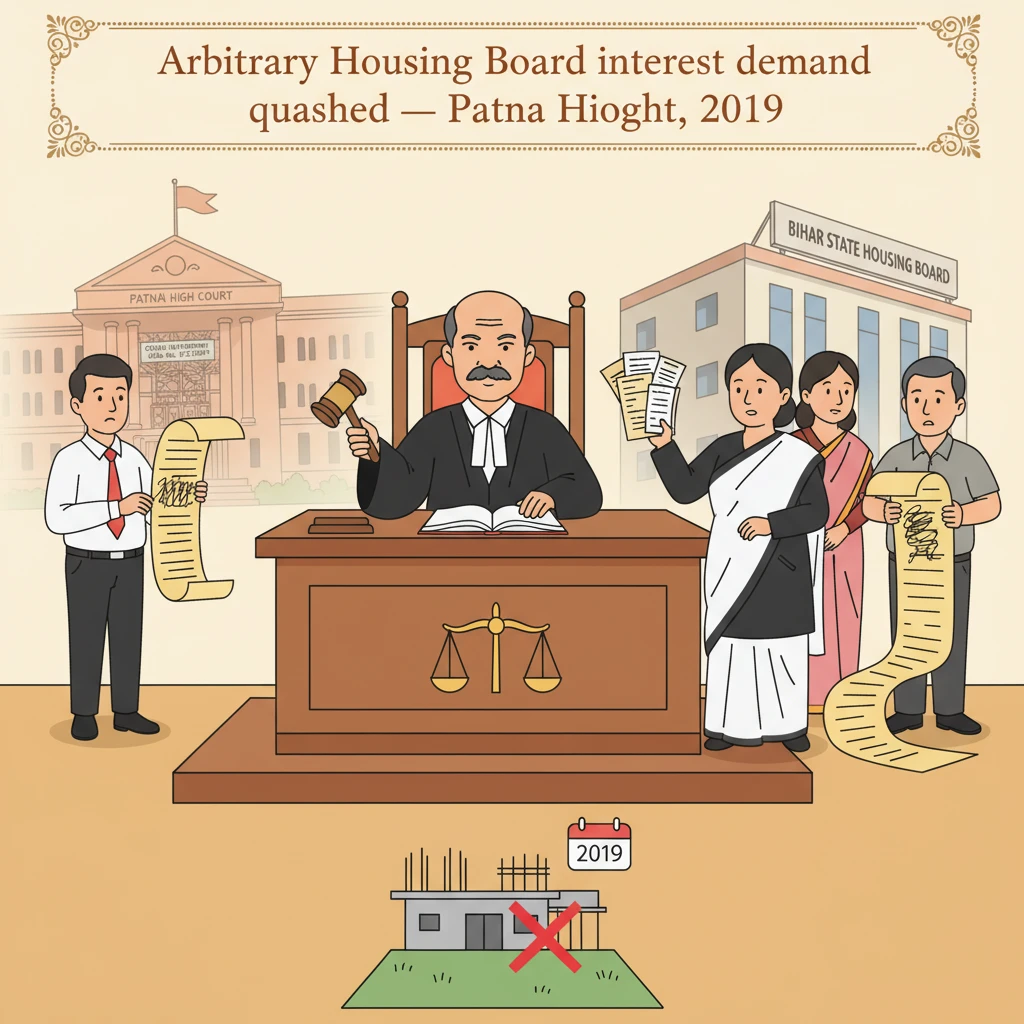
Case Background
The case arose from an auction purchase of a commercial plot in the Lohiya Nagar, Kankarbagh scheme of the Bihar State Housing Board.
The plot, numbered DS-30 and measuring about 7.30 katha, was put to public auction on 04.02.1984. The petitioner emerged as the highest bidder at a price of Rs. 9,00,000 on a hire purchase basis for a period of 66 years.
As required by the auction terms, the petitioner first deposited Rs. 10,000 as security. He then deposited Rs. 90,000 on 09.02.1984 and Rs. 1,25,000 on 27.03.1984, making up 25% of the bid amount. After this, the Board issued allotment letter no. 311 dated 06.06.1984 in his favour.
An agreement for allotment was executed on 25.02.1989 and registered on 16.03.1989. Possession of the plot was handed over to the petitioner on 26.08.1989, as admitted in the pleadings of both sides.
Under the hire purchase agreement, the remaining 75% of the price was to be paid in six equal half-yearly instalments with interest. The petitioner paid the instalments, and the last instalment of Rs. 1,50,000 was deposited on 18.11.1993. According to him he had paid the entire price and only registration of the final deed remained.
After paying all instalments, the petitioner repeatedly approached the Housing Board to complete the registration formalities. However, according to him, the Board remained inactive for years and did not finalise the issue.
Then, after about 19 years of silence, the Revenue Officer of the Bihar State Housing Board suddenly issued a notice dated 22.03.2012, demanding Rs. 1,11,01,844.43 as interest on the original plot price of Rs. 9,00,000. The petitioner immediately submitted a representation, enclosing his calculations and stating that no amount was due and the demand contained serious errors.
Despite this, on 27.11.2013 the Board issued another letter demanding Rs. 1,54,58,129.71 and threatened cancellation of the allotment if payment was not made. This led the petitioner to file Civil Writ Jurisdiction Case No. 672 of 2014 before the Patna High Court, seeking quashing of the demand and protection of his allotment.
What the Court Examined and Decided
Justice Anil Kumar Upadhyay heard the matter. The petitioner was represented by senior counsel, while the Housing Board was represented by its counsel.
The central complaint of the petitioner was that the Housing Board was trying to take advantage of its own long inaction and incompetence. He said that after he completed the payment in 1993, the Board did nothing for almost two decades, but later woke up and tried to impose a massive interest burden on him. He argued that this was wholly unjust and contrary to the hire purchase agreement.
On the other hand, the Housing Board filed three counter affidavits and tried to justify its stand by blaming the petitioner. It alleged that the petitioner had delayed execution of the agreement, delayed taking possession, and had not constructed on the plot within the time required by the agreement. The Board also claimed that it had periodically issued demand letters and reminders and that interest had accumulated because the petitioner did not pay the remaining dues in time.
In the first counter affidavit, the Board recited the basic terms of the agreement. The allottee had to pay 25% of the value upfront and the remaining 75% in six half-yearly instalments. Interest at 14% per annum was payable if each instalment was paid on or before the 15th day of the due month, and 18% if there was delay. Clause 8 allowed cancellation of allotment if two consecutive instalments were not paid.
The Board set out the deposit history: Rs. 10,000 (security) on 04.02.1984, Rs. 90,000 on 09.02.1984, Rs. 2,25,000 on 27.02.1984 (which appears to be a typographical or clerical discrepancy with the petitioner’s claim), followed by instalment payments of Rs. 1,25,000 on 27.09.1991, Rs. 2,50,000 on 02.06.1992, Rs. 1,50,000 on 22.10.1992 and Rs. 1,50,000 on 18.11.1993, totalling Rs. 6,75,000 in instalments.
Relying on its recalculations, the Board stated that by letter dated 03.01.2001 it had demanded Rs. 18,24,731 as on 31.01.2001 or Rs. 18,52,199 as on 28.02.2001 as the balance amount. Later, by letter dated 22.12.2011, it demanded Rs. 1,11,01,844.43 till December 2011. After the petitioner’s advocate sought details in 2013, a fresh figure of Rs. 1,47,57,185.78 as on August 2013 was raised. The impugned letter dated 27.11.2013 then demanded Rs. 1,54,58,129.71 as on December 2013 and threatened cancellation of allotment.
In the second supplementary counter affidavit, the Board disclosed how it arrived at an even higher figure. It said that after the last instalment of Rs. 1,50,000 on 18.11.1993, a principal amount of Rs. 7,05,962.04 remained. After adjusting the last instalment, Rs. 5,55,962.04 stood as principal on 01.12.1993. Capitalising this at 18% interest for 20 years and 1 month (till 31.12.2013) produced Rs. 1,54,58,129.71. Extending this calculation up to 31.01.2015, for one year and one month more, it claimed the total amount reached Rs. 1,85,14,201.95.
The Board also contended that a Pricing Committee had been constituted pursuant to earlier litigation (Smt. Suniti Sahay and another vs. Bihar State Housing Board) to deal with such disputes and decide the hike or price issues. It argued that the writ court was not the proper forum to calculate interest and that the dispute should either go to the Pricing Committee or to an arbitrator.
In the third supplementary counter affidavit, the Board gave a detailed chronology of letters issued from 1985 onwards, urging the petitioner to execute the agreement, take possession, submit approved building plans, and pay balance amounts. It asserted that the petitioner violated clause 13 of the agreement by not starting construction within two years of possession and completing it within a further three years.
The Court noted that despite several opportunities, the Housing Board kept shifting stands and inflating its demands. The matter lingered in court for five years. The Court recorded that it had earlier given the Board indulgence, expecting that it would come with clear facts and figures so the dispute could be settled. However, the Board continued to rely on varying calculations and did not provide a convincing legal basis for the giant increase of over Rs. 1.85 crore against an original price of Rs. 9 lakh.
Rejecting the Board’s suggestion to send the matter to arbitration or to the Pricing Committee, the Court observed that while expert bodies might be better suited to fix prices, the High Court is fully competent to examine patent illegality in the decision-making process.
The Court framed the real issue as not merely a dispute over calculation, but over the responsibility of public authorities like the Housing Board and their accountability when they themselves default and then load the citizen with interest for that default.
The judgment is strongly worded about the functioning of the Bihar State Housing Board. The Court observed that the Board was originally created to provide houses, land and flats and to promote planned development of towns, not to “mint money”. However, over the years, its functioning had turned into a “white elephant”, fomenting litigation rather than delivering housing. The Court said that in many cases, including this one, the Board kept the matter of final pricing pending for years and decades, and then raised arbitrary demands of interest while blaming the allottees.
Specifically in this case, the Court found that the Board took 19 years after the last instalment before awakening to raise a serious demand, and then sought to recover an astronomical amount by capitalising interest at high rates. The Court pointed out that the Board even asked allottees to supply copies of their own deposit receipts, which in normal course should be maintained by the Board itself. This, according to the Court, showed poor record management and shifting of responsibility onto citizens.
Justice Upadhyay recorded his inability, even by applying the test of a common man, to accept a demand of Rs. 1,85,14,201 in a case where the original auction price was Rs. 9 lakh. He held that, in the totality of circumstances, the demand was arbitrary.
The Court therefore quashed the demand of Rs. 1,85,14,201 raised by the Housing Board. It held that granting any further indulgence to the Board would be equivalent to giving a premium to its incompetence.
At the same time, the Court allowed limited scope for the Board. If the Managing Director feels that any amount is still unpaid towards the auction price, he may recalculate interest strictly in terms of the agreement, but only for the period up to the last date of instalment in 1993. This must be done after hearing the petitioner, and only simple interest can be charged, not penal or compound interest.
The Court directed that necessary corrective measures must be taken by the Managing Director within a maximum period of two months after the then ongoing general election, and that the remaining formalities for registration of the plot be completed.
Further, the Court emphasised that accountability within the Housing Board must be fixed for raising such arbitrary demands and for forcing allottees to come to court. It called upon the Managing Director to “put his house in order” and to identify those responsible for such conduct.
Why This Judgment Matters
This judgment is important for allottees of Bihar State Housing Board plots, flats or houses, particularly in Patna and surrounding areas.
First, it shows that the Patna High Court will not accept unreasonable and inflated interest demands that arise mainly because the Board delayed its own decisions for years. A public body cannot sleep over its duties and then ask ordinary citizens to pay for its inefficiency through massive interest.
Second, the judgment clearly says that in such situations the Board must act fairly, maintain its own records, and cannot push the entire burden onto allottees. Where necessary, courts will step in and declare such demands arbitrary.
Third, the Court has limited the Board’s power to recover interest. It can charge only simple interest, and only up to the last date of instalment, not for decades afterwards, and not at penal or compound rates without justification.
Finally, the judgment pushes for internal accountability within the Housing Board. It warns that officers cannot raise huge demands casually without facing consequences. This may influence how future demands are calculated and communicated to other allottees.
Legal Issues and Answers
- Issue: Whether the Bihar State Housing Board could lawfully demand over Rs. 1.85 crore as interest from an allottee whose original auction price was Rs. 9 lakh and whose instalments were completed in 1993, after decades of inaction by the Board.
Answer: No. The Patna High Court held the demand to be arbitrary and unjustified, quashed it, and restricted the Board to recalculating only simple interest up to 1993, if any amount was still due under the agreement. - Issue: Whether the Court should defer to the Board’s Pricing Committee or an arbitrator for resolving such disputes about interest and price fixation.
Answer: No. While experts may fix prices, the High Court is competent to examine patent illegality and arbitrariness in the Board’s actions. In this case, the Court declined to refer the matter elsewhere and itself decided the legality of the demand. - Issue: Whether the Housing Board could impose penal or compound interest for long periods arising from its own delays.
Answer: No. The Court directed that only simple interest, if any, strictly under the agreement and up to the last instalment date, may be recovered, and specifically ruled out penal or compound interest in this context.
Cases Cited by the Court
- The Board referred to the constitution of a Pricing Committee under the order dated 20.10.1995 of the Patna High Court in Smt. Suniti Sahay and another vs. The Bihar State Housing Board and another, CWJC No. 47 of 1994 with CWJC No. 2724 of 1994, as confirmed by the Supreme Court in order dated 11.04.1997 in SLP (C) No. 4331 of 1996. This was cited in the Board’s pleadings but not substantively relied upon by the Court for its reasoning in this case.
Case Details
Case Number: Civil Writ Jurisdiction Case No. 672 of 2014
Case Title: Manoj Kumar Bansal vs. The Bihar State Housing Board & Others
Court: High Court of Judicature at Patna
Coram: Hon’ble Mr. Justice Anil Kumar Upadhyay
Date of Judgment: 25.04.2019
Citation: 2019 (3) PLJR 298
Advocates:
For the Petitioner: Mr. S.D. Sanjay, Senior Advocate; Mr. Alok Kumar Agrawal, Advocate; Mrs. Priya Gupta, Advocate.
For the Respondents (Bihar State Housing Board): Mr. Ansuman Singh, Advocate.
Nature of the Case: Writ petition under Article 226 of the Constitution challenging a demand notice and threatened cancellation of allotment by the Bihar State Housing Board.
Link to Judgment: Click here to read the full judgment of the Patna High Court
If you found this explanation helpful and wish to stay informed about how legal developments may affect your rights in Bihar, you may consider following Samvida Law Associates for more updates.







