

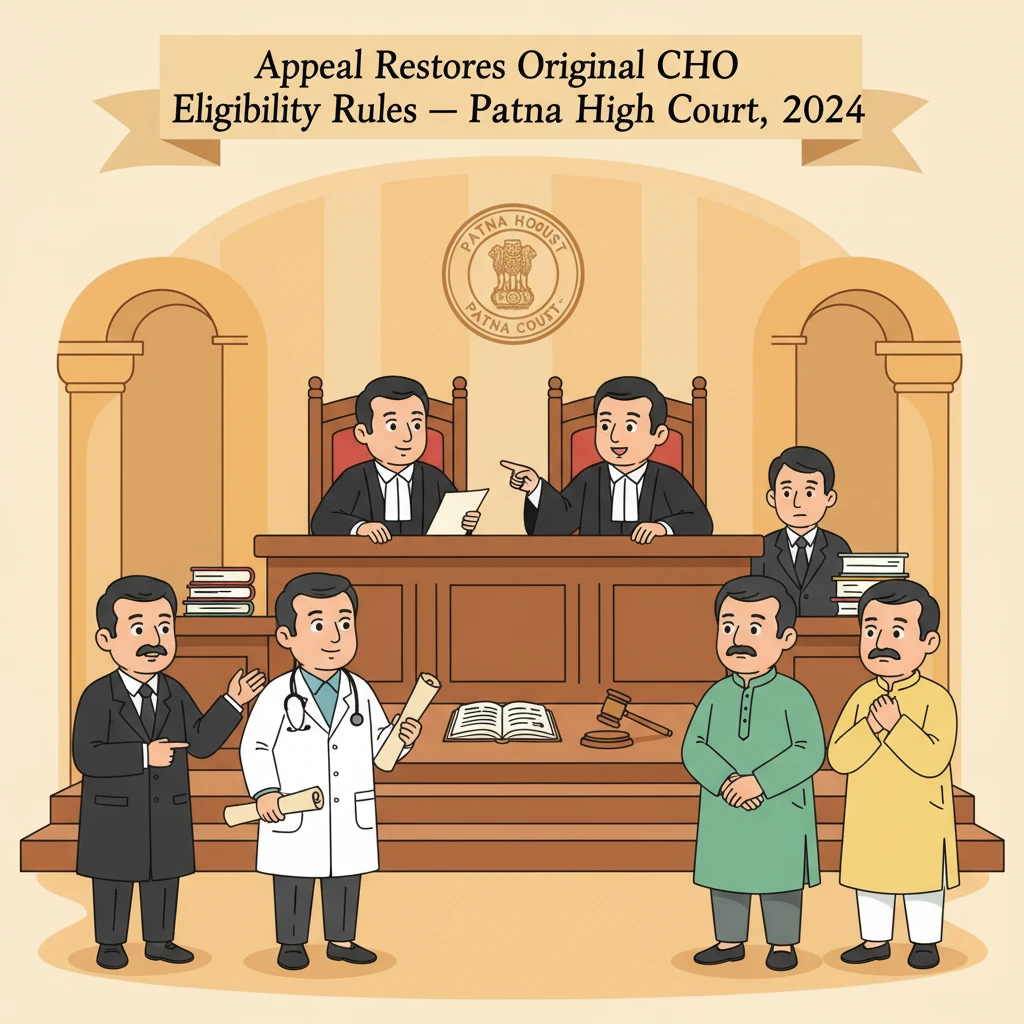
Case Background
The dispute arose from Advertisement No. 4 of 2019 dated 19.05.2019 issued for appointment of Community Health Officers (CHO) in Bihar.
The advertisement followed directives of the National Health Mission (NHM). Those directives allowed only candidates with qualifications in Ayurveda, B.Sc. Nursing and General Nursing and Midwifery (GNM) to apply for the six-month Certificate Programme in Community Health, which is compulsory for CHO posts.
Two writ petitions were filed before a learned Single Judge of the Patna High Court. One writ petition, CWJC No. 13410 of 2019, was filed by a Homeopathic doctor. The other, CWJC No. 15491 of 2019, was filed by an Unani practitioner. Both challenged their exclusion from the eligibility criteria for the six-month certificate course and consequently from the CHO posts.
During hearing of the writ petitions, the State Government made a concession before the learned Single Judge. The State said that even Unani practitioners and Homeopaths would be allowed to participate in the six months’ certificate course in Community Health under Advertisement No. 4 of 2019.
On the basis of this concession, the learned Single Judge allowed the writ petitions and permitted Unani and Homeopathic doctors to apply. This went beyond what the NHM guidelines had provided.
The advertisement process itself continued. Some candidates were selected, and the present appellant got placed in the waiting list. The appellant fell in the category originally permitted by NHM guidelines and by Advertisement No. 4 of 2019, and thus was directly affected by any expansion of eligibility.
None of these originally eligible candidates, who might lose out if more candidates were added, were made parties in the writ petitions. The appellant later came to know that, by virtue of the single judge order, Unani and Homeopathic doctors could now be considered, which could push him out of selection despite his waiting list position.
Feeling aggrieved, the appellant sought leave to file letters patent appeals against the single judge judgment in both writ petitions. The leave application, numbered I.A. No. 1 of 2022, was allowed by order dated 28.04.2023. The present appeals are LPA No. 585 of 2022 and LPA No. 586 of 2022, both arising from those writ petitions.
What the Court Examined and Decided
When the appeals were taken up, there was nearly three years’ delay in filing them. Through I.A. No. 3 of 2022 in both appeals, the appellant sought condonation of this delay of 2 years 11 months and 24 days.
The Division Bench first examined why the delay had occurred. It noted that the subject matter of the writ petitions was the eligibility of Unani and Homeopathic doctors to join the six-month Community Health course, which is required for Community Health Officer posts under NHM directions.
The NHM directives clearly limited eligibility to candidates with qualifications in Ayurveda, B.Sc. Nursing, and GNM. Advertisement No. 4 of 2019 also restricted CHO applications to persons with those qualifications, who on appointment were to undergo the six months’ certificate course in Community Health.
The Court recorded that the writ petitions were filed by a Homeopath and an Unani practitioner. Neither the appellant nor any other candidates who were admittedly eligible under the advertisement (Ayurveda, B.Sc. Nursing, GNM) were impleaded as parties, even though they would be directly affected if more categories were added.
The appellant discovered the expanded eligibility and the resulting risk to his own prospects only later, after the advertisement was acted upon and he had been placed in the waiting list. If Unani and Homeopathic candidates were included, his chance of actual appointment could be lost.
In this background, the Bench accepted that the delay in filing the appeal was sufficiently explained. It found that the circumstances, especially non-impleadment of directly affected candidates in the writ petitions, reasonably led to the late appeal. On this reasoning, the Bench condoned the delay in filing both appeals.
Turning to the merits, the Court closely looked at how the single judge judgment had been passed. The order rested on the State Government’s concession that Unani practitioners and Homeopaths would be allowed to apply under Advertisement No. 4 of 2019.
The Division Bench considered submissions of the learned Senior Counsel appearing for the State Health Society. It was pointed out that, after the single judge judgment, the State Health Society wrote to the National Health Mission on 09.11.2019 about the concession made in the High Court. The NHM responded on 17.12.2019. This response, produced as Annexure-5 in I.A. No. 4 of 2023, made the central position clear.
In its letter, the Ministry of Health and Family Welfare stated that only GNMs, B.Sc. Nursing graduates, Ayurveda practitioners, or B.Sc. in Community Health graduates are to be enrolled for the Certificate Programme in Community Health (CPCH) being offered by IGNOU or similar courses by State Health Universities. This decision was based on recommendations of an expert group.
In light of this, the Ministry advised the State Government to file a review against the single judge order. The State accordingly filed a review petition. In that review, an application for stay was rejected, leading to LPA No. 1 of 2021. In that earlier appeal, a Division Bench considered the matter and noticed the stand of the Central Government.
The Bench in LPA No. 1 of 2021 referred specifically to clause 4.1 of the “Ayushman Bharat; Comprehensive Primary Health Care through Health and Wellness Centres – Operational Guidelines”. Under clause 4.1, a Community Health Officer must be a B.Sc. in Community Health, or a GNM, or an Ayurveda practitioner, trained and certified through IGNOU or other State health and medical universities in public health and primary health care services.
However, in that earlier LPA, the Division Bench had limited itself to directing expeditious hearing of the review and listing it before an appropriate Bench. The review remained pending. Meanwhile, due to orders in the writ petition and the review, selections were held up. While rejecting stay in review, the Court had directed that the single judge judgment be complied with, further complicating the situation.
In the present appeals, the Bench carefully examined the NHM guidelines again. It concluded that the State Government could not add new qualifications for eligibility when the guidelines issued under the National Health Mission specified them exhaustively. The NHM, and through it the Central Government, alone had authority to fix eligibility for the Community Health course and CHO posts.
Therefore, the concession made by the State before the Single Judge—permitting Unani and Homeopathic practitioners to apply—was held to be legally inconsequential. The State could not override or expand the central guidelines through such a concession.
On maintainability, counsel for one of the respondents relied on an earlier Division Bench order (Annexure-1 in the counter of respondent no. 4) where an appeal by a non-party to the original proceeding had been refused. The present Bench noted that it did not have the full facts of that case. Importantly, it pointed out that in the current matter, the appellant had already obtained leave to appeal from a Division Bench of the Court.
The Bench reiterated the settled legal position: if a person who is a necessary party is not joined in a proceeding and an order passed in his absence prejudices him, he may appeal against that order, but only with the leave of the Court. Here, such leave had been granted in I.A. No. 1 of 2022. In addition, the appellant had shown specific prejudice: he was included in the waiting list, and selection had been stalled solely because of the orders based on the concession.
On this reasoning, the Bench rejected the respondents’ objection to maintainability. It held that the appeals were properly filed and maintainable since the appellant, a prejudiced necessary party, had obtained prior leave of the Court.
Returning to the core question of eligibility, the Bench reaffirmed that, under NHM guidelines, no additional categories could be introduced by the State. It stated that it was for the National Health Mission to set eligibility for the certificate course in Community Health. The role of the State was to follow those directions, not alter them.
The Court also recorded a submission made on behalf of the respondents that Unani is included within AYUSH. It acknowledged that AYUSH is a Central Government scheme covering various indigenous systems of medicine. But the Court emphasised that in this specific context, the certificate course guidelines themselves came from the Central Government and had explicitly excluded Unani practitioners and Homeopaths.
Because of this clear exclusion, the Court held that it could not declare Unani and Homeopathic practitioners eligible for the certificate course in Community Health. That policy decision lay with the Central Government and NHM, not with the State Government, and not with the Court in these appeals.
The Court also heard counsel for the Union of India, who had filed a counter affidavit supporting the appeal. This further confirmed the central stand that eligibility was confined to the categories listed in the NHM guidelines.
In the final analysis, the Division Bench allowed both LPAs and set aside the impugned single judge judgments in both writ petitions. It also stated that there can be no addition by the State to the eligibility conditions laid down by NHM. The Court left it to the State Health Society to immediately proceed with further selections in accordance with the original guidelines and Advertisement No. 4 of 2019.
Why This Judgment Matters
This judgment is important for all candidates applying to Community Health Officer posts under the National Health Mission.
First, it confirms that the State Government cannot, by making a concession in court or by its own decisions, change the eligibility conditions fixed by the Central Government or NHM guidelines. Only those qualifications listed in the official guidelines count.
Second, it protects candidates who applied in good faith under the original advertisement. If they are directly affected by a later change made without legal authority, they can challenge it, even if they were not parties in the original case, so long as they obtain leave to appeal.
Third, the judgment clears the way for the stalled selection process. The State Health Society can now move ahead with appointments based strictly on the national guidelines, giving clarity and finality to thousands of candidates.
Finally, for doctors from systems of medicine not included in the guidelines, the judgment makes it clear that any change in eligibility must come from the Central Government and NHM, not from the State or from judicial directions contrary to those guidelines.
Legal Issues and Answers
- Issue: Can Unani and Homeopathic doctors be made eligible, through a State Government concession or court order, to join the six-month Community Health course and compete for Community Health Officer posts under Advertisement No. 4 of 2019?
Answer: No. The Patna High Court held that eligibility is strictly governed by NHM and Central Government guidelines, which include only B.Sc. in Community Health, GNM, B.Sc. Nursing and Ayurveda practitioners. The State cannot add new categories, and the single judge order doing so was set aside. - Issue: Is a letters patent appeal maintainable by a person who was not a party to the original writ petition but is directly affected by the order expanding eligibility?
Answer: Yes. Where a necessary party is not impleaded and is prejudiced by an order, that person can file an appeal with leave of the Court. In this case, leave had already been granted, and the appeals were held to be maintainable. - Issue: Should the delay of almost three years in filing the appeals be condoned?
Answer: Yes. The Court accepted that the appellant learned of the prejudice later, that originally eligible candidates were not made parties to the writ petitions, and that these circumstances satisfactorily explained the delay, which was therefore condoned.
Cases Cited by the Court
- The Division Bench referred to an earlier LPA No. 1 of 2021 and to clause 4.1 of the “Ayushman Bharat; Comprehensive Primary Health Care through Health and Wellness Centres – Operational Guidelines”. No specific reported judicial precedent was cited by name in the text of this judgment.
Case Details
Case Numbers: Letters Patent Appeal No. 585 of 2022 and Letters Patent Appeal No. 586 of 2022, arising out of Civil Writ Jurisdiction Case No. 15491 of 2019 and Civil Writ Jurisdiction Case No. 13410 of 2019.
Case Title: Dr. Sudhir Kumar v. The State of Bihar & Ors. (in both LPAs, with different private respondents in each connected matter).
Coram: Hon’ble the Chief Justice K. Vinod Chandran and Hon’ble Mr. Justice Partha Sarthy.
Date of Judgment: 22.08.2024.
Citation: 2024 (4) PLJR 30.
Advocates (LPA No. 585 of 2022): For the appellant: Mr. Parijat Saurav, Advocate; Mr. Prashant Sinha, Advocate. For the State respondents: Mr. S.D. Yadav, AAG-9; Mr. Braj Bhushan Mishra, AC to AAG-9; Md. Anisur Rahman, Advocate; Md. Akram Naiyar, Advocate. For the Health Committee: Mr. P.K. Shahi, Senior Advocate; Mr. K.K. Sinha, Advocate. For the Union of India: Mrs. Sarita Bajaj, Advocate.
Advocates (LPA No. 586 of 2022): For the appellant: Mr. Parijat Saurav, Advocate; Mr. Prashant Sinha, Advocate. For the State respondents: Mr. S.D. Yadav, AAG-9; Mr. Braj Bhushan Mishra, AC to AAG-9. For the Health Committee: Mr. P.K. Shahi, Senior Advocate; Mr. K.K. Sinha, Advocate. For the Union of India: Mrs. Sarita Bajaj, Advocate.
Nature of the Case: Letters patent appeals against a single judge judgment in writ petitions concerning eligibility criteria for selection and training of Community Health Officers under National Health Mission guidelines.
Link to Judgment: Click here to read the full Patna High Court judgment
If you found this explanation helpful and wish to stay informed about
how legal developments may affect your rights in Bihar,
you may consider following Samvida Law Associates for more updates.







