

Case Background
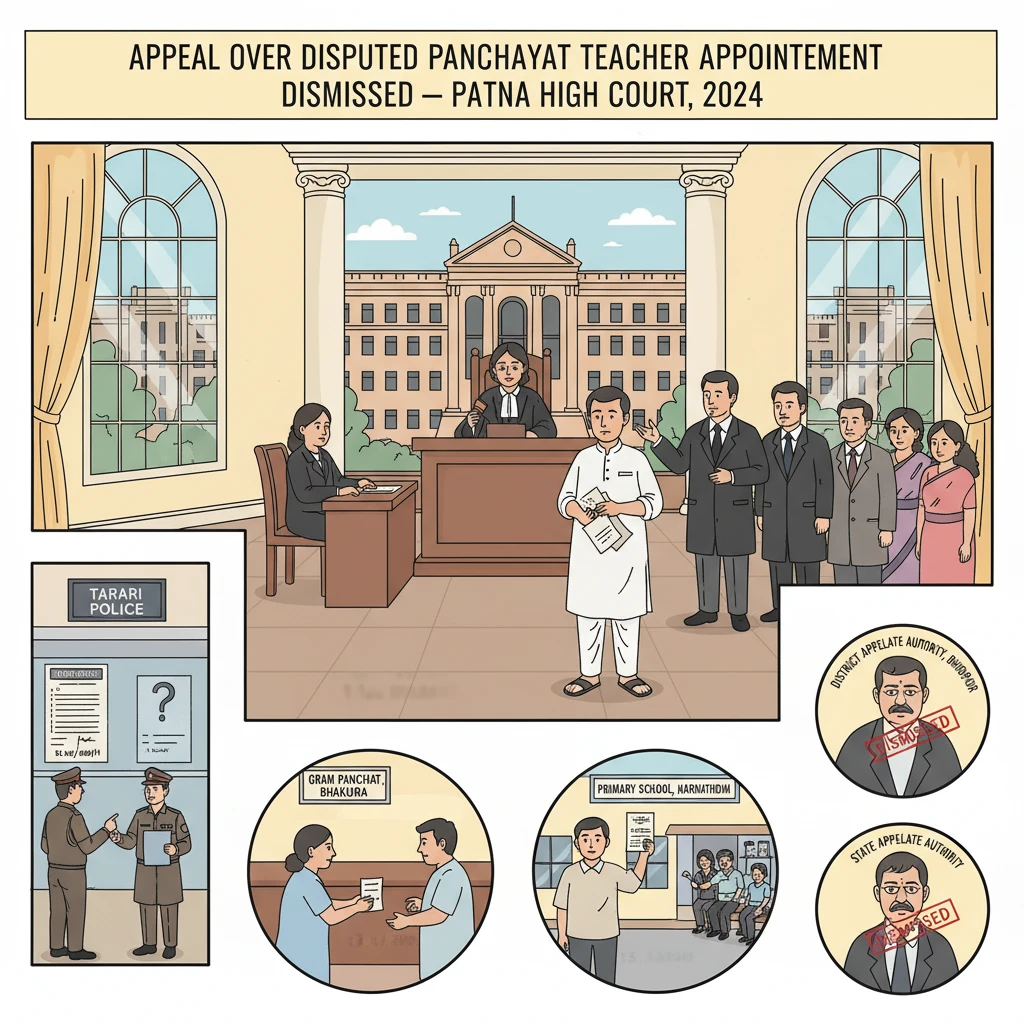
The dispute centres around appointments to the post of Panchayat Teachers in Gram Panchayat, Bhakura, Block Tarari, District Bhojpur.
According to the appellant, applications were invited for these posts. He claimed that he was eligible, submitted his application and was given a receipt dated 17.11.2008. He further claimed that he was called for counselling along with others, and that an appointment letter dated 13.8.2010 was issued to him.
The appellant stated that when he went to Primary School, Harnathdih to join, the Headmaster refused to accept his joining. The Headmaster allegedly told him that other teachers had already joined on the direction of the Panchayat Secretary and the Mukhiya of the Gram Panchayat.
Feeling aggrieved, the appellant says he approached the Appellate Tribunal. When no action was allegedly taken, he moved the Patna High Court in CWJC No. 9954 of 2012. That writ petition was disposed of because he had an alternative statutory remedy of approaching the Tribunal.
The appellant then filed an appeal before the District Appellate Authority, Bhojpur. It was registered as Appeal No. 93(A) of 2012. The Presiding Officer of the District Appellate Authority dismissed this appeal by order dated 15.6.2015.
The appellant challenged this order before the State Appellate Authority. His appeal was registered as Appeal No. 589 of 2017. The State Appellate Authority also disallowed his appeal by order dated 28.8.2019.
The appellant then filed CWJC No. 8542 of 2022 before a Single Judge of the Patna High Court, challenging the State Appellate Authority’s order. On 29.6.2022, the learned Single Judge dismissed the writ petition, mainly on the ground that there were disputed questions of fact which could not be examined in writ jurisdiction.
The present Letters Patent Appeal No. 388 of 2022 was filed by the appellant challenging the order dated 29.6.2022 of the learned Single Judge. This appeal was heard by a Division Bench consisting of Hon’ble the Chief Justice and Hon’ble Mr. Justice Partha Sarthy, who delivered the judgment on 04.10.2024.
What the Court Examined and Decided
The Division Bench first noted the appellant’s main grievance: he claimed that he was duly selected as a Panchayat Teacher, issued an appointment letter dated 13.8.2010, but was prevented from joining by the school authorities. According to him, this was done because others had already been allowed to join on the instructions of the Panchayat Secretary and Mukhiya.
The appellant’s counsel argued that the District Appellate Authority, the State Appellate Authority and the learned Single Judge all failed to properly appreciate the available evidence showing that the appellant had participated in the selection process. It was contended that it was wrong to say that the case involved disputed questions of fact that could not be gone into in writ jurisdiction. On this basis, the appellant asked the Division Bench to set aside the impugned orders and allow the appeal.
On the other hand, the State and other respondents opposed the appeal. They pointed out that the appellant approached the High Court for the first time in CWJC No. 9954 of 2012 more than two years after appointment letters had been issued and other candidates had joined their posts.
The respondents highlighted that the appellant’s claims had already been examined and rejected by both the District Appellate Authority and the State Appellate Authority. The District Appellate Authority had dismissed his appeal on 15.6.2015 and the State Appellate Authority had disallowed Appeal No. 589 of 2017 on 28.8.2019.
The respondents also pointed out that the appellant had earlier filed CWJC No. 5158 of 2016, which was disposed of with liberty to approach the State Appellate Authority. After the State Appellate Authority’s decision went against him, he filed CWJC No. 8542 of 2022, which too was dismissed. They argued that there was no merit remaining in the matter and that the present Letters Patent Appeal should also be dismissed.
The Division Bench then carefully considered the factual position as recorded in the earlier proceedings. It noted that applications were invited for the selection and appointment of Panchayat Teachers in Gram Panchayat, Bhakura. The appellant along with others had submitted applications.
However, on the respondent side, the picture was very different. According to the respondents, the original records of appointment were lost in 2011. The Panchayat Secretary had reported on 1.12.2011 to the Officer In-charge, Tarari, Bhojpur that the records had been lost on 30.11.2011. Based on this report, a sanha (DE No/009/11) was registered at the police station on 1.12.2011.
It was the specific stand of the Panchayat Secretary that the appellant had never participated in the employment process. In contrast, the private respondents (arrayed as respondent nos. 10 to 13) had duly appeared for counselling and were issued appointment letters dated 13.8.2010 and 14.8.2010. They had joined their respective schools on the strength of those letters.
While the matter was before the District Appellate Authority, the appellant and some others produced four appointment letters, all bearing the same letter no. 01 dated 13.8.2010. By comparison, the appointment letters produced by the private respondents carried different memo numbers, suggesting that their documents were part of a regular issuance process.
The appellant was unable to explain how four separate appointment letters could all have exactly the same letter number 01 with the same date. The respondents asserted that the documents produced by the appellant were interpolated and forged, and that the appellant had never taken part in the selection process at all.
This raised a core factual dispute: whether the appellant was ever selected or appointed, and whether the appointment letters he relied upon were genuine or forged. To resolve this, a court would have to examine original records, test the documents, and perhaps even take evidence.
The Division Bench noted that the District Appellate Authority had already considered these aspects. Because the original appointment records had gone missing and a police report had been lodged about their loss, the Authority did not find it safe to rely on photocopies produced by the appellant, especially when their genuineness was under serious doubt.
In these circumstances, the District Appellate Authority dismissed the appellant’s application. The State Appellate Authority later upheld this decision, agreeing that the appellant’s claim could not be accepted on the basis of photocopies that appeared doubtful and were contradicted by the respondents’ version.
The learned Single Judge, when considering CWJC No. 8542 of 2022, accepted the findings of the District and State Appellate Authorities. The Single Judge held that the matter involved disputed questions of fact which could not be effectively adjudicated in writ proceedings under Article 226 of the Constitution of India.
The Division Bench, after hearing both sides in the Letters Patent Appeal, agreed with this approach. It held that:
First, the case clearly involved serious disputed facts. Whether the appellant participated in counselling, whether he was appointed, and whether his appointment letter was fake or genuine were all strongly contested issues.
Second, the original records were missing and a police entry had already been made about their loss. In such a situation, relying merely on photocopies produced by the appellant, particularly when their numbering was suspicious, was not safe.
Third, the District and State Appellate Authorities had already made factual findings against the appellant after considering the material placed before them. There was no reason to interfere with these factual findings in writ jurisdiction.
Fourth, writ jurisdiction under Article 226 is not meant for conducting a mini-trial on facts or for deciding whether a particular document is forged or genuine. Such questions require detailed evidence, cross-examination and examination of records, which are not ordinarily undertaken in writ proceedings.
On this reasoning, the Division Bench concluded that the learned Single Judge had committed no illegality in dismissing the writ petition. The Division Bench also found no merit in the Letters Patent Appeal.
Accordingly, the appeal was dismissed and the order of the learned Single Judge was affirmed. As a result, the appellant did not get any relief regarding the alleged Panchayat Teacher appointment.
Why This Judgment Matters
This judgment is important for candidates involved in government or Panchayat recruitment disputes, particularly in Bihar.
It shows that where there is a serious dispute about basic facts — such as whether someone was actually selected, or whether an appointment letter is genuine or forged — the Patna High Court will be slow to grant relief in writ jurisdiction.
The Court emphasised that photocopies of documents, especially when their numbering or contents create suspicion, may not be accepted as proof when original records are missing and there are allegations of forgery.
For candidates, this underlines the need to keep proper original documents and to act promptly when any dispute arises. Delayed challenges, based mainly on doubtful photocopies, may not succeed.
For authorities, the judgment endorses the approach of relying on formal inquiries and police reports when original records are lost, and it supports their decisions when higher forums find no clear legal error.
Legal Issues and Answers
- Issue: Can the Patna High Court, in writ jurisdiction, decide a recruitment dispute where there are serious factual controversies about participation in selection and genuineness of appointment letters, especially when original records are missing?
Answer: No. The Court held that such disputed questions of fact, including allegations of forgery, cannot be satisfactorily examined in writ proceedings. The factual findings of the District and State Appellate Authorities were accepted and the writ, and then the appeal, were dismissed. - Issue: Was there any illegality in the learned Single Judge’s refusal to interfere with the decisions of the District and State Appellate Authorities rejecting the appellant’s claim of appointment as Panchayat Teacher?
Answer: No. The Division Bench found no illegality or infirmity in the order of the learned Single Judge and upheld the dismissal of the writ petition, thereby rejecting the Letters Patent Appeal.
Cases Cited by the Court
- No previous judgments are expressly cited or relied upon in the text of this decision.
Case Details
Case Number: Letters Patent Appeal No. 388 of 2022 in Civil Writ Jurisdiction Case No. 8542 of 2022
Case Title: Krishna Kumar v. The State of Bihar & Ors.
Citation: 2024(4) PLJR 559
Coram: Hon’ble the Chief Justice K. Vinod Chandran and Hon’ble Mr. Justice Partha Sarthy
Advocates: Mr. Ashwani Kumar Tiwary, Advocate for the appellant; Smt. Shilpa Singh, GA-12 for the respondents; Mr. Ram Vinay Pd. Singh, AC to GA-12 for the respondents; Mr. Apurva Kumar, Advocate for the respondents
Date of Judgment: 04.10.2024
CAV Date: 18.09.2024
Nature of the Case: Letters Patent Appeal against dismissal of writ petition arising from rejection of claim for appointment as Panchayat Teacher by District and State Appellate Authorities
Link to Full Judgment: Click here to read the full Patna High Court judgment
If you found this explanation helpful and wish to stay informed about
how legal developments may affect your rights in Bihar,
you may consider following Samvida Law Associates for more updates.







