

Case Background
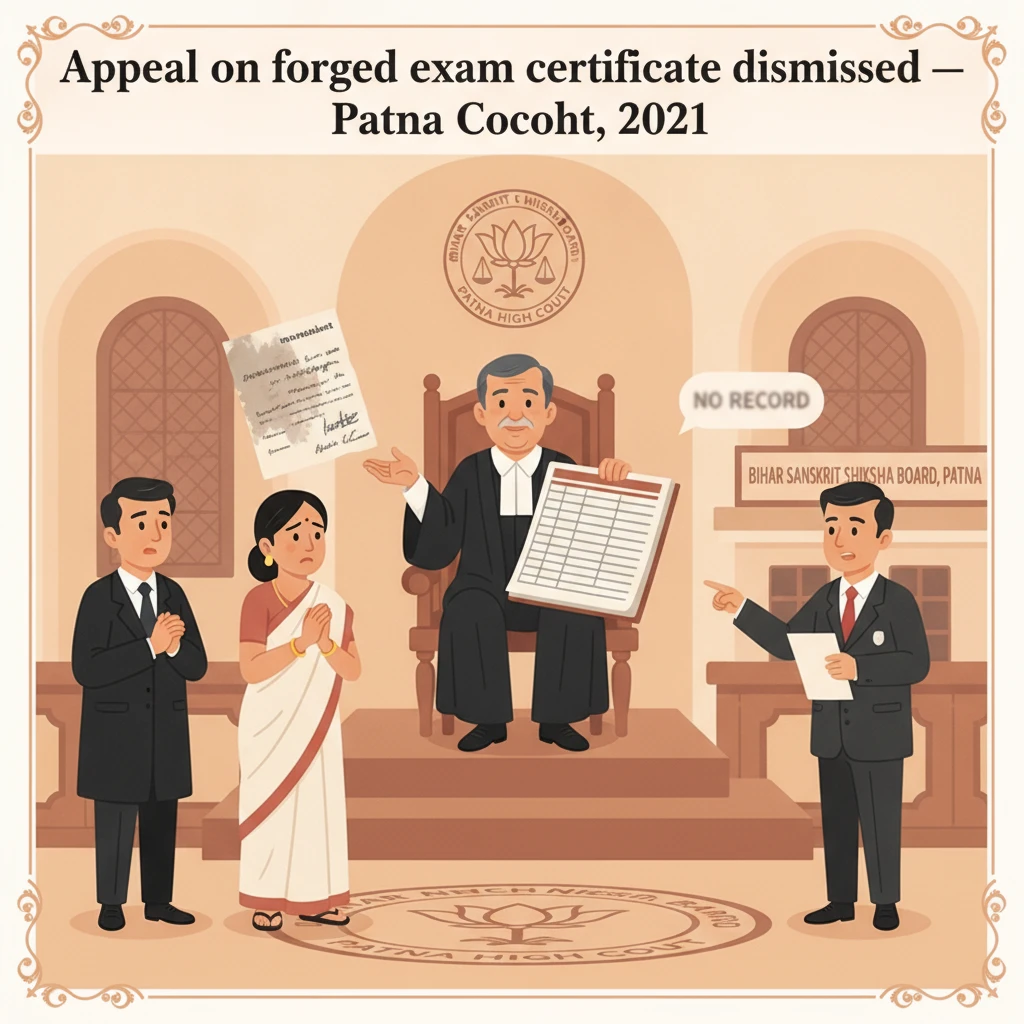
The appellant was a student of Madhyama in Baidic Sahitya Sanskrit High School, Attasarai, Nalanda. The Madhyama examination is conducted by the Bihar Sanskrit Shiksha Board, Patna.
According to her, she appeared in the Madhyama Examination, 2000 and passed in First Division. She stated that she received a marksheet, a provisional certificate and a school leaving certificate from the school.
Later, she applied for the post of Anganwari Sevika. On the basis of the merit list, she was selected for the post. At the time of joining, she was asked to produce her original Madhyama certificate issued by the Bihar Sanskrit Shiksha Board.
When she demanded the original certificate from the Board, the Board replied that no candidate with her name had appeared in the examination. The Board further stated that the roll number quoted by her belonged to another candidate, one Kumari Shalinta Suman.
Feeling aggrieved, she filed a writ petition under Article 226 of the Constitution of India before the Patna High Court. She sought quashing of an order dated 23 November 2012 (Annexure-4), by which the Board had rejected her request for issuance of the original certificate for the Madhyama course.
The learned Single Judge, after examining the original registers of the Board, dismissed the writ petition on 29 October 2015. The present Letters Patent Appeal was filed challenging that judgment.
What the Court Examined and Decided
The Division Bench, comprising Hon’ble the Chief Justice and Hon’ble Mr. Justice Prabhat Kumar Singh, first noted that the appeal arose from the dismissal of the writ petition in C.W.J.C. No. 12764 of 2013. In that petition, the appellant had asserted that she had lawfully passed the Madhyama Examination, 2000 and was entitled to receive the original certificate from the Bihar Sanskrit Shiksha Board.
The central dispute was factual: whether she had actually appeared in the examination, and whether the roll number and documents she relied upon were genuine.
In the writ proceedings, the learned Single Judge had directed the Bihar Sanskrit Shiksha Board to produce the original register of candidates for the year 2000. This register contained entries of roll numbers, registration numbers, names of students, schools and marks.
The Board produced the original register in Court. The relevant entries were shown both to the Court and to the counsel for the petitioner. The learned Single Judge recorded that the counsel for the petitioner reacted in a very unprofessional manner, making accusations against the Board and its counsel. The Single Judge considered this reaction as a response to being “cornered on false pleadings and assertions” made to obtain relief.
After personally verifying the register, the Single Judge found it authentic. The entries were sequential, without cutting, overwriting or insertion. The Court held that the Board’s stand in its counter affidavit was fully corroborated by the original register.
The register showed that the roll number claimed by the petitioner actually belonged to another candidate, Kumari Shalinta Suman. The Single Judge concluded that the petitioner had tried to use a forged or fabricated xerox copy of an admit card or marksheet to obtain a marksheet that did not belong to her.
The Single Judge also observed that the admit card relied upon by the petitioner contained overwriting, which indicated a deliberate effort at interpolation by her or on her behalf. It was further noted that her sister had been a candidate in the same examination, and that interpolations appeared to have been made based on the sister’s documents.
On these findings, the Single Judge held that the petitioner’s conduct was condemnable and that she did not deserve any benefit or relief in such controversial circumstances. The writ petition was, therefore, dismissed.
When the matter came up in appeal, the Division Bench considered not only the earlier findings but also developments during the appeal. On 24 September 2019, a Coordinate Bench had passed an interim order calling for deeper scrutiny of the Board’s records.
In that interim order, the Court recounted the appellant’s claim that she had done Madhyama through Vaidic Sahitya Sanskrit High School with roll number 127, Code 64, Registration No. 1029 of 2000, and that she had been shown as having passed in First Division with issuance of marksheet and provisional certificate.
The Court compared this claim with the information from the Board that roll number 127 belonged to Kumari Shalinta Suman, a student of Nari Gyan Bharti Sanskrit High School, Bharti Gram, Nalanda. It also noted the appellant’s assertion that she and her sister had both studied at Vaidic Sahitya Sanskrit High School, with roll numbers 127 and 128 respectively.
On examining the original record/register of marks, the interim order recorded several irregularities:
First, the name of Kumari Shalinta Suman appeared at two different serial numbers, 127 and 163, both with the same registration number 483 of 2000. Second, there was no mention of any person with registration number 1029 of 2000, which the appellant claimed as hers. Third, another student with registration number 1092 of 2000 appeared at two places (serial numbers 185 and 221), with different names but the same registration number.
These observations led the Court to doubt the authenticity of the records maintained by the Bihar Sanskrit Shiksha Board. At the same time, the Board’s counsel maintained that the admit card produced by the appellant was fake, as it contained cutting and overwriting.
The interim order directed the Board to file an affidavit clarifying which registration and roll numbers were allotted to Vaidic Sahitya Sanskrit High School and Nari Gyan Bharti Sanskrit High School, and specifically to state to whom Registration No. 1029 of 2000 was allotted. The Court also asked the Board to explain why the registration numbers in the register were not in sequence but appeared in a jumbled manner, and to clarify whether any certificate or marksheet was issued to Kumari Shalinta Suman.
During the pendency of the appeal, the Court also obtained a report from the Vigilance Department. This report, dated 6 January 2021, was received in a sealed cover and opened during the hearing of the appeal. The operative part of the report, in Hindi, indicated that wrong entries had been deliberately made in the general tabulation register to show the appellant in place of the original candidate, and that responsible Board officials and private persons were involved in this act.
The Vigilance report found that in the general tabulation register, at roll number 127, the name of the appellant of Baidic Sahitya Sanskrit Uchcha Vidyalaya, Attasarai, Nalanda, was wrongly recorded in place of the actual candidate, roll number 163, Kumari Shalinta Suman of Nari Gyan Bharti Sanskrit Uchcha Vidyalaya, Bharti Gram, Nalanda.
The report concluded that certain Board officials had misused their position to show Kumari Shalinta Suman as having passed in First Division. It recommended registration of a criminal case under Sections 467, 468, 471 of the Indian Penal Code and Section 13(2) read with Section 13(1)(d) of the Prevention of Corruption Act, 1988 (as amended in 2018) against the concerned officials and private persons.
The Division Bench summarised the Vigilance report by stating that the investigation revealed the documents relied upon by the appellant were not issued by the Bihar Sanskrit Shiksha Board, Patna. It also noted the recommendation for filing of an FIR against erring officers/officials of the Board as well as private parties.
In light of these materials, the Division Bench held that no case for interference was made out with the Single Judge’s judgment. The Court accepted that the appellant’s claim to the Madhyama certificate was unsupported by genuine Board records, and that the documents pressed by her were not authentic.
Going a step further, the Court directed the Vigilance Department to forthwith register a First Information Report in relation to the alleged forged record prepared by the institution imparting education to the appellant, officers/officials of the Bihar Sanskrit Shiksha Board, and any private parties involved in the process.
Counsel for the Vigilance Department assured the Court that the FIR would be registered within two working days. Counsel for the Vigilance and for the State also undertook to communicate the order to the Director General of Police, Bihar, the same day.
With these directions, the Letters Patent Appeal was disposed of. Any interlocutory applications in the appeal were also disposed of.
Why This Judgment Matters
This judgment highlights how seriously the Patna High Court treats misuse of educational records. The Court did not grant relief just because the appellant claimed to be a victim; instead, it insisted on verifying original registers and official records.
For students and job applicants, the case shows that using forged or altered admit cards, marksheets or certificates can lead not only to loss of employment opportunities but also to criminal investigation.
For education boards and schools, the decision sends a clear message that maintaining accurate examination records is critical. Any manipulation of registers and result sheets, whether by officials or private persons, may attract prosecution for forgery and corruption.
By directing registration of an FIR, the Patna High Court has also clarified that courts will not ignore evidence of criminal wrongdoing that surfaces in the course of civil or writ proceedings, especially where public faith in examination systems is at stake.
Legal Issues and Answers
- Issue: Was the appellant entitled to a direction to the Bihar Sanskrit Shiksha Board to issue an original Madhyama Examination, 2000 certificate in her favour?
Answer: No. The Court found, on the basis of the Board’s original register and the Vigilance report, that the appellant was not shown as a candidate in the examination and that the documents relied upon by her were not issued by the Board. - Issue: Should the High Court interfere with the Single Judge’s order dismissing the writ petition seeking quashing of the Board’s refusal letter dated 23 November 2012?
Answer: No. The Division Bench held that no case for interference was made out and upheld the Single Judge’s findings on the authenticity of the records and the petitioner’s conduct. - Issue: What action should follow once apparent forgery and manipulation of examination records are discovered in the course of the case?
Answer: The Court directed the Vigilance Department to register an FIR against the institution, concerned officials of the Bihar Sanskrit Shiksha Board and any private parties involved, for offences under the Indian Penal Code and the Prevention of Corruption Act.
Cases Cited by the Court
- The judgment does not expressly cite or rely upon any previous case law.
Case Details
Case Number: Letters Patent Appeal No. 107 of 2016 in Civil Writ Jurisdiction Case No. 12764 of 2013
Case Title: Sudha Kumari vs. The Chairman, Bihar Sanskrit Shiksha Board, Patna & Ors.
Citation: 2022 (3) PLJR 52
Court: High Court of Judicature at Patna
Coram: Hon’ble the Chief Justice; Hon’ble Mr. Justice Prabhat Kumar Singh
Date of Judgment: 21-01-2021
Advocates:
- For the Appellant: Mr. Bindhyachal Singh, Advocate; Mr. Umesh Kumar, Advocate
- For the State of Bihar: Mr. Mukund Mohan Jha, AC to GP-27
- For the Vigilance Department: Mr. Anil Singh, Advocate
- For Bihar Sanskrit Shiksha Board: Mr. S. S. Sundaram, Advocate
- For Respondent No. 6: Mr. Rabindra Pd. Singh, Advocate
Nature of the Case: Letters Patent Appeal against dismissal of writ petition under Article 226 of the Constitution of India
Link to Judgment: Patna High Court Judgment Link
If you found this explanation helpful and wish to stay informed about how legal developments may affect your rights in Bihar, you may consider following Samvida Law Associates for more updates.







