

Case Background
The dispute arises out of an agreement to sell two kathas of land in Patna district. The defendant was the undisputed owner of the suit land. He needed money and was willing to sell.
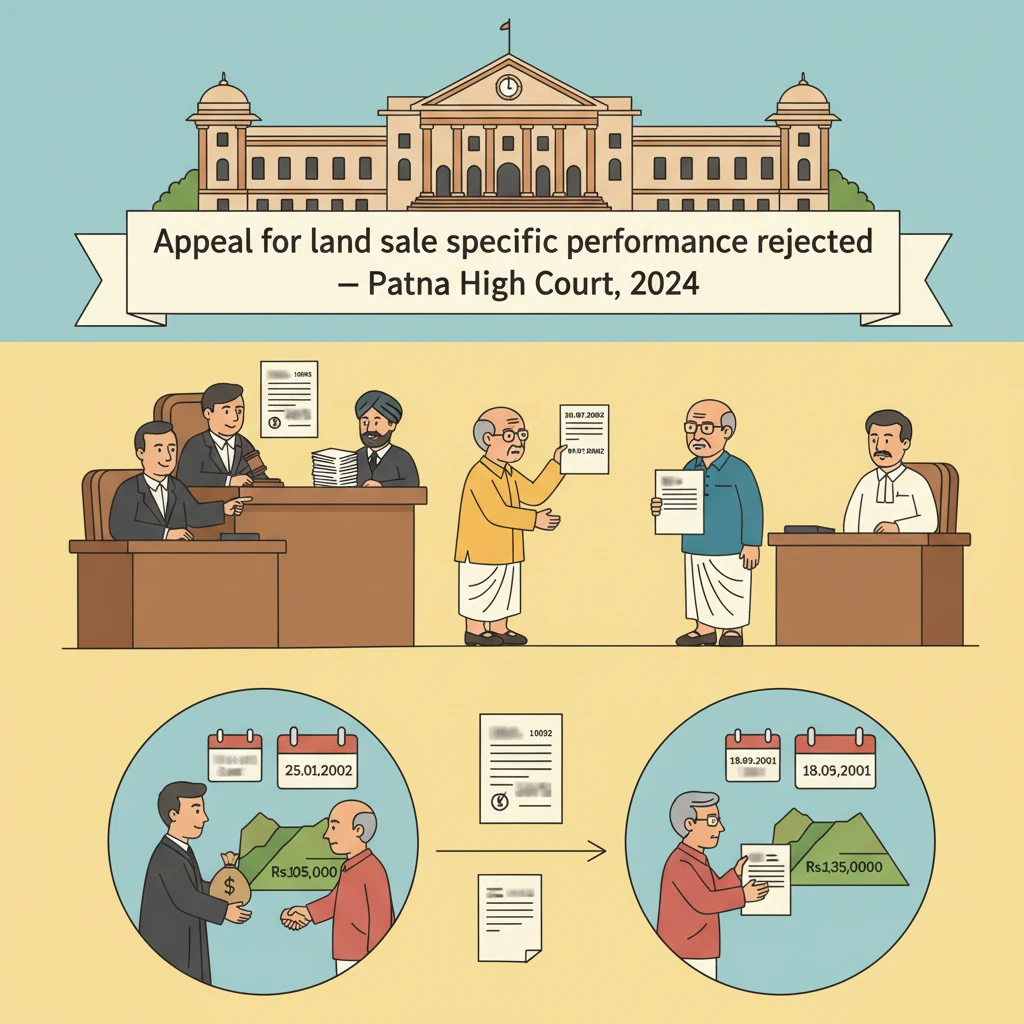
The plaintiff claimed that the defendant agreed to sell the two kathas at Rs.1,05,000 per katha, that is, for a total of Rs.2,10,000. According to the plaintiff, an agreement for sale was executed on 25.01.2002. On that date, the plaintiff said he paid Rs.60,000 as advance (bai beyana), with the balance to be paid within six months. The defendant was also to obtain permission under the Urban Land Ceiling Act and assured that the land was free from defects and encumbrances.
The plaintiff stated that he repeatedly requested the defendant to execute the sale deed and was always ready with the remaining amount. He issued a legal notice on 09.07.2002 asking the defendant to receive the balance and execute and register the sale deed by 25.07.2002.
The defendant replied on 16.07.2002 through his lawyer. In this reply he asserted that the sale price had actually been fixed at Rs.1,35,000 per katha, totalling Rs.2,70,000, and that an agreement for sale was executed earlier, on 18.09.2001. He alleged that the plaintiff later, by misrepresentation and fraud, got another document dated 25.01.2002 prepared at the reduced rate of Rs.1,05,000 per katha.
The plaintiff, through his advocate, gave a further reply on 12.08.2002, denying the earlier agreement and insisting that he remained ready to pay the balance of Rs.1,50,000 under the 25.01.2002 agreement. On 13.09.2002, the defendant again replied through his lawyer, accusing the plaintiff of avoiding execution of the sale deed and reiterating that Rs.1,05,000 per katha was the then market value.
According to the plaintiff, the defendant kept postponing execution and registration of the sale deed on frivolous grounds and stated that no permission from the Urban Land Ceiling authority was required. Claiming that the defendant had violated the agreement though the plaintiff was always ready and willing to perform his part, the plaintiff filed a suit for specific performance based on the alleged agreement dated 25.01.2002.
The defendant’s stand in the written statement was different. He pleaded that the suit was not maintainable, barred by Section 34 of the Specific Relief Act, estoppel, waiver, acquiescence and limitation. He stated that the agreement was actually executed on 18.09.2001 at Rs.1,35,000 per katha, total Rs.2,70,000, that Rs.60,000 was paid as advance on that date and that the document was prepared in duplicate. The defendant claimed he was always ready to execute the sale deed upon payment of the remaining Rs.2,10,000, but the plaintiff kept avoiding payment.
According to the defendant, when the plaintiff could not arrange the balance and the six-month period from 18.09.2001 was about to expire, the plaintiff requested extension. Trusting him, the defendant signed the document dated 25.01.2002 only for extending time, and no payment was made on that day. He denied executing a fresh agreement at a reduced price on 25.01.2002.
The trial court framed eleven issues, including the question whether the agreement was executed on 18.09.2001 or 25.01.2002, what rate was agreed, whether the 25.01.2002 document was valid, and whether the plaintiff was entitled to specific performance. After evidence, the trial court held that the genuine agreement was the one dated 18.09.2001, that the price was Rs.1,35,000 per katha, and that the 25.01.2002 document was only an extension misused to alter the rate and hence invalid. The suit was dismissed, though the plaintiff was given liberty to recover the advance of Rs.60,000 in accordance with law.
The plaintiff appealed to the Patna High Court under Section 96 CPC in First Appeal No.15 of 2008 against this judgment and decree dated 29.11.2007 of the Subordinate Judge IV, Patna in Title Suit No.35 of 2004 (15 of 2006).
What the Court Examined and Decided
Justice Sunil Dutta Mishra heard both sides. For clarity, the parties were referred to as plaintiff and defendant, their positions before the trial court. Defendant’s sons, who were minor at the time of the suit, had by then become major.
The High Court considered three main points together:
(i) whether the bai beyana agreement regarding the suit land was executed on 18.09.2001 at Rs.1,35,000 per katha or on 25.01.2002 at Rs.1,05,000 per katha; (ii) whether the plaintiff was entitled to a decree of specific performance on the basis of the 25.01.2002 agreement; and (iii) whether the trial court was justified in dismissing the suit.
On evidence, seven witnesses were examined for the plaintiff and ten for the defendant. Both sides produced documents. The plaintiff relied mainly on the notice dated 09.07.2002, the original agreement dated 25.01.2002 (Exhibit 2), the reply notice, and an application. The defendant relied on the 18.09.2001 agreement (Exhibit E), signatures of parties and witnesses on that agreement (Exhibits A, D, D/1, D/2), the reply notice, a medical prescription and a photocopy of the 25.01.2002 deed marked for identification.
There was no dispute that the defendant owned the suit land, that some agreement for sale had been executed, and that Rs.60,000 had been paid to the defendant as advance. It was also admitted that the defendant had made endorsements and signatures on both the 18.09.2001 and 25.01.2002 documents.
The High Court noted a crucial part of the plaintiff’s own cross-examination. In paragraph 20, the plaintiff (PW 3) admitted that the signature on the 18.09.2001 agreement was made in his presence and he identified the defendant’s signature (Exhibit A). This supported the defendant’s case that the agreement of 18.09.2001 was genuine.
Further, in paragraph 25 of his cross-examination, the plaintiff admitted that the original 25.01.2002 agreement carried signatures of Santosh Kumar and Chandeshwar Rai, but their signatures were missing in the photocopy (Mark X). This inconsistency created doubt over the genuineness of Exhibit 2.
The plaintiff also stated in his cross-examination that he had withdrawn money from his bank account to pay Rs.60,000, but he did not produce any passbook or proof, nor explained the failure to do so. On sale consideration rate, he admitted that the defendant initially demanded Rs.1,50,000 per katha, while he offered Rs.90,000, and a mediator Radhe Shyam was present. The Court observed that Rs.1,35,000 per katha was closer to Rs.1,50,000 than Rs.1,05,000, making the defendant’s version more probable.
The trial court had reasoned that for extension of six months’ time, the already paid Rs.60,000 might have been deducted from the total Rs.2,70,000, leaving Rs.2,10,000 at Rs.1,05,000 per katha, and signatures taken on 25.01.2002 were then misused to treat this as a fresh lower-price agreement. The High Court found this reasoning acceptable.
The Court also observed that Radhe Shyam, the mediator, was not made a witness on the agreement, but other persons like Santosh Kumar, Chandeshwar Rai and Samrendra were. Samrendra appeared as a witness on both agreements. Overall, the Court agreed with the trial court that the plaintiff failed to prove that Exhibit 2 was a valid and legal agreement for sale. Instead, Exhibit E dated 18.09.2001 was held to be the original valid agreement with consideration of Rs.2,70,000 for two kathas.
On the legal objection raised by the defendant about the agreements being unregistered, the High Court clarified the law. Relying on Supreme Court judgments such as R. Hemlata v. Kashturi (2023 SCC OnLine 381) and K.B. Saha and Sons Pvt. Ltd. v. Development Consultant Ltd. ((2008) 8 SCC 564), the Court held that even an unregistered agreement for sale can be received in evidence for a suit for specific performance. The bar under Section 49 of the Registration Act applies mainly to claims under Section 53-A of the Transfer of Property Act, not to suits for specific performance. Thus, the defendant’s argument that the documents were inadmissible for want of registration was rejected.
However, the Court stressed that mere signature on a document is not sufficient; if the executant says that the document is not what he contemplated, it amounts to denial of execution. The real question remained whether the plaintiff had proved a valid enforceable agreement and his own readiness and willingness.
On readiness and willingness, the Court referred to several Supreme Court decisions including N.P. Thirugnanam v. Dr. R. Jagan Mohan Rao ((1995) 5 SCC 115), P. Ravindranath v. Sasikala (2024 SCC OnLine SC 1749), U.N. Krishnamurthy v. A.M. Krishnamurthy (2022 SCC OnLine SC 840) and His Holiness Acharya Swami Ganesh Dassji v. Sita Ram Thapar ((1996) 4 SCC 526). These cases explain that specific performance is a discretionary, equitable remedy; the plaintiff must continuously prove financial capacity and readiness to perform his part from the date of agreement till the final decree; and bald assertions without evidence do not suffice.
Applying these principles, the Court held that the plaintiff had not proved that he was ready and willing to pay the balance consideration under the genuine agreement dated 18.09.2001, i.e., Rs.2,10,000. He never agreed to pay this amount in his pleadings or conduct. His case was built entirely on the disputed 25.01.2002 document and the lower rate, which the Court found invalid.
The Court further noted the delay. The six-month period from the agreement had long expired, and the plaintiff filed the suit only on 04.02.2004. Citing K.S. Vidyanadam v. Vairavan ((1997) 3 SCC 1) and Saradamani Kandappan v. S. Rajalakshmi ((2011) 12 SCC 18), the Court observed that even if limitation is three years, purchasers cannot sit idle and then seek specific performance; courts “frown upon” suits not filed promptly after breach or refusal. The plaintiff offered no explanation for this delay, which weighed against him in an equitable remedy.
On the argument that the agreement was signed only by the vendor, the Court relied on Aloka Bose v. Parmatma Devi (AIR 2009 SC 1527). It held that in India, even an oral agreement of sale is valid, and a written agreement signed by one party and accepted by the other can be specifically enforced. Thus, lack of buyer’s signature by itself would not invalidate a sale agreement. The problem in this case was not absence of the plaintiff’s signature, but lack of proof that the 25.01.2002 agreement was genuine.
The Court also emphasised the equitable principle that a person seeking relief must come with clean hands. It found that the plaintiff had suppressed the earlier agreement dated 18.09.2001, amounting to lack of candour. The defendant had reposed faith in him, and the plaintiff took advantage of the situation to secure signatures on a document benefiting him. The Court accepted the defendant’s plea that this was a case of fraud, and that the plaintiff had not approached the Court with clean hands.
In the end, the High Court agreed with the trial court’s finding that the true agreement was executed on 18.09.2001 at Rs.1,35,000 per katha, that the alleged 25.01.2002 agreement could not be enforced, that the plaintiff had failed to show readiness and willingness, and that the suit for specific performance had been rightly dismissed.
While observing that equity would demand return of the admitted advance of Rs.60,000, the Court noted that the plaintiff had not asked for such a relief in the suit or appeal. Hence even that relief could not be granted in this proceeding, though the trial court had rightly granted him liberty to recover the advance in accordance with law.
Finding no reason to interfere, the High Court confirmed the impugned judgment and decree of the trial court and dismissed the appeal. Each party was directed to bear its own costs. Pending applications were disposed of.
Why This Judgment Matters
This judgment is important for anyone entering into agreements for sale of land, especially in Bihar. It shows that courts will look closely at what actually happened, not just what is written in a later document.
If a buyer suppresses earlier agreements or tries to take advantage of a seller’s trust, the court can refuse the strong remedy of specific performance, even if some document favours the buyer. The Patna High Court made it clear that a person asking the court to force a land sale must act honestly and promptly.
The judgment also explains that simply saying “I was ready to pay” is not enough. The buyer must show with conduct and circumstances that he could and would pay the balance amount under the real agreement, and must move the court without unnecessary delay after breach.
For landowners and buyers alike, this decision highlights the need to keep all agreements transparent, avoid manipulating documents, and to seek legal relief in time. It also shows that even if specific performance is refused, a buyer can still be allowed separately to recover the advance paid.
Legal Issues and Answers
Issue: Was the genuine agreement for sale executed on 18.09.2001 at Rs.1,35,000 per katha, or on 25.01.2002 at Rs.1,05,000 per katha?
Answer: The Court held that the valid and original agreement was dated 18.09.2001 with consideration of Rs.1,35,000 per katha (total Rs.2,70,000). The 25.01.2002 document was treated as an improper alteration of terms and not a valid, enforceable agreement.
Issue: Was the plaintiff entitled to specific performance of the alleged agreement dated 25.01.2002?
Answer: No. The plaintiff failed to prove the genuineness of the 25.01.2002 agreement, failed to show continuous readiness and willingness to pay the agreed consideration under the genuine 18.09.2001 agreement, delayed in filing suit, and approached the Court without clean hands. Hence specific performance was refused.
Issue: Was the trial court justified in dismissing the suit for specific performance?
Answer: Yes. The Patna High Court affirmed that the trial court had correctly appreciated the evidence and law, rightly held against the plaintiff on key issues, and properly dismissed the suit while leaving the plaintiff at liberty to recover the advance money in accordance with law.
Cases Cited by the Court
- R. Hemlata v. Kashturi, 2023 SCC OnLine 381
- K.B. Saha and Sons Pvt. Limited v. Development Consultant Limited, (2008) 8 SCC 564
- N.P. Thirugnanam (D) by LRs v. Dr. R. Jagan Mohan Rao & Ors., (1995) 5 SCC 115
- P. Ravindranath & Anr. v. Sasikala & Ors., 2024 SCC OnLine SC 1749
- U.N. Krishnamurthy (since deceased) through LRs v. A.M. Krishnamurthy, 2022 SCC OnLine SC 840
- His Holiness Acharya Swami Ganesh Dassji v. Sita Ram Thapar, (1996) 4 SCC 526
- K.S. Vidyanadam & Ors. v. Vairavan, (1997) 3 SCC 1
- Saradamani Kandappan v. S. Rajalakshmi & Ors., (2011) 12 SCC 18
- Basavaraj v. Padmavathi & Anr., (2023) 4 SCC 239
- Ramrati Kuer v. Dwarika Prasad Singh, AIR 1967 SC 1134 : 1967 (1) SCR 153
- Indira Kaur & Ors. v. Sheo Lal Kapoor, (1988) 2 SCC 488
- Beemaneni Mahalakshmi v. Gangumalla Appa Rao (since dead) by LRs, (2019) 6 SCC 233
- Aloka Bose v. Parmatma Devi & Ors., AIR 2009 SC 1527
Case Details
Case Number: First Appeal No.15 of 2008; arising out of Title Suit No.35 of 2004 (15 of 2006)
Case Title: Radha Krishna Prasad v. Ram Bilas Prasad & Ors.
Citation: 2024 (4) PLJR 672
Coram: Hon’ble Mr. Justice Sunil Dutta Mishra
Advocates:
- For the appellant: Mr. V.M.K. Sinha, Advocate; Mr. Ajay Prasad, Advocate; Mr. Ajit Kumar, Advocate
- For the respondents: Mr. Shashi Nath Jha, Advocate; Mr. Sunny Kumar, Advocate
Nature of the case: First appeal under Section 96 of the Code of Civil Procedure against a decree dismissing a suit for specific performance of contract for sale of immovable property.
Date of High Court Judgment: 21.10.2024
Trial Court Judgment and Decree: 29.11.2007, Subordinate Judge IV, Patna
Link to judgment: Patna High Court Judgment – FA No.15 of 2008
If you found this explanation helpful and wish to stay informed about how legal developments may affect your rights in Bihar, you may consider following Samvida Law Associates for more updates.







