
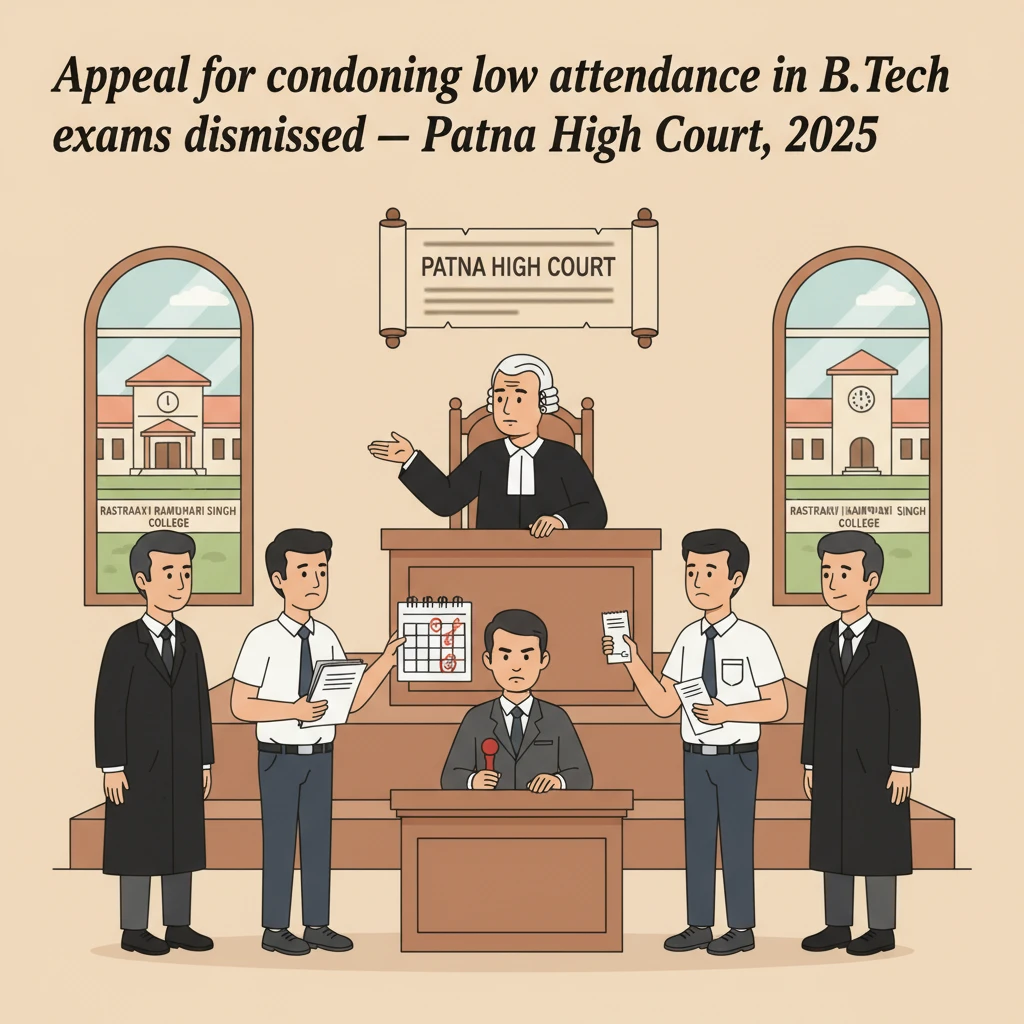
Case Background
The dispute arose from the academic sessions of B.Tech students studying under Bihar Engineering University, Patna.
One appellant, Shubham Kumar, was a B.Tech (Computer Science) student of the 2021–2025 session at Rastrakavi Ramdhari Singh College of Engineering, Begusarai. The other appellant, Shashikesh Kumar, was a B.Tech (Civil Engineering) student of the 2022–2026 session at Darbhanga College of Engineering, Darbhanga. Both colleges are affiliated to Bihar Engineering University.
Both appellants were debarred from filling up their University examination forms on the ground of shortage of attendance. According to them, appellant Shubham Kumar was debarred under a Notification dated 04.01.2024 (Annexure-D), bearing letter no. RRSDCE/EC/2024/001. Appellant Shashikesh Kumar was debarred vide Notification dated 19.09.2023 (Annexure-F), bearing letter no. 1325, issued by administrative order.
The appellants approached the High Court earlier through Civil Writ Jurisdiction Case No. 3571 of 2024. A learned Single Judge dismissed their writ petition by judgment and order dated 13.02.2025, upholding the University’s action and the mandatory 75% attendance requirement.
Aggrieved by that decision, the appellants filed Letters Patent Appeal No. 380 of 2025 and Letters Patent Appeal No. 409 of 2025 before a Division Bench of the Patna High Court, challenging the rejection of their prayer for condonation of attendance shortage, permission to sit in examinations, and alleged discrimination.
What the Court Examined and Decided
The Division Bench considered in detail the reliefs sought before the learned Single Judge, which were reiterated in the present appeals.
The appellants had asked for a mandamus to direct the respondents to conduct a re-examination of the second semester for the academic year 2021–22 for their batch. They further sought condonation of the 75% minimum attendance requirement on the ground that they faced “unfortunate and special circumstances” during the academic period, permission to appear in future examinations, and a declaration that the notifications debarring them were arbitrary and discriminatory.
They also questioned why, according to them, a special examination was arranged for failed students but not for them, despite no specific rules on such special exams. They claimed that different colleges under the same University were using different standards of attendance, which they said violated equality under the Constitution.
On facts, the appellants’ main narrative was built around the medical illness of appellant Shashikesh Kumar. He claimed to have suffered from jaundice between 25.07.2023 and 16.09.2023. He produced medical documents (Annexure-I series) to show that he was under treatment during that period. Due to this illness, he could not regularly attend classes. He argued that his absence was not voluntary and should have been condoned by the college and University.
The appellants also relied on the fact that the college and University had accepted certain payments and forms from them. In particular, appellant Shashikesh Kumar was allowed to submit his examination form along with fee of Rs. 3,700/-, accepted by the University on 20.09.2023, under Exam Form No. 111/943 (Annexure-H). He was also allowed to deposit annual fee and was issued a receipt dated 30.12.2023 for Rs. 200/- (Annexure-I).
Based on these transactions, the appellants argued that once the University accepted the examination form and fee, it created a legitimate expectation that he would be allowed to sit in the end-semester examination. Debarring him later purely on attendance grounds, they said, was arbitrary and caused irreparable harm to his academic career.
The appellants further contended that there was violation of natural justice. They claimed that no prior notice or show-cause notice was served upon appellant Shashikesh Kumar, and even his parents were not informed about the shortage of attendance before he was debarred. They argued that this denial of opportunity to explain his absence rendered the action illegal and unfair.
On discrimination, the appellants referred to an official order (Annexure-B) issued by the college authorities, by which names of students with attendance shortage were included in a list and they were restrained from filling up examination forms. They asserted that while they were stopped from appearing in exams for not having 75% attendance, some other students from a junior batch (Session 2022–26) with even lower attendance were allowed to fill forms and appear, and their results were published. For this, they relied on Annexure-K series.
They claimed that this different treatment under the same University amounted to “hostile discrimination” and was in violation of Articles 14 and 21 of the Constitution of India.
On the other side, the respondents, representing the University and colleges, placed strong reliance on the regulations of the All India Council for Technical Education (AICTE). These AICTE regulations had been adopted by Bihar Engineering University and by the Department of Science and Technology, Government of Bihar.
Under these regulations, a student must have a minimum of 75% attendance to be eligible to appear in the semester examinations. The respondents clearly stated that there is no discretion or enabling provision under the University regulations for condonation of attendance shortage on grounds such as medical illness or otherwise.
Even if appellant Shashikesh Kumar’s illness was accepted as genuine, they argued, a statutory requirement cannot be overridden on sympathetic or equitable grounds. According to the record, the appellants had attendance of only 34% and 26%, which was far below the mandatory 75% threshold, making them ineligible to take the exam.
The respondents also denied the allegation that the students were suddenly debarred. They pointed out that repeated notices were issued to all students regarding shortage of attendance. Remedial classes were conducted, and students, including the appellants, were asked to improve their attendance. Administrative Order dated 09.09.2023 (Annexure-E) informed the appellants about their shortage of attendance, and by order dated 19.09.2023 (Annexure-G), appellant no. 2 was debarred from appearing in the mid-sessional test.
Later, after deposit of examination fees (Annexure-H series), he was permitted to fill the examination form. However, this permission, according to the respondents, did not mean that attendance shortage was condoned. The statutory eligibility condition remained, and hence he could still be disqualified from actually appearing in the exam.
On the charge of discrimination, the respondents submitted that the appellants had not produced any authentic material showing that similarly situated students with less than 75% attendance were allowed to appear in examinations. They claimed that no student with less than 75% attendance was allowed to sit for exams, and the reliance on Annexure-B and Annexure-K was vague and unverified.
The respondents further cited the Supreme Court judgment in Basawaraj and Another v. Special Land Acquisition Officer, (2013) 14 SCC 81. In that decision, the Supreme Court held that Article 14 of the Constitution does not recognize “negative equality” and cannot be used to extend an illegality or mistake done in one case to others. Wrong benefits mistakenly given to someone else do not create a legal right in favour of others.
The Division Bench framed two clear issues: first, whether the appellants had shown any valid or special ground for relaxing the 75% mandatory attendance requirement; and second, whether they had proved that similarly placed students in other colleges or under the same University were allowed to appear without fulfilling the 75% criteria.
On the first issue, the Bench held that the appellants had failed to demonstrate any convincing or exceptional ground for condonation. Even assuming the medical documents about jaundice were genuine, the Court held that medical certificates cannot override a statutory requirement of 75% attendance. The Court stressed that when the rule is clear and explicit, sympathetic considerations or equitable grounds cannot be used to defeat it.
The Court also clarified that payment of fees and permission to fill up examination forms did not amount to condoning the attendance shortage. These acts were administrative and could not change the statutory eligibility condition.
The Court relied on the Supreme Court judgment in Ashok Kumar Thakur v. University of Himachal Pradesh, AIR 1973 SC 221. In that case, the Supreme Court had observed that even if the Court sympathises with a student, it cannot direct an authority to do something beyond its legal power, such as condoning attendance when regulations do not permit it. Sympathy cannot allow the Court to ignore the law.
On the second issue, related to alleged discrimination, the Bench examined Annexure-B and Annexure-K relied upon by the appellants. It found them to be unverified letters that did not show any authoritative or binding University decision granting relaxation of attendance to others. No specific names, attendance records, or official orders had been produced to prove that other students, similarly short of 75% attendance, were allowed to appear.
The Court held that mere assertions, unsupported by reliable documents, cannot sustain a plea of discrimination. The learned Single Judge had already considered these aspects and found that the appellants’ attendance was less than 50% and far short of the mandatory 75%. The Single Judge also relied on the Supreme Court decisions in Ashok Kumar Thakur, All India Student Federation (2019 (3) PLJR 727), and Basawaraj, and had held that courts cannot compel condonation of attendance shortage and Article 14 cannot be invoked to demand parity in illegality.
The Division Bench agreed fully with these findings. It held that the requirement of 75% attendance is statutory and binding. Condonation beyond the permissible limit cannot be extended where attendance is actually below 75%. The fact that the appellants had deposited fees or were allowed to fill forms did not create any vested right to appear contrary to law.
The Bench found that the authorities had applied a uniform criterion in line with regulations. There was no material indicating a different standard in other colleges. No error of law or fact was shown in the judgment of the learned Single Judge.
Accordingly, in exercise of Letters Patent jurisdiction, the Court found no ground to interfere. Both Letters Patent Appeals were dismissed, and the earlier judgment dated 13.02.2025 in C.W.J.C. No. 3571 of 2024 was affirmed, with no order as to costs.
Why This Judgment Matters
This judgment is important for students of Bihar Engineering University and other technical institutions following AICTE norms.
It clearly states that the 75% attendance rule for appearing in semester examinations is mandatory. Even serious illness, genuine medical documents, or sympathy from the Court cannot override a clear statutory requirement, especially where attendance is far below the prescribed limit.
The judgment also sends a strong message about the limits of “equality” arguments. Students cannot demand the same illegal benefit that might have been given to someone else. Courts will not extend one wrong decision to others in the name of Article 14.
For students and parents, this decision shows that regular attendance is not a formality. Paying fees, filling forms, or attending some later classes will not save a student who has already fallen far below the minimum attendance required.
Legal Issues and Answers
-
Issue: Can the Court or the University relax the mandatory 75% attendance requirement for appearing in engineering semester examinations on sympathetic or medical grounds?
Answer: No. The 75% attendance requirement, adopted under AICTE regulations, is statutory and binding. Courts cannot direct condonation beyond what the regulations permit, and medical certificates or sympathy cannot override the explicit rule. -
Issue: Did the appellants prove that similarly placed students with less than 75% attendance were allowed to appear in exams, so as to claim discrimination or equal treatment?
Answer: No. The appellants failed to produce authentic and reliable evidence such as official orders or records of other students. Unverified letters were insufficient, and therefore, the plea of discrimination was rejected. -
Issue: Does acceptance of examination fees and forms by the University create a right or legitimate expectation to appear in the exam despite lack of attendance?
Answer: No. Acceptance of fees and forms is administrative and does not amount to condonation of attendance shortage. It cannot override the statutory eligibility condition of 75% attendance.
Cases Cited by the Court
- Ashok Kumar Thakur v. University of Himachal Pradesh, AIR 1973 SC 221
- All India Student Federation, 2019 (3) PLJR 727
- Basawaraj and Another v. Special Land Acquisition Officer, (2013) 14 SCC 81
Case Details
Case Number: Letters Patent Appeal No. 380 of 2025 and Letters Patent Appeal No. 409 of 2025, arising out of C.W.J.C. No. 3571 of 2024
Case Title: Shashikesh Kumar v. The Vice-Chancellor, Bihar Engineer University & Ors; Shubham Kumar v. The Vice Chancellor, Bihar Engineering University & Ors
Coram: Hon’ble The Acting Chief Justice P. B. Bajanthri and Hon’ble Mr. Justice Alok Kumar Sinha
Citation: 2025(4) PLJR 548
Advocates:
In Letters Patent Appeal No. 380 of 2025:
- For the Appellant(s): Mr. Hari Shankar Roy, Advocate
- For the Respondent(s): Mr. P.K. Shahi, Senior Advocate; Mr. Satyam Shivam Sundaram, Advocate; Mr. Ankit, Advocate; Mr. Aman Kumar, Advocate
In Letters Patent Appeal No. 409 of 2025:
- For the Appellant(s): Mr. Hari Shankar Roy, Advocate
- For the Respondent(s): Mr. P.K. Shahi, Senior Advocate; Mr. Satyam Shivam Sundaram, Advocate; Mr. Ankit, Advocate; Mr. Aman Kumar, Advocate
Nature of the Case: Letters Patent Appeals against the judgment and order dated 13.02.2025 passed in a writ petition (Civil Writ Jurisdiction Case No. 3571 of 2024), concerning debarment of students from appearing in B.Tech semester examinations due to shortage of attendance.
Link to the Judgment: Patna High Court Judgment
If you found this explanation helpful and wish to stay informed about
how legal developments may affect your rights in Bihar,
you may consider following Samvida Law Associates for more updates.







