
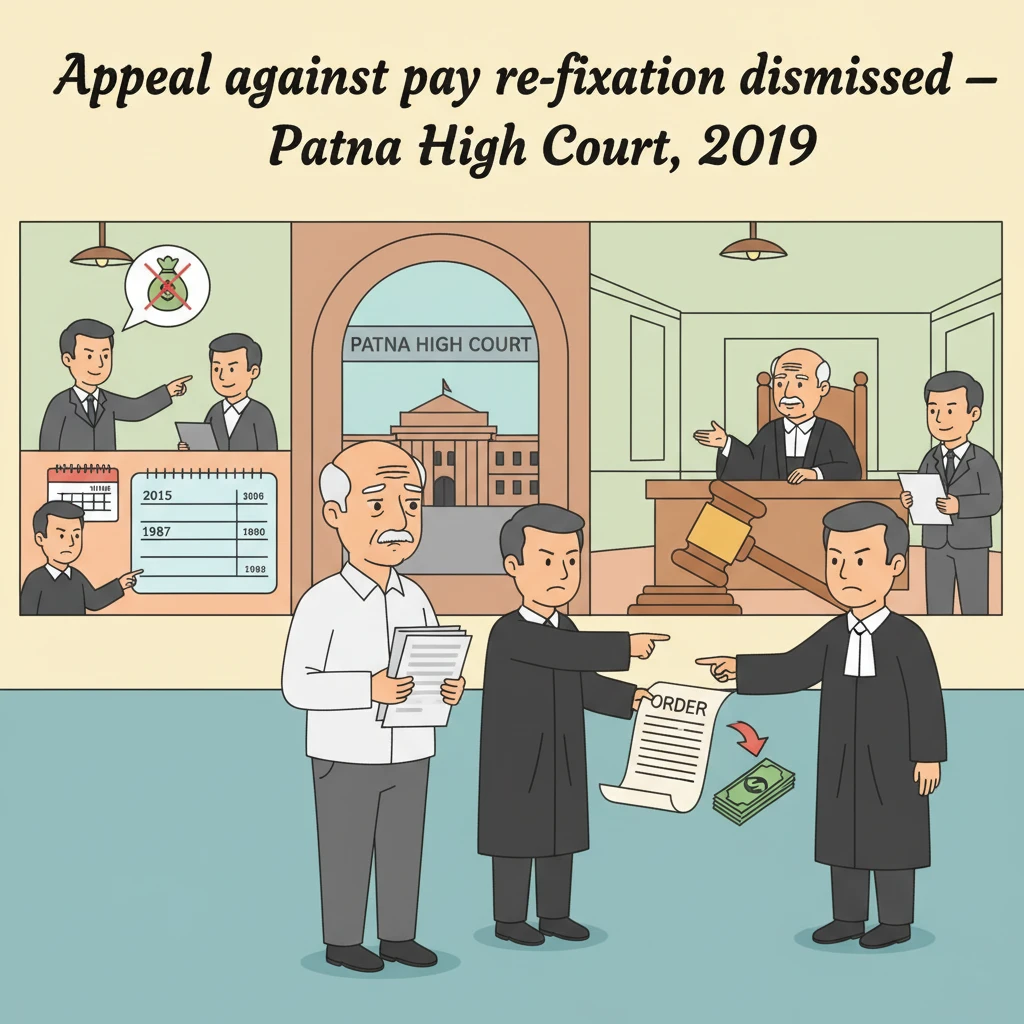
Case Background
The appellant was a government employee in the Department of Information and Public Relations, Government of Bihar. In 1987, his pay was fixed in the scale of Rs. 785–1210. He continued to receive salary and later pensionary benefits on this basis for many years.
After his retirement on 31.05.2015, the authorities re-examined his pay fixation. They concluded that his earlier pay scale was wrongly fixed and that he should have been placed in the lower scale of Rs. 580–860 from 29.08.1987. On this basis, they re-fixed his pay retrospectively and ordered recovery of the alleged excess amount already paid to him.
The appellant challenged this recovery and re-fixation before a learned Single Judge in Civil Writ Jurisdiction Case No. 9320 of 2017. By judgment dated 10.01.2018, the Single Judge held that although the re-fixation of pay was valid, recovery from the retired employee could not be made in the absence of any fraud or misrepresentation on his part. Relying on the Supreme Court decision in State of Punjab and Others v. Rafiq Masih and Others, (2015) 4 SCC 334, the learned Single Judge quashed the recovery but allowed the authorities to maintain the revised lower pay scale prospectively for pensionary purposes.
The appellant, being aggrieved by that part of the judgment which upheld the re-fixation of pay and reduced his pension and post-retiral benefits, filed the present Letters Patent Appeal (L.P.A. No. 221 of 2018) on 12.02.2018 before a Division Bench.
Meanwhile, the State of Bihar also filed its own appeal, L.P.A. No. 704 of 2018, against the same Single Judge judgment. The State was aggrieved by the direction to refund the recovered amount and the bar against recovery. That appeal was decided earlier, on 06.07.2018, by another Division Bench of the Patna High Court.
What the Court Examined and Decided
The Division Bench in the present case (L.P.A. No. 221 of 2018) carefully examined the earlier decision in L.P.A. No. 704 of 2018 because both appeals arose from the same Single Judge order.
In L.P.A. No. 704 of 2018, the other Division Bench first condoned a delay of 95 days by the State in filing its appeal. It then considered the factual position of the employee’s pay fixation, retirement, and later re-fixation with retrospective effect and recovery.
That Bench noted that the employee had not been responsible for the incorrect higher pay fixation made in 1987. Drawing strength from the Supreme Court judgment in State of Punjab and Others v. Rafiq Masih and Others, (2015) 4 SCC 334, it held that recovery from such an employee, particularly after retirement, was illegal and impermissible. Accordingly, it upheld the Single Judge’s order directing refund of the recovered amount and rejected the State’s challenge to that part of the order.
However, the earlier Division Bench also agreed with the Single Judge that the re-fixation of the pay scale itself was valid. It clearly stated that the respondents would be free to re-fix the pay scale and make consequential amendments in pension and post-retiral benefits in terms of the Single Judge’s order. Thus, while the recovery was stopped and the amount already recovered had to be refunded, the lower pay scale from 29.08.1987 and its effect on pension were upheld.
After this, the appellant moved a contempt petition, M.J.C. No. 2035 of 2018, alleging non-compliance of the Single Judge’s order. In that contempt case, the authority filed a show-cause affidavit saying that the order of the Single Judge had been complied with. A consequential order dated 23.07.2018, annexed to that affidavit, recorded that the appellant had received the relevant payments and, importantly, referred to the filing and disposal of L.P.A. No. 704 of 2018.
The present Division Bench noted that although the body of the affidavit in the contempt case did not separately narrate the filing of the appeal, the annexed order of 23.07.2018 clearly mentioned L.P.A. No. 704 of 2018 and the order passed therein. A copy of this order formed part of the materials served on the appellant’s counsel.
The Bench recorded that the appellant’s counsel received this affidavit on 11.09.2018. Therefore, by that date, the appellant had knowledge that a Division Bench had already affirmed the Single Judge’s judgment, including the finding that the pay re-fixation was valid and that only the recovery was barred.
Despite this knowledge, the appellant did not seek recall, review, or any other modification of the earlier Division Bench judgment dated 06.07.2018 in L.P.A. No. 704 of 2018. Nor was any challenge raised against the consequential order dated 23.07.2018 which implemented that judgment.
In this background, the present Division Bench observed that once a co-ordinate Bench of the Patna High Court had already approved the same part of the Single Judge’s order regarding re-fixation of the pay scale, it would not be proper for another co-ordinate Bench to take a different view on the same issue at the instance of the appellant. Judicial discipline required that the subsequent Bench should not interfere with an order already affirmed by another Division Bench, particularly when the appellant had knowledge of that order and chose not to challenge it.
The Court then discussed the broader legal position concerning recovery of excess payments made to employees on account of wrong pay fixation or allowances, where there is no fault on the part of the employee. For this, it referred to a series of Supreme Court judgments.
The Court cited the three-Judge Bench decision in Shyam Babu Verma v. Union of India, (1994) 2 SCC 521, where the Supreme Court held that it would not be just and proper to recover excess amounts from employees who were not responsible for an error in pay fixation, especially when such payments had been made for a long period. At the same time, the Supreme Court upheld the distinction in pay scales awarded on merit.
Next, the Court referred to Sahib Ram v. State of Haryana, 1995 Supp (1) SCC 18. There, an employee lacking the required educational qualifications had been wrongly granted a higher scale. The Supreme Court held that the employee was not entitled to such relaxation, but still protected him from recovery of the amounts already paid, though it allowed the authorities to correct the pay fixation for the future.
The Patna High Court also noted the decision in State of Karnataka and Another v. Mangalore University Non-teaching Employees’ Association and Others, (2002) 3 SCC 302. In that case, erroneous payment of House Rent Allowance had occurred. The Supreme Court protected the employees from recovery up to a particular cut-off date where there was no fault on their part, but permitted recovery of later excess payments in instalments and left future entitlements to the Government’s decision.
Further, the Court relied on Purshottam Lal Das and Others v. State of Bihar and Others, (2006) 11 SCC 492. There, the Supreme Court stated that where a promotion or appointment is void ab initio, mere length of service on the post cannot by itself prevent recovery. Nonetheless, referring back to Sahib Ram, Bihar State Electricity Board and Another v. Bijay Bhadur and Another, (2000) 10 SCC 99, and State of Karnataka (supra), the Court disallowed recovery of amounts drawn on the wrongly granted promotional post but upheld reversion and denial of arrears for the concerned period.
The Division Bench again mentioned Rafiq Masih (White Washer) (supra), where the Supreme Court surveyed several earlier judgments, including Abdul Qadir v. State of Bihar, (2009) 3 SCC 475, and in paragraph 18 laid down illustrative situations in which recovery of excess payments from employees would be impermissible.
Using these authorities, the Patna High Court emphasised that two distinct aspects must be kept separate: (i) the validity of re-fixation of pay to correct an earlier mistake, and (ii) whether past excess payments can be recovered from the employee. The Supreme Court line of cases generally protects employees from recovery when they are not at fault, but at the same time allows governments to correct pay scales for the future and adjust pensionary benefits accordingly.
In the present case, the appellant’s pay scale of Rs. 785–1210 from 1987 was found to be incorrect, and he was in fact entitled only to the lower scale of Rs. 580–860. The earlier Division Bench had already upheld this finding and allowed the authorities to re-fix his pay and correspondingly amend his pension and post-retiral benefits, while stopping recovery of past excess payments.
Given this, the present Division Bench concluded that there was no ground to reopen or interfere with those findings. The appeal aimed at challenging only the re-fixation of the pay scale, but that issue stood finally decided by the co-ordinate Bench in L.P.A. No. 704 of 2018.
Accordingly, the Court held that, in view of the earlier judgment and absence of any challenge to it or to the consequential order dated 23.07.2018, the present Letters Patent Appeal could not be entertained. It therefore dismissed the appeal.
Why This Judgment Matters
This judgment is important for government employees and pensioners who face reductions in pay or pension due to alleged past mistakes in pay fixation.
The Patna High Court reaffirmed that while the government cannot, in many cases, recover large sums of money already paid to an employee who is not at fault, it can still correct the pay scale and adjust future pension and post-retiral benefits.
The judgment also underlines that when one Division Bench of the Patna High Court has already given a clear ruling on a particular order, another Division Bench will normally not reopen the same question, especially where the affected party knows about the earlier decision but does not challenge it.
For retired employees, this decision shows that courts may protect them from harsh recoveries, but cannot always stop the government from reducing benefits to the level legally permissible once an error is discovered.
Legal Issues and Answers
-
Issue: Can a retired government employee challenge downward re-fixation of his pay scale when a co-ordinate Bench of the Patna High Court has already upheld that re-fixation while stopping recovery of past excess payments?
Answer: No. Once a Division Bench has affirmed the validity of the re-fixation and the affected employee, despite having knowledge of that judgment, does not challenge it, a co-ordinate Bench will not interfere with the same order. -
Issue: How does the Court treat recovery of excess payments made due to wrong pay fixation where the employee is not at fault?
Answer: Following Supreme Court precedents such as Rafiq Masih, Shyam Babu Verma, Sahib Ram, and others, recovery of past excess payments is generally barred, but correction of the pay scale and impact on future pension and benefits is permissible.
Cases Cited by the Court
- State of Punjab and Others v. Rafiq Masih and Others, (2015) 4 SCC 334
- Shyam Babu Verma v. Union of India, (1994) 2 SCC 521
- Sahib Ram v. State of Haryana, 1995 Supp (1) SCC 18
- State of Karnataka and Another v. Mangalore University Non-teaching Employees’ Association and Others, (2002) 3 SCC 302
- Purshottam Lal Das and Others v. State of Bihar and Others, (2006) 11 SCC 492
- Bihar State Electricity Board and Another v. Bijay Bhadur and Another, (2000) 10 SCC 99
- Abdul Qadir v. State of Bihar, (2009) 3 SCC 475
Case Details
Case Number: Letters Patent Appeal No. 221 of 2018 in Civil Writ Jurisdiction Case No. 9320 of 2017
Case Title: Janki Ram Jha v. The State of Bihar and Others
Citation: 2019 (2) PLJR 1006
Coram: Hon’ble the Chief Justice Amreshwar Pratap Sahi and Hon’ble Justice Smt. Anjana Mishra
Advocates: For the appellant – Mr. Gajendra Kumar Jha, Advocate; Mr. Sushil Kumar Jha, Advocate; Mr. Bam Bahadur Jha, Advocate. For the State – Mr. Gyan Prakash Ojha, G.A. 7; Mr. Gopal Krishna, AC to G.A. 7.
Nature of the Case: Letters Patent Appeal arising out of a writ petition challenging recovery and re-fixation of pay and consequential pensionary benefits.
Link to Judgment: Full text of Patna High Court judgment
If you found this explanation helpful and wish to stay informed about how legal developments may affect your rights in Bihar, you may consider following Samvida Law Associates for more updates.







