

Case Background
This case arises from Criminal Appeal (DB) No.197 of 1996 and Criminal Appeal (DB) No.258 of 1996 before the Patna High Court.
Both appeals challenged a common judgment dated 16 May 1996 and sentencing order dated 17 May 1996 passed in Sessions Trial No.154 of 1993 by the 1st Additional Sessions Judge, Buxar.
In that sessions case, three men from village Barahana under Itahri Police Station, District Buxar, were tried for the murder of a woman, Sadhna Devi, from nearby village Pithan Purwa.
The trial court convicted two of them under Section 302 read with Section 34 of the Indian Penal Code (IPC) and the third under Section 302 IPC alone. All three were sentenced to life imprisonment.
The convicts then approached the Patna High Court in appeal. Criminal Appeal (DB) No.197 of 1996 was filed by the original accused nos.2 and 3, and Criminal Appeal (DB) No.258 of 1996 was filed by original accused no.1. The High Court decided both appeals together by a common judgment dated 11 March 2022.
What the Court Examined and Decided
The prosecution story, as accepted by the trial court and retold in the High Court judgment, began on the evening of 15 June 1992.
Members of the prosecuting party, including the deceased, lived in village Pithan Purwa. The accused lived in village Barahana. Both villages fell under Itahri Police Station and were close to each other. Evidence showed that the distance between the villages was only about 1¼ bigha.
According to the prosecution, an agricultural field near the house and temple of the prosecuting family was regularly used by the women of that family for easing themselves. A brick-kiln was located in that field.
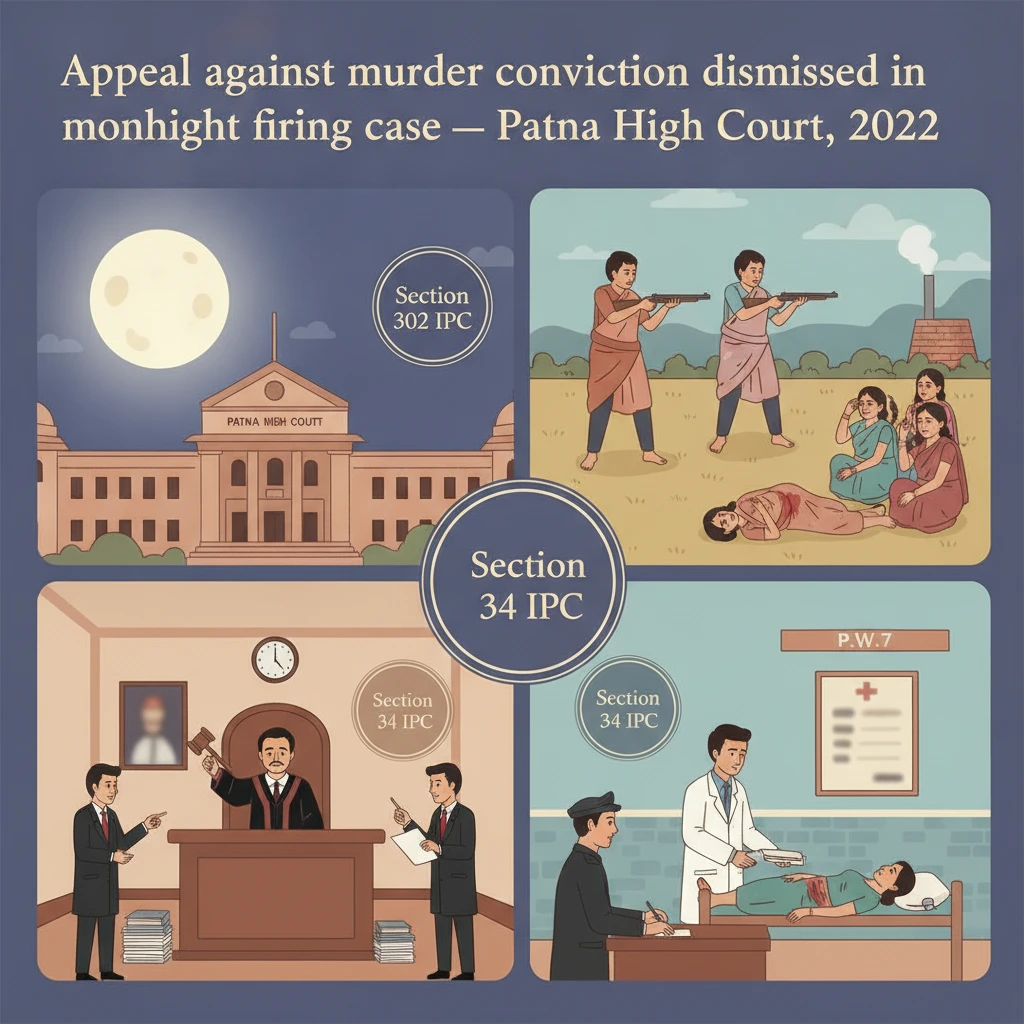
On 15 June 1992, at about 7.00–7.30 p.m., Sadhna Devi went to this field to ease herself along with several women relatives: P.W.1 Shardha Devi, P.W.2 Kausalia Giri, P.W.3 Lilavati Devi, P.W.4 Kumari Devi, P.W.8 Chandravati Devi and others.
While the women were relieving themselves, all three accused allegedly came from the eastern side, each carrying a gun. According to the eye witnesses, accused Harihar Singh and accused Rameshwar Singh exhorted that Sadhna Devi should be killed. Immediately after this exhortation, accused Radhey Shyam Singh fired a shot at Sadhna Devi from close range. The bullet struck her in the abdomen.
Sadhna Devi tried to walk some distance and then collapsed. The women started shouting. Hearing the cries and the sound of the gunshot, P.W.7 Birendra Giri and other villagers, including P.W.9 Ramdayal Kamkar, rushed to the spot.
They found Sadhna Devi lying injured with a bleeding wound on her abdomen. She and the women present stated that the three accused had fired at her and fled. P.W.7 and others then took Sadhna Devi to the Primary Health Centre.
At about 10.00 p.m. the same night, P.W.13 Dr Sanjay Das examined Sadhna Devi at the Primary Health Centre. He noted a belly-deep cut wound on the left side of her abdomen measuring 1½ by ½ inches, and multiple small charred wounds on both palms, hands and the front of her abdomen. He opined that the cut wound was caused by a firearm and referred her to the Sub-Divisional Hospital, Buxar.
Despite treatment, Sadhna Devi succumbed to her injuries. On 17 June 1992, P.W.11 Dr Ashish Kumar Goswami of S.S.P.G. Hospital, Varanasi, conducted the post-mortem. He found antemortem firearm injury on the left side of the abdomen and recovered a conical bullet. In his opinion, death was due to shock and haemorrhage resulting from the bullet injury.
In the meantime, at 10.15 p.m. on 15 June 1992, P.W.7 Birendra Giri lodged a First Information Report at Itahri Government Hospital. The FIR was recorded by P.W.14 Shankar Dayal Pandey of Itahri Police Station. P.W.12 Ramchandra Ram, the Investigating Officer, visited the spot, seized blood-stained soil, recorded witness statements and finally filed the charge-sheet.
At trial, charges were framed under Section 302 read with Section 34 IPC and Section 302 IPC. The accused pleaded not guilty.
The prosecution examined 14 witnesses. P.Ws.1, 2, 3, 4 and 8 were projected as eye witnesses. P.W.7 was the informant. P.W.9 was a co-villager. P.W.11 and P.W.13 were the doctors. P.W.6 and P.W.10 were formal witnesses; P.W.5 and P.W.10 were tendered for cross-examination. A court witness, Vijay Narain Rai, was summoned to prove the FIR documents.
The defence case was one of total denial. In cross-examination, the defence tried to show that earlier Sadhna Devi had a love affair with accused Radhey Shyam Singh and had eloped with him, but was later brought back and then married to another man about 40 days before the incident. On this basis, the defence suggested that the accused were falsely implicated.
Before the High Court, the appellants mainly challenged the credibility of the eye witnesses and the possibility of identification in the dark. It was argued that the incident occurred at least one-and-a-half hours after sunset on a dark night, there was no evidence of any light source, and the women doing household work were unlikely to know or identify the accused, who were from another village. The defence relied on State of Bihar v. Bachesh Kumar Singh, 2021(3) PLJR 297, and Ashoksinh Jayendrasinh v. State of Gujarat, (2019) 6 SCC 535.
The High Court first noted that the homicidal death of Sadhna Devi was not disputed. Medical evidence confirmed death by firearm injury. The real issue was whether the accused were the assailants and whether the prosecution witnesses were reliable.
The Court addressed the argument that all eye witnesses were close relatives of the deceased and therefore interested. Referring to the Supreme Court judgment in Dalip Singh v. State of Punjab, AIR 1953 SC 364, the Bench reiterated that related witnesses are often natural witnesses and their evidence cannot be discarded merely because of relationship. What matters is whether their testimony is cogent and trustworthy.
On facts, the Court found that all the women witnesses were natural witnesses. The field where the incident occurred was next to their house and temple and was their regular place for easing themselves. They were present there together with the deceased at the relevant time.
The Court closely analysed the testimony of P.W.4 Kumari Devi, an aunt of the deceased, and described it effectively as of sterling quality. She stated that while they were sitting for easing, the three accused came from the eastern side with guns. She identified them clearly and said that accused Radhey Shyam fired at Sadhna on the exhortation of the other two. She had known the accused since childhood, as the land they used for easing belonged to village Barahana and she regularly saw people from that village.
In cross-examination, P.W.4 named several villagers from Barahana, explained how the villages were close, and clarified that she had seen the incident from just about four cubits away. There was no crop in the field, so her view was unobstructed. The Court held that her evidence about identification and the incident was natural, consistent and unshaken.
P.W.1 Shardha Devi, also an aunt of the deceased, gave a similar account. She said the three accused arrived with guns, they all stood up due to embarrassment, and on the command of accused Harihar, accused Radhey Shyam immediately fired at Sadhna, who fell down. Her cross-examination confirmed important details such as the time of marriage of Sadhna, the location of the family temple and the place of easing, and the proximity from which she saw the firing. The Court found her testimony corroborative and reliable.
P.W.3 Lilavati Devi and P.W.8 Chandravati Devi, both aunts of the deceased, also supported the prosecution version. They confirmed that the accused came from the eastern side with guns, that accused Harihar and Rameshwar gave the command, and that accused Radhey Shyam fired at the abdomen of Sadhna, after which she collapsed. They spoke of the absence of crop in the field and the small distance between the two villages, again supporting clear visibility and prior acquaintance.
P.W.2 Kausalia Giri, mother of some of these witnesses, had weak eyesight and admitted difficulty seeing in the evening. The Court therefore chose to rely less on her regarding the actual firing, although her presence at the spot was accepted.
The High Court then examined the question of light. The incident time was around 7.30 p.m., and cross-examination suggested it happened about one to one-and-a-half hours after sunset. However, the defence did not put any question to the eye witnesses about lack of light or inability to see. On the contrary, evidence showed close proximity, open field, and prior familiarity with the accused.
The Court took judicial notice under Section 57 of the Evidence Act that 15 June 1992 was a full moon night and that the sunset time at Buxar was 6.46 p.m. It observed that on a full moon night, in an open field, there would be sufficient natural light for identification, especially of persons already well known to the witnesses. The Court noted that persons of previous acquaintance can be recognised even by gait and posture.
In this factual setting, the Court held that the reliance on Ashoksinh Jayendrasinh was misplaced. In that Supreme Court case, the incident occurred at 9.00 p.m. and the site documents showed no source of light, making identification doubtful. Here, the circumstances were different: full moon night, early evening, close proximity and prior acquaintance.
The Court also considered the evidence of P.W.7 and P.W.9, who said that on reaching the spot they found Sadhna lying injured and that she told them about the firing by accused Radhey Shyam in the company of the other accused. While the Bench was cautious about resting the case on this oral dying declaration because the injury was on a vital part, it regarded the eye witness testimony as already sufficient and trustworthy.
The argument based on State of Bihar v. Bachesh Kumar Singh, about lack of corroboration of what was told to the first informant, was rejected. The Court held that the eye witnesses were making hue and cry when P.W.7 arrived at the spot, naturally about the firing incident, and there was no real omission weakening their evidence.
On this overall assessment, the High Court concluded that the prosecution had proved beyond reasonable doubt that accused Radhey Shyam fired the fatal shot at Sadhna Devi and that he did so in furtherance of the common intention shared with the other two accused, who had come armed with guns and instigated the firing.
The Court therefore found no merit in either appeal and dismissed both, affirming the convictions and life sentences imposed by the trial court.
Why This Judgment Matters
This Patna High Court judgment is important for people in rural Bihar and elsewhere who worry that courts will not believe family members who witness a crime.
The Court clearly stated that close relatives can be the most natural and truthful witnesses, especially when a crime happens near the house, like in a field used daily by the family.
The decision also shows that courts can rely on natural light conditions, such as a full moon night, when assessing whether witnesses could see and identify the accused. Lack of electric light alone does not make the case weak, if the setting and testimony support clear visibility.
For victims and their families, the case underlines that a prompt FIR, medical examination, consistent witness statements and strong cross-examination performance together can sustain a conviction even many years later.
Legal Issues and Answers
-
Issue: Did Sadhna Devi die a homicidal death due to a firearm injury?
Answer: Yes. Medical evidence from the Primary Health Centre and the post-mortem clearly established a firearm injury to the abdomen causing death by shock and haemorrhage. -
Issue: Were the three accused correctly identified as the assailants despite the incident occurring after sunset in an open field?
Answer: Yes. The Court held that related women witnesses were natural and reliable, they knew the accused from nearby village Barahana, saw them from very close range, and the full moon night provided sufficient light for identification. -
Issue: Was there sufficient evidence of common intention to attract Section 302 read with Section 34 IPC against two of the accused?
Answer: Yes. All three arrived armed with guns, two of them exhorted to kill Sadhna Devi, and the third immediately fired, showing shared intention to commit murder.
Cases Cited by the Court
- Dalip Singh v. State of Punjab, AIR 1953 SC 364 (on appreciation of related and interested witnesses).
- State of Bihar v. Bachesh Kumar Singh, 2021(3) PLJR 297 (referred to by defence; held not applicable to the facts).
- Ashoksinh Jayendrasinh v. State of Gujarat, (2019) 6 SCC 535 (relied on by defence regarding identification in darkness; distinguished by the Court).
Case Details
Case Number: Criminal Appeal (DB) No.197 of 1996 with Criminal Appeal (DB) No.258 of 1996
Case Title: Harihar Singh Yadav @ Harihar Singh and another v. The State of Bihar; Radhey Shyam Singh Yadav @ Radhey Shyam Singh v. The State of Bihar
Coram: Hon’ble Mr. Justice A. M. Badar and Hon’ble Mr. Justice Sunil Kumar Panwar
Date of Patna High Court Judgment: 11-03-2022
Trial Court Case: Sessions Trial No.154 of 1993, Court of the 1st Additional Sessions Judge, Buxar
Citation: 2022(2) PLJR 4
Advocates:
In Criminal Appeal (DB) No.197 of 1996: Ms. Surya Nilambari, Amicus Curiae for the appellants; Ms. Shashi Bala Verma, A.P.P. and Mr. Ajay Mishra, A.P.P. for the State.
In Criminal Appeal (DB) No.258 of 1996: Ms. Surya Nilambari, Amicus Curiae for the appellant; Mr. Shashi Bala Verma, A.P.P. and Mr. Ajay Mishra, A.P.P. for the State.
Nature of the Case: Criminal appeals (Division Bench) against conviction and life sentence for murder under Section 302 IPC and Section 302 read with Section 34 IPC.
Link to Judgment: Click here to view the full judgment on the Patna High Court website
If you found this explanation helpful and wish to stay informed about
how legal developments may affect your rights in Bihar,
you may consider following Samvida Law Associates for more updates.







